
AI adoption is moving fast, but the teams that get the most value from it are not usually the ones that buy first. They are the ones that pause at the right moment, define the business problem clearly, and bring in expert help before a tool rollout becomes a scattered experiment.
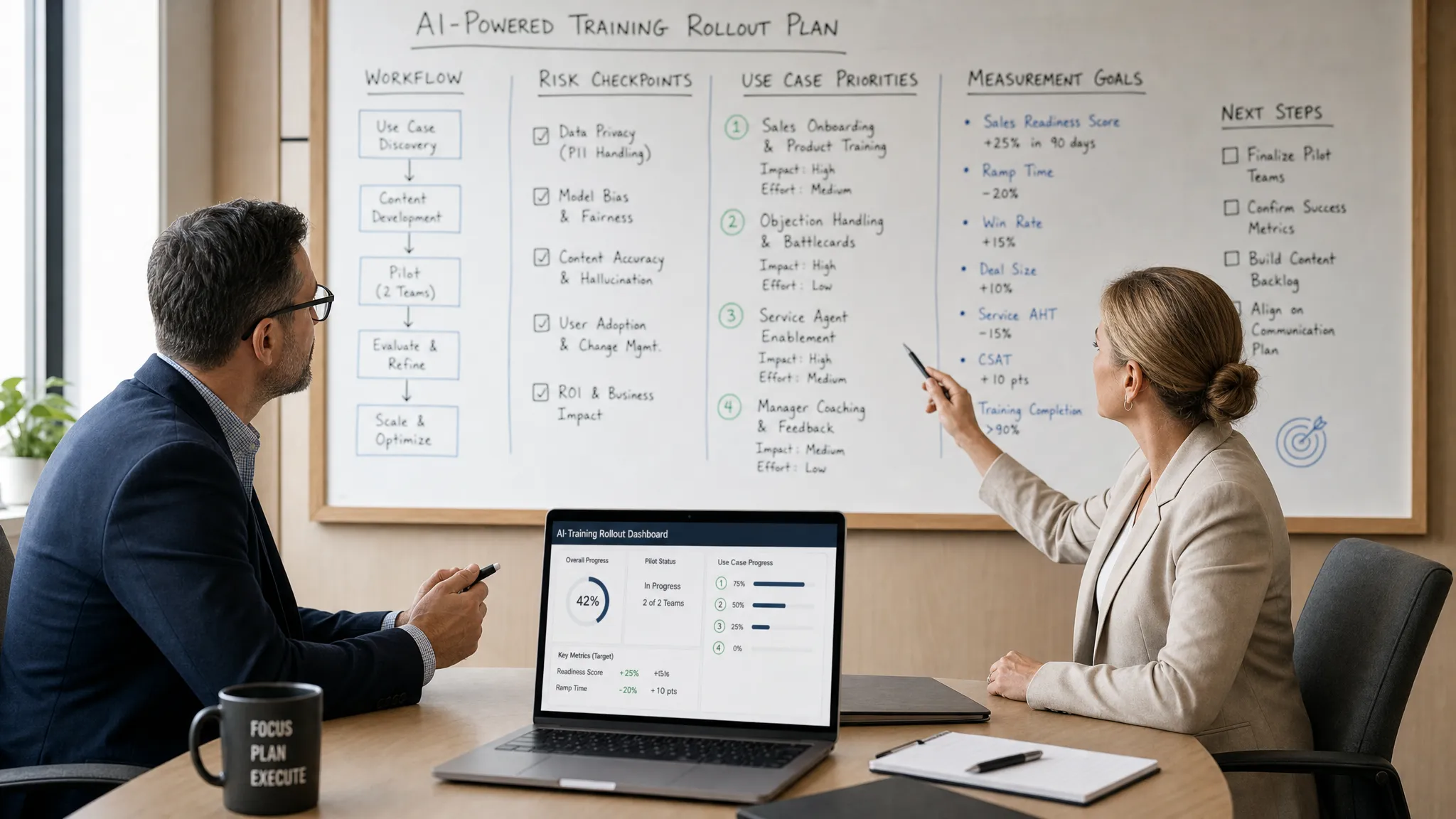
That is where an AI consultation can be useful. For sales, service, enablement, and customer-facing teams, the right consultation helps translate big AI ambitions into a practical plan: which workflows to improve, which skills to train, which risks to manage, and how to measure whether AI is actually improving performance.
The question is not simply, “Should we use AI?” Most teams already are, formally or informally. The better question is, “Is now the right time to get structured guidance?”
What an AI consultation should help you decide
A good AI consultation is not a generic product demo or a vague discussion about automation. It should help your team make better decisions about where AI belongs in your operating model.
For a customer-facing team, that often means answering questions such as:
- Which conversations create the most revenue risk or customer friction?
- Where are reps, agents, or managers spending time on repetitive coaching or preparation?
- What skills need to improve across the team, not just with one or two individuals?
- What data, content, scripts, or scenarios are needed to make AI training useful?
- How will leaders measure adoption, confidence, and performance improvement?
According to McKinsey’s research on generative AI adoption, organizations are increasingly using AI, but capturing value depends on redesigning workflows and managing risk, not just deploying tools. That makes timing important. Book too early and you may not know what problem you are solving. Book too late and your team may already be stuck with disconnected tools, low adoption, or unclear ROI.
The strongest signs it is time to book an AI consultation
Your team is performing inconsistently in high-stakes conversations
If two reps handle the same objection in completely different ways, or if service agents vary widely in tone, escalation judgment, or resolution quality, you likely have a readiness gap. Traditional training can explain the standard, but it often fails to create consistent behavior under pressure.
This is a strong moment to seek AI guidance because the problem is specific and measurable. An AI consultation can help identify which customer interactions should become practice scenarios, how skill levels should be customized, and what feedback managers need to see over time.
For example, a sales team may need to practice pricing objections, competitive comparisons, or late-stage procurement pushback. A service team may need to rehearse frustrated customer calls, policy explanations, or complex escalation paths. In both cases, the goal is not “AI for training” in general. The goal is better performance in repeatable conversation moments.
Training is happening, but behavior is not changing
Many organizations already invest in onboarding sessions, call libraries, LMS modules, sales playbooks, and manager coaching. Yet leaders still hear the same issues on calls: weak discovery, poor objection handling, inconsistent follow-up, or robotic service responses.
That gap usually means the team has information but not enough practice. An AI consultation can help you assess whether scenario-based learning would improve retention and confidence. It can also help define what “good” looks like in realistic terms, so feedback is not based only on manager opinion.
Managers cannot coach at the speed the business needs
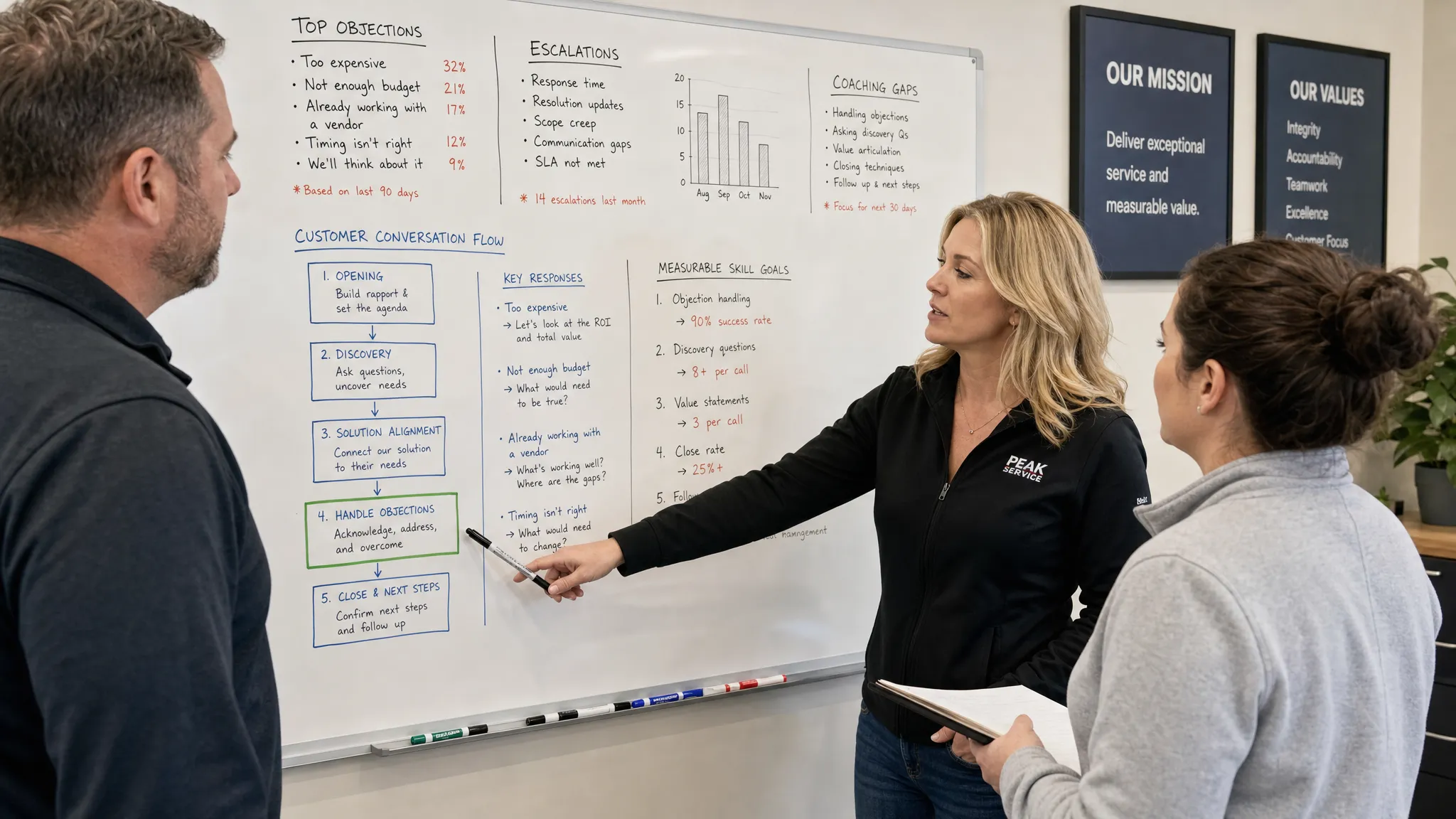
Frontline managers are often the bottleneck in team development. They are expected to review calls, give feedback, forecast accurately, coach new hires, reinforce messaging, and keep performance on track. Even great managers cannot personally roleplay every scenario with every team member every week.
If coaching demand is outpacing manager capacity, it is time to evaluate whether AI can extend coaching without replacing human leadership. A consultation can help you decide which parts of practice and feedback can be automated, which moments still require manager involvement, and how analytics should surface the people who need attention most.
You are launching a new product, market, message, or process
Change creates skill gaps. A new product launch, pricing model, support workflow, compliance requirement, or go-to-market motion can make yesterday’s training outdated quickly.
This is one of the best times to book an AI consultation because the organization already has urgency and a clear reason to standardize learning. The consultation can help convert launch materials into realistic practice scenarios, define readiness checkpoints, and prepare the team before customers expose the gaps.
You need proof that training is working
If leadership is asking for evidence beyond completion rates, you may need a more data-driven training model. Completion tells you who took a course. It does not tell you whether someone can handle a difficult customer conversation.
An AI consultation can help clarify which metrics matter. For customer-facing teams, useful indicators may include confidence growth, scenario performance, skill progression, objection handling quality, coaching frequency, and manager follow-up. The right measures depend on your goals, but the principle is the same: training should connect to observable performance.
AI pilots are already happening without a clear plan
Some teams book an AI consultation before they buy anything. Others wait until employees are already experimenting with AI tools on their own. If your team is using AI informally for call prep, email writing, training content, or customer responses, you need alignment.
This does not mean experimentation is bad. It means the organization needs guardrails, security standards, approved use cases, and a consistent way to evaluate value. The NIST AI Risk Management Framework emphasizes the importance of governing, mapping, measuring, and managing AI risk. For business teams, that translates into a practical question: do we know where AI is helping, where it is risky, and who owns the outcomes?
When to book now, and when to wait
Not every team needs a consultation immediately. Use this table to assess whether the timing is right.
| Situation | Book an AI consultation now | Wait or do internal prep first |
|---|---|---|
| Business problem | You can name a performance gap, such as objection handling, onboarding speed, or service consistency | You only have a broad interest in AI with no defined problem |
| Leadership alignment | A sales, service, enablement, or operations leader is ready to sponsor the work | No one owns the decision or follow-through |
| Training content | You have scripts, call examples, playbooks, or customer scenarios to build from | Your processes are undocumented and vary by team |
| Measurement | You know which outcomes need to improve | You cannot yet define success beyond “use AI” |
| Urgency | A launch, hiring wave, quality issue, or revenue target creates a clear timeline | There is no business deadline or adoption pressure |
| Risk | Customer conversations involve compliance, brand, churn, or revenue risk | The use case is low impact and easy to test informally |
The best timing is usually when you have enough clarity to discuss real workflows, but still have time to shape the AI rollout before habits harden.
What to prepare before an AI consultation
You do not need a complete AI strategy before the consultation. In fact, the consultation should help refine that strategy. But you will get more value if you arrive with a practical snapshot of your current state.
Bring the following if you have them:
- Current training materials, playbooks, talk tracks, scripts, or knowledge base articles
- Examples of difficult sales or service conversations your team handles often
- Performance goals such as ramp time, conversion rate, customer satisfaction, resolution quality, or coaching coverage
- A list of user groups, including new hires, experienced reps, managers, agents, or account teams
- Known constraints such as security requirements, systems, approval processes, or compliance considerations
- Existing metrics from your CRM, help desk, call review process, LMS, or enablement tools
The goal is not to overwhelm the consultant with documents. The goal is to make the conversation concrete. Specific examples lead to better recommendations.
What should happen during a productive AI consultation
A useful consultation should move from business context to implementation path. If the conversation stays at the level of AI trends, it will not help your team decide what to do next.
Expect the discussion to cover several practical areas.
Use case prioritization
Not every workflow deserves AI investment at the same time. The consultation should help rank opportunities by impact, feasibility, risk, and adoption likelihood. For a sales team, that might mean starting with objection handling before expanding into onboarding. For a service team, it might mean starting with escalation practice before adding broader quality coaching.
Scenario design
For training use cases, scenario quality matters. Generic prompts rarely create realistic practice. Your team needs scenarios that reflect actual buyer objections, customer emotions, policies, product details, and communication standards.
This is where AI roleplay and simulation can be especially valuable. Instead of asking employees to read a guideline, you can let them practice the conversation, receive feedback, and improve through repetition.
Feedback and coaching model
The consultation should define what type of feedback users will receive and how managers will use performance data. Real-time feedback can help individuals adjust quickly, while progress tracking analytics can help leaders see patterns across teams.
The best model does not remove managers from coaching. It gives them better insight into where coaching is needed.
Pilot scope
A strong AI consultation should end with a realistic next step. That often means a pilot focused on one team, one workflow, or one performance gap. A pilot should be small enough to manage, but meaningful enough to show whether AI will improve the way people work.
Security and governance
AI tools need to fit your organization’s standards for data handling, access, and acceptable use. This is especially important for enterprise teams and customer-facing workflows. Ask how data is protected, what information should not be entered into AI systems, and how administrators can manage usage.
Questions to ask before choosing an AI partner
If your consultation includes a vendor or platform evaluation, ask questions that reveal whether the solution can support real team adoption.
- How will your team help us identify the highest-value AI use case?
- Can training scenarios be personalized to our roles, products, customers, and skill levels?
- What kind of real-time feedback will users receive?
- How can managers track progress across individuals and teams?
- What analytics are available to connect training activity to performance improvement?
- How does the platform support different experience levels, from new hires to senior team members?
- What security practices are in place for enterprise use?
- What does a focused pilot look like, and how should success be measured?
These questions keep the conversation grounded in outcomes rather than features alone.
When an AI consultation may not be the right next step
There are moments when your team should pause before booking a consultation. If there is no executive sponsor, no urgent workflow, and no willingness to run a pilot, an AI consultation may turn into an interesting conversation without action.
You may also need internal prep first if your team cannot describe its current process. For example, if every manager coaches differently and no one agrees on the ideal customer conversation, start by documenting the standard. AI can reinforce a strong operating model, but it should not be used to hide the absence of one.
That said, you do not need perfect documentation. If you know the performance problem and have a motivated owner, a consultation can help structure the next steps.
How Scenario IQ fits into the conversation
If your AI consultation points toward improving sales or service conversations, Scenario IQ is built for that category of problem. The platform provides AI-powered roleplay simulations, personalized training scenarios, real-time feedback, adaptive guidance, and progress tracking analytics for teams.
That makes it relevant when your organization wants to help people practice realistic conversations, build confidence, handle objections, and improve customer interactions in a measurable way. It is especially useful when leaders want training that is team-focused rather than limited to one-off coaching sessions.
Scenario IQ also supports customizable skill levels, performance metric dashboards, daily actionable tips, and enterprise-grade security, which can help organizations move from AI interest to structured adoption.
FAQ
What is an AI consultation? An AI consultation is a structured discussion that helps your team identify where AI can improve workflows, training, decision-making, or performance. For sales and service teams, it often focuses on use cases like roleplay practice, coaching, feedback, analytics, and customer conversation readiness.
When should a sales team book an AI consultation? A sales team should book an AI consultation when reps struggle with consistent messaging, objection handling, discovery, onboarding, or manager-led coaching capacity. It is also useful before a product launch, market shift, or major enablement initiative.
When should a customer service team book an AI consultation? A service team should book one when customer interactions vary in quality, agents need more practice with difficult scenarios, escalation paths are inconsistent, or leaders need better visibility into skill development and coaching needs.
Do we need technical expertise before booking an AI consultation? No. You do not need to be an AI expert. You should be ready to discuss your team’s goals, current workflows, training challenges, and success metrics. A good consultation translates those business needs into practical AI options.
How do we know if an AI consultation was successful? A successful consultation should leave you with clear priority use cases, recommended next steps, pilot scope, measurement criteria, and an understanding of risks or requirements. You should know what to test, who should be involved, and what success will look like.
Ready to decide if AI training is the right move?
If your team needs more consistent sales or service conversations, now may be the right time to explore AI-supported practice. Scenario IQ helps teams build confidence through personalized roleplay simulations, real-time feedback, and analytics leaders can use to guide coaching.
Get started with Scenario IQ to explore how AI consultation and scenario-based training can support your team’s next performance goal.