

Most sales teams agree on what to train: discovery, product demo, and negotiation. The harder question is what to train first when time is limited, performance is uneven, and pipeline targets do not wait.
The right answer is not a debate about methodology. It is a diagnostic problem: your team should train the skill that removes the biggest constraint in your revenue system right now. In practice, that constraint usually shows up as a measurable “leak” between stages of your funnel.
Below is a practical framework to decide whether to start with discovery, demo, or negotiation, plus a simple way to sequence all three without creating whiplash for reps.
The fastest way to decide: find the constraint
A useful rule: train the skill that most directly improves your next broken conversion.
- If reps are getting first meetings but not advancing, start with discovery.
- If opportunities advance but stall after the presentation, start with demo.
- If deals reach the finish line but slip, discount, or no decision, start with negotiation.
This approach keeps training aligned with business outcomes while avoiding “random acts of enablement.”
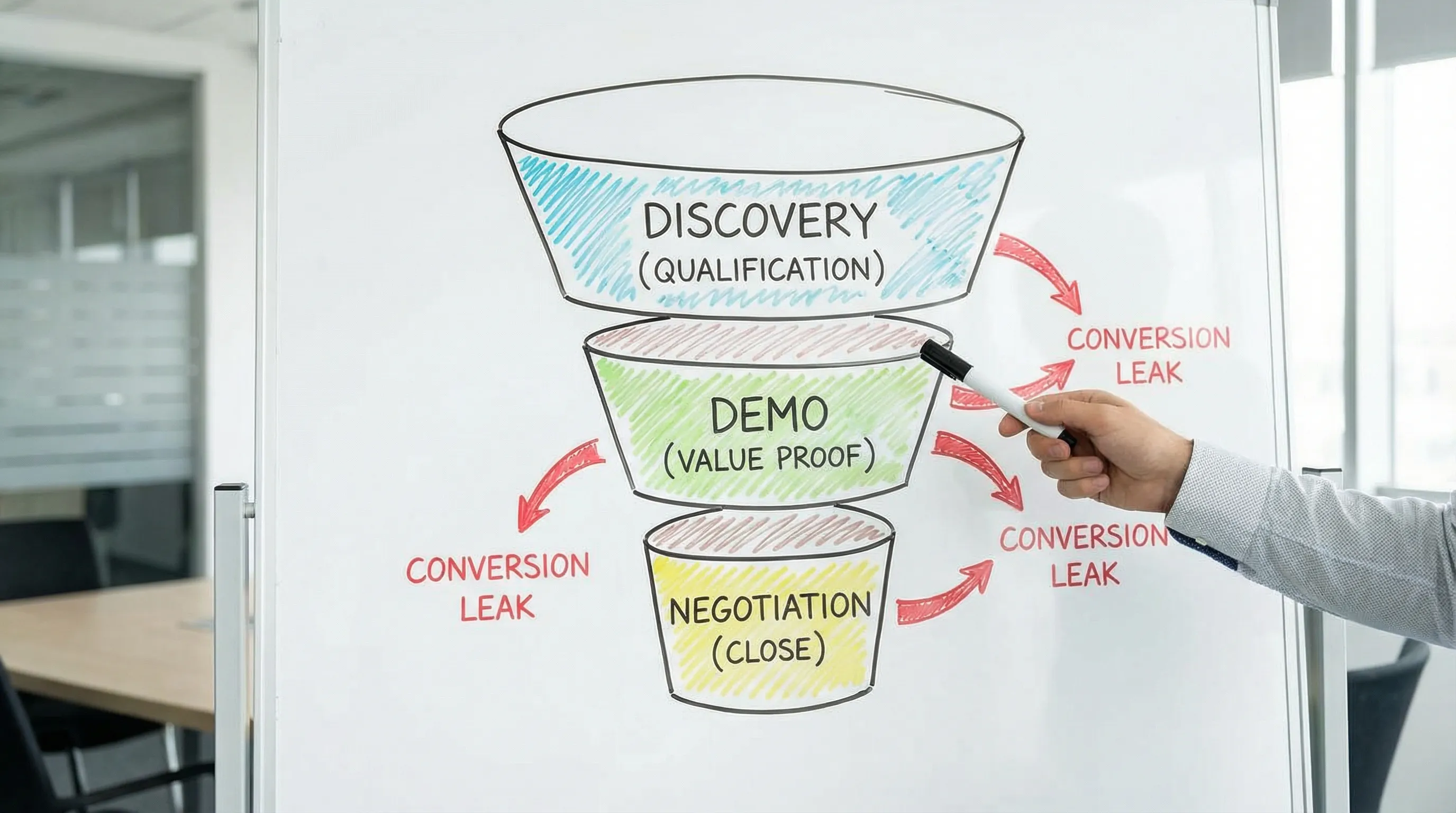
What each skill actually fixes (and what it cannot)
Discovery training improves
Discovery is the highest-leverage skill when your pipeline quality is inconsistent.
It strengthens:
- Problem clarity: what is painful, for whom, and why now
- Qualification: fit, urgency, decision process, and constraints
- Deal framing: success criteria and measurable outcomes
- Objection prevention: handling concerns before they harden
Discovery does not fix a demo that fails to connect product capabilities to outcomes. It also will not save a deal where procurement dynamics dominate and reps lack closing discipline.
Demo training improves
Demo skills matter most when you sell something complex, differentiated, or easy to misunderstand.
It strengthens:
- Value proof: mapping capabilities to success criteria
- Narrative control: problem, impact, approach, proof, next step
- Stakeholder alignment: making the demo land for multiple roles
- Momentum: clear mutual plan and next meeting outcome
A stronger demo cannot compensate for weak discovery. If reps demo the wrong thing to the wrong person, the best storytelling in the world becomes “interesting” instead of “urgent.”
Negotiation training improves
Negotiation is often trained last, but it should be trained first when money is leaking late-stage.
It strengthens:
- Protecting price: trading value for concessions, not discounting by default
- Deal control: anchoring, options, and commitments
- Risk reduction: handling legal, security, and procurement pushback
- Closing discipline: next steps, deadlines, and mutual action plans
Negotiation cannot fix a deal that has no business case, no champion, and no quantified impact. Late-stage pressure usually reveals earlier-stage gaps.
Use funnel symptoms to pick the right starting point
If you only look at quota attainment, everything looks like a training problem. Instead, look at stage-to-stage conversion, average sales cycle by stage, and loss reasons.
Here is a practical cheat sheet you can use in a pipeline review.
| What you’re seeing in the funnel | Likely root cause | Train first | What to practice (roleplay prompt) |
|---|---|---|---|
| Lots of first calls, few second meetings | Poor qualification, unclear problem, no urgency | Discovery | “Prospect is curious but non-committal. Uncover pain, quantify impact, and confirm decision process.” |
| Demos happen, but next steps are vague or delayed | Demo not tied to outcomes, weak close on meeting | Demo | “Run an outcome-based demo for two stakeholders with different priorities, then secure a mutual next step.” |
| Deals reach proposal, then stall or shrink | No champion, weak business case, poor mutual plan | Discovery (yes, often) | “Re-open discovery with an economic buyer to confirm ROI, timeline, and consequences of delay.” |
| High discounting near end of quarter | Concession habits, weak trade strategy, fear of loss | Negotiation | “Procurement asks for 15% off. Hold price by trading for term length, references, or scope.” |
| ‘No decision’ losses dominate | No compelling event, weak change management | Discovery | “Customer likes it but cannot prioritize. Build urgency and align on a compelling event.” |
| Competitive losses after demo | Weak differentiation narrative, unclear value proof | Demo | “Competitor is ‘cheaper and similar.’ Demonstrate differentiated value tied to the customer’s metrics.” |
A second lens: match training to your deal motion
Your funnel metrics tell you where the leak is. Your deal motion tells you which skill creates the biggest lift.
Train discovery first when
Discovery should lead when your motion depends on diagnosing and shaping the problem.
Common situations:
- Enterprise or mid-market sales with multiple stakeholders
- New product categories where buyers need education
- New reps ramping, or teams with inconsistent qualification
- Inbound lead volume is strong, but pipeline quality is weak
What “good” looks like: reps can articulate the customer’s problem in the customer’s language, quantify impact, and confirm the path to a decision.
What to train inside discovery:
- Question sequences that progress from symptoms to business impact
- How to test urgency without sounding aggressive
- Confirming decision process early (not after the demo)
- Summarizing and aligning on success criteria before presenting anything
Train demo first when
Demo should lead when your product is the primary “proof point” and the buying team needs to see the workflow.
Common situations:
- Product-led motions expanding into sales-assisted deals
- Highly visual or technical products where “seeing is believing”
- High volume of demos but low demo-to-proposal conversion
- Competitive deals where differentiation must be shown, not asserted
What “good” looks like: the demo feels like the solution to a defined problem, not a tour of features.
What to train inside the demo:
- Translating discovery notes into a demo agenda the customer agrees with
- Role-based storytelling (end user vs manager vs finance)
- Checkpoints during the demo that confirm relevance
- A strong close that sets a specific next event (pilot, security review, pricing call)
Train negotiation first when
Negotiation should lead when late-stage execution and commercial discipline are the bottleneck.
Common situations:
- Discounting is rising and average selling price is falling
- Legal and procurement cycles are stretching close dates
- Reps “give away” concessions without getting value back
- Customers are asking for pilots, free months, or scope expansions as conditions
What “good” looks like: reps trade, not cave, and they can defend value with calm structure.
What to train inside negotiation:
- Pre-negotiation planning (must-haves, nice-to-haves, walk-away)
- Trading concessions (term, payment, scope, references, case study)
- Handling “we need approval” and “send your best price” tactics
- Resetting timelines and commitments when deals drift
The most effective sequencing for most teams (without boiling the ocean)
Even if one area is the immediate constraint, most teams still need all three skills. The key is sequencing so early-stage work feeds later-stage performance.
A practical approach for many organizations is:
- Start with the biggest leak (from your funnel symptom)
- Add the adjacent skill next (because improvements compound)
- Finish with the skill that protects revenue (usually negotiation)
Here is a simple four-week sequence that works well when you want momentum quickly.
| Week | Focus | Outcome you want | Example practice scenario |
|---|---|---|---|
| 1 | Discovery fundamentals | Higher-quality opportunities and clearer success criteria | “First call with a skeptical director. Qualify, quantify, and confirm decision process.” |
| 2 | Outcome-based demos | Better demo-to-next-step conversion | “Demo to an end user and a VP. Tailor value and secure a defined next meeting.” |
| 3 | Objection handling (bridge week) | Fewer stalls caused by uncertainty | “Customer raises security, change management, and pricing concerns. Respond and keep momentum.” |
| 4 | Negotiation and closing | Less discounting and fewer ‘no decision’ losses | “Procurement asks for a discount and net-60 terms. Trade concessions and close on commitments.” |
If your team is already late-stage heavy (many proposals out, quarter-end pressure), flip it: train negotiation first, then re-inforce discovery so the next quarter is healthier.
Why AI roleplay is a good fit for this decision
Once you know what to train first, the next challenge is repetition, consistency, and feedback quality. Traditional roleplays often break down because:
- Managers do not have time to run enough reps
- Practice quality varies by facilitator
- Feedback is subjective, or arrives too late to change behavior
An AI roleplay approach is useful here because it scales deliberate practice.
With a platform like Scenario IQ, teams can run AI-powered roleplay simulations aligned to the exact skill you chose (discovery, demo, or negotiation), adjust customisable skill levels, and get real-time feedback immediately after each attempt. Over time, progress tracking analytics help you see whether training is changing the leading indicators that matter, such as next-step conversion, objection outcomes, or discount behavior.
If you are trying to answer “what to train first,” this matters because you can:
- Launch targeted scenarios quickly (no weeks of scheduling)
- Standardize coaching across regions and managers
- Adapt difficulty as reps improve (so practice stays challenging)
Measure training impact with leading indicators, not just closed-won
Closed-won is the scoreboard, but it is slow. To verify you picked the right starting point, track leading indicators tied to the skill.
Examples:
- Discovery: first-to-second meeting rate, qualification completeness, “no decision” rate
- Demo: demo-to-proposal rate, multi-threading rate (more stakeholders engaged), competitive win rate
- Negotiation: average discount, percentage of deals with traded concessions, late-stage cycle time
If you are using AI roleplay, you can also track skill signals such as improvement in objection handling consistency, adherence to your talk track, or whether reps are reliably confirming next steps.
A simple decision rule you can use this week
If you want a quick call without over-analysis, use this:
- If pipeline quality is the problem, train discovery first.
- If the product story is the problem, train demo first.
- If price and late-stage control are the problem, train negotiation first.
Then sequence the other two in the next 30 to 60 days so your team does not “fix one stage and break another.”
When you are ready to operationalize this, Scenario IQ can help you stand up targeted practice fast using AI-driven roleplays, real-time feedback, and analytics that show whether the constraint actually moved. Explore the platform at Scenario IQ and start with the single skill that will unlock the most revenue first.