
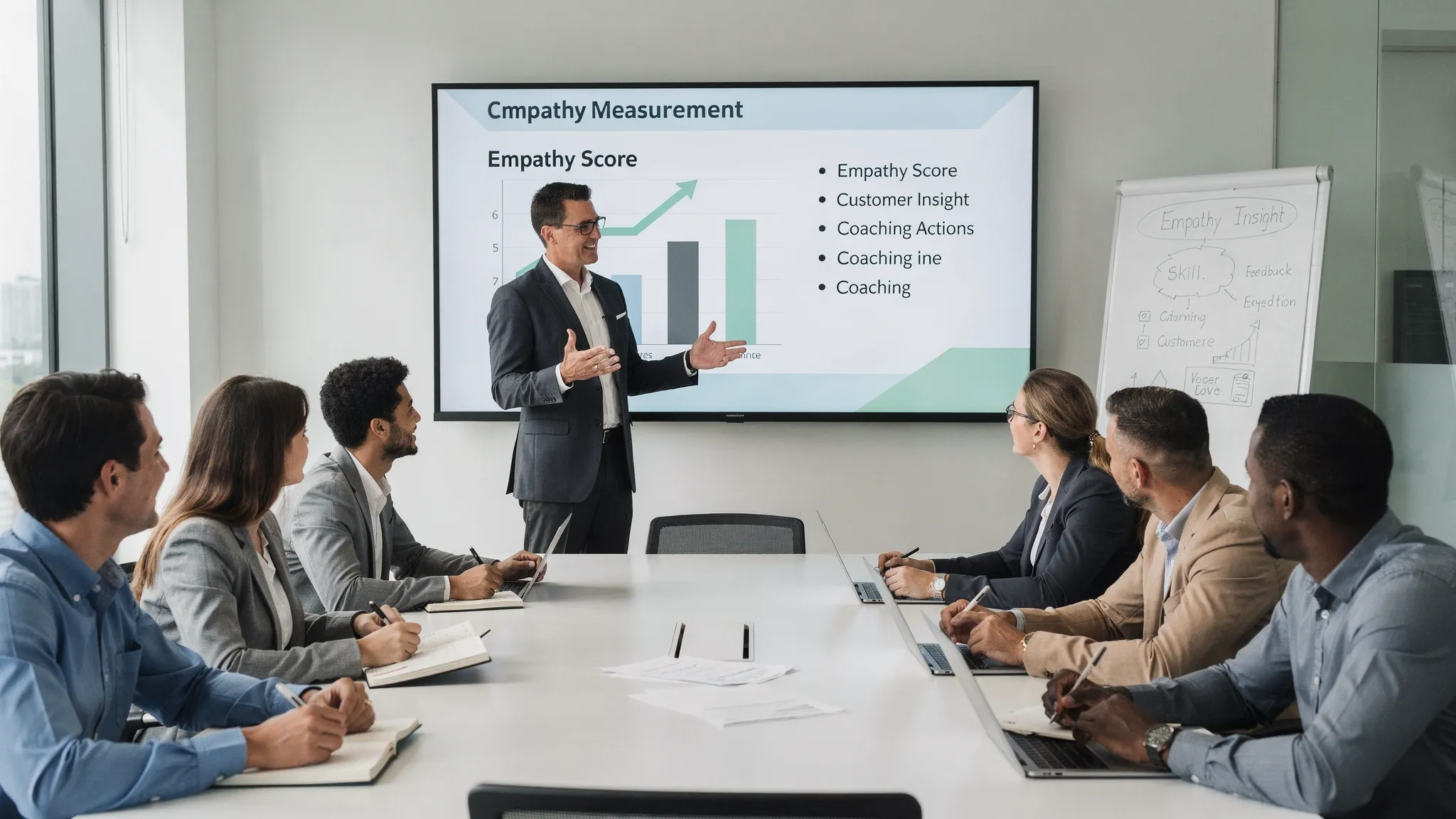
Customer empathy is often treated as a soft skill, which makes it easy to praise and hard to improve. Teams complete a workshop, managers remind people to “listen better,” and customer feedback is reviewed weeks later. The problem is not that empathy cannot be measured. The problem is that many organizations measure the wrong things.
Effective empathy training should show whether employees can recognize what a customer is feeling, understand what they need, respond in a way that builds trust, and move the conversation toward a useful outcome. That applies to customer service, sales, onboarding, account management, support, and any role where a conversation can either repair or damage the relationship.
The goal is not to turn empathy into a script. It is to make the behaviors behind empathy visible enough to coach, practice, and improve.
Why customer empathy needs better measurement
Customer empathy is not simply being friendly. A representative can sound warm and still miss the customer’s concern. A salesperson can apologize repeatedly and still fail to understand why a buyer is hesitant. A support agent can use all the right words and still leave the customer confused about what happens next.
That is why customer empathy training should measure observable behaviors, not personality traits. You are looking for evidence that the employee can listen, interpret, adapt, and act.
Vague measurement creates three common problems. First, managers give feedback that is too general, such as “be more human” or “show more care.” Second, employees optimize for surface-level signals, like using the customer’s name or saying “I understand” without actually demonstrating understanding. Third, leaders struggle to prove whether training improves customer outcomes.
A stronger measurement approach connects three layers: what people practice, how their behavior changes in real conversations, and what customers experience as a result.
The four layers of empathy training measurement
Customer empathy is best measured through a mix of leading and lagging indicators. Leading indicators show whether employees are building the right skills. Lagging indicators show whether those skills are improving customer outcomes.
| Measurement layer | What to measure | Example indicators | Why it matters |
|---|---|---|---|
| Practice engagement | Whether employees are practicing enough and at the right difficulty | Scenario completion, repeat attempts, time in simulation, skill level progression | Shows whether training is happening, but does not prove behavior change on its own |
| Empathy behaviors | Whether employees demonstrate specific empathy skills | Emotional recognition, validation, question quality, ownership language, next-step clarity | Makes coaching specific and actionable |
| Conversation transfer | Whether trained behaviors appear in real customer interactions | QA scores, transcript reviews, manager observations, escalation patterns | Shows whether training is transferring into the work |
| Customer outcomes | Whether the customer experience improves | CSAT, customer effort, first-contact resolution, retention, conversion, complaints | Connects empathy training to business impact |
The most useful programs do not rely on a single score. They combine multiple signals so leaders can see both skill growth and operational impact.
Core behaviors to measure in customer empathy training
Empathy becomes measurable when you break it into behaviors that can be observed during roleplay, coaching sessions, and live conversations.
1. Emotional recognition
Before someone can respond empathetically, they need to identify the emotional state of the customer. Is the customer confused, anxious, disappointed, skeptical, rushed, embarrassed, or angry? These are not interchangeable. A confused customer needs clarity. An angry customer may need acknowledgment and ownership before details. A skeptical buyer may need proof and patience.
In training, emotional recognition can be measured by asking employees to identify the customer’s likely emotion and explain the evidence. In AI simulations, this can be built directly into the scenario. For example, after a roleplay, the learner might be asked to summarize the customer’s emotional state, urgency, and underlying concern.
Strong indicators include accurate identification of emotional cues, recognition of unstated concerns, and the ability to adjust the conversation based on the customer’s mood.
2. Specific validation
Validation is one of the clearest signs of empathy, but only when it is specific. A generic “I understand” can feel dismissive if it is not followed by evidence that the employee actually understood.
Better validation reflects the customer’s situation back to them. For example, “I can see why that would be frustrating, especially because you already contacted us last week and expected this to be resolved by now.” That statement acknowledges emotion, context, and impact.
Measure whether the employee validates the customer’s concern before moving to a solution. Also look at whether the validation is specific to the facts of the conversation or simply a scripted phrase.
3. Listening and interruption control
Empathy requires giving the customer enough space to explain the issue. In live calls, this can be measured through talk-to-listen ratio, interruption frequency, and whether the employee paraphrases before diagnosing.
In written channels, listening shows up differently. It may appear as accurate summarization, fewer repeated questions, and responses that address the customer’s full message instead of only the first issue mentioned.
The key question is simple: did the employee understand the customer before trying to solve the problem?
4. Question quality
Empathetic employees ask questions that reduce customer effort. Poor questions make the customer repeat themselves, provide irrelevant information, or feel like the employee has not been paying attention.
Measure question quality by looking at whether questions are necessary, clear, and sequenced well. Good questions uncover context without sounding like an interrogation. They also help the employee tailor the next step.
Useful indicators include open-ended discovery questions, concise clarifying questions, avoidance of redundant questions, and confirmation before action.
5. Ownership and accountability
Customers do not only want to feel heard. They want confidence that someone is taking responsibility for the next step. Empathy without ownership can feel performative.
Ownership language includes clear statements about what the employee will do, what the customer can expect, and when follow-up will happen. It also avoids blame-shifting. For example, “Here is what I can do next” is usually stronger than “That is handled by another department.”
Measure whether the employee clearly owns the path forward, even when they cannot immediately solve the problem.
6. Adaptability by customer type and context
A high-performing team does not use the same empathy style with every customer. A frustrated enterprise buyer, a first-time user, a long-term account at risk, and a customer with a billing issue all require different responses.
Training should measure whether employees adapt to the customer’s emotional state, knowledge level, urgency, and relationship history. This is where personalised training and scenario-based practice are valuable, because employees can rehearse different customer profiles rather than memorizing one ideal conversation.
A practical empathy scorecard
A scorecard helps managers and trainers turn abstract expectations into consistent coaching. The exact scoring model should fit your business, but the categories below are a strong starting point.
| Skill area | What strong performance looks like | What weak performance looks like |
|---|---|---|
| Emotional recognition | Correctly identifies the customer’s emotion and underlying concern | Responds only to surface details or misreads the customer’s tone |
| Validation | Acknowledges the customer’s feeling, context, and impact | Uses generic empathy phrases without showing understanding |
| Listening | Lets the customer explain, summarizes accurately, avoids interruption | Jumps to a solution too quickly or asks the customer to repeat information |
| Question quality | Asks relevant questions that reduce effort and clarify next steps | Asks unnecessary, confusing, or repetitive questions |
| Ownership | Explains what will happen next and who is responsible | Shifts responsibility or leaves the customer unsure what happens next |
| Resolution support | Connects empathy to a useful action, option, or recommendation | Sounds caring but does not move the issue forward |
For most teams, a simple 1 to 5 scale works well. The most important part is calibration. Managers should review examples together so a “4” means the same thing across teams, locations, and channels.
Metrics to use carefully
Some customer experience metrics are useful, but they can be misleading if used alone. Empathy is contextual, and the customer’s rating may reflect the product issue, policy limitation, wait time, or price, not only the employee’s behavior.
| Metric | Why it can mislead | Better way to use it |
|---|---|---|
| CSAT | A customer may rate the outcome, not the empathy shown | Pair with transcript review or scenario scores |
| Average handle time | Shorter conversations are not always better | Pair with first-contact resolution and customer effort |
| Sentiment score | Sentiment may reflect the situation more than the employee | Compare sentiment change from start to end of conversation |
| Apology count | More apologies do not always mean more empathy | Measure specific validation and ownership instead |
| Training completion | Completion proves attendance, not skill | Pair with roleplay performance and follow-up assessments |
This does not mean these metrics are bad. It means they need context. A team that reduces handle time while customer effort rises may be moving faster but making customers feel rushed. A team with high CSAT but weak ownership may be pleasant but inconsistent. The best measurement systems look for patterns, not isolated numbers.
How AI simulations improve empathy measurement
Traditional empathy training often depends on occasional workshops, manager observation, or inconsistent shadowing. Those methods can help, but they are hard to scale. AI simulations make empathy practice more repeatable and measurable.
With AI-powered roleplay simulations, employees can practice difficult conversations in a safe environment before they happen with real customers. Scenarios can be customized by customer type, issue complexity, emotional intensity, and skill level. Real-time feedback can show whether the learner acknowledged the customer, asked relevant questions, and provided a clear next step.
AI simulations are especially useful for measuring progress over time. A team can complete a baseline scenario, receive coaching, practice targeted skills, and then retake a similar scenario at a higher difficulty level. This creates a clearer view of employee skill development than a one-time training event.
For organizations building AI-assisted workflows around coaching, transcript analysis, or internal knowledge sharing, a shared AI agent environment for teams can also help standardize how teams manage permissions, tools, and run history across collaborative AI use cases.
The key is to use AI as a coaching amplifier, not as a replacement for human judgment. Managers should still review examples, calibrate scores, and connect feedback to the realities of the customer experience.
Connecting empathy metrics to business outcomes
Empathy training earns executive support when it is connected to outcomes the business already cares about. The connection will differ by function.
For customer service teams, the focus may be fewer escalations, better first-contact resolution, lower customer effort, or improved complaint recovery. For sales teams, empathy may show up as stronger discovery, better objection handling, higher trust, and improved conversion rates. For account management, it may affect renewal conversations, expansion opportunities, and retention risk.
A practical way to connect empathy to outcomes is to choose one primary business goal per training cycle. For example, a support organization might focus on reducing escalations from frustrated customers. The training scenarios, scorecard, coaching conversations, and dashboards should then emphasize emotional recognition, validation, ownership, and de-escalation.
Avoid trying to prove everything at once. A focused measurement plan is easier to interpret and easier to improve.
Building a customer empathy measurement plan
A good measurement plan does not need to be complicated. It needs to be consistent.
- Define the behavior you want to improve: Choose a specific skill, such as validating frustrated customers, asking better discovery questions, or taking ownership after a service failure.
- Create realistic scenarios: Use customer situations your team actually faces, including common objections, complaints, confusion points, and emotional triggers.
- Capture a baseline: Run employees through a roleplay demo, simulation, or observed conversation before coaching begins.
- Score with a clear rubric: Use consistent criteria for emotional recognition, validation, listening, question quality, ownership, and resolution support.
- Coach with examples: Show employees the exact moment where empathy was strong, missing, or unclear.
- Remeasure after practice: Compare performance across similar scenarios and look for improvement in both skill scores and customer outcomes.
This cycle turns customer empathy from a one-time training topic into an ongoing performance habit.
What leaders should review in an empathy dashboard
A useful dashboard should help leaders answer practical questions. Are employees improving after practice? Which empathy behaviors are strongest and weakest? Do certain teams, regions, roles, or customer segments need targeted coaching? Are improvements in training showing up in customer conversations?
For Scenario IQ users, this is where progress tracking analytics and performance metric dashboards can support team-focused learning. Leaders can review how employees are progressing through scenarios, where skill gaps remain, and which coaching areas need attention. Combined with real-time feedback and adaptive guidance, empathy training becomes easier to personalize without losing consistency across the team.
The most valuable dashboards do not simply rank employees. They reveal where coaching will have the highest impact.
Frequently Asked Questions
What is the best metric for customer empathy training? There is no single best metric. The strongest approach combines roleplay performance, observable conversation behaviors, and customer outcomes such as customer effort, CSAT, escalation rate, and first-contact resolution.
How often should customer empathy be measured? Measure at baseline, after coaching, and at regular intervals afterward. For active customer-facing teams, monthly or quarterly reviews usually provide a better signal than a once-a-year assessment.
Can AI accurately measure empathy? AI can help identify patterns, provide real-time feedback, and create consistent practice environments. However, human calibration is still important, especially for nuanced conversations, sensitive customer situations, and coaching decisions.
Should empathy scores affect performance reviews? Empathy metrics can inform performance reviews, but they should be used carefully. Employees need clear rubrics, fair calibration, and enough practice opportunities before empathy scores influence formal evaluation.
How do you measure empathy in written support channels? Look for accurate summarization, specific validation, clarity, tone, personalization, and next-step ownership. Written empathy is less about sounding warm and more about making the customer feel understood and supported with minimal effort.
Make customer empathy measurable with Scenario IQ
Customer empathy improves when teams can practice realistic conversations, receive specific feedback, and track progress over time. Scenario IQ helps organizations do exactly that with AI-powered roleplay simulations, personalised training scenarios, real-time feedback, adaptive guidance, and analytics built for team development.
If your customer service, sales, or support teams need more than generic training, Scenario IQ can help turn empathy into a measurable, coachable skill. Explore Scenario IQ to see how AI-driven scenario training can strengthen customer conversations and improve team performance.