
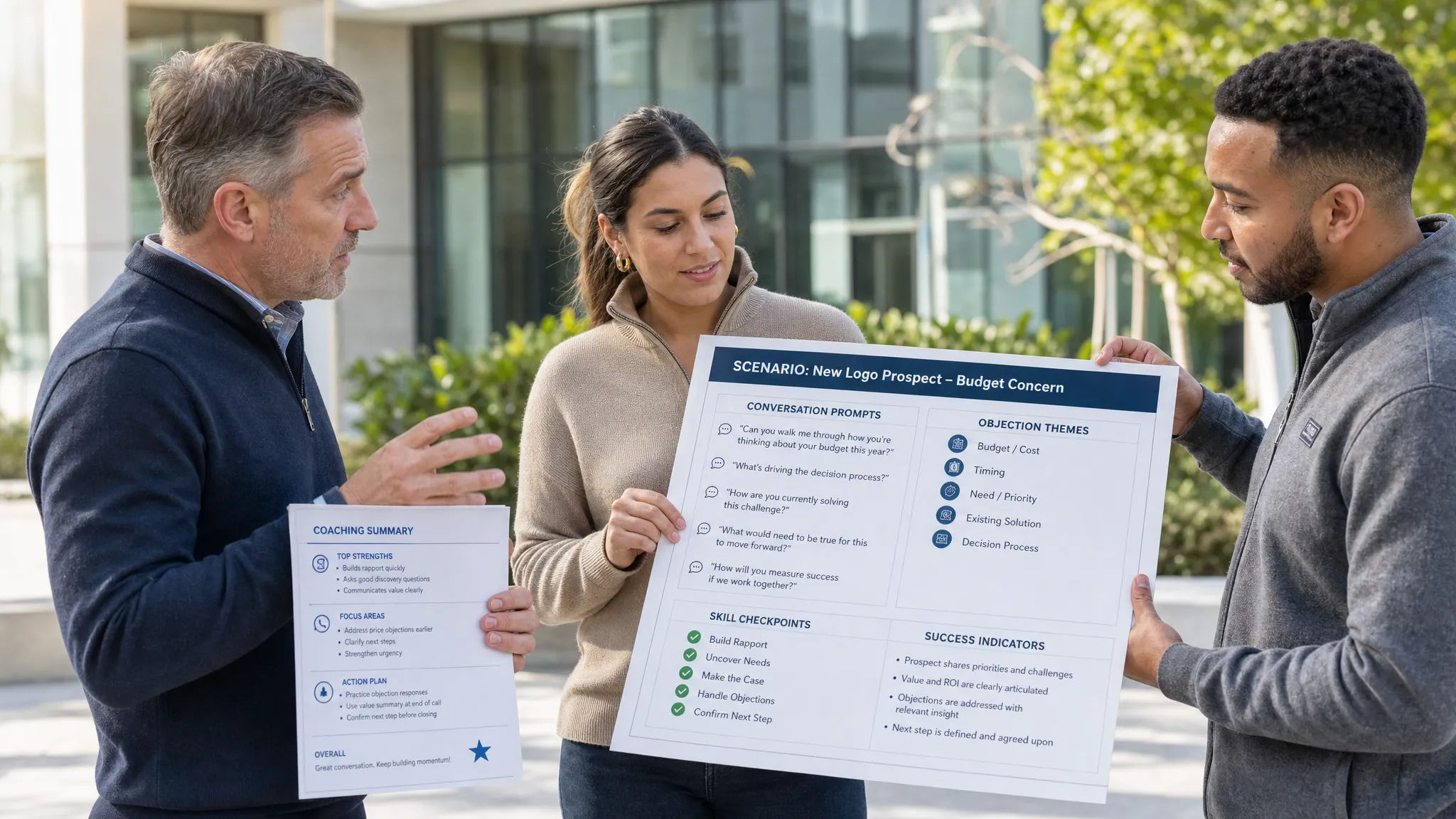
Revenue teams do not need an AI course that only explains prompts, model types, or futuristic use cases. They need one that helps sellers, account managers, customer success teams, and service leaders perform better in the moments that affect revenue: discovery calls, objections, renewals, escalations, handoffs, and follow-ups.
That difference matters. A generic AI course can improve awareness. A revenue-focused AI course should improve behavior.
As AI becomes part of everyday go-to-market work, the best training programs combine practical AI literacy with role-specific practice, measurable coaching, and clear guardrails. The goal is not to turn every rep into a technical expert. The goal is to help every customer-facing team member use AI confidently, safely, and effectively in real conversations.
Why revenue teams need a different kind of AI course
Revenue teams operate under pressure. They need to respond to buyer concerns, qualify opportunities, communicate value, and protect customer trust. A course designed for general business users rarely reflects that environment.
An effective AI course for revenue teams should connect AI concepts to the workflows that matter most, such as preparing for calls, practicing objection handling, improving discovery questions, coaching customer conversations, and identifying performance gaps. It should also help managers understand whether training is changing behavior, not just whether someone completed a module.
This is especially important because AI adoption is no longer a side project. McKinsey's research on the state of AI continues to show that organizations are moving from experimentation toward practical deployment. For revenue leaders, the question is no longer whether AI will affect sales and service work. The question is whether teams will be trained well enough to use it responsibly and productively.
The best AI course starts with revenue outcomes
Before comparing course vendors or training formats, define what the course must improve. If the answer is only “AI fluency,” the program may be too vague.
A stronger objective sounds like this: “Help account executives use AI to prepare for discovery calls, practice value-based messaging, and handle pricing objections with more confidence.” That objective is specific, observable, and connected to revenue performance.
For revenue teams, useful outcomes often include:
- Better discovery and qualification conversations
- Faster ramp time for new reps
- More consistent objection handling
- Improved confidence in customer-facing conversations
- Stronger manager coaching visibility
- Better service recovery and escalation handling
- More consistent messaging across sales, success, and support
The course should make these outcomes measurable. Completion rates are useful, but they are not enough. Look for signs that learners are improving in realistic scenarios, applying feedback, and building repeatable habits.
Generic AI course vs. revenue-team AI course
Many AI courses look polished, but not all are built for customer-facing teams. Use this comparison to spot the difference quickly.
| Course element | Generic AI course | Revenue-team AI course |
|---|---|---|
| Primary goal | Explain AI concepts and tools | Improve revenue conversations and team performance |
| Learning format | Videos, readings, quizzes | Practice, roleplay, feedback, and reinforcement |
| Examples | Broad productivity tasks | Discovery, objections, renewals, escalations, follow-ups |
| Personalization | Same curriculum for everyone | Scenarios adapted by role, skill level, and use case |
| Measurement | Course completion and quiz scores | Skill progress, scenario performance, coaching insights |
| Manager value | Limited visibility | Team analytics and coaching opportunities |
| Risk coverage | Basic AI warnings | Data privacy, customer trust, compliance, and usage guardrails |
A revenue-team AI course should feel close to the work. If the examples could apply equally to finance, HR, engineering, and sales, the course may not go deep enough for your team.
Look for scenario-based practice, not just passive learning
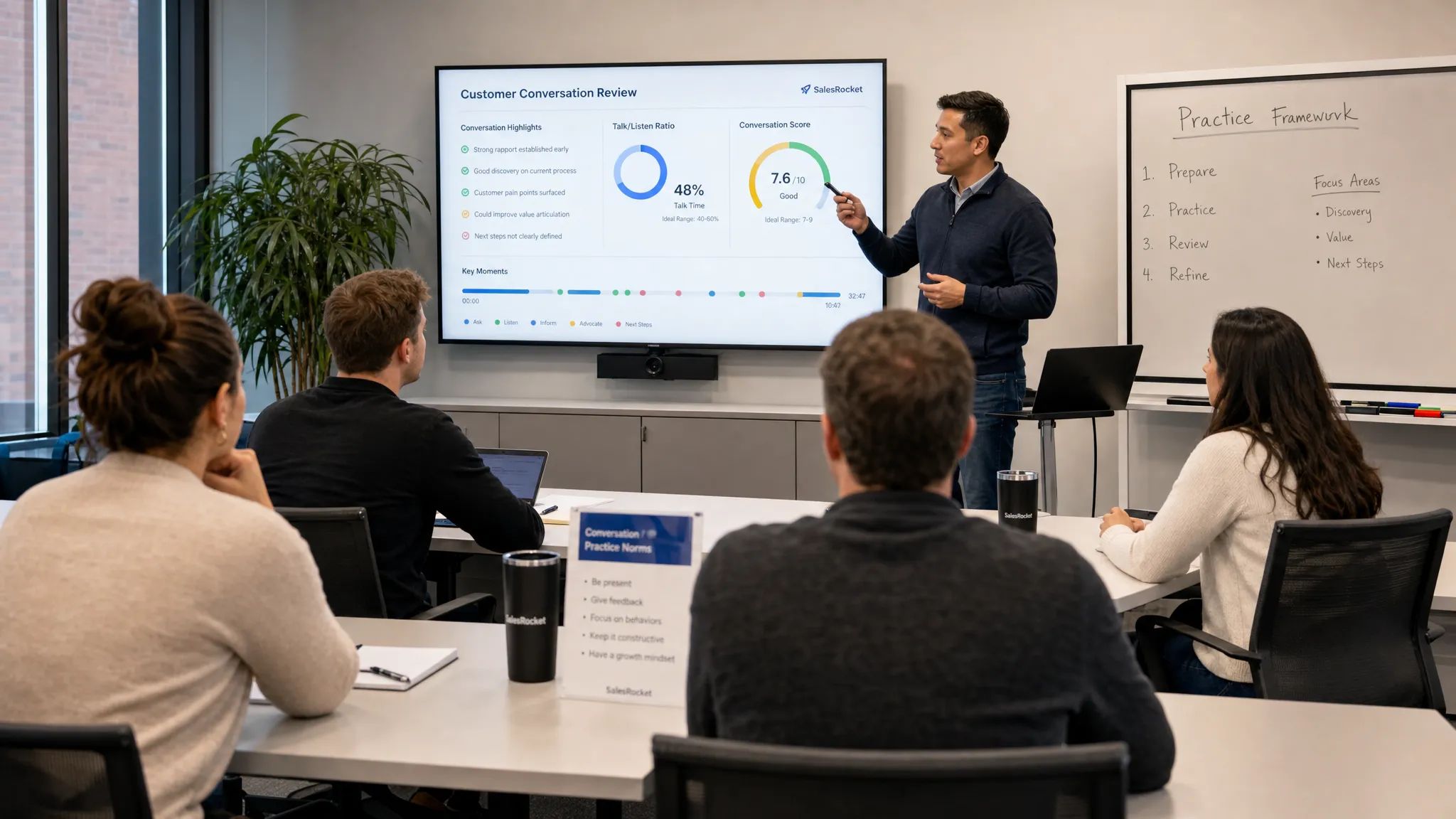
AI is best learned through use. Revenue skills are also best learned through practice. That makes scenario-based training especially valuable for sales and service teams.
Passive content can introduce concepts, but it rarely builds confidence under pressure. A rep may understand how to write a prompt, yet still struggle when a buyer says the product is too expensive. A support agent may know the policy, yet still freeze when an upset customer challenges the response.
The best AI course gives learners realistic situations where they can practice, make mistakes, receive feedback, and try again. For example, a seller might practice a late-stage negotiation with a skeptical economic buyer. A customer success manager might practice a renewal conversation after a customer reports low adoption. A service agent might practice de-escalating a frustrated customer while protecting brand trust.
This is where AI roleplay can be especially useful. Instead of waiting for a manager to schedule practice time, learners can engage in simulated conversations that adapt to their responses. Scenario IQ, for example, provides AI-powered roleplay simulations, personalized training scenarios, real-time feedback, and progress tracking analytics for team-focused learning.
Prioritize personalization by role, skill level, and customer context
Revenue teams are not one-size-fits-all. A business development representative, account executive, customer success manager, and service agent all need different practice environments.
A useful AI course should account for those differences. New reps may need foundational practice on messaging and call structure. Experienced reps may need advanced work on executive conversations, procurement pressure, or competitive displacement. Service teams may need training on empathy, resolution speed, and escalation judgment.
Personalization should also reflect the customer context. Selling into enterprise accounts is different from helping small business customers. Handling a renewal risk is different from managing a first discovery call. If a course cannot adapt to these realities, learners may disengage because the material feels too generic.
When evaluating a course, ask whether it can support different skill levels and scenarios. Scenario IQ includes customizable skill levels and adaptive feedback and guidance, which are important capabilities when training a mixed team.
Make real-time feedback a non-negotiable requirement
Feedback is where training becomes coaching. Without it, learners may repeat the same weak habits without realizing it.
For revenue teams, feedback should be specific enough to guide the next attempt. “Good job” is not enough. “Ask one more impact-focused question before presenting the solution” is more useful. “Acknowledge the pricing concern before defending value” is even better because it connects feedback to behavior.
A strong AI course should help learners understand what they did well, where they missed the mark, and how to improve. Real-time feedback is especially valuable because it shortens the learning loop. Instead of waiting days for a manager to review a call, reps can practice and adjust immediately.
Look for feedback that addresses both communication and strategy. The best programs evaluate not only whether someone used the right words, but whether they asked relevant questions, identified buyer pain, handled resistance, and moved the conversation forward.
Evaluate the analytics available to managers
For enablement and revenue leaders, one of the biggest advantages of AI-based training is visibility. Traditional training often leaves managers guessing. They may know who attended a workshop, but not who can apply the skill in a live conversation.
A high-quality AI course should provide analytics that help leaders identify trends and coach more effectively. This does not mean reducing people to scores. It means giving managers a clearer view of where the team is confident, where they need support, and which skills are improving over time.
Useful analytics may include progress tracking, performance trends, scenario completion, skill gaps, and team-level patterns. Scenario IQ offers progress tracking analytics and performance metric dashboards, which can help organizations connect training activity to coaching priorities.
When reviewing analytics, ask whether the data is actionable. A dashboard that looks impressive but does not guide coaching decisions will have limited value.
Insist on practical AI safety and governance
Revenue teams work with sensitive information. They may handle prospect data, customer details, pricing discussions, contract context, competitive intelligence, and support history. An AI course must teach people how to use AI responsibly.
This includes what not to enter into AI tools, how to review AI-generated outputs, when human judgment is required, and how to avoid over-reliance on automated suggestions. It should also clarify internal policies around customer data, confidentiality, and approved tools.
The NIST AI Risk Management Framework is a useful reference for organizations building AI governance practices. While a revenue-team course does not need to turn every learner into a risk expert, it should reinforce safe, trustworthy AI usage.
Security also matters at the platform level. If your organization is evaluating AI training software, ask about enterprise-grade security, data handling, access controls, and how learner interactions are managed. Scenario IQ lists enterprise-grade security as part of its platform capabilities, which is an important consideration for teams training at scale.
Check whether the course reinforces learning over time
One-off training events rarely create durable behavior change. Revenue teams need reinforcement, especially when the skill involves live communication.
A strong AI course should provide ongoing opportunities to practice and improve. Daily actionable tips, adaptive guidance, and scenario repetition can help learners build habits between formal training sessions. Managers can then use progress data to focus team meetings, coaching sessions, or one-on-ones on the skills that matter most.
The right question is not, “Can we launch this course?” It is, “Will this course still be improving behavior 30, 60, and 90 days from now?”
If the answer is unclear, the program may be too event-based. Revenue training should be continuous because buyer conversations change, market conditions shift, and new objections appear.
Questions to ask before choosing an AI course
Use the following checklist when comparing options. It will help you separate general AI education from training that can actually support revenue performance.
| Evaluation area | Question to ask | Red flag |
|---|---|---|
| Revenue alignment | Does the course address sales, service, success, or account management workflows? | The curriculum focuses only on generic AI productivity |
| Practice design | Do learners practice realistic customer conversations? | Training is mostly videos and quizzes |
| Feedback quality | Does feedback explain how to improve the next attempt? | Feedback is vague or only score-based |
| Personalization | Can scenarios adapt by role, level, or use case? | Every learner receives the same path |
| Manager visibility | Can leaders track progress and spot coaching needs? | Reporting is limited to completion data |
| Governance | Does the course teach safe and responsible AI use? | Data privacy and approval workflows are barely mentioned |
| Reinforcement | Does learning continue after the first session? | The course ends after a single workshop or module |
These questions are useful whether you are evaluating a standalone AI course, a broader enablement program, or an AI roleplay training platform.
How to pilot an AI course with a revenue team
A pilot helps you test the course before rolling it out across the organization. Keep it focused. Choose one team, one business problem, and a small set of measurable outcomes.
For example, you might pilot an AI course with a team of account executives who need to improve pricing objection handling. Give them a baseline scenario, provide training and practice, then compare performance after several sessions. Ask managers whether they see better confidence and consistency in live conversations.
The pilot should include both learner feedback and manager feedback. Learners can tell you whether the scenarios feel realistic and useful. Managers can tell you whether the training creates coaching leverage.
A good pilot does not need to prove every business outcome immediately. It should prove that the course is relevant, usable, measurable, and likely to improve performance if scaled.
Common mistakes to avoid
One common mistake is buying an AI course because it sounds innovative, without connecting it to a clear revenue problem. Another is assuming that AI literacy alone will change behavior. Knowledge matters, but customer-facing performance depends on practice.
A third mistake is ignoring managers. If managers cannot see progress or reinforce the training, adoption will fade. The best AI course should support both individual learners and team leaders.
Finally, avoid treating AI as a shortcut around human skill. AI can help teams prepare, practice, and improve, but revenue conversations still depend on judgment, empathy, curiosity, and trust. The course should strengthen those human skills, not replace them.
Frequently Asked Questions
What is an AI course for revenue teams? An AI course for revenue teams teaches sales, service, success, and account management professionals how to use AI in practical customer-facing workflows. The best courses include realistic scenarios, roleplay, feedback, and manager analytics rather than only general AI theory.
How is a revenue-focused AI course different from a general AI course? A general AI course usually focuses on concepts, tools, and productivity. A revenue-focused course connects AI to conversations that affect pipeline, retention, customer experience, and team performance.
Should an AI course include roleplay? Yes, especially for customer-facing teams. Roleplay helps learners practice real situations, such as objections, discovery calls, escalations, and renewals. AI roleplay can make practice more frequent, personalized, and scalable.
What should managers look for in course analytics? Managers should look for progress trends, skill gaps, scenario performance, and coaching opportunities. Completion data is useful, but it should not be the only measure of training impact.
Is AI training safe for teams that handle customer data? It can be, if the course and platform include clear governance, responsible AI guidance, and appropriate security practices. Teams should understand what information can be used, what should remain confidential, and when human review is required.
Build AI training around the conversations that drive revenue
The right AI course should do more than introduce new technology. It should help revenue teams practice better conversations, receive timely feedback, build confidence, and give leaders visibility into performance.
Scenario IQ is designed for AI-driven, scenario-based training across sales and service teams. With AI-powered roleplay simulations, personalized training scenarios, real-time feedback, progress tracking analytics, adaptive guidance, daily actionable tips, customizable skill levels, and team-focused learning, it helps organizations turn AI training into measurable skill development.
If your team is ready to move beyond generic AI education, explore how Scenario IQ can help you build practical, personalized training for the revenue moments that matter most.