
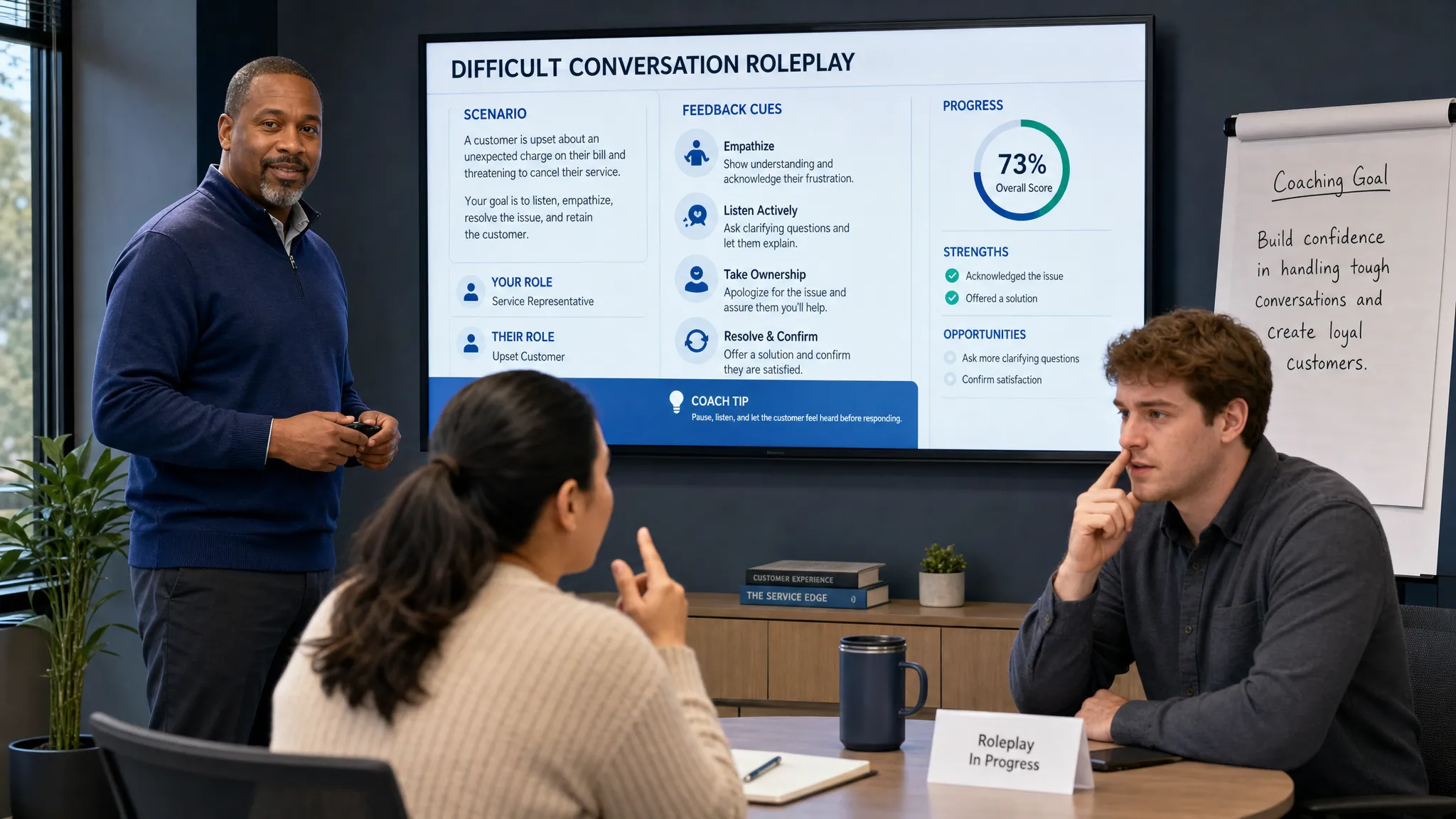
AI service in training software is not a chatbot bolted onto a course library. At its best, it is a practice environment that helps people rehearse high stakes conversations, get immediate coaching, and return to work with more confidence.
That distinction matters. Sales and service teams do not struggle because they lack another PDF, webinar, or policy page. They struggle when a real customer pushes back, asks an unexpected question, sounds frustrated, or needs a fast answer under pressure. Great training software should prepare people for those moments before they happen.
For leaders evaluating AI-enabled learning tools, the question is not whether the platform uses artificial intelligence. The better question is whether the AI service helps employees build observable skills, helps managers coach more effectively, and helps the organization measure progress without adding more administrative work.
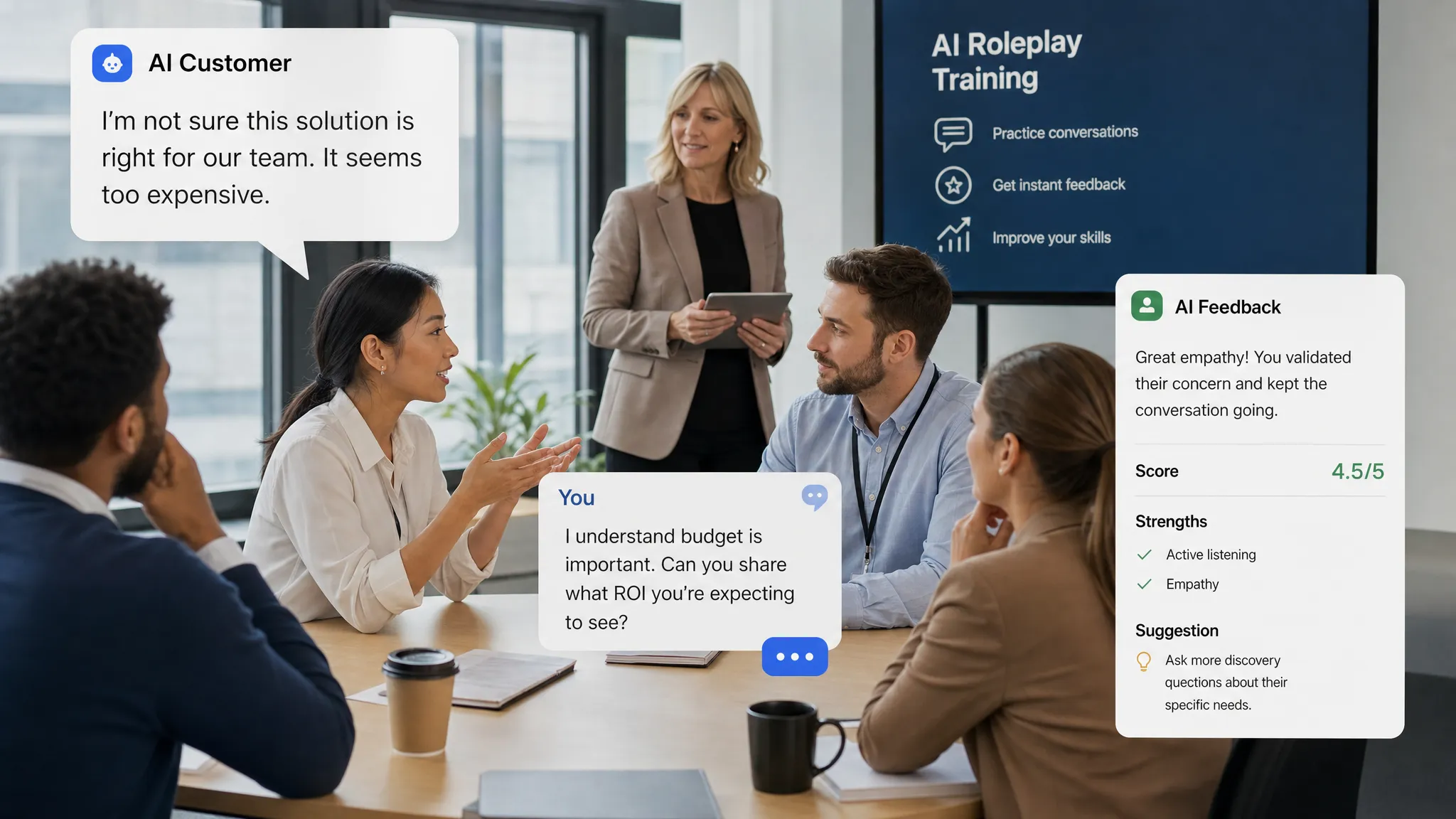
What AI service should mean in training software
Great AI service combines three experiences into one system: the learner experience, the coaching experience, and the leadership experience. If any one of these is weak, the training may feel innovative but fail to change behavior.
Learners need realistic practice that feels relevant to their role. Managers need signals that show where coaching is needed. Leaders need performance data they can connect to business outcomes such as customer satisfaction, objection handling, ramp time, retention, or sales readiness.
In other words, AI service is not just automation. It is the ability to deliver timely, personalized, and measurable support at the exact point where a person is trying to improve.
| Dimension | What great AI service looks like | What weak AI service looks like |
|---|---|---|
| Learner experience | Realistic scenarios, adaptive difficulty, useful feedback | Static modules, generic quizzes, one size fits all practice |
| Manager experience | Clear skill signals and coaching priorities | Completion reports with little behavioral insight |
| Leadership experience | Progress analytics tied to team capability | Vanity metrics that show activity but not readiness |
| Trust and governance | Secure, transparent, and reviewable AI use | Unclear data practices and black box scoring |
Realistic roleplay beats generic branching scripts
The strongest AI training platforms make practice feel close to the real conversation. That does not mean the simulation has to perfectly imitate every customer or prospect. It means the learner must make decisions, respond in their own words, and adapt when the conversation changes.
Traditional branching scenarios often train people to choose from prewritten answers. That can be useful for basic knowledge checks, but it is limited. Real conversations are rarely multiple choice. A frustrated customer may mix emotion with a technical issue. A buyer may raise three objections at once. A new employee may know the right policy but struggle to explain it clearly.
AI-powered roleplay gives teams a more active form of practice. Instead of selecting an answer, employees can rehearse the conversation itself. They can practice de-escalation, discovery, objection handling, closing language, empathy, compliance phrasing, and next-step setting in a low risk environment.
This aligns with how people learn durable skills. Learning research on retrieval practice shows that actively recalling and applying information can strengthen learning more effectively than passive review. In workplace terms, employees need to practice saying the words, not just recognize the correct answer on a slide.
Personalization should go deeper than names and job titles
A platform that says it is personalized should do more than insert a learner’s name into a prompt. Personalization should affect the scenario, the difficulty, the feedback, and the recommended next step.
For a new service representative, that may mean practicing simple customer greetings, policy explanations, and escalation paths. For a senior account executive, it may mean handling complex procurement objections or negotiating with multiple stakeholders. For a team lead, it may mean coaching an underperforming rep or responding to an upset enterprise customer.
Good AI service adapts to where the learner is today. It does not force every person through the same path at the same pace. It identifies skill gaps, provides relevant practice, and increases the challenge as the learner improves.
This is where scenario-based training becomes especially valuable. Scenario IQ, for example, is built around AI-driven, personalized scenarios, customizable skill levels, and adaptive feedback. Those capabilities matter because training only becomes useful when the practice reflects the situations employees actually face.
Feedback must be immediate, specific, and actionable
Feedback is the difference between repetition and improvement. A rep can practice ten times and still reinforce the wrong habit if nobody tells them what to change.
Great AI service provides feedback while the experience is still fresh. That feedback should be specific enough to help the learner adjust their next attempt. It should not simply say the response was good or needs work. It should explain what happened, what was missed, and how to improve.
For example, a service rep might acknowledge the customer’s frustration but fail to confirm the issue before offering a solution. A sales rep might handle the first objection well but skip the step of confirming business impact. A support agent might provide accurate information but sound robotic or dismissive.
| Feedback quality | Example | Impact on learning |
|---|---|---|
| Vague | Good job handling the customer | Learner feels encouraged but may not know what to repeat |
| Judgmental | That was wrong | Learner may lose confidence without understanding the fix |
| Specific | You acknowledged frustration, but you offered a solution before confirming the issue | Learner can improve the next response immediately |
| Actionable | Try asking one clarifying question before presenting the resolution | Learner has a clear behavior to practice |
The best systems also separate skill feedback from personality feedback. Employees should not feel judged as people. They should understand which behaviors improved the conversation and which behaviors need more practice.
Analytics should show readiness, not just activity
Many training tools are good at tracking completions. Completion data has value, but it does not prove someone is ready for a difficult customer conversation.
Great AI service helps leaders see whether skills are improving over time. That means analytics should go beyond who finished a module. They should help answer questions such as: Which teams are improving? Which scenarios create the most difficulty? Which skills need coaching? Which employees are ready for more advanced practice?
This is especially important for sales and service leaders who need to connect training to performance. A dashboard cannot guarantee revenue growth or customer loyalty by itself, but it can make behavior change visible. It can also help managers spend coaching time where it matters most.
The Kirkpatrick Model is often used in learning and development to think about training impact across reaction, learning, behavior, and results. AI training software can support this kind of measurement by showing not only whether people completed training, but whether their responses, confidence, and skill execution are improving.
| Metric category | What to look for | Why it matters |
|---|---|---|
| Participation | Scenario attempts and completion patterns | Shows adoption and consistency |
| Skill performance | Scores or qualitative indicators by skill area | Reveals strengths and gaps |
| Progress over time | Improvement across repeated simulations | Shows whether practice is working |
| Team trends | Comparisons by role, region, cohort, or manager | Helps prioritize coaching resources |
| Coaching focus | Common missed behaviors or recurring objections | Gives managers practical next steps |
Scenario IQ includes progress tracking analytics and performance metric dashboards, which are valuable when leaders want to move from training attendance to training effectiveness.
Human oversight keeps AI training credible
AI should not replace managers, trainers, or subject matter experts. It should make their work more scalable and consistent.
Human oversight matters for several reasons. First, organizations need to make sure scenarios reflect the company’s actual policies, tone, products, and customer expectations. Second, managers need the ability to interpret performance data in context. Third, employees are more likely to trust AI feedback when they know it supports, rather than replaces, human coaching.
A strong AI training program includes clear rubrics, manager review, scenario calibration, and a process for updating content. If a policy changes, the training should change. If a new objection appears in the market, the roleplay library should evolve. If a team is struggling with a specific skill, the software should help leaders focus practice around that skill.
Trustworthy AI also requires governance. The NIST AI Risk Management Framework highlights characteristics such as validity, reliability, safety, security, accountability, transparency, privacy, and fairness. Those principles are highly relevant when AI is used to evaluate employee performance or guide professional development.
Security and privacy are part of the service experience
Training software often handles sensitive information. Even when simulations use fictional customers, platforms may collect learner performance data, coaching notes, team trends, and role-specific scenarios. If the system is used for sales, service, or support training, it may also reflect business processes that should not be exposed publicly.
That makes security a core part of great AI service. Buyers should understand how data is handled, who can access performance information, how scenarios are managed, and what controls are available for enterprise use.
This is not just an IT concern. Employees are more likely to practice honestly when they trust the environment. Managers are more likely to use analytics when the data is reliable and appropriately protected. Leaders are more likely to scale AI training when security expectations are clear.
Scenario IQ lists enterprise-grade security as part of its platform, which is an important consideration for organizations that want AI roleplay and analytics without compromising trust.
The learner experience has to feel safe and useful
If employees avoid the platform, the AI service has failed, no matter how advanced the model is.
Great training software creates psychological safety. Learners should be able to make mistakes, try different phrasing, and repeat difficult conversations without embarrassment. This is one of the biggest advantages of AI roleplay. It gives people a private space to practice before they face a live customer, prospect, or team member.
The experience should also fit into the workday. Short, focused practice sessions often work better than long, infrequent training events. Daily actionable tips, adaptive guidance, and clear next steps can help employees build skill gradually instead of cramming before a launch, promotion, or performance review.
Good AI service also respects different confidence levels. Some learners want a challenging simulation right away. Others need lower-stakes practice before they are comfortable. Customizable skill levels help teams support both groups without slowing everyone down.
A practical checklist for evaluating AI service training software
When comparing platforms, it helps to evaluate the service experience rather than the feature list alone. A long list of AI capabilities does not always translate into better training outcomes.
Use this checklist to pressure test whether a solution will improve real performance.
| Evaluation question | What a strong answer includes |
|---|---|
| Can learners practice real conversations in their own words? | AI-powered roleplay, dynamic responses, and realistic scenario design |
| Can scenarios be tailored to roles and skill levels? | Personalized training paths and adjustable difficulty |
| Is feedback immediate and behavior-specific? | Clear guidance that explains what to improve and how |
| Can managers see progress over time? | Analytics that show skill growth, not just completions |
| Does the platform support team-based learning? | Manager visibility, shared coaching focus, and team trend insights |
| Are AI outputs governed and reviewable? | Human oversight, calibration, and transparent evaluation criteria |
| Is security appropriate for enterprise use? | Clear data handling, access controls, and security commitments |
| Can the program evolve as the business changes? | Adaptable scenarios and ongoing feedback loops |
The best choice is usually not the platform with the flashiest AI demo. It is the platform your team will actually use, trust, and learn from.
Common red flags to watch for
Not every AI training tool delivers meaningful service. Some products look impressive in a demo but fall short when teams use them at scale.
Watch for these warning signs:
- The AI only summarizes content and does not create meaningful practice.
- Feedback is generic, overly positive, or difficult to act on.
- Analytics focus mainly on logins, time spent, or completions.
- Scenarios cannot be adapted to your roles, customers, or market.
- Managers have little visibility into skill gaps or coaching priorities.
- The vendor cannot clearly explain data handling, privacy, or governance.
A good platform should make the training experience more practical, not more complicated. If managers need to manually interpret everything or learners do not understand how to improve, the AI is not providing enough service.
Where Scenario IQ fits
Scenario IQ is designed for organizations that want AI-driven, scenario-based training for sales and service performance. The platform focuses on AI-powered roleplay simulations, personalized training scenarios, real-time feedback, adaptive guidance, progress tracking analytics, and team-focused learning.
For leaders, that combination addresses a common training gap. Teams often know what good communication looks like in theory, but they do not get enough safe, structured practice before real conversations. Scenario-based AI training helps close that gap by turning difficult customer and prospect moments into repeatable practice.
For learners, the value is confidence. They can rehearse objections, service recovery, discovery questions, and other high impact conversations before the stakes are real. For managers, the value is visibility. They can see where individuals and teams are improving, then coach with better context.
That is what great AI service should do: make practice more realistic, feedback more useful, coaching more focused, and performance improvement easier to measure.
Frequently Asked Questions
What does AI service mean in training software? AI service means the platform uses artificial intelligence to support better learning outcomes, not just automate content. In training software, that usually includes realistic simulations, personalized practice, real-time feedback, analytics, and guidance that helps learners improve specific behaviors.
How is AI roleplay different from traditional e-learning? Traditional e-learning often teaches information through videos, slides, and quizzes. AI roleplay lets learners practice conversations in their own words, respond to changing scenarios, and receive feedback on how they handled the interaction.
Can AI training replace managers or coaches? No. The strongest use of AI training is to support human coaching. AI can provide scalable practice and surface skill gaps, while managers add context, judgment, encouragement, and accountability.
What metrics should leaders track in AI training software? Leaders should track adoption, scenario completion, skill improvement over time, recurring missed behaviors, team trends, and coaching priorities. Completion rates are useful, but they should not be the only measure of success.
Why does security matter in AI service training? Security matters because training platforms may process employee performance data, team analytics, role-specific scenarios, and sensitive business context. Strong security and clear governance help protect trust as AI training scales.
Turn AI service training into a repeatable advantage
Great AI service in training software is practical, measurable, and human-centered. It helps employees practice the conversations that matter, gives them feedback they can use immediately, and gives leaders a clearer view of readiness across the team.
If your organization wants to build confidence in sales and service conversations, Scenario IQ provides AI-powered roleplay simulations, personalized scenarios, real-time feedback, progress tracking analytics, and team-focused learning designed to help people perform when the conversation counts.