

Sales training has always had a simple goal, help reps say the right things in the moments that matter. The hard part is getting enough realistic practice, with coaching that is specific enough to change behavior, and consistent enough to stick.
That is exactly where AI roleplay can shine, but only when the AI experience is genuinely well designed. A “chatbot that talks back” is not the same as a training environment that builds confidence, improves objection handling, and creates measurable lift.
Below is what great AI experience looks like in sales training, how to spot it quickly, and how to evaluate platforms so you invest in something your team will actually use.
Start with the outcome, not the model
A great AI experience in sales training is not defined by how advanced the underlying model sounds. It is defined by whether it helps a rep:
- Practice the right conversations for their role and market
- Get feedback they can apply in the next call
- Repeat until the skill becomes automatic
This aligns with what we already know about skill development: experts are built through focused practice paired with high-quality feedback, not through passive learning. If you want the research framing, Harvard Business Review’s overview of deliberate practice is a solid starting point because it emphasizes repetition, coaching, and specific goals as the core ingredients of improvement.
What “great” feels like for the learner (rep experience)
Sales reps adopt training when it is fast, relevant, and safe. In practice, a great AI experience has several predictable characteristics.
1) Scenarios feel realistic, not generic
If the AI prospect sounds like a script, reps will treat the training like a checkbox. Realism is not only “natural language,” it is context and constraints.
Great looks like:
- The prospect has a believable role (industry, seniority, priorities)
- The conversation includes natural friction (pushback, ambiguity, time pressure)
- The scenario matches how deals actually progress (discovery, qualification, pricing pressure, procurement)
A quick test: ask the system to roleplay a late-stage stakeholder who is supportive but worried about internal change management. If it cannot sustain that nuance for more than a few turns, scenario realism is not ready.
2) Personalization is meaningful (and controllable)
“Personalized” should not mean the AI guesses. Great AI training lets the rep (or manager) control what is being practiced.
Great looks like:
- Adjustable difficulty and skill level (from foundational to advanced)
- Focused practice modes (one skill at a time, such as reframing, questioning, or negotiating)
- Scenarios tuned to product, ICP, and common objections
Control matters because reps need to practice what they are weak at, and managers need consistency across a team.
3) Feedback is immediate, specific, and actionable
The most common failure mode in AI training is “feedback that reads like a performance review.” It feels smart, but it does not change behavior.
Great looks like:
- Feedback tied to exact moments in the conversation
- Clear coaching language (what happened, why it matters, what to try next)
- Suggested rewrites or alternative responses the rep can practice immediately
Research on feedback consistently points to the same idea: feedback works best when it is clear, task-focused, and usable, not vague praise or criticism. (If you want a deeper academic reference, Hattie and Timperley’s work on the power of feedback is widely cited in education and training research.)
4) The experience builds confidence through psychological safety
Roleplay is effective, but it can be uncomfortable, especially for newer reps or those moving into a new segment. The AI experience should create a practice environment where people take risks without social penalty.
Great looks like:
- Private practice where reps can repeat scenarios without embarrassment
- Coaching language that is direct but supportive
- The ability to replay and retry specific moments
This is closely related to the concept of psychological safety, a well established driver of learning behavior in teams (Amy Edmondson’s work is a foundational reference here).
5) It fits into the rep’s day, not their “someday”
The best AI training is not a quarterly event. It is closer to a gym routine.
Great looks like:
- Short sessions (often 5 to 15 minutes) that still feel complete
- Easy re-entry (continue where you left off, or start a new micro-scenario)
- Lightweight prompts or daily tips that encourage consistent practice
When training is too heavy, it gets postponed. When it is too shallow, it gets dismissed. The sweet spot is quick, structured practice with clear improvement signals.

What “great” looks like for leaders (manager and enablement experience)
A platform can feel great for reps and still fail the business if leaders cannot see what is improving or where to coach next.
1) Analytics answer coaching questions, not just reporting questions
Dashboards are only useful when they drive action. Leaders need to know what to coach, who needs help, and whether practice is transferring to performance.
Great looks like:
- Skill trend visibility (for example, objection handling improving week over week)
- Drill-down into conversations to see why a score changed
- Team-level patterns (common weak points, common missed questions)
The key is “diagnostic” analytics, not vanity metrics.
2) Standardization without making everyone sound the same
Enablement teams want consistency, but sales success also depends on authenticity. A great AI experience supports a common framework while still allowing individual voice.
Great looks like:
- Shared scenario libraries for onboarding and recurring skills
- Clear scoring rubrics tied to your methodology (discovery, MEDDICC-style signals, SPIN-like questioning patterns, etc.)
- Coaching that rewards clarity and curiosity, not canned phrasing
3) Fast iteration: scenarios evolve as the market evolves
When pricing changes, competitors reposition, or a new objection trend appears, training should update quickly.
Great looks like:
- Simple scenario editing and rollout
- The ability to create role-specific and region-specific variations
- Versioning or governance so teams are not practicing outdated messaging
The trust layer: privacy, security, and responsible AI
Sales conversations often include sensitive data (customer names, commercial terms, account strategies). A great AI experience makes trust visible.
Great looks like:
- Clear data handling policies and enterprise-grade security controls
- Guardrails that reduce unsafe outputs (for example, toxic language, disallowed content)
- Transparency about what is stored, what is used to improve the system, and what is not
If your organization is building an AI governance program, referencing frameworks like the NIST AI Risk Management Framework can help align training tech with broader risk expectations.
A practical evaluation rubric (what to ask in a demo)
Use the table below to evaluate the AI experience quickly, without getting lost in buzzwords.
| Dimension | What great AI experience looks like in sales training | What to ask / test live |
|---|---|---|
| Scenario realism | Believable personas, natural friction, deal-stage accuracy | “Give me a late-stage pricing pushback with procurement constraints.” |
| Personalization | Adjustable skill levels and role-based scenarios | “Can I set this for a new SDR vs a senior AE?” |
| Feedback quality | Specific, timestamped, behavior-changing coaching | “Show me what I did wrong in one moment and how to redo it.” |
| Practice loop | Retry, replay, drill one skill repeatedly | “Can I repeat only the objection section until I improve?” |
| Measurement | Skill trends and diagnostic insight, not just scores | “What would a manager do with this dashboard on Monday?” |
| Adoption | Short sessions, low friction, clear prompts | “How long is a typical practice session and what does a rep do next?” |
| Trust | Security posture and clear data policies | “What data is stored, for how long, and who can access it?” |
Common red flags (when the AI experience will fail in the real world)
It is useful to name the patterns that reliably lead to low adoption.
Feedback is polished but not coachable
If the system cannot tell a rep exactly what to change in the next attempt, it becomes “interesting” instead of “useful.”
Scenarios are impressive demos, not repeatable training
A flashy one-time conversation is not a training program. You need repeatable drills and progressive difficulty.
Scoring is a black box
If reps cannot understand why they got a score, they will not trust it, and managers will not coach from it.
The platform creates compliance behavior
If training feels like surveillance, reps will minimize time spent rather than maximize learning.
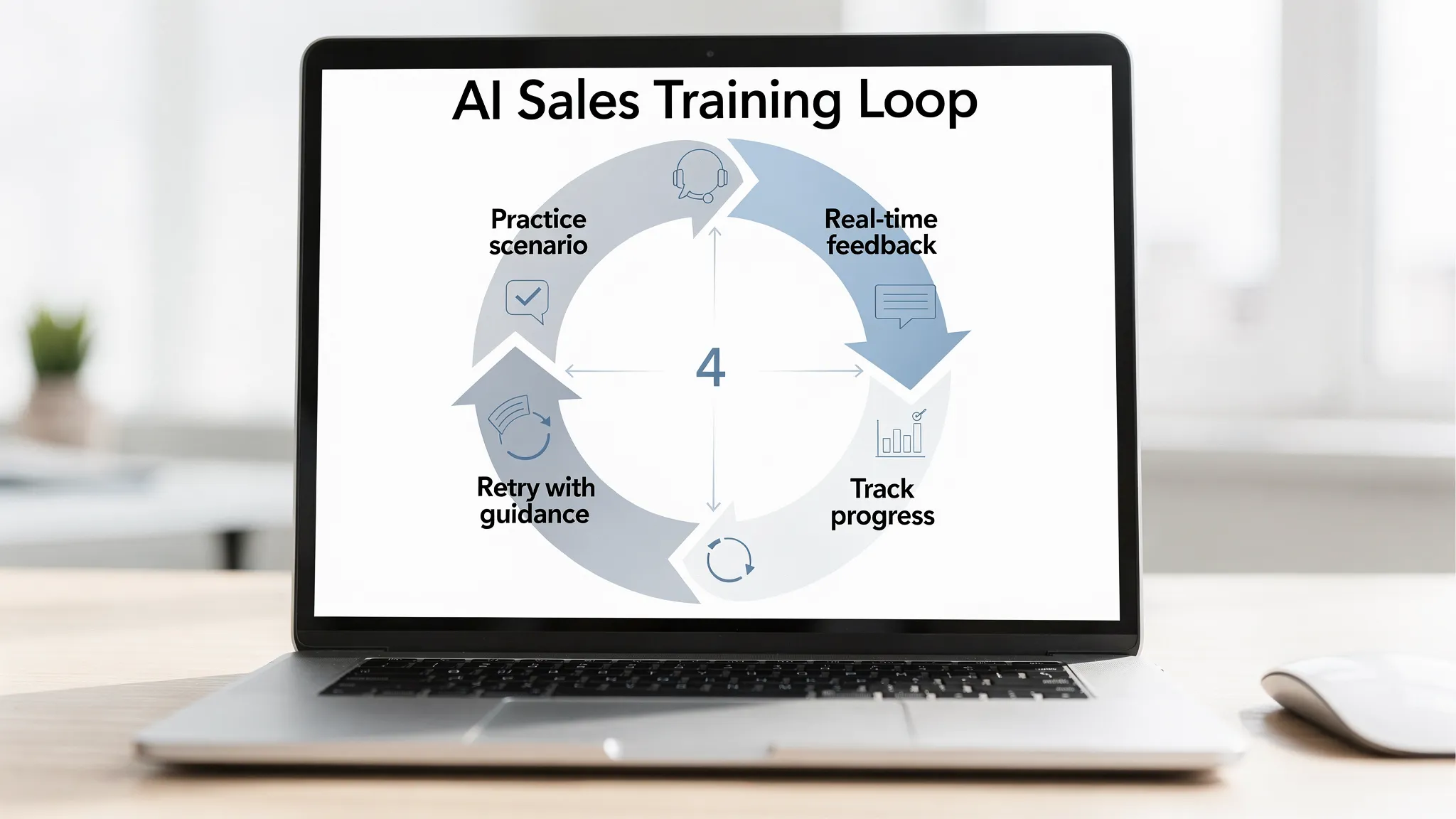
What this means in practice (a simple “great AI experience” loop)
When AI training is working, you can see a tight loop:
- Rep practices a realistic scenario aligned to their role
- AI gives immediate feedback tied to specific moments
- Rep retries the same moment with a better approach
- Progress tracking shows skill movement over time
- Manager coaching focuses on the highest-impact gaps
Where Scenario IQ fits
Scenario IQ is built around this practical loop: AI-powered roleplay simulations, personalized training scenarios, real-time feedback, and progress tracking analytics designed for teams.
If you are comparing tools, focus on whether the experience helps reps practice the exact conversations your business depends on, and whether managers get actionable insight that translates into better coaching. Features like adaptive guidance, customizable skill levels, team-focused learning, daily tips, and enterprise-grade security are not “nice-to-haves” when you are trying to scale consistent performance across a sales org.
Frequently Asked Questions
What does “AI experience” mean in sales training? It refers to the end-to-end user experience of AI-driven practice and coaching, including scenario realism, personalization, feedback quality, ease of use, analytics for managers, and trust factors like privacy and security.
Is AI roleplay actually better than traditional roleplay? It can be, mainly because it enables more repetitions with immediate feedback and less scheduling friction. The best programs often combine both: AI for high-frequency practice and managers for human coaching and reinforcement.
What should AI feedback include to be useful for reps? It should reference specific moments in the conversation, explain why an approach worked or failed, and give an alternative phrasing or tactic the rep can immediately retry.
How do you measure whether AI sales training is working? Look for skill trend improvement over time, greater consistency across the team, and clearer coaching signals for managers. Then connect those improvements to business outcomes where possible (for example, improved discovery quality, higher meeting-to-opportunity conversion, better objection handling rates).
How do I choose scenarios to train first? Start with high-frequency, high-impact moments: discovery calls, pricing pushback, competitor comparisons, and common objections that stall deals. Build from foundational skills to advanced scenarios as confidence grows.
What should companies ask about data privacy when using AI training? Ask what data is stored, how it is protected, who can access it, whether it is used to train models, and what retention and deletion controls exist.
See what great AI roleplay training feels like
If you are aiming to improve objection handling, confidence, and consistency across your team, explore Scenario IQ to see how AI-driven roleplay, real-time feedback, and progress tracking can support a modern sales training program.