
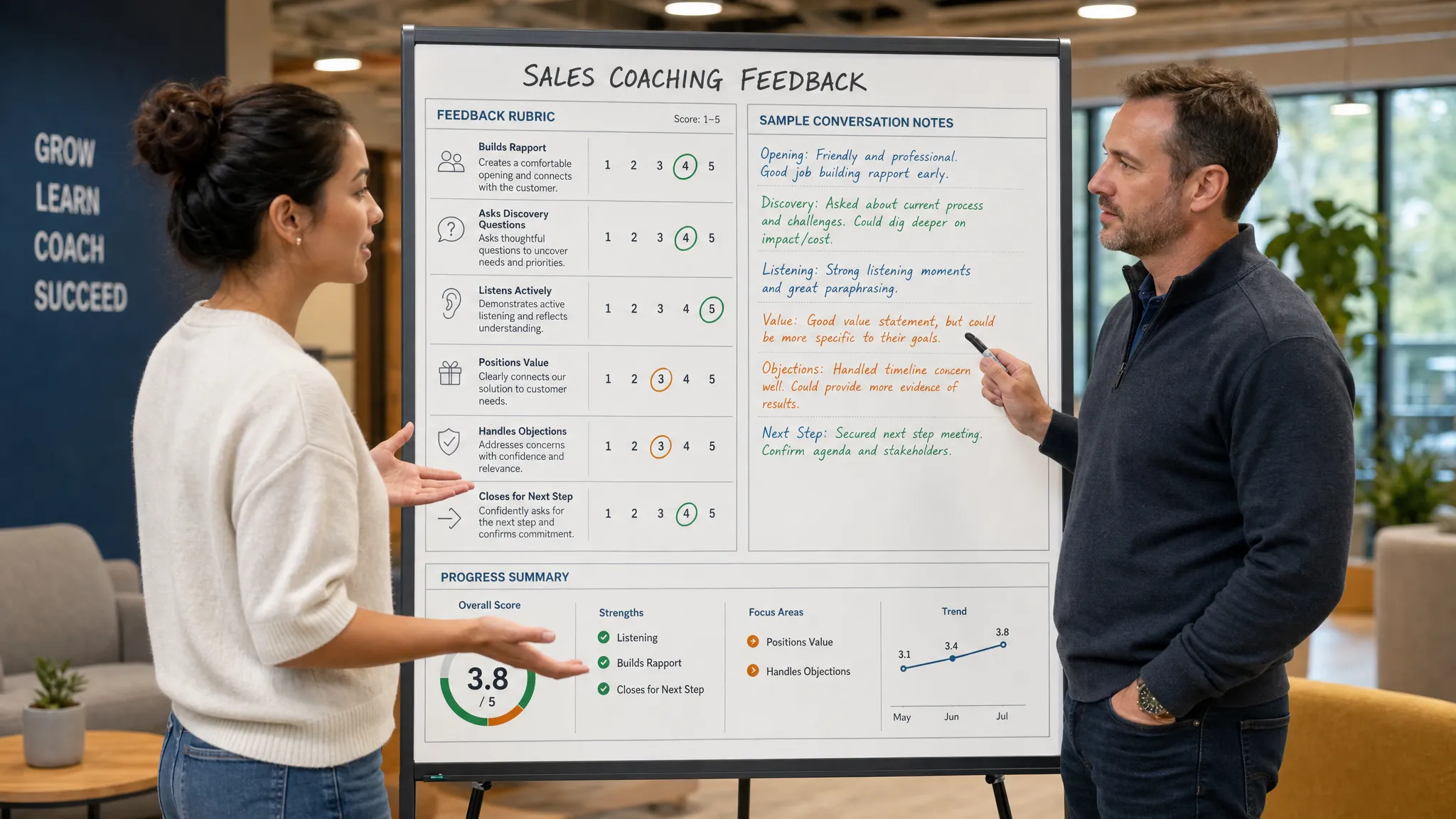
Training an AI for better coaching and feedback is not just a technical project. It is an operating discipline. The goal is not to make a model sound smart, it is to help people practice realistic conversations, understand what they did well, and improve the next time they face a customer, prospect, or teammate.
For sales, service, and support teams, that distinction matters. Generic AI can produce generic advice. A well-trained AI coaching system can reinforce your methodology, recognize skill gaps, adapt scenarios to each learner, and give feedback that is specific enough to change behavior.
The teams that get the best results usually do not start with a massive data science initiative. They start by defining what good performance looks like, then use AI to make practice, feedback, and coaching more consistent.
What training an AI really means in coaching
When people hear the phrase training an AI, they often imagine building a large language model from scratch. In most organizations, that is not what is needed.
For coaching and feedback, training an AI usually means shaping an existing AI system around your business context, your skill expectations, and your learners. That includes the scenarios it presents, the rubrics it uses, the examples it learns from, the feedback style it follows, and the performance signals it tracks over time.
In practical terms, you are teaching the AI five things:
- What a strong interaction sounds like in your business
- What common mistakes or weak behaviors look like
- How to score performance consistently
- How to deliver feedback in a way people can act on
- How to adapt difficulty as learners improve
This is especially important in customer-facing roles. A sales rep handling a pricing objection needs different coaching than a service agent calming an frustrated customer. A new hire needs different feedback than a tenured enterprise account executive. AI coaching becomes valuable when it can reflect those differences instead of applying one-size-fits-all advice.
Start with coaching outcomes, not AI capabilities
The most common mistake in AI coaching projects is starting with the tool instead of the outcome. Before configuring prompts, scenarios, or analytics, leaders should define the behaviors they want to improve.
For example, a sales team may want reps to ask better discovery questions, link pain points to business impact, and handle objections without discounting too early. A service team may want agents to acknowledge emotion, clarify the issue, confirm next steps, and avoid overpromising.
These outcomes should be observable. If a manager cannot hear or read the behavior in a conversation, the AI will struggle to coach it reliably.
A clear outcome might sound like this: The learner should be able to uncover the economic impact of a customer problem by asking at least two follow-up questions before presenting a solution.
A vague outcome sounds like this: The learner should be more consultative.
The first gives the AI something to evaluate. The second leaves too much room for inconsistent feedback.
Build realistic scenarios from real conversations
AI coaching is only as useful as the practice environment. If the scenario feels artificial, learners treat it like a game. If it reflects the pressure, ambiguity, and nuance of real conversations, they are more likely to build confidence that transfers to the field.
Strong scenarios usually include context, stakes, customer emotion, role expectations, and success criteria. They should also vary by difficulty. A beginner might practice a straightforward objection. An advanced learner might face a skeptical buyer with competing priorities, budget pressure, and a tight timeline.
For sales and service training, realistic scenario inputs can include:
- Common objections from prospects or customers
- Call recordings or conversation notes, where permitted
- CRM stage definitions and deal risks
- Support ticket themes and escalation patterns
- Product positioning and approved messaging
- Manager feedback from previous coaching sessions
Privacy and governance matter here. Do not feed sensitive customer data into an AI system without proper controls, consent, and security review. The NIST AI Risk Management Framework is a useful reference for organizations thinking through AI risk, measurement, governance, and trustworthiness.

Create feedback rubrics before creating prompts
Prompts matter, but rubrics matter more. A rubric tells the AI what to listen for, how to judge quality, and how to turn observations into feedback.
Without a rubric, AI feedback often sounds polished but imprecise. It may say, You handled the objection well, or Try to be more empathetic. Those comments are easy to agree with and hard to use.
A useful coaching rubric breaks performance into specific, measurable behaviors. It also separates what happened from what should happen next.
| Coaching dimension | What the AI should evaluate | Example feedback signal |
|---|---|---|
| Discovery quality | Did the learner ask relevant, layered questions? | Asked one surface-level question but did not explore business impact |
| Active listening | Did the learner reflect or confirm the other person’s concern? | Acknowledged the concern before moving to a recommendation |
| Objection handling | Did the learner clarify the objection before responding? | Responded to price concern without identifying budget owner or timing |
| Message clarity | Was the explanation concise and tailored? | Used product terms without connecting them to the customer’s goal |
| Next-step control | Did the learner confirm ownership, timing, and action? | Ended with a general follow-up instead of a specific agreed next step |
The best rubrics are short enough for learners to remember and specific enough for managers to trust. If a rubric has 25 categories, it becomes noise. If it has only one score, it hides the behaviors that need coaching.
Use examples to calibrate the AI
Training an AI for better feedback requires calibration. That means giving the system examples of strong, average, and weak performance so it can learn the difference.
Human coaches do this naturally. A manager may say, This rep did a great job validating the customer’s concern, but missed the chance to ask about decision criteria. AI needs the same kind of guidance.
Calibration examples should include the conversation excerpt, the expected score, and the reason behind that score. This helps the AI move beyond keyword spotting. For instance, a learner can say I understand your concern without actually demonstrating empathy. A calibrated coaching system should evaluate the quality of the response, not just the presence of a phrase.
A simple calibration set might include:
- Three examples of excellent objection handling
- Three examples of partial or inconsistent objection handling
- Three examples of poor objection handling
- Manager notes explaining each score
- Approved coaching language for improvement suggestions
Over time, this calibration should be reviewed. Markets change, products change, buyer expectations change, and service policies change. AI coaching should evolve with them.
Make feedback immediate, specific, and behavior-based
One of the biggest advantages of AI coaching is speed. Traditional coaching often happens days or weeks after a call, if it happens at all. By then, the learner may not remember the moment clearly.
Real-time or near-real-time feedback can close that gap. But speed alone is not enough. Fast feedback that is vague still fails.
Effective AI feedback should include three elements: the observed behavior, the impact of that behavior, and the next action. For example: You responded to the price objection immediately, but you did not ask what the buyer was comparing the price against. Next time, ask whether the concern is budget, perceived value, or comparison to another vendor before responding.
That kind of feedback is actionable because it tells the learner exactly what to change.
This aligns with a core principle of workplace learning: feedback is most useful when it is timely, tied to a specific task, and clear enough to guide the next attempt. AI makes that possible at scale, especially for teams where managers cannot personally review every practice session.
Personalize coaching without fragmenting standards
Personalization is one of the strongest use cases for AI in training. Two learners may complete the same roleplay and need completely different feedback. One may rush discovery. Another may ask thoughtful questions but struggle to close for next steps.
However, personalization should not mean every learner is judged by a different standard. The AI should adapt the learning path while keeping the core performance expectations consistent.
A practical approach is to create levels. For example, early-stage learners might be evaluated on structure and confidence. Intermediate learners might be evaluated on depth, adaptability, and objection handling. Advanced learners might be evaluated on executive presence, strategic framing, and commercial judgment.
This is where adaptive simulations can be especially useful. If a learner consistently performs well, the AI can increase the challenge. If a learner struggles, it can offer more guided practice before moving on.
Keep humans in the coaching loop
AI can scale coaching, but it should not replace leadership judgment. Managers, trainers, and enablement teams still play a critical role in defining standards, reviewing feedback quality, and coaching the human context behind performance.
A healthy AI coaching program uses the AI for repetition, consistency, and pattern detection. Human coaches then focus on higher-value work: motivation, judgment, career development, team culture, and nuanced customer strategy.
This also helps build trust. If employees believe AI feedback is a black box, they may resist it. If they see that managers review the criteria, explain the purpose, and use the insights to support growth, adoption improves.
Human review is especially important when AI feedback may affect performance evaluations, compensation, or promotion decisions. In those cases, organizations should be transparent about how AI-generated insights are used and where human oversight applies.
Measure whether AI coaching changes performance
Training an AI is not complete when the system launches. The real test is whether coaching improves behavior and business outcomes.
Start by separating learning metrics from performance metrics. Learning metrics show whether people are practicing and improving inside the training environment. Performance metrics show whether that improvement carries into real work.
| Measurement area | Example metric | Why it matters |
|---|---|---|
| Practice adoption | Roleplays completed per learner | Shows whether the team is building repetition |
| Skill improvement | Score change by rubric category | Reveals which behaviors are improving or stuck |
| Coaching consistency | Score variance across similar scenarios | Helps identify unclear rubrics or calibration issues |
| Manager action | Coaching follow-ups completed | Connects AI feedback to human reinforcement |
| Business impact | Win rate, conversion rate, CSAT, first-contact resolution | Links training to outcomes leaders care about |
Be careful not to overclaim causation too early. If win rates improve, AI coaching may be one factor among many. Strong measurement compares trends over time, looks at participation levels, and studies whether specific skill improvements correlate with downstream results.
The most useful analytics do not just show who scored highest. They show where the team is getting stuck and what to coach next.
Common mistakes when training an AI for coaching
AI coaching programs usually fail for predictable reasons. The technology may work, but the operating model around it is weak.
One mistake is using generic scenarios. If every learner practices the same easy conversation, the system becomes a checkbox activity. Scenarios should reflect real buyer objections, customer frustrations, service policies, and role-specific challenges.
Another mistake is asking the AI to evaluate too many things at once. Learners cannot improve 12 behaviors after one roleplay. Focus each scenario on a small number of skills, then build complexity over time.
A third mistake is treating AI feedback as final. AI should be monitored, calibrated, and improved. If learners repeatedly say the feedback is unfair or irrelevant, that is not just an adoption problem. It may be a training problem.
Finally, many teams forget to train managers. If managers do not understand the rubrics, analytics, or recommended follow-ups, AI coaching stays isolated from the broader performance system.
A practical workflow for training an AI coaching system
The best implementation path is iterative. Start with one high-value use case, prove that the feedback is useful, then expand.
A practical workflow looks like this:
- Define the target skill: Choose one behavior that matters, such as discovery, objection handling, escalation, or renewal conversations.
- Write the performance standard: Describe what good, average, and poor performance look like in observable terms.
- Build realistic scenarios: Use common customer situations, role context, emotional tone, and difficulty levels.
- Create the feedback rubric: Keep it focused, behavior-based, and aligned with manager coaching language.
- Calibrate with examples: Review sample responses and adjust scoring until leaders trust the feedback.
- Launch with human reinforcement: Have managers use AI insights in one-on-ones, team coaching, and practice assignments.
- Review analytics and refine: Look for patterns, update scenarios, and improve the rubric as performance data accumulates.
This workflow helps teams avoid the trap of launching AI coaching as a novelty. Instead, it becomes part of a continuous improvement system.
How Scenario IQ supports AI coaching and feedback
Scenario IQ is built for organizations that want AI-driven, scenario-based training for sales, service, and other communication-heavy teams. The platform supports AI-powered roleplay simulations, personalized training scenarios, real-time feedback, adaptive guidance, progress tracking analytics, daily actionable tips, customizable skill levels, and team-focused learning.
For leaders, the value is not just that people can practice more often. It is that practice can be structured around the conversations that matter most, with feedback that helps learners build confidence and improve over time.
With performance metric dashboards and progress tracking analytics, teams can also move beyond anecdotal coaching. Leaders can see patterns across learners, identify skill gaps, and make better decisions about where to focus enablement.
Enterprise-grade security also matters when training involves internal messaging, customer-facing scenarios, or sensitive team performance data. AI coaching should help people improve without creating unnecessary risk.
FAQ
What does training an AI mean for coaching and feedback? It means configuring an AI system around your scenarios, rubrics, examples, feedback style, and performance goals so it can provide relevant coaching instead of generic advice.
Do companies need to build their own AI model for coaching? Usually not. Most teams can use an AI coaching platform and train it through scenario design, evaluation criteria, calibration examples, and ongoing feedback loops.
How can AI feedback be made more accurate? Accuracy improves when the AI uses clear rubrics, realistic examples, manager-approved scoring standards, and regular calibration. Human review is also important for trust and quality control.
Can AI coaching replace sales or service managers? No. AI can scale practice and provide consistent feedback, but managers still provide context, motivation, judgment, and coaching conversations that require human leadership.
What should teams measure after launching AI coaching? Track practice completion, skill improvement by category, feedback consistency, manager follow-up, and business outcomes such as conversion rate, win rate, CSAT, or first-contact resolution.
Turn AI coaching into measurable team improvement
Training an AI for better coaching and feedback is really about training your organization to define, practice, measure, and reinforce great performance. When scenarios are realistic, rubrics are clear, feedback is specific, and managers stay involved, AI becomes more than a training tool. It becomes a scalable coaching system.
If your team wants to build confidence through realistic practice, improve objection handling, and turn feedback into measurable progress, Scenario IQ can help. Explore AI-powered roleplay simulations, personalized scenarios, real-time feedback, and performance analytics designed for modern sales and service teams.