
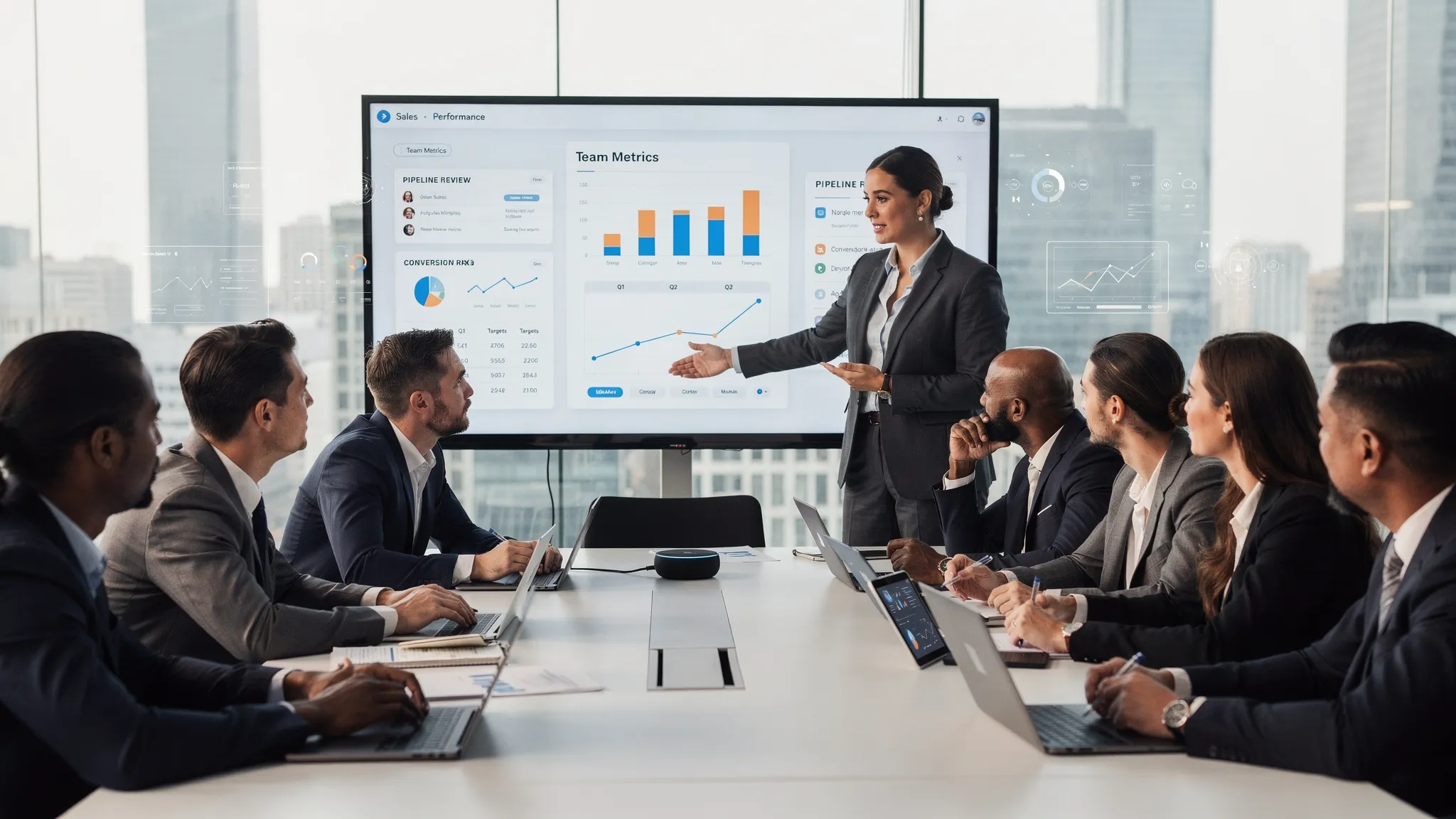
Sales teams are entering 2026 with more tools than ever, but also more pressure. Buyers are better informed, buying committees are larger, budgets are scrutinized earlier, and AI has raised the bar for speed and personalization. The teams that win will not simply “use AI.” They will combine technology with stronger human skills: sharper discovery, clearer value communication, better objection handling, and the confidence to perform in complex conversations.
For sales leaders, enablement teams, and revenue executives, the question is not whether your team needs more training. The real question is: which sales skills deserve the most attention now?
Below are the sales skills your team needs most in 2026, plus practical ways to train them through scenario-based learning, roleplay, feedback, and measurable performance analytics.

Why sales skills are changing in 2026
The fundamentals of selling still matter. Reps need to understand the customer, build trust, communicate value, and close next steps. What has changed is the environment around those fundamentals.
B2B buyers now move across digital, remote, and in-person touchpoints, often before they ever speak to a seller. McKinsey’s B2B research has repeatedly shown that buyers expect an omnichannel experience, not a one-size-fits-all sales motion. At the same time, sales reps are juggling more administrative work, more tools, and more internal coordination. Salesforce’s State of Sales has highlighted how much seller time can be consumed by non-selling activities.
AI is accelerating this shift. It can summarize accounts, draft outreach, generate call notes, and suggest next steps. But it cannot replace the judgment required to diagnose a business problem, navigate stakeholder politics, or respond well when a buyer says, “This is not a priority right now.”
That means 2026 sales training should focus less on static scripts and more on adaptive performance. Your team needs to practice realistic situations, receive real-time feedback, and build the confidence to handle the conversations that actually determine revenue.
The sales skills your team needs most in 2026
1. Commercial acumen
Commercial acumen is the ability to understand how a customer’s business works, what drives their priorities, and how your solution connects to measurable outcomes. In 2026, this skill separates average reps from trusted advisors.
A rep with commercial acumen does not just ask, “What are your pain points?” They ask questions that reveal revenue impact, cost pressure, operational risk, customer experience gaps, or strategic urgency. They can connect the buyer’s initiative to broader business outcomes such as margin improvement, employee productivity, retention, speed to market, or risk reduction.
This matters because buyers are under pressure to justify every purchase. If your team cannot translate product value into business value, deals slow down or stall.
To train this skill, build scenarios where reps must uncover the business impact behind a surface-level problem. For example, a customer might say, “Our service team is inconsistent.” The rep should learn to investigate what that means in business terms: lower customer satisfaction, higher escalations, longer onboarding, or lost renewals.
2. AI-assisted preparation with human judgment
AI-assisted preparation is becoming a baseline sales skill. Reps should know how to use AI to research accounts, identify likely priorities, prepare discovery questions, and tailor messaging. But the key skill is not prompt writing alone. It is judgment.
Your team needs to know when AI output is useful, when it is generic, and when it needs verification. A seller who blindly trusts AI-generated insights may sound polished but inaccurate. A seller who combines AI research with critical thinking can show up faster, better prepared, and more relevant.
In 2026, sales leaders should train reps to use AI for:
- Account and industry research
- Persona-based call planning
- Objection preparation
- Follow-up message drafting
- Competitive positioning practice
The goal is not to automate the seller’s thinking. The goal is to give sellers more time and context so they can have better conversations.
3. Consultative discovery
Discovery remains one of the most important sales skills, but the standard is higher. Buyers do not want to answer a long checklist of basic questions they already covered on your website or intake form. They expect sellers to bring context, insight, and a point of view.
Strong consultative discovery has three parts: preparation, active listening, and intelligent follow-up. Reps should be able to ask questions that uncover the buyer’s current state, desired future state, obstacles, stakeholders, timing, and decision criteria.
The best discovery conversations feel less like interrogation and more like diagnosis. The seller helps the buyer understand the problem more clearly.
A useful training exercise is to give reps the same buyer profile but different hidden motivations. One buyer may care about cost reduction, another about team productivity, and another about reducing customer complaints. The rep’s job is to listen closely enough to find the real driver, not just run through a script.
4. Value articulation
Value articulation is the ability to explain why your solution matters in the buyer’s language. This is especially important in crowded markets where products can look similar from the outside.
In 2026, teams need to move beyond feature-led pitches. A feature-led pitch says, “We have dashboards, automation, and integrations.” A value-led conversation says, “This helps your managers identify coaching gaps faster, reduce inconsistent customer conversations, and improve team performance with measurable feedback.”
The difference is clarity. Buyers should be able to repeat your value internally after the call. If they cannot, the deal is vulnerable.
Sales managers can train this by asking reps to convert features into outcomes. For every product capability, the rep should answer three questions: what it does, why it matters, and how it affects the customer’s business.
5. Objection handling under pressure
Objection handling is not about having a clever comeback. It is about staying calm, understanding the concern behind the objection, and responding in a way that moves the conversation forward.
Common 2026 objections include:
- “We are not prioritizing this right now.”
- “We already have a tool for that.”
- “The budget is tight.”
- “We need to prove ROI first.”
- “Our team will not adopt another platform.”
The best reps do not rush to defend. They clarify, acknowledge, reframe, and then connect the response to the buyer’s priorities. For example, if a buyer says adoption is a concern, the rep might explore what has failed in past rollouts, who needs to be involved, and what success would look like in the first 30 or 60 days.
This is where virtual roleplay training is especially powerful. Reps can practice difficult objections in a safe environment before facing them in live deals. Real-time feedback helps them improve tone, structure, confidence, and message quality.
6. Multi-stakeholder communication
Few meaningful deals are decided by one person. Even when a rep has a strong champion, that champion often has to persuade finance, operations, IT, legal, procurement, or executive leadership.
Harvard Business Review has written about consensus buying, and the core lesson still applies: sellers must help buying groups align around change. In 2026, that means reps need to understand stakeholder motivations and tailor communication to each audience.
A sales leader may care about pipeline performance. A service leader may care about customer satisfaction. A finance stakeholder may care about efficiency and measurable return. An IT stakeholder may care about security, implementation, and governance.
Training should include scenarios where reps must identify missing stakeholders, coach a champion, or adapt a message for different decision makers. This skill is often the difference between a promising opportunity and a deal that disappears into internal review.
7. Executive-level storytelling
Executives do not want every detail. They want the strategic point, the business risk, the opportunity, and the recommended decision.
Executive-level storytelling is the ability to make a complex sales conversation concise and compelling. Reps must be able to summarize the customer’s current challenge, explain the cost of inaction, connect the solution to strategic outcomes, and propose a clear next step.
A strong executive story often follows a simple structure:
| Story element | What the rep should communicate |
|---|---|
| Current situation | What is happening in the buyer’s business today |
| Business impact | Why it matters financially, operationally, or strategically |
| Desired outcome | What the buyer wants to improve |
| Solution connection | How your solution helps create that outcome |
| Next step | What decision or action should happen next |
This skill can be trained through timed exercises. Give reps two minutes to brief an executive, then provide feedback on clarity, relevance, and confidence.
8. Digital and asynchronous selling
Not every sales moment happens on a live call. Buyers evaluate vendors through emails, videos, proposals, social interactions, chat, and shared documents. In 2026, reps need to sell effectively across asynchronous channels.
This includes writing concise follow-ups, creating useful recap notes, sending relevant resources, and making it easy for champions to share information internally. A great sales conversation can lose momentum if the follow-up is vague or too long.
A strong follow-up message should remind the buyer of the business issue, summarize agreed priorities, provide the promised resource, and confirm the next action. It should not read like a generic template.
Sales teams can train this by reviewing real follow-ups and asking, “Would this help the buyer take the next step?” If the answer is no, the message needs work.
9. Negotiation and mutual action planning
Negotiation in 2026 is less about discounting and more about alignment. Buyers want flexibility, but sellers need to protect value. The strongest reps understand trade-offs, create mutual action plans, and keep momentum without becoming pushy.
A mutual action plan helps both sides agree on steps, owners, timing, success criteria, and decision requirements. This reduces ambiguity and makes complex deals easier to manage.
Negotiation training should include realistic pressure. For example, a buyer asks for a discount at the end of the quarter, delays legal review, or introduces a new stakeholder late in the process. The rep must respond without giving away value too quickly.
10. Coachability and continuous improvement
Coachability may be the most underrated sales skill. Markets change, messaging changes, competitors change, and buyer expectations change. Reps who can receive feedback, practice deliberately, and improve quickly will outperform reps who rely only on experience.
This is also where managers need better visibility. If coaching depends only on occasional call reviews or subjective impressions, skill gaps can go unnoticed. Progress tracking analytics, performance dashboards, and structured feedback make coaching more consistent and actionable.
Coachability is not just a personality trait. It is a behavior that can be reinforced through regular practice, clear standards, and feedback loops.
Sales skills training priorities by role
Not every seller needs the same training emphasis. A business development representative, account executive, customer success manager, and frontline manager all contribute to revenue, but they face different moments of truth.
| Role | Highest-priority skills | Example training scenario |
|---|---|---|
| SDR or BDR | Personalization, discovery, objection handling | A prospect says they are too busy and already have a vendor |
| Account executive | Commercial acumen, value articulation, negotiation | A buying committee needs ROI proof before moving forward |
| Customer success manager | Expansion discovery, stakeholder communication, retention conversations | A customer is underusing the solution and questioning renewal |
| Sales manager | Coaching, feedback delivery, performance diagnosis | A rep is creating pipeline but failing to progress opportunities |
| Service team leader | Communication, de-escalation, customer confidence | A customer is frustrated after receiving inconsistent support |
The takeaway is simple: sales performance improves faster when training is relevant to the role, skill level, and real customer conversations each person faces.
How to train these skills in 2026
Traditional training often fails because it is too passive. A workshop may introduce a framework, but reps do not build confidence until they apply it under realistic conditions. In 2026, the best sales training will be active, personalized, and measurable.
Scenario-based training works because it mirrors the complexity of real buyer conversations. Instead of memorizing scripts, reps practice decisions: what to ask, how to respond, when to challenge, and how to move the conversation forward.
An effective training program should include four elements.
First, define the behaviors you want to improve. “Get better at discovery” is too broad. A better target is: “Ask at least three business-impact questions before presenting a solution.”
Second, create realistic scenarios based on your market, buyer personas, objections, and deal stages. The closer the practice is to the real sales environment, the more useful it becomes.
Third, provide immediate feedback. Reps need to know what worked, what missed the mark, and what to try next. Delayed feedback is less effective because the conversation has already faded from memory.
Fourth, track progress over time. Skill development should be visible. Managers should be able to see whether reps are improving in confidence, messaging, objection handling, and other key competencies.
This is where an AI training platform can help. Scenario IQ offers AI-powered roleplay simulations, personalized training scenarios, real-time feedback, adaptive guidance, progress tracking analytics, team-focused learning, and performance metric dashboards. These capabilities help organizations turn training from a one-time event into an ongoing performance system.
A practical 30-day plan for sales skill development
If you are planning team training for 2026, start with a focused 30-day sprint rather than trying to fix everything at once.
| Week | Focus | Training activity | Success indicator |
|---|---|---|---|
| Week 1 | Baseline assessment | Run roleplay simulations for discovery and objection handling | Managers identify the top three skill gaps |
| Week 2 | Targeted practice | Assign personalized scenarios by role and skill level | Reps improve on specific feedback areas |
| Week 3 | Complexity building | Add multi-stakeholder, budget, and timing objections | Reps maintain structure under pressure |
| Week 4 | Measurement and coaching | Review analytics, dashboards, and manager observations | Each rep has a clear next development goal |
This approach keeps training practical. It also gives managers enough data to coach based on observed behavior, not guesswork.
How to measure whether sales skills are improving
Sales skills should connect to business outcomes, but you need both leading and lagging indicators. Revenue is the ultimate measure, but it often changes after the skill improvement has already happened. That is why training analytics matter.
Useful indicators include:
- Discovery quality scores
- Objection handling performance
- Confidence ratings before and after practice
- Conversion from first meeting to next step
- Sales cycle progression
- Deal qualification accuracy
- Manager coaching completion
- Rep participation and improvement trends
The goal is not to turn people into numbers. The goal is to give managers and reps a shared view of progress. When teams can see improvement, coaching becomes more specific and motivation increases.
Frequently Asked Questions
What is the most important sales skill in 2026? The most important sales skill is the ability to connect customer problems to measurable business outcomes. AI can help with preparation, but reps still need commercial acumen, discovery, and value articulation to earn trust.
How does AI change sales training? AI makes sales training more personalized, scalable, and realistic. Teams can practice AI-driven scenarios, receive real-time feedback, and track progress across specific skills instead of relying only on occasional workshops.
Why is roleplay still useful for sales teams? Roleplay is useful because sales performance depends on live conversation skills. Virtual roleplay training allows reps to practice objections, discovery, negotiation, and stakeholder conversations before they happen with real buyers.
How often should sales teams practice skills? Short, frequent practice is usually more effective than one large training event. Weekly or even daily practice moments, supported by feedback and actionable tips, help reps build habits over time.
What sales skills should managers coach first? Managers should start with the skills that create the biggest revenue bottleneck. If opportunities are not converting, focus on discovery and value articulation. If deals stall late, focus on stakeholder communication, negotiation, and business case development.
Build the sales skills your team needs for 2026
The best sales teams in 2026 will not be the teams with the most scripts or the most tools. They will be the teams that practice the right conversations, adapt quickly, and use feedback to improve every week.
If you want to strengthen sales performance, customer conversations, and employee skill development across your organization, Scenario IQ can help your team train with AI-powered roleplay simulations, personalized scenarios, real-time feedback, and actionable analytics.
Turn sales training into measurable performance improvement, and help your team enter every buyer conversation with more confidence.