
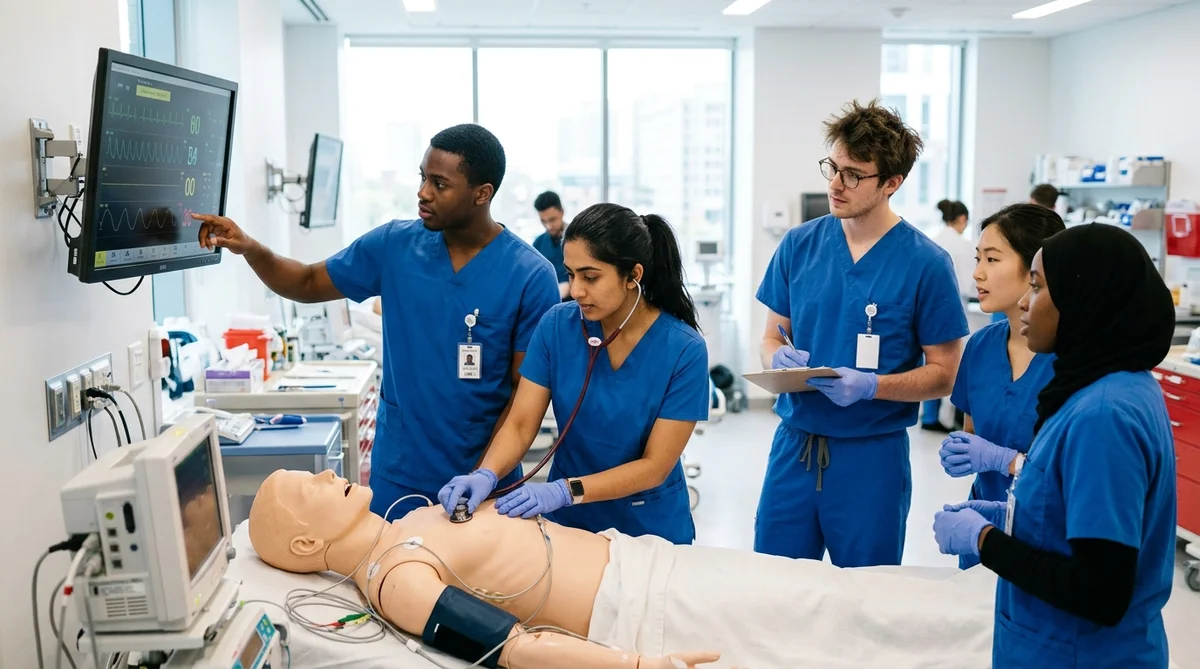
A patient simulator is a high-fidelity educational tool designed to mimic human physiological responses and pathological conditions for clinical training. Modern AI-driven simulators can reduce medical errors by up to 40% by providing risk-free environments where students practice diagnosis and communication before interacting with live patients in a clinical setting.
Defining the Modern Patient Simulator
In the context of contemporary healthcare, a patient simulator is no longer just a static mannequin. It represents a sophisticated ecosystem of hardware and software designed to replicate the complexities of the human body and the unpredictability of human behavior. From the early days of Resusci Anne to today’s advanced robotic systems that breathe, bleed, and respond to medication, the goal remains the same: to bridge the gap between theoretical knowledge and clinical practice.
Simulators serve as a bridge. They allow practitioners to fail safely. In medicine, the cost of a mistake is high, but the cost of not practicing is higher. By utilizing a patient simulator, medical students and seasoned professionals can refine their psychomotor skills and clinical judgment without risking patient safety. This is particularly vital in high-stakes environments like the ICU or emergency department, where split-second decisions are the difference between life and death.
What are the different types of patient simulators?
The market for simulation technology is diverse, catering to different educational needs ranging from basic anatomy to complex surgical procedures. Understanding the distinctions is crucial for institutions looking to invest in their training infrastructure.
| Simulator Category | Description | Primary Use Case |
|---|---|---|
| Task Trainers | Partial body parts (e.g., an arm for IV starts). | Mastering specific psychomotor skills. |
| High-Fidelity Mannequins | Full-body robots with physiological responses. | Team-based emergency response training. |
| Virtual Patient Simulation | Software-based avatars driven by AI. | Diagnostic reasoning and communication skills. |
| Standardized Patients | Actors trained to portray specific illnesses. | Interpersonal and bedside manner assessment. |
While physical mannequins are excellent for hands-on procedures, virtual patient simulation has gained massive traction due to its scalability. Platforms like Scenario IQ leverage AI to create dynamic interactions that evolve based on the trainee's input, offering a level of nuance that physical models often lack. This software-driven approach allows for rapid iteration of scenarios, covering rare diseases that a student might not see in years of clinical rotations.
The Evolution of AI Roleplay for Universities
Universities are increasingly moving away from traditional lecture-based models toward active learning. The integration of AI roleplay for universities has transformed how soft skills are taught. While a student might know the pharmacological treatment for a condition, delivering a terminal diagnosis or handling an irate family member requires a different set of competencies.
These soft skills are often the most difficult to teach but the most critical for patient satisfaction and legal risk mitigation. By using AI-driven platforms, students can engage in unlimited practice sessions. They receive real-time feedback on their tone, empathy, and clarity. This aligns with modern pedagogical frameworks that emphasize deliberate practice and immediate corrective feedback.
Why is a patient simulator essential for patient safety?
The landmark report "To Err Is Human" by the Institute of Medicine highlighted that tens of thousands of deaths occur annually due to preventable medical errors. A patient simulator acts as a primary defense mechanism against these statistics. By simulating the "Swiss Cheese Model" of accident causation, educators can show students how small oversights accumulate into catastrophic failures.
Simulation allows for the rehearsal of "low-frequency, high-stakes" events. For instance, a rare anesthetic complication might occur once in a decade for a specific provider. Without a simulator, that provider’s first encounter with the complication is on a live patient. With simulation, they can have managed that exact scenario dozens of times in a controlled environment. This builds muscle memory and reduces the cognitive load during the actual event.
Key Features of High-Fidelity Simulators
When evaluating a patient simulator, several technical features determine its effectiveness in a clinical curriculum:
- Physiological Modeling: The ability of the simulator to automatically adjust heart rate, blood pressure, and oxygen saturation in response to interventions like intubation or drug administration.
- Haptic Feedback: In surgical or task-based simulators, the physical resistance felt by the trainee must mimic real human tissue.
- Natural Language Processing (NLP): For virtual simulators, the ability to understand and respond to verbal cues naturally is paramount.
- Data Analytics: Modern platforms must track performance metrics to identify specific gaps in a learner's knowledge.
For institutions focusing on the behavioral side of medicine, incorporating the 5 best AI roleplay training software platforms for 2024 can provide a comprehensive toolkit for developing both technical and interpersonal excellence.
How does AI improve the realism of patient simulators?
Artificial Intelligence has revolutionized simulation by moving it from a scripted "if-this-then-that" logic to a generative, adaptive experience. In the past, a simulator's responses were limited to what the instructor programmed manually during the session. Today, AI engines can generate autonomous patient personas with unique medical histories, cultural backgrounds, and emotional states.
This level of realism is critical for teaching diagnostic reasoning. An AI-driven patient simulator can exhibit subtle symptoms that change over time, forcing the student to re-evaluate their hypothesis. Furthermore, AI allows for personalized learning paths. If a student consistently struggles with respiratory assessments, the system can adapt the difficulty of the next scenario to focus specifically on those weaknesses. This is a core feature of Scenario IQ, which uses adaptive guidance to ensure no two training sessions are identical, keeping learners engaged and challenged.
Measuring the Impact: The Kirkpatrick Model
To justify the investment in simulation technology, healthcare administrators often look to the Kirkpatrick Model of evaluation. This framework measures training effectiveness across four levels: Reaction, Learning, Behavior, and Results.
| Level | Metric in Simulation | Expected Outcome |
|---|---|---|
| Level 1: Reaction | Student engagement and perceived realism. | Increased confidence in clinical skills. |
| Level 2: Learning | Pre- and post-simulation knowledge tests. | Demonstrated mastery of clinical protocols. |
| Level 3: Behavior | Observation of performance in real clinical settings. | Reduced time to perform procedures accurately. |
| Level 4: Results | Hospital-wide patient outcome data. | Lower infection rates and mortality figures. |
Simulation directly impacts Level 3 and Level 4. When a team practices a "Code Blue" on a high-fidelity patient simulator, their coordination during a real cardiac arrest improves significantly. This transfer of training is the ultimate goal of any simulation program.
Integrating Communication Training
While technical skills are vital, the breakdown in communication is a leading cause of sentinel events in hospitals. Training must include modules on 15 essential customer service training topics to boost performance, adapted for the healthcare environment. Topics such as active listening, de-escalation, and clear information transfer (SBAR) are perfectly suited for simulation.
For example, a scenario might involve a patient simulator refusing a necessary treatment. The student must navigate this "objection" much like a sales professional, but with the ethical constraints of medical practice. Using frameworks found in guides like mastering the objection handling script can help clinicians develop the structured communication needed to ensure patient compliance and safety.
The Role of Scenario IQ in Clinical Excellence
Scenario IQ provides the infrastructure for this high-level behavioral training. By offering AI-powered roleplay simulations, it allows medical and nursing programs to scale their simulation efforts without the need for expensive, room-sized hardware for every student. The platform’s ability to provide real-time feedback and daily actionable tips ensures that learning is continuous rather than a one-off event in a simulation lab. This persistent training model is essential for maintaining competency in a rapidly evolving field.
FAQ
What is the difference between a low-fidelity and high-fidelity patient simulator? Low-fidelity simulators are usually static models used for basic skill practice, like a plastic arm for injections. High-fidelity simulators are computer-controlled, move, breathe, and respond physiologically to treatments, providing a much more immersive and realistic experience.
Can a patient simulator replace clinical rotations? No, simulators are intended to supplement, not replace, real-world experience. They prepare students so that when they do enter clinical rotations, they have a foundational level of competence and confidence, allowing them to get more out of their time with real patients.
How much does a high-fidelity patient simulator cost? Prices vary widely, with high-end robotic mannequins costing anywhere from $50,000 to over $100,000. However, virtual patient simulation software offers a more cost-effective and scalable alternative for many institutions focusing on diagnostic and communication skills.
How does AI contribute to patient simulation? AI enables simulators to have natural conversations, adapt their physiological responses based on complex variables, and provide personalized feedback to the learner. It allows for the creation of diverse and unpredictable patient encounters that traditional scripted simulations cannot match.
Is simulation training only for doctors? Absolutely not. Simulation is critical for the entire healthcare team, including nurses, paramedics, respiratory therapists, and even administrative staff. Interprofessional education (IPE) where different roles practice together in a simulation is one of the most effective ways to improve hospital safety culture.
As healthcare continues to embrace digital transformation, the role of the patient simulator will only grow. By combining physical realism with the cognitive depth of AI-driven platforms like Scenario IQ, we can ensure that the next generation of healthcare providers is better prepared, more empathetic, and more capable than ever before. Explore how AI-driven scenarios can transform your training curriculum today.