
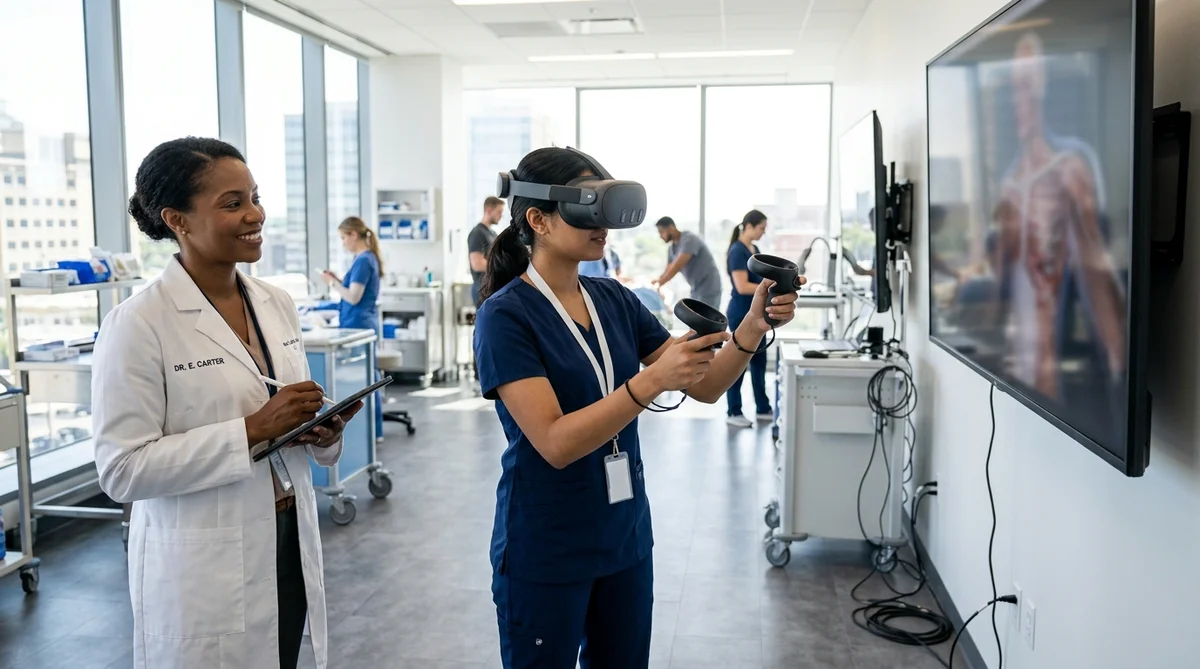
Virtual reality medical simulation is a high-fidelity training methodology that uses immersive technology to replicate clinical environments, allowing practitioners to practice 150+ distinct surgical procedures or diagnostic workflows without patient risk. By 2026, over 45% of teaching hospitals are expected to integrate VR-based curricula to reduce medical errors and improve procedural speed by up to 30%.
The Paradigm Shift: From "See One, Do One" to "Simulate Many"
For decades, the standard for medical education followed the Halstedian model: "See one, do one, teach one." While this apprenticeship model has produced generations of capable physicians, it carries inherent risks in a modern healthcare landscape that demands zero-error tolerance. The introduction of virtual reality medical simulation has fundamentally altered this trajectory. Instead of a student's first experience with a rare complication occurring in a live operating room, they can now encounter that specific scenario hundreds of times in a digital space.
This shift is not merely about technical proficiency; it is about the cognitive load management required during high-stakes interventions. When a resident uses immersive technology, they are not just practicing the mechanics of a suture or the placement of a catheter; they are training their brain to remain calm and analytical under pressure. This is a core tenet of mastering scenario based training, where the environment is designed to challenge the learner's decision-making process as much as their physical dexterity.
How Does Virtual Reality Medical Simulation Improve Patient Outcomes?
The ultimate metric for any medical advancement is patient safety. Research indicates that surgeons who train using virtual reality medical simulation exhibit a 40% increase in procedural accuracy compared to those trained via traditional methods. By providing a sandbox where mistakes do not result in morbidity or mortality, VR allows for the exploration of "what if" scenarios. For instance, if a trainee makes a critical error in a VR simulation, the software can pause, provide immediate feedback, and allow the trainee to rewind and attempt the procedure again. This iterative learning process is vital for building the muscle memory necessary for complex surgeries.
Furthermore, VR simulations contribute to shorter operative times. Because the surgeon has already navigated the specific anatomy—often reconstructed from the actual patient's CT or MRI scans—the actual procedure becomes a execution of a pre-rehearsed plan. This reduction in time spent under anesthesia directly correlates with lower infection rates and faster recovery times for patients.
| Training Method | Realism Level | Risk to Patient | Repeatability | Cost per Session |
|---|---|---|---|---|
| Traditional Lectures | Low | None | High | Low |
| Cadaveric Labs | High | None | Low | Very High |
| Mannequin Sim | Medium | None | Medium | Medium |
| VR Simulation | Very High | None | Infinite | Low (Post-Hardware) |
The Technical Pillars of Immersive Medical Training
Effective virtual reality medical simulation relies on three primary technical pillars: visual fidelity, haptic feedback, and physiological accuracy. Visual fidelity ensures that the digital organs, blood vessels, and tissues look and behave like their biological counterparts. High-resolution textures and realistic lighting are necessary to prevent the "uncanny valley" effect that can distract learners. Platforms like Scenario IQ leverage these immersive elements to create realistic roleplay environments that go beyond just the physical, focusing on the psychological presence of the trainee.
Haptic feedback is perhaps the most critical component for surgical training. It involves the use of specialized controllers or gloves that provide tactile resistance. When a trainee "cuts" through tissue in the simulation, the haptics provide a sense of resistance that varies depending on the density of the tissue. Without this feedback, the simulation remains a visual exercise rather than a physical one. Finally, physiological accuracy ensures that the "virtual patient" responds to interventions in real-time. If a trainee administers the wrong dosage of a virtual drug, the patient's heart rate and blood pressure must reflect that error accurately.
What are the Primary Benefits of VR for Surgical Training?
The benefits of VR in surgery extend across the entire career arc of a physician, from medical school to continuing education for seasoned consultants. Key advantages include:
- Anatomical Variation: Traditional training often relies on standardized models. VR can introduce thousands of anatomical variations, preparing surgeons for the reality that no two patients are identical.
- Objective Assessment: Unlike a human observer, VR software can track every millimeter of movement, the force applied to tissues, and the economy of motion. This provides an unbiased, data-driven assessment of a surgeon's skill.
- Remote Collaboration: Surgeons in different parts of the world can enter the same virtual operating room to collaborate on a complex case, sharing expertise without the need for travel.
- Reduced Costs: While the initial investment in VR hardware is significant, the long-term cost is far lower than maintaining a cadaver lab or a high-end nursing simulation lab equipped with multiple high-fidelity mannequins.
Beyond the Scalpel: Communication and the Virtual Patient Simulation
While surgical precision is vital, a significant portion of medical errors stem from communication failures. This is where virtual patient simulation becomes an essential tool. Training doctors and nurses to deliver bad news, handle an irate family member, or coordinate with a multidisciplinary team is notoriously difficult to standardize. Using AI-driven roleplay, Scenario IQ allows healthcare professionals to practice these high-stakes conversations with AI avatars that respond dynamically to the tone and content of the trainee's speech.
This application is a critical component of healthcare customer service training, ensuring that the patient's emotional journey is managed with as much care as their clinical treatment. By practicing objection handling and empathetic listening in a low-stakes environment, staff can build the confidence needed to maintain professionalism during real-world crises. Scenario IQ provides the adaptive guidance and real-time feedback necessary to turn these interactions into measurable skills rather than just "soft" attributes.
Can Virtual Reality Medical Simulation Replace Traditional Clinical Rotations?
The short answer is no, but it can significantly augment them. The consensus among medical educators is that VR should serve as a bridge between the classroom and the clinic. Traditional rotations are limited by the patients who happen to be in the hospital at that time. A student might spend a month in neurology and never see a specific type of rare stroke. Virtual reality medical simulation ensures that every student graduates with exposure to a core set of mandatory clinical scenarios, regardless of the hospital's current patient load.
Moreover, VR allows for "pre-loading" knowledge. A student can spend hours in a virtual environment mastering the steps of an appendectomy so that when they finally step into a real operating room, they aren't trying to remember where to stand or what instrument comes next. They are free to observe the nuances of the lead surgeon's technique and the dynamics of the surgical team. This hybrid approach maximizes the value of the limited time spent in actual clinical settings.
Evaluating Training ROI: The Kirkpatrick Model and Beyond
To justify the investment in virtual reality medical simulation, institutions must measure its effectiveness. Many healthcare organizations utilize the Kirkpatrick Model of training evaluation to track success across four levels: Reaction, Learning, Behavior, and Results. At the "Results" level, hospitals look for a decrease in surgical site infections, a reduction in the use of disposable supplies during training, and an overall improvement in patient satisfaction scores.
Scenario IQ assists in this evaluation process by providing performance metric dashboards that track progress over time. By analyzing data from thousands of simulations, administrators can identify specific areas where a cohort might be struggling—such as post-operative handoffs or specific diagnostic steps—and adjust the curriculum accordingly. This data-driven approach ensures that the training is not just high-tech, but high-impact.
Overcoming Implementation Hurdles in Healthcare Institutions
Despite the clear advantages, integrating virtual reality medical simulation into a legacy healthcare system is not without challenges. The primary hurdles include technical friction, faculty buy-in, and curriculum integration. Technical friction involves the logistics of maintaining headsets, ensuring software is updated, and providing enough physical space for trainees to move safely. Faculty buy-in is equally important; veteran clinicians must see the VR tool as a valuable asset rather than a gimmick that replaces their mentorship.
To overcome these obstacles, institutions should start with a pilot program targeting a specific department, such as emergency medicine or orthopedics. By demonstrating clear wins—such as reduced orientation time for new residents—the program can gain the political and financial capital needed for a hospital-wide rollout. It is also essential to ensure that the VR content is aligned with national standards and certifications to ensure that the time spent in simulation counts toward professional development requirements.
The Future of AI-Driven Clinical Competency
As we look toward the next decade, the convergence of AI and VR will create even more sophisticated training environments. We are moving toward a future where virtual patient simulation will be indistinguishable from real-life interactions. AI will not only control the dialogue of virtual patients but will also adjust the difficulty of a surgical procedure in real-time based on the trainee's heart rate and stress levels, as detected by the VR headset's sensors.
Scenario IQ is at the forefront of this evolution, developing adaptive guidance systems that act as a virtual mentor, whispering suggestions or providing haptic prompts when a student falters. This level of personalized, scalable training was once a dream of science fiction, but it is now a foundational component of modern medical education. As these technologies become more accessible, the gap between theoretical knowledge and clinical mastery will continue to shrink, leading to a safer, more efficient healthcare system for everyone.
FAQ
How much does it cost to implement virtual reality medical simulation? The cost varies significantly based on scale, ranging from $5,000 for a single-user setup to over $500,000 for a dedicated hospital-wide simulation center. Long-term ROI is achieved through reduced training time and lower medical error rates.
Is VR training as effective as practicing on cadavers? While cadavers provide unmatched anatomical realism, VR offers the benefit of infinite repeatability and the ability to simulate physiological responses like bleeding or cardiac arrest, which cadavers cannot. Most top-tier programs use a combination of both.
Can VR simulation help with nursing shortages? Yes, VR can accelerate the onboarding of new nurses by allowing them to practice high-frequency tasks and emergency protocols in a compressed timeframe, helping them reach clinical competency faster than traditional shadowing alone.
Does virtual reality cause motion sickness in medical trainees? Modern VR headsets with high refresh rates and low latency have significantly reduced "sim sickness." Most users acclimate within a few sessions, and specialized medical software is designed to minimize rapid artificial movements that trigger nausea.
Is the data from VR simulations secure and HIPAA-compliant? Leading platforms prioritize enterprise-grade security and ensure that any data collected on trainee performance is handled according to healthcare privacy standards, often anonymizing data used for institutional research.
To see how AI-driven roleplay can transform your team's communication and clinical readiness, explore the adaptive training solutions offered by Scenario IQ. Our platform bridges the gap between technical skill and human interaction, ensuring your healthcare professionals are prepared for every scenario they will face in the field.