

Most organizations don’t lack manager effort, they lack manager practice. New managers are often taught to “check the boxes” (listen to calls, review tickets, audit pipelines), then wonder why performance plateaus. Inspection can enforce compliance, but it rarely builds capability.
If you want managers who develop people, handle real objections in the moment, and lift sales and service results, the best training approach is simple: teach a clear coaching standard, then build coaching reps through realistic scenarios with fast feedback and measurable progress.
Why traditional manager training produces inspectors
Many leadership programs are heavy on concepts and light on behavior change. Managers leave with frameworks, but go back to the same environment that rewards:
- Activity metrics (calls made, tickets closed, meetings held)
- “Gotcha” quality audits
- One-way feedback (“Here’s what you did wrong”)
- Inconsistent shadowing (dependent on who is available and what happens that day)
That set-up nudges managers toward inspection because it is the fastest way to look in control.
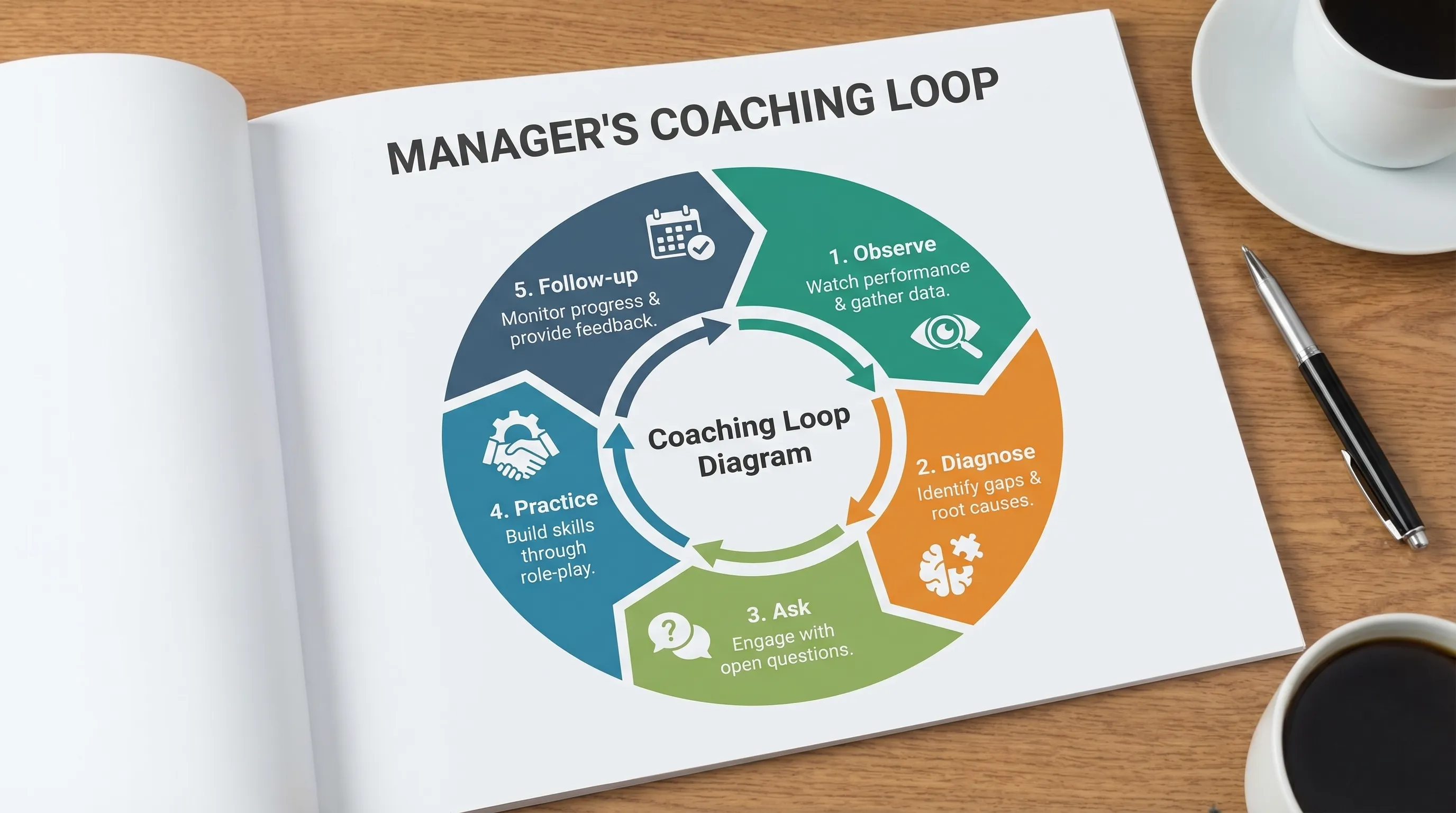
But coaching is a different job. Coaching requires diagnosing what’s driving performance, guiding the rep to think, practicing alternatives, and following up.
Gallup has long emphasized how much managers matter, including its finding that managers account for a large share of the variance in team engagement (often cited as “up to 70%”). That’s why coaching skill is not a “nice to have”, it is a leverage point. See: Gallup, It’s the Manager.
What “coach, not inspect” actually means (in behaviors)
To train coaching, you need an observable standard. Here’s a practical definition:
Inspection = evaluating past behavior against a checklist.
Coaching = improving future behavior through diagnosis, guided practice, and accountability.
A useful way to make this real is to map the behaviors side-by-side.
| Moment | Inspector behavior | Coach behavior |
|---|---|---|
| Reviewing a call or ticket | Scores and corrects | Identifies one leverage skill, asks what the rep noticed, chooses a practice target |
| Handling mistakes | Focuses on compliance and blame | Frames it as a skill gap, isolates the moment that mattered, practices a better option |
| Objections | Provides a script | Builds a decision tree, practices variations, checks for understanding |
| 1:1s | Status updates | Skill-building plan (one priority), commitment, follow-up date |
| Performance dips | Pressure and policing | Diagnoses (skill vs will vs process), removes blockers, creates reps and reinforcement |
When managers can reliably do the “coach” column under time pressure, performance changes.
The best way to train managers: scenario-based coaching practice with tight feedback loops
The most reliable method for behavior change is deliberate practice, which focuses on repeated reps, targeted feedback, and progressively harder difficulty. (For background on deliberate practice, see Harvard Business Review and the research it summarizes.)
That maps perfectly to manager coaching:
- Managers must practice conversations, not just learn concepts
- They need feedback on specific micro-skills (question quality, diagnosis, reinforcement)
- They need repetition across contexts (new hires, top performers, objection handling, policy constraints)
A scenario-based approach creates a safe, controlled environment where managers can build coaching instincts before they’re in a live 1:1.
What high-impact coaching scenarios look like
The best scenarios are not generic. They reflect the real moments that create outcomes in your business.
Examples:
- A sales rep is discounting early and says “If I don’t cut price, I lose deals”
- A customer service rep follows policy but escalations are rising because customers feel dismissed
- A top performer resists coaching (“I’m hitting quota, why change?”)
- A new hire is overwhelmed and starts skipping discovery steps
- A rep is “busy” but activity is misaligned with pipeline stage
In each scenario, the manager’s job is to:
- Diagnose what’s happening (skill, confidence, clarity, process)
- Use questions that lead the rep to insight
- Practice one improved behavior (a redo, not a lecture)
- Set a specific follow-up (what will be measured, by when)
A practical coaching curriculum for managers (that actually sticks)
You do not need a massive program. You need a tight system that creates repetition.
1) Define a coaching standard with a small set of teachable behaviors
Keep it simple enough to observe and measure. For example:
- Ask at least two high-quality questions before advising
- Identify one skill priority per session
- Run a short practice rep (roleplay) in every coaching conversation
- Agree on one next action and a check-in point
This becomes your calibration tool across managers.
2) Build a scenario library that matches real revenue and service drivers
A scenario library should cover:
- The most common objections
- The highest-impact moments in your sales or service process
- The highest-risk behaviors (discounting, weak discovery, poor de-escalation)
- Different skill levels (new manager, experienced manager, senior leader)
If you want transfer to the job, scenarios must use your language (product terms, policy constraints, customer types).
3) Train with fast feedback, not delayed scoring
Coaching skill improves fastest when feedback is:
- Immediate (right after the rep)
- Specific (one or two behaviors, not a general critique)
- Comparable (the same standard for every manager)
This is also where many programs fail. They measure outcomes (quota, CSAT) but don’t measure coaching behaviors consistently.
4) Track progress as a capability, not just an outcome
Outcomes lag. Skills lead.
Track leading indicators like:
- Frequency of coaching reps per week
- Quality of questions (open, diagnostic, forward-looking)
- Consistency of follow-up
- Scenario coverage (how many scenarios practiced, at what level)
Then connect them to outcomes (win rate, ramp time, QA, escalations).
A simple 30-day plan to shift managers from inspection to coaching
This is a lightweight plan that works well for sales and customer service leaders.
| Week | Focus | What managers do | What you measure |
|---|---|---|---|
| 1 | Coaching baseline | Learn the coaching standard, record a baseline coaching conversation, practice 3 core scenarios | Baseline rubric score, scenario completion |
| 2 | Diagnosis and questions | Practice “ask before advise” scenarios, focus on identifying root cause | Question quality score, clarity of coaching plan |
| 3 | Practice reps (roleplay) | Run redo reps (manager coaches rep through a replay), increase scenario difficulty | Number of practice reps, behavior change commitment |
| 4 | Follow-up and accountability | Follow up on commitments, coach resistance, coach high performers | Follow-up rate, performance movement on chosen KPI |
The hidden win: this plan changes what “good management” looks like day-to-day.
Why AI roleplay training is the multiplier (especially at scale)
Scenario-based training works, but traditional roleplay has constraints:
- It is hard to schedule
- It is inconsistent across facilitators
- Some managers avoid it (fear of looking bad)
- Feedback quality varies widely
AI-driven roleplay addresses those constraints by making practice available on demand and more consistent.
With an AI training platform like Scenario IQ, organizations can run AI-powered roleplay simulations that adapt to the manager, deliver real-time feedback, and provide progress tracking analytics across individuals and teams. That combination matters because it turns coaching from an occasional workshop into a weekly habit.
What to look for in AI roleplay for manager coaching:
- Personalised training scenarios aligned to your coaching standard
- Adaptive feedback and guidance that targets the manager’s weakest micro-skill
- Team-focused learning so coaching expectations stay consistent across regions
- Actionable analytics so enablement leaders can see adoption and improvement
- Enterprise-grade security for confidence in data handling
How to tell if your manager coaching training is working
Don’t rely on vibes. Use a balanced scorecard of capability and outcomes.
| Category | Metric | What “good” looks like |
|---|---|---|
| Coaching activity | Coaching reps per manager per week | Stable cadence (for example, 3 to 5 short reps) |
| Coaching quality | Rubric score (questions, diagnosis, practice, follow-up) | Upward trend over 4 to 8 weeks |
| Skill transfer | Rep behavior change on targeted skill | Measurable shift (ex: more discovery questions, fewer early discounts) |
| Business outcomes | Win rate, ramp time, CSAT, QA, escalations | Improvement that follows capability gains |
If activity is high but outcomes do not move, the coaching standard is likely unclear or practice is not targeting real constraints.
Common pitfalls (and how to avoid them)
Mistaking more inspection for better management. If managers are drowning in audits, they won’t coach. Protect time for short coaching reps.
Training managers on scripts instead of thinking. Scripts break under pressure. Train diagnosis and decision-making through varied scenarios.
One-and-done workshops. Coaching is a performance skill. If there are no weekly reps, skills decay.
No calibration across managers. Without a shared rubric, coaching becomes subjective. Define behaviors and measure consistently.
Only measuring lagging outcomes. Revenue and CSAT matter, but they are downstream. Measure coaching behaviors and skill adoption.
Frequently Asked Questions
What’s the difference between coaching and inspecting? Inspecting evaluates past actions against a checklist. Coaching improves future performance through diagnosis, practice, and follow-up.
How do you train managers to coach if they don’t have time? Use short, repeatable scenario reps (5 to 10 minutes) that target one micro-skill and build a weekly cadence instead of occasional long sessions.
What should managers coach first in sales or customer service? Start with the highest-leverage behaviors in your process (for example, discovery quality in sales, de-escalation and empathy in service), then build scenarios around them.
How do you measure coaching quality without being subjective? Create a simple rubric with observable behaviors (question quality, diagnosis clarity, practice rep included, follow-up agreed) and score consistently across managers.
Can AI roleplay really help managers become better coaches? Yes, when it provides realistic scenarios, immediate targeted feedback, and analytics that reinforce a consistent coaching standard across the organization.
Build coaching managers with Scenario IQ
If you want managers who coach consistently (not just inspect), make practice unavoidable and feedback immediate.
Scenario IQ helps teams do that with AI-driven, personalised scenario-based training, including AI-powered roleplay simulations, real-time feedback, and progress tracking analytics.
Explore Scenario IQ and see how AI roleplay can fit your coaching system: https://scenarioiq.ai