

Service recovery is where customer relationships are either repaired or permanently lost. When someone is angry, they are not only upset about the problem, they are reacting to the feeling of being ignored, blamed, or forced to do extra work to get what they paid for.
That is why service recovery roleplay is one of the highest leverage training methods for customer support and service teams. It turns stressful, high-stakes moments into repeatable skills: de-escalation, ownership, clear next steps, and confident resolution.
What “service recovery” actually means (and what it is not)
Service recovery is the structured response to a service failure: a late delivery, a billing mistake, a broken product, a system outage, a missed appointment, or a policy friction that surprises the customer.
It is not:
- “Being nice” while doing nothing
- Over-apologizing without taking ownership
- Hiding behind policy language
- Rushing to a refund before understanding the real need
Great recovery is a combination of emotion management (lowering the heat) and problem management (fixing the issue with minimal customer effort).
Why roleplay works for angry-customer situations
Angry-customer conversations are hard to train with quizzes or slide decks because performance depends on real-time behaviors:
- Tone, pacing, and phrasing under pressure
- Listening for the real issue beneath the complaint
- Knowing when to explain, when to ask, and when to act
- Handling policy constraints without sounding powerless
Roleplay creates “safe reps” so agents can practice the hardest parts without risking real accounts.
AI roleplay can make this even more scalable by simulating realistic pushback, adapting difficulty levels, and giving consistent feedback across a team.
The emotional mechanics of an angry customer
In recovery conversations, customers commonly seek four things:
- Recognition: “You see what happened and why it matters.”
- Fairness: “This outcome makes sense given the inconvenience.”
- Control: “I know what happens next and I have options.”
- Effort reduction: “You are doing the work, not me.”
Your roleplay scenarios should deliberately pressure-test each one. For example, a customer who feels out of control will keep escalating until the agent gives a clear plan, timeframe, and ownership.
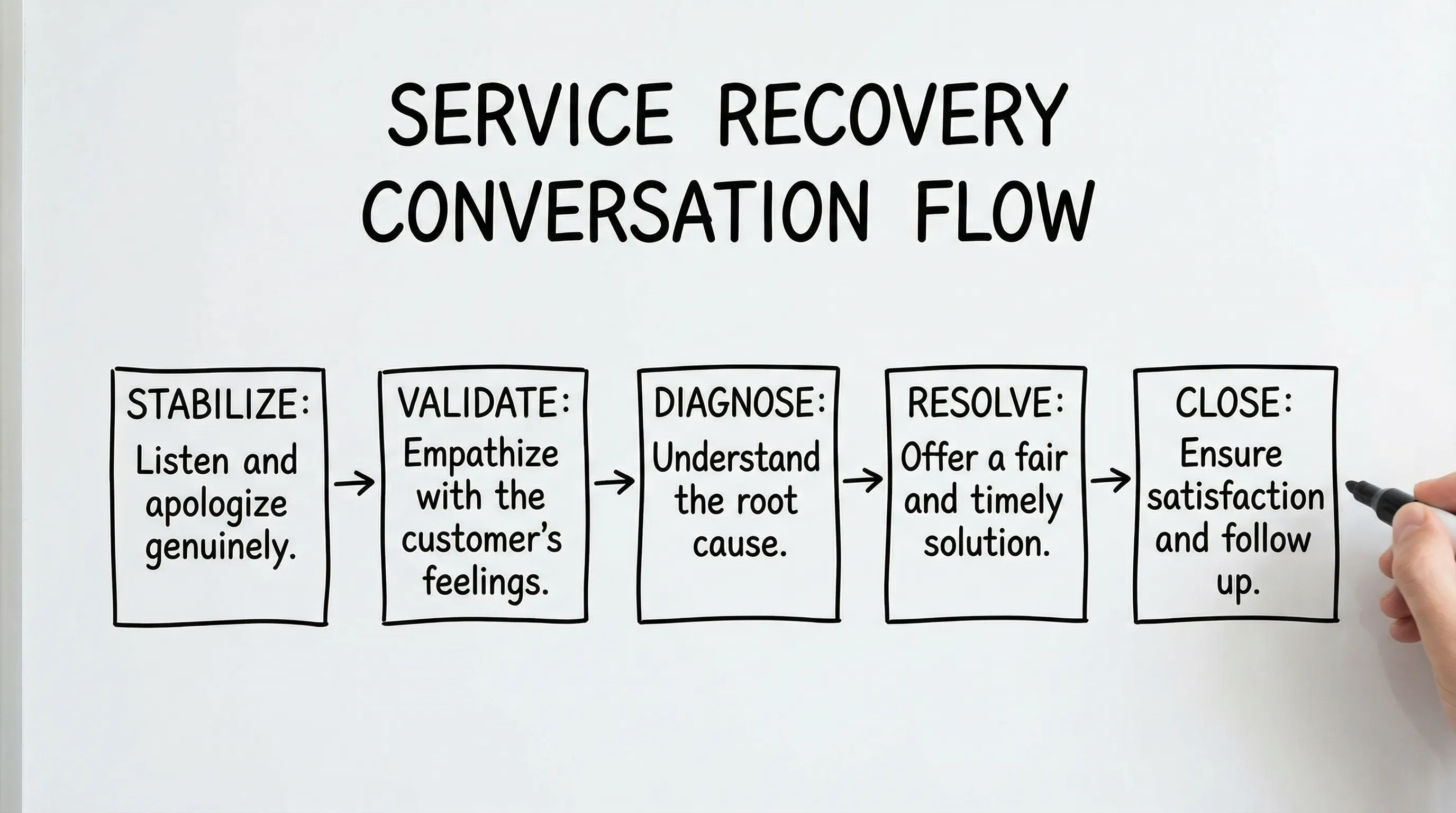
A simple service recovery framework to train (and measure)
Most teams struggle because they train “be empathetic” as a vague instruction. Instead, train a concrete sequence that can be coached and scored.
Step 1: Stabilize the moment
Goal: reduce intensity before attempting detailed troubleshooting.
Agent behaviors to practice:
- Lower your pace, keep your voice steady
- Use short, clear sentences
- Avoid “calm down” or “there’s nothing I can do”
Example lines:
- “I hear how frustrating this has been. I’m going to take ownership of getting this sorted.”
- “Thank you for explaining that. Let’s fix it step by step.”
Step 2: Validate and align
Validation is not admitting fault blindly. It is confirming the customer’s experience.
Example lines:
- “If I were charged twice, I’d be upset too. You’re right to flag this.”
- “You expected this to be resolved on the first call. That’s reasonable.”
Step 3: Diagnose with purpose
Good diagnosis questions are tight and confidence-building. Bad questions feel like interrogation.
Use:
- “Just to confirm…”
- “So I don’t waste your time…”
- “The fastest way to fix this is…”
Example lines:
- “So I don’t waste your time, can I confirm the email on the account and the date of the charge?”
- “Which outcome would you prefer: a replacement shipped today, or a refund processed now?”
Step 4: Resolve and document next steps
Resolution needs three elements:
- What will happen
- When it will happen
- Who owns it
Example lines:
- “Here’s what I’m going to do: I’ll reverse the duplicate charge today. You’ll see the pending reversal within 24 hours, and the funds typically settle within 3 to 5 business days. I’ll email you confirmation in the next 10 minutes.”
Step 5: Close with confidence (not defensiveness)
A strong close prevents re-contact and restores trust.
Example lines:
- “Before we end, is there anything else related to this issue that I can fix right now?”
- “If anything looks off, reply to my email and it comes straight back to me.”
Service recovery roleplay scenarios your team should practice
The biggest mistake in roleplay design is making scenarios too easy. Real customers interrupt, jump around, add new information late, and react strongly to policy boundaries.
Use scenarios that include:
- An emotional driver (angry, anxious, betrayed, embarrassed)
- A constraint (policy limit, inventory shortage, SLA, compliance)
- A success definition (what “good” looks like)
Here is a scenario bank you can reuse across phone, chat, and in-person teams.
| Scenario | What the customer says (starting point) | Hidden driver | What success looks like | Common failure mode |
|---|---|---|---|---|
| Duplicate charge | “You charged me twice. Fix it now.” | Fear of being taken advantage of | Ownership, clear reversal timeline, confirmation | Over-explaining payment systems, no timeline |
| Late delivery for an event | “It was supposed to arrive yesterday. It’s useless now.” | Time pressure, embarrassment | Acknowledge impact, offer realistic options, fair remedy | Deflecting to carrier, minimizing impact |
| Product defect after light use | “This broke in a week. Your quality is terrible.” | Betrayal, regret | Replace or refund with minimal effort, restore confidence | Arguing about usage, blaming customer |
| Outage impacting work | “Your platform is down and I’m losing money.” | Loss of control, urgency | Clear incident status, workaround, next update time | Vague statements, no update cadence |
| Policy conflict | “Your policy is ridiculous. I want an exception.” | Need to be treated fairly | Empathize, explain the why, offer best available path | Hiding behind policy, sounding powerless |
| Repeat contact | “This is my third time calling. No one helps.” | Feeling ignored | Apology plus accountability, one-thread ownership | Treating it like a fresh case, no recap |
A coaching scorecard that makes roleplay measurable
If you cannot score it, you cannot improve it. A scorecard also keeps coaching consistent across team leads.
Use a rubric like this during roleplay (human-led or AI-scored), and track improvement over time.
| Competency | What “good” sounds like | Simple scoring guide |
|---|---|---|
| De-escalation | Calm pace, no defensiveness, acknowledges emotion | 1: escalates, 3: neutral, 5: noticeably calms customer |
| Ownership | Clear “I will” statements and next steps | 1: passes off, 3: partial, 5: full ownership |
| Discovery | Focused questions that reduce effort | 1: scattered, 3: adequate, 5: efficient and clear |
| Resolution clarity | What, when, who is explicit | 1: vague, 3: mostly clear, 5: unmistakable |
| Policy navigation | Explains constraints without hiding behind them | 1: rigid, 3: mixed, 5: firm and helpful |
| Close and prevention | Confirms outcome, prevents repeat contact | 1: abrupt, 3: okay, 5: confidence plus safety net |
The “language swaps” that instantly improve recovery conversations
Small phrasing changes can reduce friction dramatically. Train these as explicit swaps in roleplay.
- Replace “That’s our policy” with “Here’s what I can do today, and here’s what I cannot do, so you can choose the best option.”
- Replace “You need to…” with “The fastest way to fix this is…”
- Replace “I’m sorry you feel that way” with “I’m sorry this happened. I can see why it’s frustrating.”
- Replace “There’s nothing I can do” with “I cannot do X, but I can do Y right now.”
How to run service recovery roleplay sessions that actually change behavior
Most roleplay fails because it is either too performative or too infrequent. The goal is not acting, it is building reflexes.
Keep sessions short and frequent
Aim for 10 to 20 minutes per rep. Frequency beats marathon training.
Use tight briefs, not scripts
Give the agent a goal and constraints, then let them choose language. Over-scripted roleplay creates “training voice” that disappears under real stress.
Debrief with evidence
After each rep, review:
- The exact moment the customer calmed down or escalated
- Whether the agent offered a clear plan with timelines
- Which phrase caused friction
Calibrate across leaders
Two supervisors scoring differently will confuse your team. Run occasional calibration sessions using the same scenario and scorecard.

Using AI roleplay training to scale service recovery practice
Live roleplays require manager time, consistent acting, and careful coaching. That is hard to scale, especially across shifts and locations.
An AI training platform can help teams practice service recovery more often by:
- Simulating difficult customer emotions consistently
- Adjusting difficulty based on skill level
- Providing real-time feedback on empathy, clarity, and resolution steps
- Tracking progress across individuals and teams
Scenario IQ is designed for this kind of scenario-based practice, offering AI-powered roleplay simulations, personalized training scenarios, real-time feedback, and progress tracking analytics for team learning. If you want to explore what AI-driven practice could look like for your service organization, you can review the platform at Scenario IQ.
What to track after you start service recovery roleplay
To prove impact, pair training metrics with operational metrics.
Training metrics that show skill growth:
- De-escalation score trend (from your rubric)
- Time to reach a clear resolution plan (in roleplay)
- Percentage of reps with explicit “what, when, who” resolution language
- Reduction in coaching notes for defensiveness or policy conflict
Operational metrics that reflect customer outcomes:
- Repeat contact rate for the same issue
- Escalation rate to supervisors
- First-contact resolution (where it is meaningful for your context)
- Customer sentiment tags in QA reviews
- Refund or concession rates (to ensure you are not “buying peace” unnecessarily)
The key is balance: better recovery should reduce escalations and repeat contacts while keeping remedies consistent and fair.
Make “angry customer” a trained scenario, not a surprise
Service recovery is not a personality trait. It is a set of behaviors that can be practiced, coached, and improved like any other professional skill.
When you build a repeatable roleplay program with realistic scenarios, clear scoring, and consistent debriefs, your team stops fearing angry customers. They start guiding conversations confidently, resolving issues faster, and turning high-friction moments into trust-building ones.
If you are building a modern training approach, AI roleplay can help you deliver more reps per agent, more consistency in coaching, and clearer analytics across your service team. Learn more about scenario-based training at Scenario IQ.