

Sales roleplay works when reps feel safe to try, fail, and improve. But in many teams, roleplay becomes a “gotcha” exercise: the manager has a mental checklist, the rep doesn’t know what matters, and feedback feels subjective. That is exactly where scorecards for sales roleplay earn their keep.
A well-built scorecard turns coaching into a shared language. It clarifies what “good” looks like, makes progress measurable, and helps reps trust the process because outcomes are tied to observable behaviors, not opinions.
What a sales roleplay scorecard actually is (and what it is not)
A sales roleplay scorecard is a simple rubric used to evaluate performance in a simulated sales conversation. It typically includes:
- The skills being assessed (for example: discovery, objection handling, next steps)
- Behavior-based criteria for each skill
- A consistent rating scale with clear anchors
- Notes on evidence (what was said or done)
- A coaching action (what to practice next)
It is not a tool to “grade” someone’s talent. If reps believe the scorecard is primarily about judgment or punishment, trust collapses and roleplay quality drops.
Why reps don’t trust roleplay scoring (even when managers mean well)
In most orgs, distrust is not about bad intent. It comes from predictable breakdowns:
Subjective scoring
If one manager values “rapport” and another values “agenda control,” reps get mixed signals. They stop believing scores reflect real performance.
Vague criteria
“Be consultative” or “handle objections well” is not coachable. Vague categories feel like opinions, and opinions feel unfair.
Hidden standards
If the rep only discovers the standard after they fail, roleplay feels like a test, not training.
No calibration
Even a strong scorecard fails if evaluators don’t align on what a 3 versus a 5 looks like.
Misuse of scores
If roleplay scores get used as performance management without context, reps will perform for the score instead of practicing the skill.
The trust-first principles of a great scorecard
Before you write a single criterion, align on principles that protect trust.
1) Behavioral, not personality-based
Score what the rep did or said.
- Better: “Confirmed decision process and stakeholders.”
- Risky: “Confident presence.”
2) Transparent and shared upfront
Reps should see the scorecard before they roleplay. Surprise standards create defensiveness.
3) Relevant to the real sales motion
A generic rubric does not build trust. The scorecard should mirror how your team actually sells: your discovery flow, your qualification method, your ICP, your common objections.
4) Consistent across managers
If scoring changes depending on who’s watching, the tool becomes political.
5) Designed for coaching, not compliance
Every section should translate into a practice plan: “Do more of X, change Y, try Z next time.”
How to build a sales roleplay scorecard reps will trust
This is a practical build process you can run in a week, then refine.
Step 1: Pick the roleplay type and define “win conditions”
Start with one roleplay scenario type, not “all sales calls.” Examples:
- First meeting discovery call
- Pricing pushback
- Competitor comparison
- Renewal risk or escalation
Then define the outcome in plain language.
For example: “By the end of this roleplay, the rep earns agreement on the next step and confirms the customer’s problem, impact, and decision path.”
When reps agree the outcome matches reality, scoring feels fair.
Step 2: Choose 5 to 8 competencies max
Scorecards fail when they try to measure everything. Keep it focused.
Common, high-signal competencies for sales roleplay include:
- Opening and agenda setting
- Discovery quality
- Qualification (fit and urgency)
- Value articulation
- Objection handling
- Conversation control (structure, clarity)
- Next steps and close
- Professionalism and tone (only if behavior-based)
If you need more, create multiple scorecards by call type instead of stuffing one rubric.
Step 3: Write observable criteria for each competency
This is where trust is won.
For each competency, write 2 to 4 behaviors that can be verified from the conversation. Use verbs and evidence.
Examples:
- “Asks at least two impact questions tied to the customer’s role.”
- “Summarizes the customer’s problem in the customer’s words and asks for confirmation.”
- “Handles pricing pushback by exploring constraints before offering concessions.”
Avoid criteria that rely on mind-reading:
- “Seemed genuinely curious.”
- “Built strong rapport.”
You can still coach those elements, but they do not belong in the scored portion unless you can translate them into visible behaviors.
Step 4: Use a 4- or 5-point scale with anchors
A scale is only trustworthy when people know what each number means.
A practical approach is a 1 to 4 scale:
- 1 (Missing): Behavior not demonstrated.
- 2 (Developing): Attempted, but incomplete or inconsistent.
- 3 (Meets): Solid, consistent execution.
- 4 (Excellent): High-quality execution that improves the outcome.
Why not 1 to 10? Because wider scales create false precision and invite debate.
Step 5: Add an “evidence” line under every score
Reps trust scoring when they can see the receipts.
For each competency, require a short note:
- Exact phrase used
- Question asked
- Customer reaction
- Moment where control was lost
This shifts feedback from “I felt like…” to “At 02:10, you said…, and the customer responded…”
Step 6: Build in self-scoring to reduce defensiveness
If the rep scores themselves first, two good things happen:
- You learn how they perceive the call.
- Coaching becomes a comparison of perspectives, not a top-down judgment.
A simple workflow is:
- Rep completes self-score and highlights one moment they would redo.
- Coach scores independently.
- Discuss gaps, then agree on one practice target.
Step 7: Calibrate with other managers (mandatory)
Calibration is where fairness is created.
Run a short session:
- Everyone scores the same recorded roleplay (or the same written transcript).
- Compare scores.
- Debate only using the criteria and anchors.
- Rewrite criteria that produce wide variance.
Do this quarterly or whenever you change the scorecard.
Step 8: Pilot, then iterate based on rep feedback
Trust increases when reps see their input shape the tool.
Pilot for two weeks with one team. Ask:
- Which criteria felt unclear?
- Where did scoring feel subjective?
- Which category best predicted whether the roleplay “worked?”
Then tighten the rubric.
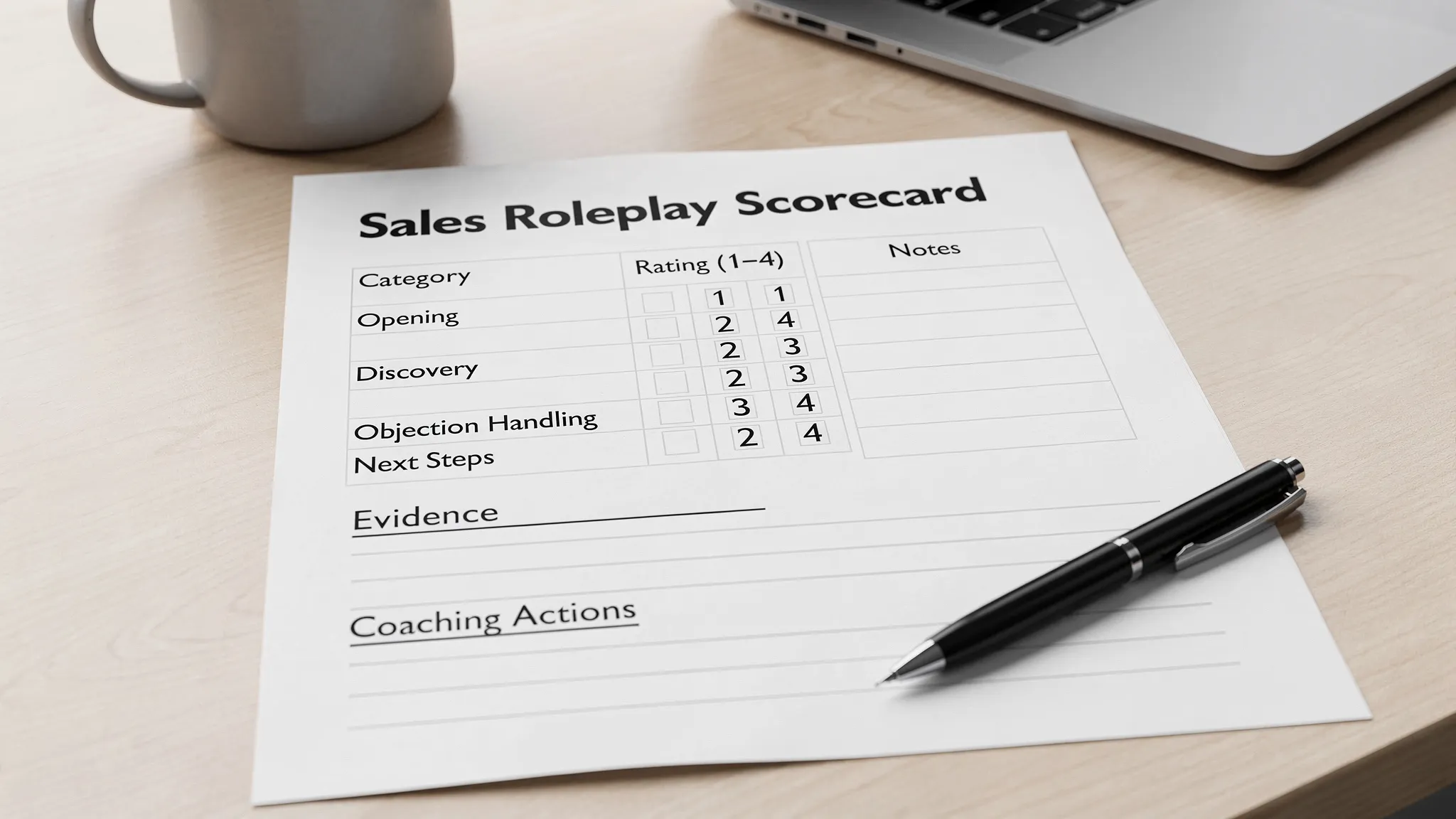
A practical scorecard template (example)
Below is an example rubric for a discovery call roleplay. Adjust it to match your sales process, ICP, and messaging.
| Competency | What “Meets” looks like (score = 3) | What “Excellent” looks like (score = 4) | Evidence to capture |
|---|---|---|---|
| Opening and agenda | Sets purpose, confirms time, and asks permission to proceed with an agenda | Tailors agenda to the customer’s stated goals and earns explicit buy-in | Exact agenda statement and customer response |
| Discovery depth | Asks open questions that uncover current state and problems | Connects problems to impact, priorities, and constraints with follow-ups | 2 to 3 best questions asked |
| Qualification | Confirms key elements (need, stakeholders, timing, constraints) relevant to your process | Identifies disqualifiers early and adjusts path accordingly | What was confirmed and what remains unknown |
| Value articulation | Links product value to stated pains without pitching too early | Quantifies or sharpens impact using customer language and examples | The value statement used |
| Objection handling | Clarifies the objection before responding, then addresses with a relevant approach | Uses objection to deepen discovery and move the deal forward | The objection, rep’s response, customer reaction |
| Next steps | Proposes a clear next step with date, purpose, and mutual commitments | Aligns next step to decision process and reduces friction (materials, attendees) | Next step language and commitments |
To keep trust high, add a final field that is not scored:
- Coach notes (not scored): One strength to repeat, one change for next time, one practice drill.
How to use scorecards during roleplay (without killing confidence)
Scorecards should structure coaching, not interrupt learning.
Score after the roleplay, not during (most of the time)
If you score live, reps feel watched. A better pattern is:
- Run the roleplay uninterrupted.
- Let the rep reflect for 60 seconds.
- Score and discuss using evidence.
Focus on one improvement target per session
A scorecard can surface 10 issues. Trust is built by choosing one and helping the rep win quickly.
Keep a consistent practice loop
Reps trust systems that create visible progress:
- Roleplay
- Score with evidence
- Choose one target
- Practice the specific moment again
- Re-score that moment
Common mistakes that make scorecards feel unfair
Overweighting “style”
If the rep hits the right behaviors but gets scored down for personality differences, the process feels biased. Keep criteria behavior-based.
Scoring too many items
When everything is scored, nothing is learned. Slim the rubric.
Treating roleplay like a performance review
If a roleplay score becomes a label, reps stop experimenting. Position it as practice data.
No link to the field
Trust increases when roleplay criteria match what actually wins deals. Bring in examples from real calls, win-loss notes, and frontline manager input.
Where AI roleplay fits: making scoring more consistent and actionable
One reason teams struggle with scorecards is operational: managers do not have time to run enough repetitions and track progress across a team.
An AI training platform can help by making practice more frequent and feedback more immediate. Scenario IQ, for example, provides AI-powered roleplay simulations, real-time feedback, and progress tracking analytics that can support a scorecard-driven coaching culture.
A practical way to combine them is:
- Use your scorecard as the “definition of done” for a specific scenario (for example: pricing pushback).
- Have reps practice that scenario repeatedly in a consistent environment.
- Review progress trends over time using analytics, then coach the lowest-scoring competency with targeted drills.
Important: the trust lever is still the same. Be transparent about what is measured, how it is used, and how reps will benefit.

A simple rollout plan that earns buy-in
If you are introducing scorecards to a team that has “roleplay trauma,” treat rollout as change management.
Start with a rep advisory group
Invite a few respected reps to help define competencies and anchors. When peers help build the system, it gains legitimacy.
Separate practice from compensation
If you eventually want to connect coaching metrics to performance management, start by keeping roleplay scoring purely developmental. Announce that boundary clearly.
Publish examples of each score level
Share short clips or transcripts that show what a 2, 3, and 4 look like for one competency. This reduces anxiety and debate.
Measure what you want more of
If you want better discovery, score discovery. If you want cleaner next steps, score next steps. Do not score “confidence” and hope it improves.
What good looks like: the “trust test” for your scorecard
Before you finalize your scorecard, run this quick test:
- Could two different managers score the same roleplay within one point of each other?
- Can a rep improve a score by changing specific words or actions?
- Does every category tie to real outcomes in your sales motion?
- Does the scorecard produce one clear practice action, not just a rating?
If the answer is yes, your scorecard will not just measure roleplay, it will make roleplay worth doing.
When reps trust the scoring, they practice more honestly, take more risks, and improve faster. And that is the whole point.