

Objection handling is one of the few sales skills where the fastest path to improvement is not “more theory,” it is repetition under realistic pressure. The challenge is that most teams practice objections too loosely: the rep already knows what’s coming, the manager interrupts to coach, and nobody tracks whether the response actually moved the deal forward.
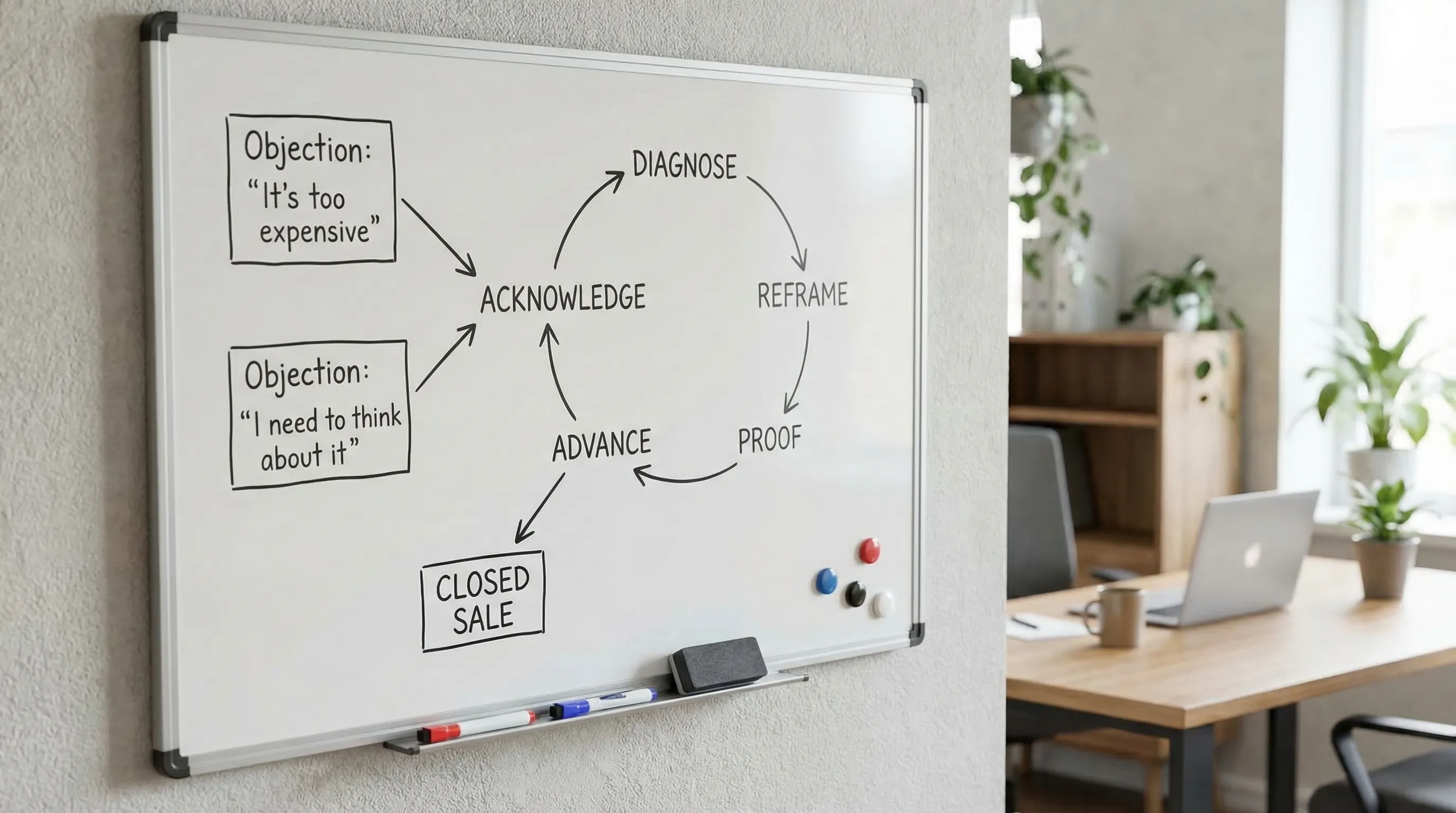
Sales roleplay scripts solve that, but only when they’re written to force the right behaviors quickly: acknowledge, diagnose, reframe, confirm, and advance. Below is a practical script library and a simple way to run drills that build speed and confidence without turning roleplay into awkward theater.
What makes an objection-handling roleplay script work (and train fast)
A script is useful when it produces a repeatable “micro-win” in under 60 to 90 seconds. In practice, that means the rep can:
- Lower tension (so the buyer keeps talking)
- Uncover the real objection (instead of arguing with the surface statement)
- Make one relevant, concrete pivot (value, risk reduction, proof, next step)
- Ask for a commitment that matches the stage (not always “close now”)
This aligns with what performance researchers call deliberate practice: targeted repetitions with immediate feedback, not vague “practice makes perfect.” (See Ericsson’s foundational work on deliberate practice in expert performance: https://doi.org/10.1037/0033-295X.100.3.363)
The 20-minute drill that improves objection handling quickly
If you want speed, keep practice short and highly constrained.
Set the rules (so reps don’t ramble)
Use one objection at a time. Each rep gets two attempts.
- Attempt 1: “First response only” (max 20 seconds)
- Attempt 2: Full loop (max 75 seconds) ending in a next step
The key constraint: no feature dumping. If the rep cannot ask at least one clarifying question, they do not understand the objection.
Score it with a simple rubric
Track improvement across reps and over time. Here’s a lightweight rubric you can use in a spreadsheet or in an AI training platform that supports analytics.
| Skill element | What “good” sounds like | Common fail |
|---|---|---|
| Acknowledge | Validates concern without agreeing to the conclusion | Defensive tone or instant rebuttal |
| Diagnose | Asks a clear question to find the real blocker | Assumes the meaning of the objection |
| Reframe | Links to a buyer outcome (time, risk, revenue) | Talks about features or company history |
| Proof | Offers one crisp example, metric, or customer story | Overpromises or makes unverifiable claims |
| Advance | Asks for a specific next step | “Let me know” ending |
Use roleplay the way buyers actually talk
Buyers rarely deliver objections as clean sentences. They hedge, change topics, and test your confidence. Your scripts should include:
- Interruptions (“Yeah but…”)
- Constraints (“We have to decide by Friday.”)
- Power dynamics (“My CFO will never sign.”)
This is where AI roleplay training can be especially effective: you can run the same scenario multiple times with slight variations, get real-time feedback, and track progress without needing a manager in every session.

Sales roleplay scripts: 10 high-frequency objections (with fast, trainable responses)
Each script below is written in a tight pattern:
- Buyer objection
- Rep response (what to say)
- One diagnosing question (what to ask)
- Next step (what to secure)
Adapt the wording to your market, but keep the structure. The structure is what trains speed.
1) “It’s too expensive.”
Rep response: “Totally fair to look at cost. Before we compare price, can I check what you’re measuring it against, and what a ‘good result’ would look like for you?”
Diagnose: “Is the concern the overall budget, or that you’re not yet convinced you’d get the ROI?”
Reframe + proof: “If we can show a path to (specific outcome) within (timeframe), the sticker price matters less than the cost of staying where you are.”
Advance: “If we map ROI in 10 minutes using your numbers, would you be open to a follow-up with your decision-maker?”
2) “We already have a vendor.”
Rep response: “That makes sense. Most teams I talk to already have something in place. I’m not trying to rip and replace. I want to understand where it’s working, and where it’s falling short.”
Diagnose: “What do you wish your current setup did better, even if you’re ‘okay’ with it today?”
Reframe + proof: “If there’s one gap costing time or deals, it can be worth solving that gap first.”
Advance: “Would it be helpful if we ran a side-by-side pilot on that one gap?”
3) “Now isn’t a good time.”
Rep response: “I hear you. Timing is real. When people say that, it’s usually bandwidth, budget cycle, or priority. Which is it on your side?”
Diagnose: “What would have to change for it to become the right time?”
Reframe + proof: “If we can reduce the lift on your team and still get a measurable result, you don’t need ‘perfect timing,’ just a low-friction start.”
Advance: “Should we schedule a 15-minute scoping call for next week to see if a small start makes sense?”
4) “Send me information.”
Rep response: “Happy to. To make it useful, can I ask two quick questions so I don’t send a generic deck?”
Diagnose: “What’s the decision you’re trying to make, and what would you need to believe for this to be a ‘yes’?”
Reframe + proof: “If I send one page addressing those points and a short example, it’ll be easier to evaluate.”
Advance: “If I send that today, can we pencil a 12-minute call on Thursday to react to it?”
5) “We need to think about it.”
Rep response: “Of course. When you think about it, what specifically are you weighing?”
Diagnose: “Is it about risk, internal buy-in, or comparing alternatives?”
Reframe + proof: “If we remove the biggest unknown, the decision usually becomes clearer.”
Advance: “What’s the #1 unknown we can answer on a quick call with (stakeholder)?”
6) “Your competitor is cheaper.”
Rep response: “They might be, and you should compare. To be fair, can we define what ‘cheaper’ means for you: lowest monthly price, or lowest total cost to get the outcome?”
Diagnose: “What outcome matters most, and what happens if you miss it?”
Reframe + proof: “If the cheaper option requires more manual effort, more ramp time, or more rework, it can end up costing more.”
Advance: “If we list the top three requirements and score both options, would you want to do that together?”
7) “I don’t have authority.”
Rep response: “Thanks for being direct. Let’s make this easy for you. If we bring in the right person, what do they care about most?”
Diagnose: “Who besides you is involved, and what’s their main concern?”
Reframe + proof: “If we tailor the conversation to their priorities, you won’t have to ‘sell it internally’ alone.”
Advance: “Would you be comfortable introducing us, or should we draft a short intro email you can forward?”
8) “We tried something like this before, it didn’t work.”
Rep response: “That’s helpful context. If it failed before, there’s usually a specific reason. Can I ask what broke: adoption, results, or implementation?”
Diagnose: “What would have to be different this time for it to work?”
Reframe + proof: “If we can design the rollout around that failure point, you’re not repeating history, you’re fixing it.”
Advance: “Can we spend 15 minutes mapping the prior attempt and identifying the one change that would make it successful?”
9) “This is not a priority.”
Rep response: “Understood. Priorities are crowded. Can I ask what is a priority, and what problem it’s solving?”
Diagnose: “How are you measuring success for that priority this quarter?”
Reframe + proof: “If this connects directly to that metric (pipeline, retention, resolution time), it may not be a separate priority, it may be a lever.”
Advance: “If we can tie this to one KPI you already track, would you be open to a quick working session?”
10) “Just give me your best price.”
Rep response: “I can definitely talk pricing, but I don’t want to guess and overcharge or under-scope. Can we confirm what you need so the price matches the outcome?”
Diagnose: “What does success look like, and what constraints are fixed on your side?”
Reframe + proof: “Once scope is clear, I can put forward the most cost-effective option.”
Advance: “If we confirm scope in 10 minutes, can I send a firm quote by end of day?”
Make scripts feel real without making them sloppy
A common mistake is trying to make scripts sound “natural” by removing structure. Keep the structure and add realism through variables:
- Buyer persona variable: CFO, VP Sales, RevOps, Support Leader
- Stage variable: discovery, evaluation, procurement
- Emotion variable: rushed, skeptical, curious, annoyed
If you’re generating or refining scripts with AI, keep it ethical and transparent. Avoid anything that aims to mask authorship or “beat detectors.” Tools marketed as AI-detection bypass tools (for example, Detection Drama) are not the point in sales enablement and can create trust and compliance issues. The goal is clear, human, brand-aligned communication, not evasion.
Turn scripts into scenario training (so reps build instincts)
Scripts become training when you stop treating them as lines to recite and start treating them as decision points.
Use “choose the move” branching
Give the rep two acceptable paths, but only one is optimal for the moment.
Example for “It’s too expensive”:
- Path A: Diagnose ROI (best early)
- Path B: Offer discount (usually premature)
Then score what they chose and why.
Train at multiple skill levels
If you run the same objection for everyone, top reps get bored and new reps panic. Adjust difficulty by changing constraints:
- Beginner: buyer answers clarifying questions directly
- Intermediate: buyer is vague, needs tightening
- Advanced: buyer is hostile or has procurement constraints
This is where platforms like Scenario IQ can help: you can deliver personalised training scenarios, adapt difficulty, and provide real-time feedback while capturing analytics like talk-to-listen ratio, filler words, and whether the rep advanced the next step.
Manager coaching prompts that accelerate improvement
When coaching after a roleplay, avoid “You should’ve said…” feedback first. That creates dependency. Instead, ask prompts that sharpen judgment:
- “What did you believe the buyer meant by that objection?”
- “What did you need to learn before answering?”
- “What would you ask if you could redo just the first 10 seconds?”
- “What is the smallest next step you could ask for that still moves the deal?”
Then run the rep through a second repetition immediately. The second rep is where learning locks in.
How to operationalize this across a team (without a calendar revolt)
If you want objection handling to improve in weeks, not quarters, keep it lightweight and frequent:
- Two objections per week
- Two short attempts per rep per objection
- One score tracked per attempt (pick a single focus each week, like Diagnose)
In practice, this becomes a habit: reps learn that objections are not roadblocks, they are a request for clarity and confidence. With tight scripts, fast drills, and consistent scoring, you’ll see fewer stalled deals, cleaner next steps, and more consistent messaging across the team.
If you want to scale this beyond manager-led sessions, consider running a roleplay demo with an AI training platform that supports adaptive simulations, progress tracking, and team analytics. The main goal is simple: more realistic reps, more feedback per rep, and better objection-handling instincts when the real call gets tense.