

Roleplay is one of the fastest ways to build real selling skill because it forces reps to perform, not just consume information. But even the best roleplay program can lose impact if the follow-up content is generic, hard to find, or disconnected from what reps just practiced.
Sales enablement content works best when it functions like reinforcement: it reminds, prompts, and upgrades the exact behaviors you want to hear on real calls. Below is a practical framework for creating sales enablement content that reinforces roleplay lessons, using learning science, workflow-friendly formats, and performance data.
Why roleplay needs reinforcement content (and why most enablement libraries fail)
Roleplay creates a spike in capability: reps try new language, receive feedback, and leave with fresh intent. Then reality happens. They get busy, they revert to old habits, and the lesson fades.
This is not a motivation problem, it is how memory works. Two research-backed principles matter most here:
- The spacing effect: people retain knowledge better when practice is spread out over time rather than crammed in one session. A widely cited review in Psychological Science summarizes how distributed practice improves long-term retention across contexts (Cepeda et al., 2006).
- Retrieval practice: recall strengthens memory more than rereading. When reps have to pull an idea from memory (for example, responding to an objection), they encode it more deeply. This effect is well-established in cognitive science (Karpicke & Roediger, 2008).
Most enablement “content libraries” fail because they are built for reference (lots of assets) instead of reinforcement (the right asset at the right moment).
Start with a “roleplay-to-content map” (so your content mirrors real conversations)
Before creating new collateral, translate roleplay lessons into a simple map that connects:
- Conversation moments (where reps struggle)
- Behavior standards (what “good” sounds like)
- Reinforcement assets (what helps them do it again)
- Signals (how you will measure improvement)
Here is a template you can copy.
| Roleplay moment | What good looks like (behavior) | Reinforcement content format | Where it lives in workflow | What to measure |
|---|---|---|---|---|
| First 60 seconds | Clear agenda, relevance, tight positioning | 1-page “opening script” + audio example | CRM deal screen or call prep doc | Call open rate to next step, rep confidence score |
| Discovery | Fewer “feature” questions, more problem framing | Question bank + note-taking checklist | Call prep + in-meeting notes | Talk-to-listen ratio, # of pain points captured |
| Pricing pushback | Validate, re-anchor value, trade concessions | Objection card + 3 trade-off options | On-call cheat sheet | Discount frequency, stall recovery rate |
| Competitive comparison | Reframe to outcomes, avoid mudslinging | Competitor “battlecard light” (3 points max) | Deal stage enablement pack | Win/loss notes, competitor mentions |
| Next steps | Specific mutual action plan | Follow-up email template + MAP checklist | Email tool + CRM task | Meetings booked, cycle time |
The key is that each asset is tied to a moment reps actually experience and can be used inside the flow of work.
The enablement content formats that reinforce roleplay best
Not every format reinforces skill equally. Long PDFs can be helpful for onboarding, but they rarely change in-call behavior. These formats tend to produce better transfer from practice to performance.
Conversation “blueprints” (talk tracks that explain the why)
A conversation blueprint is not a rigid script. It is a short structure that shows intent, sequencing, and optional phrasing.
Make it:
- Scenario-specific: separate versions for inbound demo, renewal risk, expansion, and procurement.
- Modular: open, discovery, transition, close. Reps can grab only what they need.
- Annotated: one line of rationale per section (why this question, why this sequence).
If your roleplay training includes personalized scenarios, align blueprints to those scenarios so reps recognize them instantly.
Objection “cards” built from real roleplay breakdowns
Objection handling content works best when it reflects the exact language customers use and the exact mistakes reps make.
A high-performing objection card includes:
- The objection verbatim (what the buyer says)
- The trap (what reps typically do that backfires)
- A 3-step response (validate, diagnose, respond)
- Two proof points (one quantitative, one story)
- One safe question to regain control
Keep it short enough to read in 20 seconds. If it cannot be used mid-call, it will not reinforce behavior.
“Micro-drills” that force retrieval (the secret weapon)
Micro-drills are tiny prompts that make reps recall a skill, not reread it. They can be delivered as:
- A daily prompt in Slack or Teams
- A 2-minute quiz
- A “record a 30-second answer” assignment
These drills work especially well when paired with adaptive feedback from roleplay training, so reps practice the specific behaviors they personally need.
Deal-stage enablement packs (content that shows up at the right time)
Instead of one giant library, create small packs tied to key stages.
Examples:
- After first meeting: recap email template, mutual action plan checklist, recap call snippet
- Before pricing: value recap framework, concession trading sheet
- Before legal/procurement: security one-pager, stakeholder mapping checklist
This is where enablement content becomes a reinforcement system, not a repository.
Manager coaching guides (so reinforcement happens in 1:1s)
Roleplay lessons stick longer when managers reinforce them. Provide a manager guide that includes:
- 3 coaching questions aligned to the roleplay rubric
- A quick “listen-for” checklist
- A short practice prompt for the next 1:1
It should take a manager fewer than 5 minutes to prepare.
Use a reinforcement cadence that matches how reps forget
Reinforcement is a schedule, not a one-time follow-up. A simple cadence often beats a complex one because it actually gets executed.
Here is a practical model that aligns with spacing and retrieval.
| Time after roleplay | Reinforcement goal | Example asset | Time required |
|---|---|---|---|
| Same day | Lock in the “one thing” | 60-second recap + one prompt | 2 to 3 minutes |
| 48 hours | Retrieval practice | Micro-drill on the hardest moment | 2 to 5 minutes |
| 7 days | Build flexibility | Alternative phrasing for same scenario | 5 minutes |
| 14 days | Apply to live deal | Deal-stage pack + pre-call checklist | 5 to 10 minutes |
| Monthly | Sustain and level up | New scenario roleplay + coaching guide | 20 to 30 minutes |
If you do nothing else, do the 48-hour retrieval step. That is often where behavior change is won or lost.
Let roleplay analytics decide what content to build next
One advantage of AI-driven roleplay training is that you can move beyond opinions about what reps need. Use training data to drive enablement priorities.
If your platform provides real-time feedback, progress tracking, and performance dashboards, you can turn patterns into a content backlog, for example:
- Recurring weak moments: pricing, competitive questions, next-step clarity
- Behavior gaps: too much monologue, weak discovery sequencing, lack of validation
- Consistency issues: some reps can do it once, few can do it weekly
Then build content that targets the gap precisely.
A simple operating rhythm:
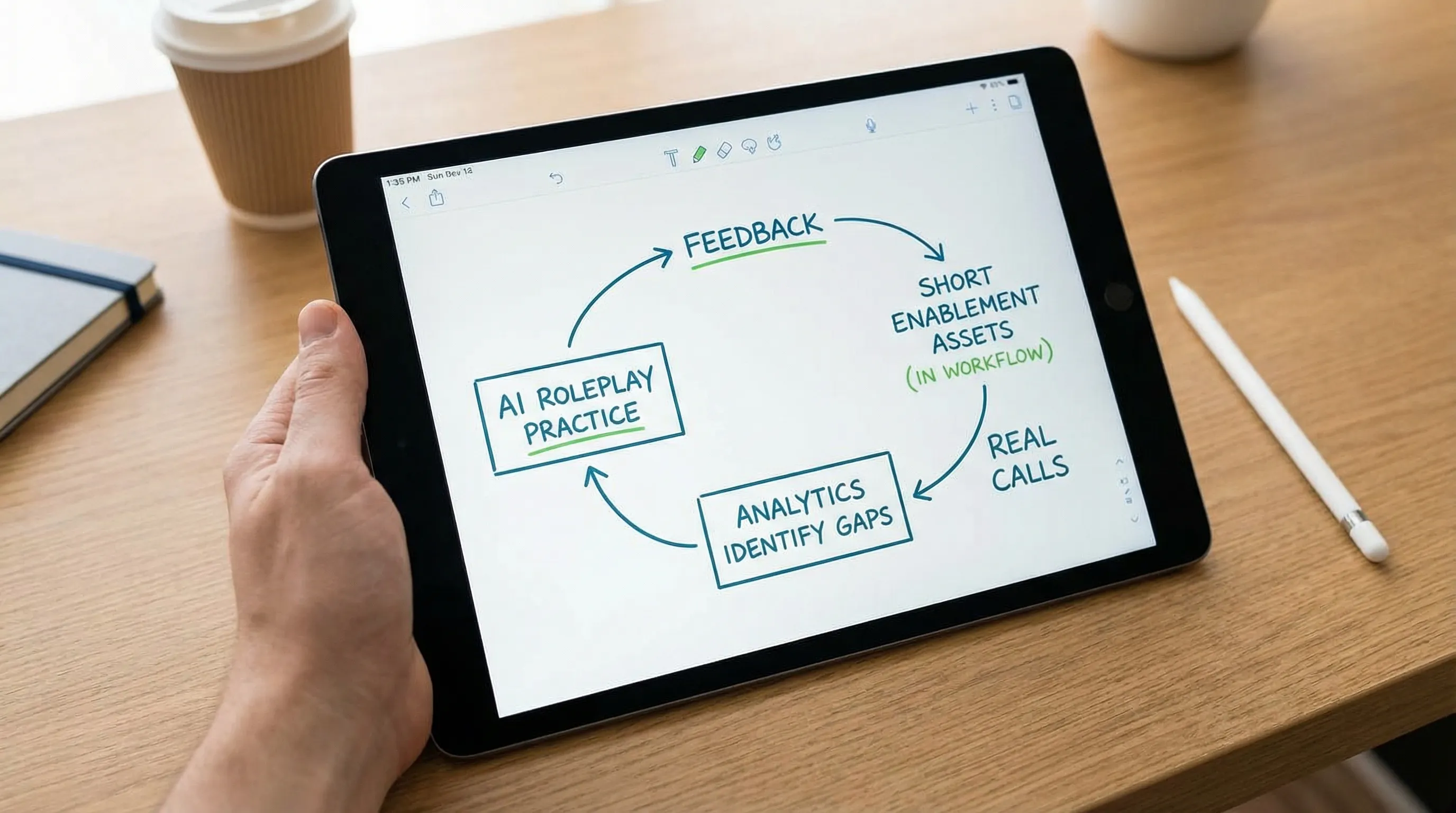
- Review top 3 breakdown moments from roleplay performance each week.
- Publish one reinforcement asset that addresses the biggest, most frequent breakdown.
- Assign a short drill that forces reps to retrieve the new behavior.
- Have managers reinforce it in 1:1s using the coaching guide.
This keeps enablement content relevant, current, and tied to skill outcomes.
Make reinforcement content easy to use (or it will not get used)
Even great content fails if it is hard to find mid-week, mid-quarter, mid-chaos. Design for the rep’s reality.
Reduce choices on purpose
If a rep opens a folder and sees 47 assets, they choose none. Create “one best next asset” per scenario.
Build for scanning
Aim for:
- 5 lines, not 5 paragraphs
- Bolded headers that match what a buyer says
- One example line reps can borrow verbatim
Write in the language of the call
If your roleplay scenarios include realistic buyer phrasing, reuse that phrasing in your assets. Reinforcement works best when it triggers recognition.
Measuring whether your enablement content is reinforcing skill (not just getting clicks)
Content views are not the outcome. Reinforcement content should show movement in skill and performance.
A balanced measurement approach typically includes:
- Adoption metrics: open rate, completion rate, time-to-first-use
- Skill metrics: roleplay scores over time, improvement by competency, scenario pass rates
- Business metrics: stage conversion, discounting trends, cycle time, renewal risk reduction
The cleanest signal is skill lift that sustains: do reps perform better in roleplay two weeks later without extra coaching? Reinforcement content should make that answer “yes” more often.
Common mistakes to avoid
Treating content as a substitute for practice
Reading about objection handling is not the same as producing it under pressure. Reinforcement content should prompt practice, not replace it.
Publishing generic “best practices” that do not match your deals
If your reps sell to procurement-heavy enterprises, generic SMB closing tips will not transfer. Anchor assets to your scenarios, your deal stages, and your buyer reality.
Forgetting the manager layer
Reps do what gets coached. If managers do not have a simple guide, reinforcement becomes optional.
Bringing it together with AI roleplay training
The most effective enablement systems connect three things: practice, feedback, and reinforcement. That is why AI-powered roleplay training is a strong foundation, you can deliver consistent scenarios, personalized practice, real-time feedback, and analytics that reveal what to reinforce next.
If you want to operationalize this approach, start small:
- Pick one high-impact scenario (pricing pushback, discovery, renewal risk).
- Run roleplay.
- Publish two reinforcement assets (an objection card and a micro-drill).
- Track improvement in the next roleplay cycle.
Scenario IQ is built around AI roleplay simulations, personalized scenarios, real-time feedback, and progress analytics, which makes it well-suited to this reinforcement loop. You can learn more at Scenario IQ.