

AI is reshaping sales teams faster than most enablement programs can keep up. The real advantage is not “using AI” everywhere, it is deciding where automation increases speed and consistency, and where humans still win on judgment, trust, and empathy.
This guide breaks down Sales and AI: what to automate vs keep human, with a practical decision framework, concrete workflow examples, and risk controls you can apply in 2026.
The mistake most teams make with Sales and AI
Sales leaders often start AI adoption with tools, not tasks. They buy a conversation intelligence platform, add an email generator, connect an SDR copilot, then wonder why results are mixed.
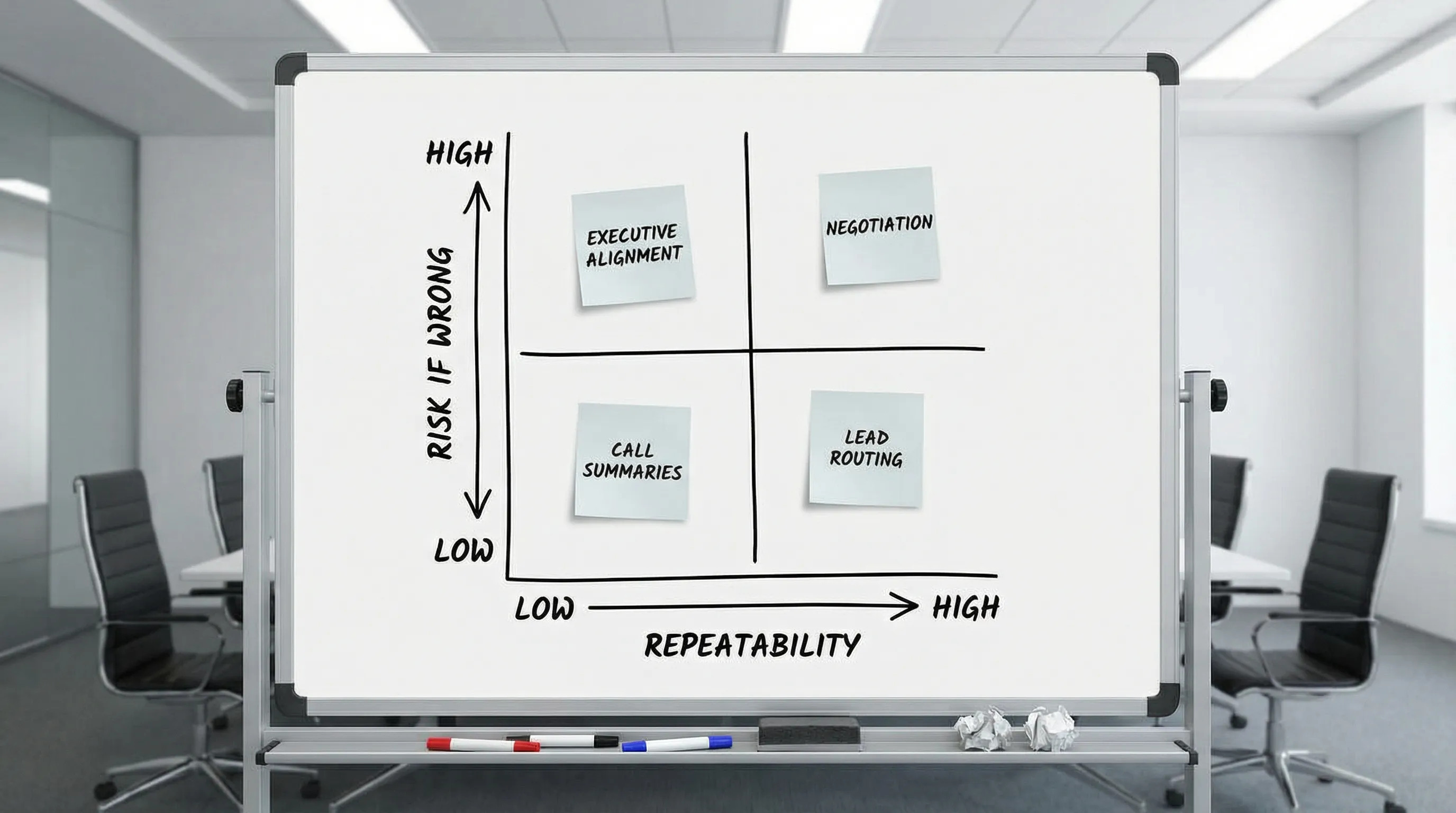
A better approach is to map your sales motion into three categories:
- Repeatable work where the “right answer” looks similar across deals (great for automation).
- Variable work where context changes the best move (better for human judgment, supported by AI).
- High-stakes work where errors damage trust, brand, or compliance (human-owned, AI-assisted).
When you align AI to the right category, you get leverage without losing authenticity.
A simple framework: Should this sales task be automated?
Before automating, ask four questions:
1) Is the input structured enough? If the task relies on clean CRM fields, product docs, or call transcripts, AI can help reliably. If it relies on “reading the room,” proceed carefully.
2) Is the outcome reversible? If a mistake can be caught quickly (internal summarization), automate more. If the mistake is public or contractual (pricing promises, legal terms), keep it human-owned.
3) Is there a clear definition of quality? If you can define what “good” looks like (a compliant call summary, a discovery question set), you can automate with guardrails.
4) Does it affect trust? The closer the task is to relationship building, negotiation, or sensitive customer situations, the more important the human role becomes.
What to automate in sales (high leverage, low regret)
These are areas where AI typically improves speed, consistency, or coverage, and where you can add review steps to keep quality high.
1) Admin and CRM hygiene
Most teams lose selling time to busywork. AI can reliably support:
- Call and meeting summaries (with action items and next steps)
- CRM field suggestions based on notes and conversations
- Activity logging (emails, meetings, touchpoints)
Best practice: treat AI output as a draft, and require rep confirmation before it becomes a system of record.
2) Lead routing and prioritization (with transparent rules)
AI can help identify which leads to work first by combining signals (form intent, firmographics, engagement, prior conversations). This is particularly useful when inbound volume is high and response time matters.
Guardrail: ensure routing logic is explainable enough for managers to audit. If your team cannot answer “why did the model prioritize this lead,” you risk chasing noise.
3) Research and account prep
AI is strong at compressing information:
- Company background and recent announcements
- Persona snapshots and likely KPIs
- Competitor comparisons (when grounded in approved sources)
This is a time-saver, but it still needs human verification, especially for regulated industries and fast-changing product claims.
4) First-draft outbound messaging and follow-ups
AI is useful for:
- Drafting cold emails from a proven structure
- Adapting a message to an industry or role
- Creating follow-ups that reference prior context
Critical rule: do not let AI improvise product guarantees, pricing, or customer outcomes. Keep a library of approved proof points and make the model pull from it.
5) Enablement content operations
Sales enablement teams can use AI to accelerate:
- Call snippet tagging and theme extraction
- FAQ and objection library drafts
- Microlearning summaries from long training sessions
This helps your enablement team scale without turning every update into a weeks-long project.
What to keep human in sales (where judgment and trust win)
AI can support these moments, but it should not be the “driver.” The human seller owns the outcome.
1) Discovery that changes the deal
Great discovery is not just asking questions, it is sensing what the buyer is not saying and adjusting in real time. AI can suggest questions, but humans should:
- Decide which thread to pursue
- Notice emotional shifts, confusion, hesitation
- Adapt when the conversation reveals new stakeholders or political risk
If your discovery becomes scripted automation, buyers feel it immediately.
2) Negotiation, trade-offs, and deal strategy
Negotiation involves nuance: power dynamics, timing, internal alignment, and concessions that signal value. AI can prepare scenarios and surface options, but humans should:
- Decide what to concede and what to protect
- Manage tone and relationships under pressure
- Align legal, finance, and procurement constraints
Use AI as a strategy assistant, not as an auto-pilot.
3) Handling emotionally charged objections
Some objections are logical (“your competitor is cheaper”). Others are emotional (“I do not trust this will work”). AI can help you rehearse responses, but in the live moment the human must:
- Build psychological safety
- Ask clarifying questions without defensiveness
- Acknowledge risk and co-create a plan
This is where sales skill becomes a differentiator.
4) Executive conversations and consensus building
C-level conversations often hinge on credibility, prioritization, and risk framing. AI can summarize a business case, but humans must:
- Tell a coherent story tied to business outcomes
- Navigate stakeholder alignment and politics
- Earn trust with measured, accountable language
5) Ethics, compliance, and accountability
If a customer challenge escalates, or if a conversation touches sensitive topics, you need clear human accountability.
For AI risk management guidance, many organizations reference the NIST AI Risk Management Framework to structure governance, transparency, and oversight.
The “hybrid” approach: AI drafts, humans decide
Most high-performing teams land on a hybrid workflow:
- AI proposes (draft message, summary, next best action)
- Human disposes (approves, edits, rejects)
- System records (only after approval)
This reduces busywork while protecting trust.
A practical workflow example (post-call)
A realistic post-call flow looks like this:
- AI generates a summary, key objections, and next-step suggestions.
- The rep edits for accuracy, tone, and commitments.
- The manager reviews deals above a defined threshold (for example strategic accounts or late-stage opportunities).
- Only then does the CRM update and the follow-up email go out.
The point is not perfection, it is controlled speed.
Where Sales and AI often go wrong (and how to prevent it)
AI failures in sales are usually process failures. Here are common risks and practical controls.
| Risk area | What goes wrong | Practical control | Who owns it |
|---|---|---|---|
| Hallucinated claims | AI invents features, outcomes, or customer stories | Grounding in approved collateral, require rep approval | Enablement + Sales |
| Tone and brand drift | Messages feel generic or “AI-written” | Brand voice guidelines, examples of “good” | Marketing + Sales |
| Privacy and data handling | Sensitive data used in prompts or stored improperly | Data policies, vendor review, role-based access | Security + Legal |
| Bias in lead scoring | Certain segments are unfairly deprioritized | Audits, explainable criteria, human override | RevOps |
| Over-automation | Reps rely on suggestions and stop thinking | Coaching, skill practice, quality scorecards | Sales Leadership |
If you sell into regions with privacy regulation, coordinate with legal on applicable requirements (for example CCPA in California and GDPR in the EU).
What this means for sales managers: coach the “human layer”
As automation increases, coaching should shift from “did you log the activity?” to “did you make the right decisions?”
The biggest management opportunity is building repeatable human excellence in moments AI cannot own:
- Discovery depth
- Objection handling
- Negotiation posture
- Executive presence
This is also where sales training needs to evolve. Traditional roleplays are inconsistent and hard to scale. AI can help by making practice frequent, measurable, and tailored.
Using AI roleplay to keep the human advantage
If AI is taking more of the repetitive work, sellers need more reps at the high-value skills, not fewer.
Scenario-based AI roleplay can help teams:
- Practice objections safely before real calls
- Get immediate feedback on clarity, empathy, and structure
- Build confidence through repetition at the right difficulty
- Track progress over time so coaching is targeted
Scenario IQ is built around this idea, AI-driven roleplay training that helps sales and service teams improve performance with personalized simulations, real-time feedback, and analytics. Learn more at Scenario IQ.
A balanced rollout plan (so AI adoption sticks)
Successful Sales and AI rollouts usually follow a predictable pattern:
Start with two use cases
Pick one operational use case (summaries, CRM assist) and one revenue use case (outbound drafts, lead prioritization). Keep the scope narrow so you can measure change.
Define “human checkpoints”
Decide where approvals are mandatory, especially for:
- Late-stage deal messaging
- Pricing and commercial terms
- Customer commitments and timelines
Instrument quality, not just activity
Track error rates and outcomes, not only volume. Examples include summary accuracy, email reply rates, meeting-to-opportunity conversion, and forecast consistency.
Train to the new workflow
Do not assume reps will “figure it out.” Teach prompt hygiene, verification habits, and when to ignore the AI suggestion.
Frequently Asked Questions
Will AI replace salespeople? AI will replace parts of the sales job, especially repetitive admin and first-draft content. Relationship building, discovery, negotiation, and executive influence still require human ownership.
What should sales teams automate first? Start with low-risk, high-volume work like call summaries, CRM updates, and internal research. Add outbound drafting next, with strong guardrails and human review.
How do we keep AI-generated outreach from sounding generic? Use a clear message framework, brand voice guidelines, and rep editing. Ground outputs in real customer proof points and avoid vague claims.
Is lead scoring with AI risky? It can be if the model is a black box. Reduce risk with transparent criteria, regular audits, and a human override process.
How can we train sellers for the skills AI cannot do? Use consistent practice and coaching focused on discovery, objections, and negotiation. AI roleplay can scale practice with real-time feedback and measurable progress.
Build the right balance of automation and human skill
Sales and AI works best when automation handles the repeatable work and humans focus on the moments that require trust and judgment. If you want to strengthen those human moments at scale, explore Scenario IQ for AI roleplay training that helps teams practice objections, build confidence, and improve real-world performance.