

Objection handling is where deals are won or quietly lost. The challenge is not knowing the “perfect script”, it is building the judgment and confidence to respond well in the moment, across different buyer personalities, industries, and deal stages. That is exactly where sales AI tools have started to earn their keep: helping reps practice, managers coach, and teams standardize what “good” sounds like.
This guide breaks down the main types of sales AI tools for objection handling and deal coaching, what to look for when evaluating them, and a practical rollout plan you can use with a real team.
What “sales AI tools” means for objection handling and coaching
When buyers search for sales AI tools, they are usually not looking for one magical app. They are trying to solve one or more of these problems:
- Reps freeze when objections come up (price, timing, competition, internal buy-in).
- Coaching is inconsistent, depending on the manager.
- Teams cannot tell whether training is improving outcomes.
- New hires ramp slowly, and tenured reps repeat the same mistakes.
In practice, sales AI tools for objection handling and deal coaching fall into a few categories:
- AI roleplay and simulation: practice conversations in realistic scenarios, get feedback, and repeat.
- Conversation intelligence: analyze real calls, spot objection patterns, and surface coaching moments.
- Deal coaching and forecasting assist: highlight risk, next steps, and gaps in mutual action plans.
- Content and messaging assist: generate battlecards, objection responses, and follow-ups (with governance).
- Sales enablement and learning analytics: track completion, proficiency, and behavior change.
The best stacks connect practice (simulated), reality (calls and pipeline), and coaching (manager workflows).
Why AI helps with objections specifically
Objections are hard to train because they are situational. A “price objection” can mean:
- “I do not see the value.”
- “I am afraid of making the wrong decision.”
- “I need budget approval.”
- “A competitor gave me a number and I am anchoring on it.”
AI-based coaching can help because it supports three things humans struggle to do at scale:
- Deliberate practice: repeating the same skill with variation until it becomes automatic.
- Consistent feedback: the same rubric applied across reps, teams, and regions.
- Pattern detection: finding which objections show up most, where they appear in the cycle, and which responses correlate with progression.
This is especially relevant in 2026 as many sales orgs continue to rebalance toward productivity and efficiency. For broader context on how teams are adopting AI in selling workflows, see McKinsey’s coverage of AI in commercial and go-to-market functions (example overview: McKinsey insights on generative AI and business).
The tool categories that matter (and how they support coaching)
Here is a practical map of sales AI tool categories, focused on objection handling and deal coaching.
| Category | Best for | How it helps with objections | What to watch out for |
|---|---|---|---|
| AI roleplay simulations | Skill building before and between calls | Safe practice for price, competition, timing, and stakeholder objections, with repeatable feedback | If scenarios are generic, reps learn “scripts” instead of judgment |
| Conversation intelligence | Coaching from real calls | Identifies objection moments, talk tracks, competitor mentions, and sentiment shifts | Privacy, consent, and over-reliance on surface metrics |
| Deal coaching assist | Pipeline execution | Flags stalled deals, missing stakeholders, weak next steps, and risk signals | Bad data in CRM means bad recommendations |
| Messaging and content assist | Response quality at speed | Drafts follow-ups, objection rebuttals, and recap emails, aligned to frameworks | Governance is essential to avoid inaccurate claims |
| Enablement analytics | Proving impact | Connects training participation to observed behaviors and outcomes | Correlation is not always causation |
If your main pain is “reps struggle live when buyers push back,” start with AI roleplay and a clear objection rubric. If your pain is “we do not know what is happening on calls,” conversation intelligence becomes the foundation.

What to look for in sales AI tools for objection handling
Not all “AI coaching” is coaching. When you evaluate tools, anchor your criteria to the behaviors you need to change.
1) Scenario quality and personalization
For objection handling, the difference between useful and ignored training is realism.
Look for:
- Role, industry, and deal stage customization (first call vs late-stage negotiation).
- Ability to model different buyer profiles (skeptical CFO, technical evaluator, rushed champion).
- Adjustable difficulty, so reps can progress rather than plateau.
2) Feedback that is specific and actionable
Generic feedback like “be more confident” does not change behavior.
Better feedback includes:
- Whether the rep asked clarifying questions before responding.
- Whether they confirmed the real objection.
- Whether they quantified value or tied it to the buyer’s goals.
- Whether they kept control of next steps.
3) Manager workflows (coaching must fit reality)
If managers cannot use it in 15 minutes between meetings, it will not scale.
Strong tools support:
- Quick review of a rep’s practice and progress.
- Simple coaching notes and follow-up assignments.
- Team views to spot common gaps (for example, “timing objection stalls”).
4) Analytics you can trust
You want analytics that connect training to performance signals, without pretending to “guarantee” outcomes.
Practical analytics include:
- Proficiency over time by objection type.
- Improvements in structure (asking, confirming, responding) rather than only “score.”
- Team-level heatmaps of where reps struggle.
5) Security, data handling, and compliance
For enterprise teams, this is non-negotiable.
Evaluate:
- What data is stored (call recordings, transcripts, scenario responses).
- How access is controlled.
- Vendor security posture (Scenario IQ, for example, positions enterprise-grade security as a core feature, which should be validated during procurement).
For a general security risk framing, NIST’s guidance is a solid starting point: NIST AI Risk Management Framework.
A simple framework for training objections with AI (that managers will actually use)
Tools work best when you standardize the method. Here is a lightweight framework you can implement in weeks, not quarters.
Step 1: Build your “objection library” (start small)
Pick 8 to 12 objections that actually show up in your deals.
Common categories:
- Price and budget
- Timing and prioritization
- Competition and differentiation
- Trust and risk (security, implementation, change management)
- Internal buy-in (legal, finance, IT)
Step 2: Define what “good” sounds like (your rubric)
Keep it simple and coachable. One practical rubric for objections:
- Acknowledge the concern without defensiveness
- Clarify with a question (or two)
- Confirm the real blocker
- Respond with value, evidence, and options
- Advance to a concrete next step
Your AI tool should reinforce this structure through feedback and scoring.
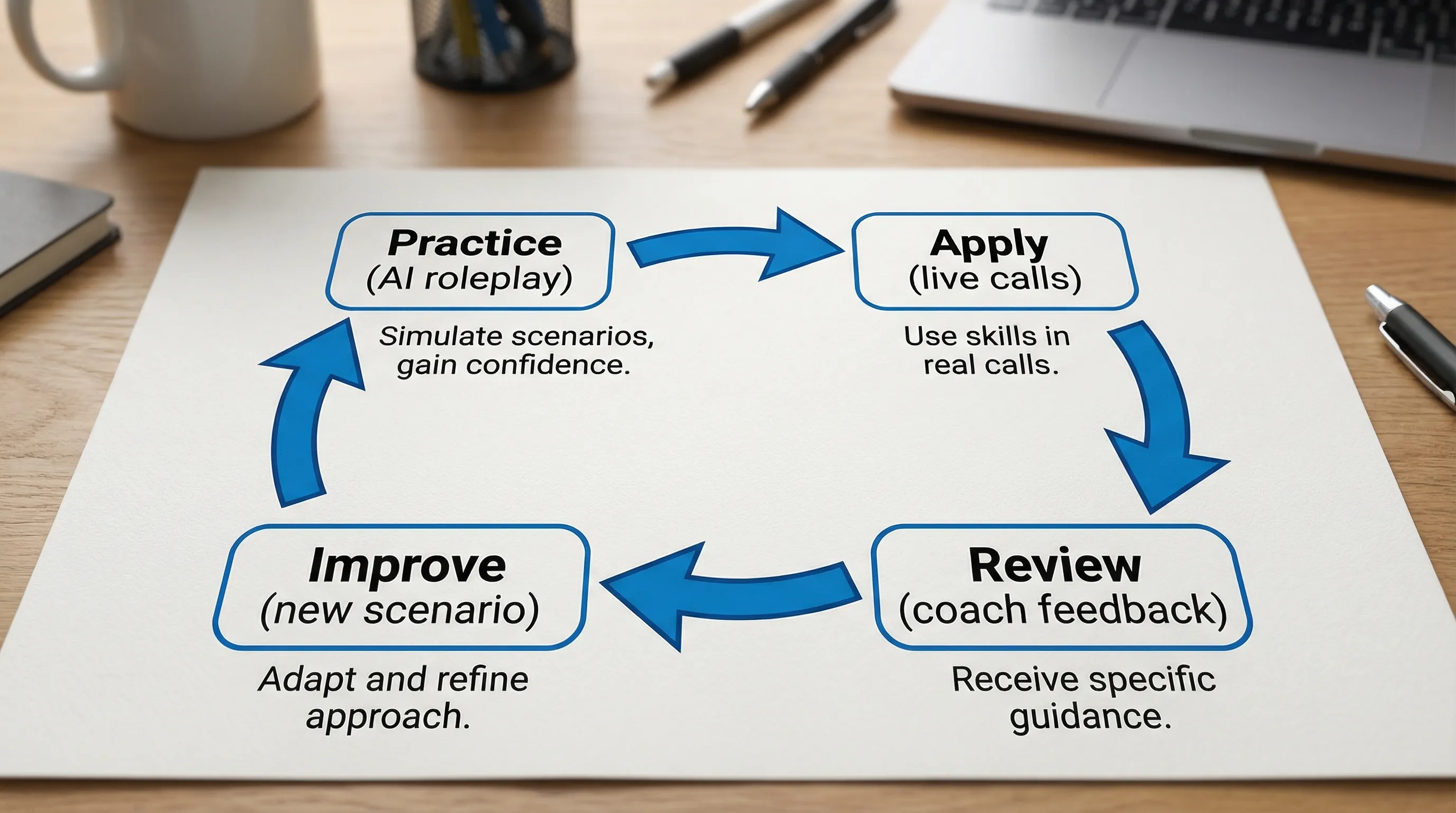
Step 3: Practice in simulations before calls
This is where AI roleplay shines because reps can repeat the same objection with different buyer styles.
A workable cadence for most teams:
- 10 to 15 minutes of roleplay practice, 3 times per week
- One focused objection theme per week (example: “price and procurement”)
- A short manager review weekly (top strengths, one improvement target)
Step 4: Coach using real deal context
Once the team has a baseline, connect practice to live deals:
- Before a key call, assign a scenario that matches the account situation.
- After the call, review what objection appeared, then assign a targeted simulation to redo that moment.
This creates a closed loop: practice, apply, review, repeat.
How to use sales AI tools for deal coaching (not just “training”)
Objection handling is a skill, deal coaching is the system around it.
Here are high-impact ways teams use sales AI tools for deal coaching:
Pre-call deal prep
AI can help reps prepare for what is likely to happen:
- Which stakeholders might object, and why
- Which value proof points match the buyer’s priorities
- Which questions to ask to uncover the real blocker
Pipeline inspection and risk detection
Deal coaching tools can highlight common risk signals:
- No clear next step scheduled
- Single-threaded relationships
- Late-stage objections surfacing for the first time
The goal is not to replace a manager’s judgment, it is to make review conversations more consistent.
Post-call coaching moments
Conversation intelligence can help managers coach with evidence:
- Where did the buyer push back?
- Did the rep ask clarifying questions?
- Did they anchor to outcomes or features?
- Did they confirm next steps?
For teams looking for benchmark-style perspectives on sales performance and productivity trends, Salesforce’s annual report is a widely referenced resource: Salesforce State of Sales.
Common pitfalls (and how to avoid them)
Treating AI as a script generator
If reps memorize responses, they fail when the buyer’s wording changes.
Fix: Train principles and patterns (clarify, confirm, advance), not monologues.
Measuring the wrong thing
If your KPI is “training completed,” you will get completion, not improvement.
Fix: Track proficiency by objection type, then connect it to leading indicators like meeting-to-next-step conversion, late-stage stall rates, and win-loss reasons.
Rolling out too broad, too fast
A library of 100 scenarios sounds impressive and gets ignored.
Fix: Start with 10 scenarios tied to your most common objections, then expand once adoption is strong.
Skipping manager enablement
If managers are not calibrated on what “good” looks like, AI scores will not change outcomes.
Fix: Run a short manager calibration using the same rubric and example calls or scenarios.
Frequently Asked Questions
What are the best sales AI tools for objection handling? The best fit depends on whether you need practice, coaching from real calls, or pipeline-focused deal coaching. Many teams start with AI roleplay simulations for repetition and confidence, then add conversation intelligence to coach from real buyer interactions.
Can AI actually improve objection handling, or does it just generate scripts? AI is most effective when it supports deliberate practice and provides specific feedback (for example, whether a rep clarified the real objection and advanced next steps). Tools that only generate responses can help speed, but they do not build live conversational skill on their own.
How do I measure whether AI deal coaching is working? Use a mix of skill and outcome metrics: proficiency by objection type, reductions in late-stage stalls, improved next-step conversion rates, and win-loss insights tied to specific objections. Avoid relying only on training completion.
What is the fastest way to roll out AI coaching to a sales team? Start with a small objection library (8 to 12), a simple rubric, and a weekly cadence of short practice sessions plus manager review. Expand scenarios after adoption and coaching habits are established.
Put objection handling on repeat with Scenario IQ
If your team needs more consistent objection handling and stronger deal coaching, Scenario IQ is built for scenario-based practice at scale. It provides AI-powered roleplay simulations, personalised training scenarios, real-time feedback, and progress tracking analytics so reps can build confidence and managers can coach using clear signals.
Explore Scenario IQ here: Scenario IQ | AI Sales & Service Training That Closes Deals