

Most “AI for sales” tools look impressive in a demo, then quietly become shelfware once the quarter gets busy. In 2026, revenue leaders are dealing with a new reality: AI is everywhere, buyers are harder to persuade, and the winning teams are the ones that turn AI into consistent behaviors (better discovery, tighter objection handling, calmer service recovery), not just prettier content.
This guide explains what to look for when evaluating SaaS AI for revenue teams in 2026, with a practical checklist you can use to compare vendors, run a pilot, and measure ROI.
What “SaaS AI” should mean for revenue teams in 2026
In a revenue context, SaaS AI is only valuable if it does at least one of these things reliably:
- Improves rep and agent performance in real conversations (calls, chat, email)
- Reduces time to proficiency for new hires
- Creates a repeatable coaching system at scale
- Produces analytics you can trust (not vanity dashboards)
In 2026, the most useful AI products for revenue teams typically fall into three buckets:
- Conversation intelligence and guidance (what happened, what to do next)
- Enablement and training (practice, feedback, coaching loops)
- RevOps analytics and forecasting (pipeline health, quality signals)
Many platforms claim to do all three. In practice, the best results often come from picking one primary job (for example, “skill improvement through practice”) and integrating it into your workflows.
The 4 pillars to evaluate SaaS AI for revenue teams
Pillar 1: Outcome fit (does it change performance, or just output?)
Before model quality and integrations, validate the business outcome.
Ask:
- What specific behavior does this tool improve (discovery depth, objection handling, de-escalation, cross-sell motions)?
- Where does it live in the week (before calls, after calls, during onboarding, weekly coaching)?
- How will managers use it without adding hours of admin?
A useful rule: if success depends on people “remembering to use it,” adoption will drop. Look for software that becomes part of existing rhythms (training plans, coaching sessions, QA reviews, onboarding).
Pillar 2: AI quality (accuracy, consistency, and coaching usefulness)
In 2026, “powered by an LLM” is table stakes. What matters is whether the system:
- Produces consistent feedback across similar situations
- Explains feedback in a way that is coachable (clear, specific, actionable)
- Can be tuned to your messaging, policy, and tone without breaking
If your use case includes scoring, coaching, or skill assessment, you should also care about evaluation rigor. Ask vendors how they test reliability and reduce unsafe or inconsistent outputs.
Two helpful references for your internal AI governance checklist:
- NIST AI Risk Management Framework (for risk, governance, accountability)
- OWASP Top 10 for LLM Applications (for common LLM security risks)
Pillar 3: Data, security, and governance (non-negotiable in revenue orgs)
Revenue teams touch sensitive data: customer identifiers, pricing, contract details, payment disputes, health or financial context (in regulated industries), and call recordings.
What to look for:
- Enterprise-grade security posture (ask about SOC 2 Type II, ISO 27001, pen testing cadence, and incident response)
- Tenant isolation and access controls (SSO, SCIM, role-based permissions)
- Data retention controls (can you set retention policies that match your compliance needs?)
- Clear policies on model training (does your data get used to train shared models?)
If a vendor cannot answer these with clarity, that is a 2026 red flag.
Pillar 4: Deployment reality (integrations, change management, measurable ROI)
AI that cannot connect to your revenue stack becomes another tab no one opens.
Prioritize:
- CRM compatibility (fields, objects, reporting alignment)
- Identity and user provisioning (SSO, SCIM)
- Reporting exports and APIs (so RevOps can validate impact)
- Admin experience (templates, role management, versioning)
Then define ROI in operational terms, not just “time saved.”
A 2026 buyer’s checklist (use this to compare vendors)
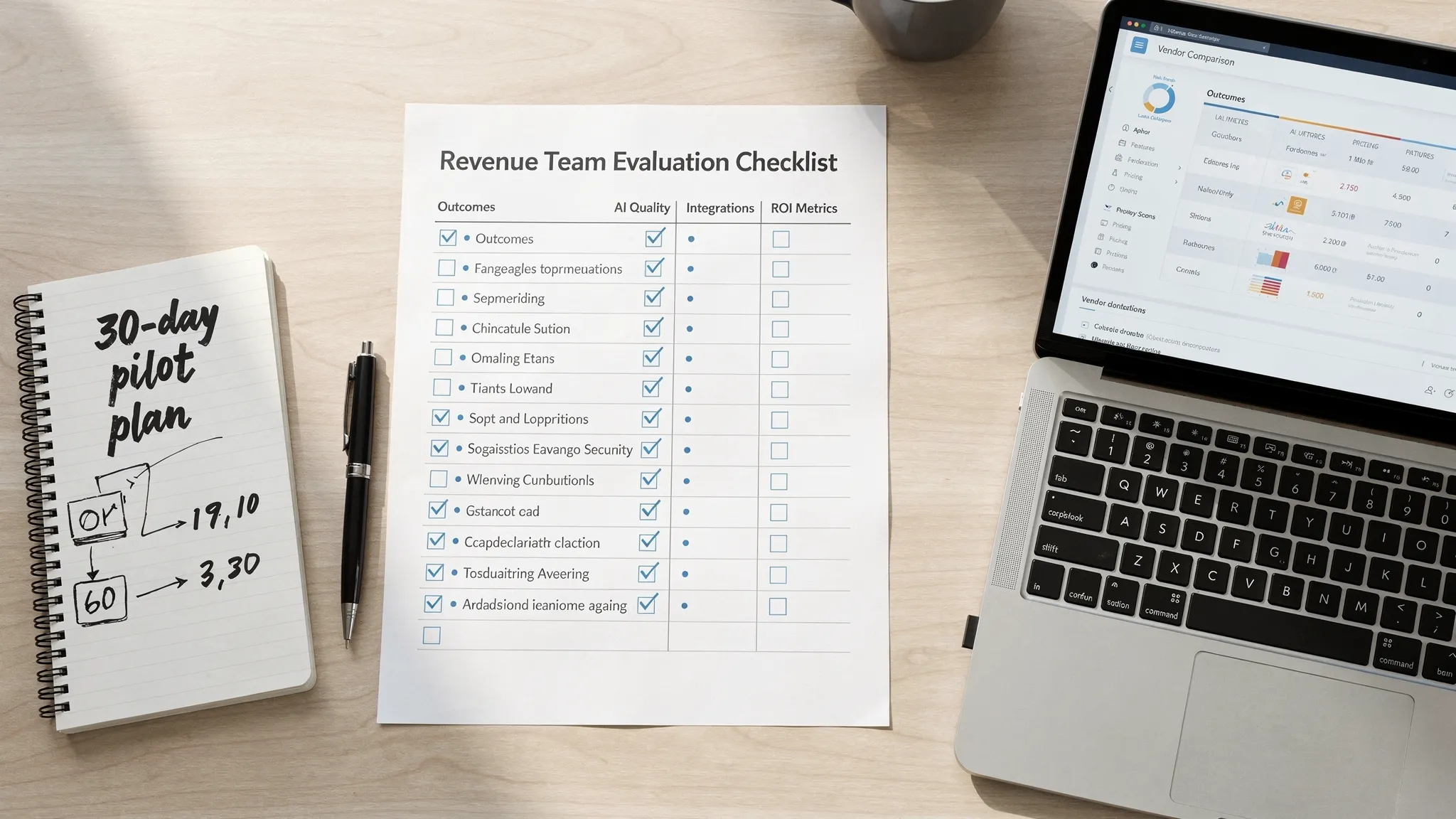
Use the table below as a vendor scorecard during demos and pilots.
| Evaluation area | What “good” looks like | What to ask in the demo | Red flag |
|---|---|---|---|
| Use case clarity | One primary job to be done, clearly tied to revenue metrics | “Show me the workflow for one rep from Monday to Friday.” | Tool does everything, but nothing is measurable |
| Personalization | Scenarios and guidance adapt by role, segment, skill level | “How do you tailor to SMB vs enterprise, SDR vs AE, Tier 1 vs Tier 3 support?” | Same generic prompts for everyone |
| Feedback quality | Specific, actionable coaching (not vague summaries) | “Show a weak performance and the exact coaching it triggers.” | Feedback is mostly praise or generic tips |
| Consistency | Similar inputs produce similar scores and guidance | “If we replay this scenario, do we get the same evaluation?” | Scores change dramatically run to run |
| Manager workflow | Makes coaching easier, not heavier | “How does a manager run a weekly coaching session using this?” | Requires managers to build everything manually |
| Analytics integrity | Metrics map to behaviors and outcomes | “How do you validate that this score predicts conversion, retention, or QA results?” | Dashboards with no connection to KPIs |
| Integrations | Works with CRM, identity, and reporting | “What data comes in and what data goes out?” | No API, limited exports |
| Security | SSO, SCIM, audit logs, controls | “Can I see role permissions and audit logs?” | Security answers are vague |
| Data governance | Clear retention, access, and training policies | “Is our data used to train shared models?” | Cannot commit in writing |
| Implementation | Realistic timeline and change plan | “What is required from RevOps and IT in week 1?” | “It’s plug-and-play” with no specifics |
| Support | Enablement + ongoing success plan | “What does success look like at 30, 60, 90 days?” | Support is only reactive tickets |
| Proof | References in similar orgs and roles | “Can you connect us with a customer with the same motion?” | No relevant references |
Metrics that actually prove impact (by revenue function)
Different teams should measure different outcomes. Agree on a small set of metrics before you pilot.
| Team | Leading indicators (move first) | Lagging indicators (prove ROI) |
|---|---|---|
| Sales (SDR/AE) | Discovery quality score, objection handling competency, talk track adherence | Win rate, sales cycle length, average deal size, ramp time |
| Service / Support | De-escalation competency, policy accuracy, empathy and clarity indicators | CSAT, repeat contact rate, churn risk, escalation rate |
| Customer Success | Renewal and QBR readiness, risk identification consistency | Net revenue retention, renewal rate, expansion rate |
Tip: pick 1 to 2 leading indicators and 1 lagging metric for a 30-day pilot. Too many metrics creates analysis paralysis.
The vendor questions that matter most in 2026
During procurement, most teams ask about features. In 2026, you also need to ask about reliability, governance, and operational fit.
Here are high-signal questions that quickly separate strong vendors from risky ones:
- How do you measure and improve evaluation consistency? (Especially if the AI scores calls, roleplays, or chats.)
- What controls prevent hallucinations or policy-breaking guidance?
- How do you handle customer data, retention, and training permissions?
- What does “personalization” mean in your product? (Rules, rubrics, role-based scenarios, adaptive difficulty.)
- What is the minimum manager time required per rep per week to see results?
- How do you prove outcomes beyond engagement? (Not logins, not “minutes saved.”)
If answers are marketing-level, require follow-ups in writing.
How to run a 30-day pilot that produces a real decision
A strong pilot is short, focused, and measurable. Here is a structure that works well for revenue teams.
Step 1: Choose one motion and one audience
Examples:
- SDRs handling top 5 objections
- AEs improving discovery for a specific ICP
- Support agents reducing escalations in billing disputes
Keep the pilot group small enough to manage (but large enough to see patterns).
Step 2: Define “done” before you start
Write down:
- Success metrics (leading and lagging)
- Minimum adoption threshold (for example, sessions per week)
- Manager involvement expectations
- What data you will use as the baseline (last 30 to 90 days)
Step 3: Instrument the workflow
Make it easy to participate:
- SSO access
- Pre-built scenarios or templates aligned to your messaging
- A consistent coaching cadence (weekly is often enough)
Step 4: Review weekly, decide at day 30
At least once a week, review:
- Skill deltas (what improved, for whom)
- Edge cases (where the AI gave confusing guidance)
- Operational friction (where people stopped using it)
By day 30 you should have enough signal to decide: expand, adjust scope, or stop.
Where Scenario IQ fits for revenue teams
If your primary need is making reps and agents better in real conversations, Scenario IQ is designed around practice and coaching.
Scenario IQ provides AI-driven, personalized scenario-based training for sales and service teams, including:
- AI-powered roleplay simulations to practice realistic conversations
- Personalized training scenarios that can align to roles, skill levels, and common situations
- Real-time feedback and adaptive guidance during practice
- Progress tracking analytics to monitor improvement across individuals and teams
- Team-focused learning with enterprise-grade security
This is especially useful when you want a scalable way to build confidence, improve objection handling, and standardize service quality without relying solely on live manager coaching time.
To explore whether it matches your 2026 enablement strategy, visit Scenario IQ.
Frequently Asked Questions
What is SaaS AI for revenue teams? SaaS AI for revenue teams is software that uses AI to improve sales and service performance through coaching, automation, analytics, and workflow support across the funnel.
What should I prioritize first when evaluating SaaS AI in 2026? Start with the business outcome and workflow fit. If the tool does not reliably change behaviors (and fit into weekly routines), model quality and features will not matter.
How can I tell if an AI coaching tool is reliable? Ask to see repeatability (same input, similar score and feedback), edge-case handling, and how they test evaluation consistency. Also review governance controls and documentation.
Do I need integrations for an AI training tool? Not always, but you should be able to track adoption and outcomes. At minimum, look for SSO and exportable reporting so RevOps can validate results.
What security requirements are common for revenue AI tools? Many orgs require SSO, role-based access, audit logs, defined data retention, and evidence of a mature security program (often SOC 2 Type II or ISO 27001).
How long should a pilot take? For most revenue AI tools, 30 days is enough to validate adoption and leading indicators, then use the next 30 to confirm lagging metrics as you expand.

Build a revenue team that practices like it performs
If you want SaaS AI that drives measurable improvement, focus on tools that create consistent practice, actionable feedback, and manager-friendly coaching loops.
Scenario IQ is built for that outcome. Learn more at scenarioiq.ai and evaluate it using the checklist above.