

Sales and service leaders often inherit a familiar debate: should you invest more in call monitoring (QA, scorecards, coaching off real interactions) or in roleplay training (practice conversations before they hit customers)? Both can move performance, but they improve different things at different speeds.
If your priority is faster skill improvement, the answer usually depends on one question: are you trying to diagnose what happened or build the ability to do it better next time?
What call monitoring actually trains (and what it doesn’t)
Call monitoring typically includes listening to live or recorded calls, scoring them against a rubric, and coaching reps on what to change. It excels at:
- Accuracy and accountability: confirming what was said, whether disclosures were made, and how closely reps follow the playbook.
- Real customer context: seeing how your market truly responds, including unexpected objections.
- Systemic insight: identifying patterns across calls (for example, a confusing pricing page causing the same question repeatedly).
But call monitoring is not “practice.” It is evaluation + feedback. That distinction matters for speed.
Even with strong coaching, improvement can be slow when:
- Feedback arrives hours or days after the call.
- Reps get limited repetitions of the specific moment they struggled with (for example, a cancellation threat or a pricing objection).
- Managers can only review a small sample of calls per rep, per week.
Call monitoring is invaluable for visibility and quality control. It is less efficient as a primary engine for rapid skill acquisition.
What roleplay training actually trains (and why it tends to be faster)
Roleplay training creates simulated customer interactions where reps can practice a skill repeatedly: discovery, objection handling, de-escalation, empathy, negotiation, and closing. When roleplay is designed well, it aligns with what learning science calls deliberate practice: focused repetition on specific skills, with feedback, gradually increasing difficulty.
The most cited foundation here is Anders Ericsson’s work on deliberate practice, which argues expert performance is largely built through structured practice and feedback loops, not just experience alone (“The role of deliberate practice in the acquisition of expert performance”).
Roleplay can improve faster because it compresses the cycle:
- Practice the exact moment (for example, “I’m just shopping around”).
- Get feedback immediately.
- Repeat with a tougher variation.
- Build confidence through safe failure.
In customer-facing roles, speed often comes from how many high-quality reps a person can do per week. Real customers rarely give you that volume on the same skill, and call monitoring rarely gives you the repetitions.
“Improves faster” depends on what you measure
Before choosing an approach, define what “faster” means for your team. You can track speed in two categories.
Leading indicators (move first)
These tend to improve quickest with roleplay:
- Confidence entering calls
- Consistency in talk tracks
- Objection-handling fluency
- De-escalation behavior under pressure
A useful feedback reference point is that timely, specific feedback has a strong effect on learning outcomes, especially when it helps learners close the gap between current and desired performance (Hattie and Timperley, “The Power of Feedback”).
Lagging indicators (move later)
These often require both methods and enough real call volume:
- Conversion rate
- Escalation rate
- CSAT drivers (where measurable)
- Refunds, chargebacks, repeat contacts
Roleplay can accelerate readiness, but lagging metrics still need real-world execution to confirm lift.
Where call monitoring wins (and why you still need it)
Call monitoring is the fastest tool for certain goals.
Compliance, safety, and risk control
If you operate in regulated environments, call monitoring can be non-negotiable for adherence and documentation. Roleplay can help train compliance language, but monitoring validates execution.
Discovering what’s actually happening in the wild
Monitoring is your “source of truth” for:
- Real customer objections you did not anticipate
- Product confusion points
- Process breakdowns (handoffs, policies, wait times)
Coaching experienced reps on micro-behaviors
For tenured reps, small behaviors can have outsized impact (interrupting, hedging language, failing to confirm next steps). A real call is often the best mirror.
In short: call monitoring is excellent for diagnosis and governance.
Where roleplay training wins (and why it usually improves faster)
Roleplay is typically the faster tool when you need to build capability, especially in these scenarios.
Onboarding and ramp
New hires need concentrated repetitions quickly: opening, discovery, objection handling, closing, and service recovery. Waiting for “enough real calls” slows ramp and increases customer risk.
High-stakes, low-frequency scenarios
Some of the most important moments do not happen often:
- “I want to cancel.”
- “Your competitor is cheaper.”
- “This is unacceptable, I’m escalating.”
- “Send me your best offer right now.”
Roleplay lets you rehearse these moments weekly, instead of hoping they occur naturally.
Launching new messaging, pricing, or policy
When your playbook changes, you want behavioral adoption quickly. Roleplay gives managers and enablement teams a controlled environment to validate that reps can execute the new approach.
Building confidence without customer fallout
Roleplay creates psychological safety: reps can try, fail, and adjust without damaging a live relationship.
The real bottleneck: manager time
Most organizations underestimate how quickly call monitoring hits a capacity wall.
A manager can only review so many calls, write so many notes, and deliver so many coaching sessions per week. As teams grow, “monitor more” often becomes “monitor less consistently.”
Roleplay shifts the load by making practice available on demand, and by standardizing feedback quality.
Side-by-side comparison (speed, scale, and use cases)
| Dimension | Roleplay training | Call monitoring |
|---|---|---|
| Primary purpose | Build skills through repetition | Diagnose performance on real calls |
| Feedback timing | Immediate or near-immediate | Often delayed (post-call review) |
| Repetitions per skill | High (practice the same moment many times) | Low (depends on call mix) |
| Customer risk | Low (safe practice) | Medium (learning happens on real customers) |
| Best for | Onboarding, new playbooks, objection handling, de-escalation | Compliance, QA, real-world pattern detection |
| Main constraint | Scenario quality and adoption | Manager time and sample size |
If your question is strictly “what improves faster?”, roleplay is usually the faster path for behavior change because it multiplies practice reps and shortens the feedback loop.
The best answer for most teams: monitor to diagnose, roleplay to fix
High-performing enablement programs treat call monitoring and roleplay as a closed loop.
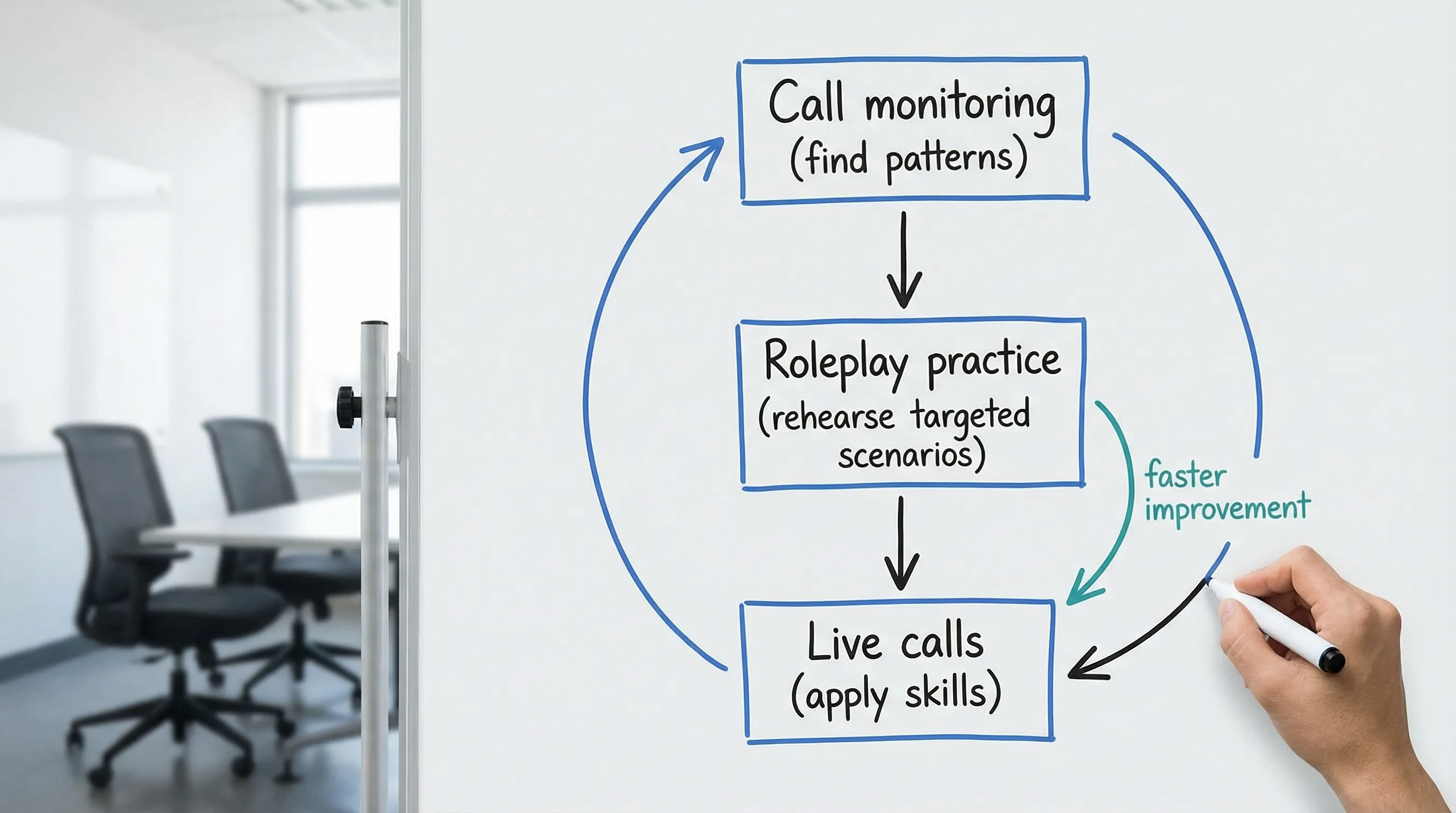
Use call monitoring to identify the “one moment” that matters
Instead of generic coaching (for example, “improve discovery”), pinpoint a moment you can practice:
- Handling a specific objection
- Setting next steps clearly
- Confirming value before price
- Defusing anger without over-apologizing
Turn that moment into a scenario with a clear rubric
The rubric should describe observable behaviors (what “good” sounds like), not vague traits.
Practice until the rep is fluent, not just correct
Correct once is not mastery. Fluency means they can execute under time pressure, with a difficult customer persona, and with curveballs.
Return to monitored calls to validate transfer
Roleplay is successful when it shows up in live calls. Monitoring is where you confirm that the behavior held under real conditions.
Why AI roleplay often outpaces traditional roleplay
Traditional peer roleplay can work, but it has common failure points: inconsistent acting, awkwardness, limited time, and feedback quality that depends on who you are paired with.
AI roleplay addresses many of these constraints by making practice:
- Consistent: scenarios don’t drift.
- Personalized: difficulty can adjust to skill level.
- Immediate: feedback arrives in the moment.
- Trackable: progress can be measured over time.
Scenario IQ is built around AI-driven, personalised scenario-based training with AI-powered roleplay simulations, real-time feedback, and progress tracking analytics so teams can practice the exact conversations that drive revenue and retention. If you want to see what that looks like in practice, you can explore Scenario IQ at scenarioiq.ai.
A practical decision guide (when to prioritize which)
Prioritize roleplay training when
- You are onboarding new reps or rolling out a new script
- Objection handling is inconsistent across the team
- Customer escalations are rising and you need faster de-escalation behaviors
- Managers cannot keep up with coaching demand
Prioritize call monitoring when
- You need tighter QA or compliance coverage
- You suspect messaging misalignment in real customer conversations
- You want to diagnose systemic issues (product, policy, process)
Choose a blended approach when
Most teams should. Monitoring finds the truth, roleplay builds the skill, and monitoring confirms the skill transferred.
How to implement a “faster improvement” program in 30 days
Week 1: Pick a measurable skill and define “good”
Focus on one high-impact skill (for example, “handle pricing objections” or “prevent cancellations”). Decide how you will evaluate it in both roleplay and monitored calls.
Week 2: Build targeted scenarios and run short practice bursts
Short, frequent practice tends to beat long, infrequent sessions for habit formation. Keep scenarios aligned to what you are hearing on calls.
Week 3: Add difficulty and variability
Introduce tougher customer personas, tighter constraints (for example, time), and common curveballs.
Week 4: Validate on real calls and tighten the loop
Compare pre and post samples in monitored calls and keep the scenarios that correlate with real behavior change.
Frequently Asked Questions
Is call monitoring training or quality assurance? It can be both, but it is primarily quality assurance and coaching based on real interactions. It becomes “training” only when you turn insights into repeated practice.
Can roleplay training replace call monitoring? Not fully. Roleplay accelerates skill-building, but call monitoring is still important for compliance, customer truth, and verifying that training transferred to live performance.
What improves faster for new hires: roleplay training or call monitoring? Roleplay training usually improves faster for new hires because it creates many repetitions with immediate feedback before they face a wide range of real customer situations.
How do you measure whether roleplay is working? Use a mix of roleplay scores (rubric-based), consistency over time, and targeted live-call behaviors (for example, whether the rep actually uses the new objection framework).
What’s the biggest mistake teams make with call monitoring? Treating feedback as the intervention. Feedback helps, but behavior change usually requires structured practice, not just notes and a scorecard.
Build faster improvement with AI roleplay
If your team is relying on call monitoring to do all the heavy lifting, you may be asking managers and customers to absorb the cost of learning. Scenario IQ helps you speed up capability building with AI roleplay simulations, personalised training scenarios, real-time feedback, and analytics that make progress visible.
Explore Scenario IQ and see how AI roleplay can fit into your coaching loop: https://scenarioiq.ai.