

Most reps do not lose deals because they forgot a product fact. They struggle because the live conversation moves faster than training did. A buyer pushes back on price. A customer is frustrated. A stakeholder asks a question the rep did not expect. In that moment, confidence, judgment, and communication skills matter as much as knowledge.
That is why role playing AI is becoming a practical tool for sales and service teams. It gives reps a safe place to rehearse high-stakes conversations before they happen with real customers. Instead of waiting for a manager to schedule a mock call or hoping a rep learns from a difficult live interaction, teams can create repeatable practice that adapts to each learner.
The goal is not to replace coaching. It is to make practice more frequent, more realistic, and easier to measure.
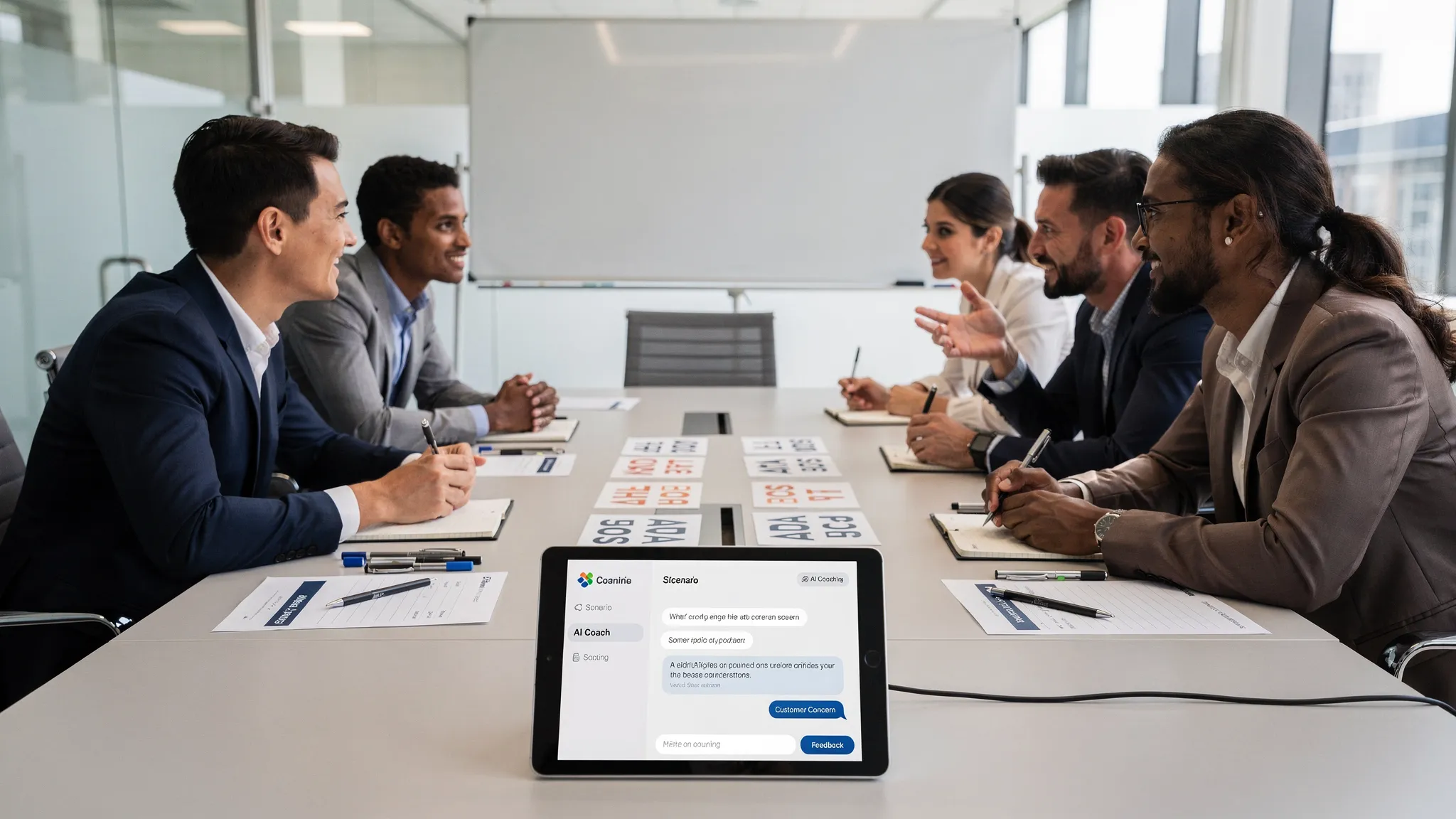
Why safer rep practice matters
Traditional sales and service training often depends on three imperfect options: classroom learning, peer roleplay, and real customer calls. Each has value, but each has limits.
Classroom training can explain the right message, but it rarely creates pressure. Peer roleplay is useful, but it can feel awkward, inconsistent, or too easy. Live calls reveal true readiness, but they are a risky place to discover that a rep cannot handle a pricing objection, a cancellation threat, or a frustrated customer.
Safer practice matters because reps need room to make mistakes without damaging customer trust. They also need to repeat the same skill enough times for it to become natural.
This aligns with the broader concept of deliberate practice. In a well-known Harvard Business Review article, K. Anders Ericsson and colleagues explain that expertise develops through focused practice, feedback, and repeated improvement, not simple experience alone. Sales and service performance works the same way. Reps improve faster when they practice specific behaviors, receive feedback, and try again.
Psychological safety matters too. Amy Edmondson's research on psychological safety and learning behavior found that teams learn more effectively when people feel safe speaking up, asking questions, and acknowledging mistakes. Role playing AI can support that environment by giving reps a private, low-pressure space to try, fail, and improve before a manager or customer is involved.
What role playing AI actually does
Role playing AI uses artificial intelligence to simulate realistic conversations between a rep and a customer, buyer, prospect, or internal stakeholder. A rep can practice a discovery call, objection handling, account renewal, support escalation, upsell conversation, or service recovery scenario. The AI responds dynamically based on what the rep says, rather than following a rigid script.
A strong roleplay experience usually includes a few core elements:
- A scenario with context, such as buyer persona, deal stage, product issue, or customer sentiment.
- A simulated conversation partner that reacts to the rep's choices.
- Feedback on communication, clarity, tone, objection handling, and next steps.
- Progress tracking so reps and leaders can see improvement over time.
- Adjustable difficulty so practice can match a rep's skill level.
This is different from a quiz or static script. A quiz checks whether someone remembers information. A script tells someone what to say. Role playing AI tests whether a rep can apply judgment in a realistic conversation.
| Training method | Best for | Common limitation |
|---|---|---|
| Static scripts | Message consistency | Reps may sound robotic or struggle when the customer goes off script |
| Classroom training | Introducing concepts | Limited practice under conversational pressure |
| Peer roleplay | Team learning and coaching | Quality varies by partner, time, and comfort level |
| Call reviews | Learning from real examples | Feedback arrives after a customer interaction has already happened |
| Role playing AI | Repeated, adaptive practice | Works best when scenarios and rubrics are well designed |
How role playing AI makes practice safer
The safest training environment is not one where reps avoid hard conversations. It is one where they can face hard conversations repeatedly before customer trust is on the line.
Role playing AI helps teams create that environment in several ways.
First, reps can practice privately. A new hire who feels embarrassed about stumbling through discovery questions can rehearse without worrying about wasting a manager's time or being judged by peers. That private repetition can make live coaching more productive because the rep arrives with more self-awareness.
Second, teams can simulate difficult or sensitive moments. A service rep can practice de-escalating an angry customer. A sales rep can practice responding when a buyer says the budget is gone. An account manager can rehearse a renewal conversation after a service failure. These are exactly the moments that matter most, but they are hard to reproduce consistently in traditional training.
Third, AI roleplay can standardize practice. If every rep faces the same baseline scenario, leaders can compare readiness more fairly. This helps reduce the guesswork that often enters coaching when one manager grades strictly, another gives vague encouragement, and another focuses only on activity metrics.
Fourth, safer practice can support compliance and brand consistency. Teams can rehearse approved language, escalation paths, disclosure requirements, and tone expectations before reps encounter those situations live. This is especially valuable in regulated industries or any environment where one careless phrase can create risk.
Finally, role playing AI helps normalize practice as part of the job. Top performers often rehearse naturally. Less experienced reps may only practice when required. AI makes repetition easier to schedule and easier to scale across teams.
How it makes practice smarter
Safer practice is only half the value. The bigger opportunity is smarter practice.
In many organizations, coaching is based on fragments of evidence. A manager hears one call, checks CRM notes, reviews a few outcomes, and tries to infer what the rep needs. That can work for small teams, but it becomes inconsistent as the organization grows.
Role playing AI can create more structured signals. Platforms like Scenario IQ offer AI-powered roleplay simulations, personalized training scenarios, real-time feedback, progress tracking analytics, adaptive feedback and guidance, customizable skill levels, daily actionable tips, and performance metric dashboards. Used well, those capabilities help managers see not only whether a rep practiced, but where that rep is improving and where they still need support.
For example, two reps might both lose deals to pricing objections. One may be discounting too quickly. Another may be failing to connect value to the buyer's business problem. A generic training module would treat both reps the same. Smarter roleplay can give each rep a scenario and feedback path that matches the skill gap.
The same applies to customer service. One rep may need help with empathy and tone. Another may need to improve troubleshooting structure. Another may need to recognize when to escalate. AI-based practice can focus on those differences without requiring every rep to sit through the same one-size-fits-all training.
High-impact use cases for sales and service teams
Role playing AI is most effective when tied to specific conversations that affect revenue, retention, or customer satisfaction. It should not be a novelty exercise. It should be connected to the moments where better rep performance changes outcomes.
Common use cases include:
- New hire onboarding, where reps need safe repetition before speaking with customers.
- Objection handling, especially around price, timing, competition, risk, and authority.
- Discovery calls, where reps must ask better questions and avoid jumping into a pitch too early.
- Product launches, where teams need to learn new messaging quickly and consistently.
- Customer escalations, where tone, empathy, and next steps can protect trust.
- Renewal and expansion conversations, where reps need to connect outcomes to value.
The best teams often start with one or two high-stakes scenarios rather than trying to simulate every possible conversation. For example, a sales team might begin with pricing objections and competitive displacement. A service team might begin with cancellation prevention and angry customer de-escalation.
Starting narrow makes it easier to build a strong rubric, measure improvement, and prove value before expanding.
What a strong AI roleplay scenario includes
The quality of the scenario determines the quality of the practice. A vague prompt creates vague feedback. A well-designed scenario gives the rep a realistic challenge, clear expectations, and a meaningful path to improvement.
| Scenario component | Why it matters |
|---|---|
| Business context | Helps the rep understand the account, customer issue, or deal stage |
| Customer persona | Shapes tone, priorities, objections, and decision criteria |
| Rep objective | Clarifies what success looks like in the conversation |
| Built-in friction | Creates realistic pressure, such as budget concern or frustration |
| Feedback rubric | Defines what the AI and coach should evaluate |
| Difficulty level | Keeps practice challenging without overwhelming the rep |
| Follow-up expectation | Reinforces next steps, summaries, commitments, and escalation paths |
A strong scenario should not reward reps for simply saying the right keywords. It should evaluate whether the rep listens, responds to the customer's actual concern, asks relevant questions, and moves the conversation forward appropriately.
For sales teams, that may mean testing business acumen, discovery depth, objection handling, and value articulation. For service teams, it may mean testing empathy, clarity, troubleshooting discipline, ownership, and escalation judgment.
Building a practical rollout plan
The easiest way to fail with role playing AI is to treat it as another tool reps are supposed to use without connecting it to their daily work. Adoption improves when leaders make practice relevant, short, and measurable.
Start by identifying the conversations that create the most risk or opportunity. Look at lost deals, support escalations, churn reasons, low customer satisfaction scores, onboarding gaps, and manager feedback. Choose scenarios that clearly connect to business outcomes.
Next, define what good looks like. If a rep is practicing a pricing objection, leaders should agree on the behaviors they want to see. Those might include acknowledging the concern, clarifying the buyer's comparison point, restating value, asking about decision criteria, and avoiding an immediate discount.
Then set a realistic practice cadence. Daily practice does not need to mean long sessions. Short, focused repetitions can be more useful than occasional marathon training. Scenario IQ's daily actionable tips and adaptive guidance can support this type of continuous learning without making practice feel like a separate event.
Managers should review trends, not just individual scores. If many reps struggle with the same objection, the issue may be messaging, enablement, product positioning, or market fit. If one rep consistently struggles with confidence or structure, the manager can coach that person directly.
Finally, refresh scenarios regularly. Customer expectations change. Competitors change. Product messaging changes. The roleplay library should evolve with the conversations reps are actually having.
Governance, privacy, and responsible AI use
AI training tools should be implemented with the same care as any system that handles employee performance data or customer-related context. Safer practice also means safe operations.
The NIST AI Risk Management Framework encourages organizations to govern, map, measure, and manage AI risks. For roleplay training, that means leaders should think about data protection, transparency, fairness, and human oversight before scaling the program.
Practical safeguards include using approved scenario content, avoiding unnecessary sensitive customer data, explaining how feedback is generated, and keeping managers involved in coaching decisions. AI can surface patterns and accelerate feedback, but it should not become the only judge of rep potential or performance.
Enterprise-grade security is also important for organizations that train teams at scale. If scenarios include product positioning, competitive strategy, customer situations, or internal coaching data, leaders should choose platforms designed with security and organizational controls in mind.
Metrics that show whether practice is working
The point of role playing AI is not more training activity. The point is better readiness. Teams should measure whether practice is changing behavior and improving outcomes.
Useful metrics include:
| Metric | What to look for |
|---|---|
| Practice completion | Whether reps are consistently engaging with assigned scenarios |
| Skill progression | Whether scores or qualitative feedback improve over time |
| Time to readiness | How quickly new hires become confident enough for live conversations |
| Objection handling quality | Whether reps respond with structure instead of defensiveness or discounting |
| Manager coaching focus | Whether managers can spend more time on targeted coaching |
| Business outcomes | Whether trained skills correlate with conversion, retention, or customer satisfaction trends |
Not every metric needs to be perfect at the start. A simple baseline is enough. Record how reps perform before training, run focused practice, then compare progress after several repetitions. Over time, performance dashboards and analytics can help leaders identify patterns across individuals, teams, roles, and scenarios.
Common mistakes to avoid
Role playing AI works best when it is treated as a coaching system, not a content repository. Teams should avoid a few common mistakes.
One mistake is creating scenarios that are too generic. If the customer persona, industry, objection, and success criteria are vague, the practice will feel artificial. Reps need scenarios that resemble the conversations they actually face.
Another mistake is overemphasizing scores. Scores can be useful, but they should lead to coaching, not fear. If reps believe every practice session is a judgment, they may avoid experimentation. The safest learning environments reward improvement, not perfection.
A third mistake is removing the manager from the loop. AI can provide immediate feedback and track progress, but managers still play a crucial role in reinforcing expectations, interpreting patterns, and connecting practice to real customer conversations.
Finally, teams should not roll out too many scenarios at once. Start with the moments that matter most. Build confidence. Show progress. Then expand.
Frequently Asked Questions
What is role playing AI? Role playing AI is software that simulates realistic conversations so sales and service reps can practice with an AI customer, buyer, or stakeholder. It typically provides feedback, adapts to the rep's responses, and helps track progress over time.
Does AI roleplay replace sales managers or coaches? No. It is best used to extend coaching, not replace it. AI can give reps more practice and immediate feedback, while managers provide context, judgment, accountability, and personalized coaching.
Is role playing AI only for sales teams? No. It is also useful for customer service, support, account management, onboarding, and any role that depends on communication under pressure.
How often should reps practice with AI? Short, consistent practice is usually more effective than occasional long sessions. Many teams benefit from focused practice tied to current priorities, such as a new objection, product launch, or service escalation theme.
What should leaders look for in a role playing AI platform? Look for realistic simulations, personalized scenarios, real-time feedback, progress tracking, adaptable skill levels, analytics, security, and the ability to support team-wide learning.
Build safer, smarter practice with Scenario IQ
Reps should not have to learn their hardest lessons in front of customers. With the right role playing AI, teams can create realistic practice, deliver timely feedback, and build confidence before high-stakes conversations happen.
Scenario IQ helps organizations use AI-driven, personalized scenario-based training to improve communication, performance, and readiness. With AI roleplay simulations, real-time feedback, progress tracking analytics, adaptive guidance, customizable skill levels, and team-focused learning, Scenario IQ gives sales and service teams a smarter way to practice.
If your reps need more confidence, better objection handling, and safer preparation for customer conversations, explore how Scenario IQ can help your team train with purpose.