

Scoring drift is one of the fastest ways to make a QA program feel “unfair.” Two reviewers listen to the same support call and land on different scores, different coaching notes, and different priorities. Agents lose trust, managers lose time, and leadership starts questioning whether QA data is reliable enough to drive performance decisions.
QA calibration is the practical fix. Done well, it turns quality scoring into a shared language across your support organization, so coaching is consistent and measurable, even as policies, products, and customer expectations change.
What QA calibration is (and what it is not)
QA calibration is a recurring process where everyone who scores customer interactions aligns on how the rubric is interpreted, what “good” looks like, and how edge cases should be handled.
It is not:
- A debate club where the loudest person wins
- A one-time training
- A session that ends when you “average the scores”
Calibration should produce repeatable outcomes: clearer definitions, updated examples, and tighter score consistency.
Why support teams get scoring drift
Scoring drift usually shows up slowly, then suddenly becomes obvious when escalations increase or coaching feels inconsistent. Common causes include:
Rubrics that are clear in theory, vague in practice
A rubric might say “showed empathy,” but what counts as empathy in a 2-minute chat versus a 12-minute voice call? Without examples, reviewers fill in the blanks differently.
Evolving policies, products, and customer context
Support is dynamic. New features launch, refund policies change, shipping carriers have outages, and customers react differently during peak seasons. Reviewers adjust their expectations informally, and drift follows.
Reviewer bias and different mental models
Even experienced QA analysts can anchor on different things:
- One prioritizes policy adherence
- Another prioritizes tone and customer sentiment
- Another prioritizes speed and structure
Too few shared “anchor” interactions
If reviewers are not regularly scoring the same interactions and comparing results, their internal standards diverge.
Operational pressure
When QA volume spikes, reviewers can become more lenient (to move faster) or stricter (to “hold the line”). Either shift changes the meaning of the score over time.
What “good” calibration looks like in practice
A healthy calibration program has four characteristics:
Shared definitions
Every rubric item has:
- A plain-language definition
- A pass/fail threshold (or what separates 3/5 from 5/5)
- At least one example of a “pass” and a “miss”
A source of truth
Decisions do not live in someone’s notes. They live in a maintained location (a decision log, rubric notes, or QA playbook) with versioning.
Measurable scoring alignment
You are not guessing whether calibration “worked.” You measure agreement and variance.
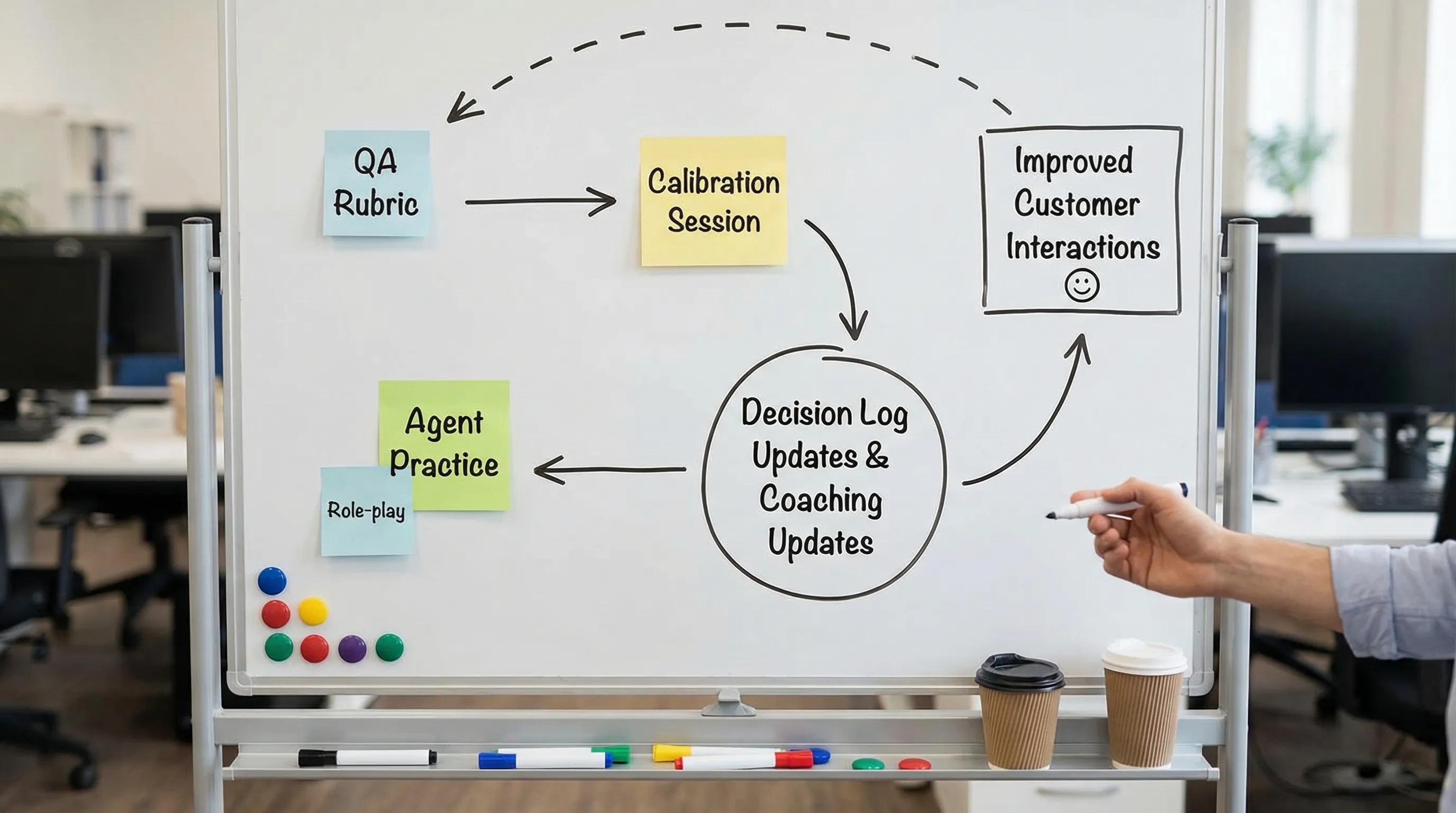
A closed loop into coaching and training
Calibration is only valuable if it changes behavior. That means updated coaching guidance, refreshed enablement materials, and practice opportunities for agents.
Build a QA rubric that resists drift
Before you improve calibration meetings, make sure the scorecard itself is calibratable.
Use fewer, sharper categories
A long rubric with overlapping items invites interpretation differences. Many teams do better with categories like:
- Accuracy and policy compliance
- Resolution quality (did we solve the problem)
- Communication (tone, clarity, empathy)
- Process (documentation, tags, required steps)
Define critical errors explicitly
Critical errors (sometimes called “auto-fails”) reduce argument during calibration. Examples might include:
- Disclosure and compliance failures
- Incorrect refunds or billing actions
- Account security mishandling
If you do not define critical errors, reviewers will invent their own “this is unacceptable” thresholds.
Add an “evidence rule”
A simple calibration-friendly rule is: scores must be justified by observable evidence in the interaction (a quote, timestamp, or transcript snippet). This reduces subjective scoring.
How to run a QA calibration session (a format that actually reduces drift)
A calibration meeting should be structured like a mini-lab: independent scoring first, discussion second, documented decisions last.
Who should attend
Keep the group small enough to decide, broad enough to represent reality:
- QA analysts (all scorers)
- A support team lead or manager
- An enablement or training representative (optional but valuable)
- A rotating “agent voice” (optional, one person, not to litigate, but to add context)
How often to calibrate
Cadence depends on change rate:
- Fast-changing products or policy heavy teams: weekly or biweekly
- Stable environments: monthly
- After major launches, process changes, or a spike in disputes: add an ad hoc session
What to calibrate on (your interaction set)
Use 6 to 10 recent interactions that include:
- Typical contacts (to anchor baseline)
- Edge cases (to reveal ambiguity)
- At least one “near miss” where a small difference changes the score
If you can, remove agent identifiers during calibration to reduce bias.
A calibration agenda that stays productive
Here is a meeting flow that works for most support teams:
- Independent scoring (pre-work or first 10 minutes): everyone scores the same interactions without discussion.
- Variance review (10 minutes): identify where scores diverged most (overall score and key rubric items).
- Evidence-based discussion (20 to 30 minutes): reviewers cite what they observed, then map it to the rubric definition.
- Decision and documentation (10 minutes): agree on the interpretation, update the rubric notes, and add examples.
- Coaching implication (5 minutes): decide what managers should coach differently based on the decision.
The key is that you are calibrating the rubric and expectations, not deciding who was “right.”
Track scoring alignment with the right metrics
You do not need to turn QA into a statistics project, but you do need at least one consistent measure of agreement.
| Metric | What it tells you | When it’s useful | Watch-outs |
|---|---|---|---|
| Percent agreement | How often reviewers gave the same result | Simple pass/fail items, critical errors | Can look “good” even when agreement is inflated by easy cases |
| Cohen’s kappa | Agreement beyond chance | Categorical items (pass/fail, yes/no) | Needs enough samples, can be counterintuitive with rare events |
| ICC (intraclass correlation) | Consistency for scaled scores | 1 to 5 scoring rubrics, overall score alignment | Pick a consistent model and use it repeatedly |
If your team wants a readable primer on kappa and inter-rater reliability concepts, this NCBI overview on kappa statistics is a practical reference.
Set realistic targets
Targets depend on rubric complexity. The goal is not perfection, it is stability and trust. A pragmatic approach is:
- Pick one primary alignment metric
- Establish a baseline for 4 to 8 weeks
- Improve gradually while simplifying ambiguous rubric items
Reduce drift with “anchor libraries” and a decision log
Calibration fails when decisions evaporate after the meeting.
Anchor library (examples everyone can reference)
Create a small, curated set of interactions that represent:
- A perfect interaction
- A solid but improvable interaction
- A clear fail
- Common edge cases (policy gray areas, angry customers, partial resolutions)
Update the library quarterly so it stays current.
Decision log (your QA memory)
A decision log should capture what you decided and how it impacts scoring going forward.
| Field | What to record | Example |
|---|---|---|
| Date and attendees | Who aligned on the decision | “Apr 2026, QA + Support Leads” |
| Rubric item | The exact item name | “Empathy and acknowledgment” |
| Decision | The agreed interpretation | “Acknowledgment must reference the customer’s stated impact” |
| Evidence example | A quote or snippet | “I can see why that delay is frustrating…” |
| Change type | Clarification, weighting change, critical error update | “Clarification + new example” |
| Effective date | When it applies | “Immediately” |
This is also where you prevent “quiet drift,” when a new reviewer joins and unknowingly uses an outdated standard.
Make calibration stick with coaching and practice
Calibration reduces scoring drift, but it should also improve performance. That requires translating decisions into behaviors agents can practice.
Turn decisions into coaching statements
A calibration decision should become a reusable coaching line, for example:
- “When you deny a refund, you must explain the policy and offer the next best option in the same message.”
- “Empathy must reference the customer’s situation, not just a generic apology.”
Practice the hardest moments, not the easy ones
Support performance often breaks down in predictable moments:
- High emotion customers
- Policy denial
- Unclear ownership between teams
- Time pressure and multitasking
This is where scenario practice is more effective than passive feedback.
Scenario IQ can support this step by letting teams rehearse calibrated behaviors through AI roleplay simulations, with real-time feedback and progress tracking analytics. After a calibration session updates what “good” looks like, you can convert those decisions into targeted practice scenarios so agents build consistent habits, not just receive a revised scorecard.
You can explore the platform here: Scenario IQ.
Common calibration pitfalls (and how to fix them)
Pitfall: Calibrating only the overall score
Fix: Calibrate the top 2 to 4 rubric items that drive the most disagreement. Drift usually concentrates in a few subjective categories.
Pitfall: Using extreme interactions only
Fix: Include “boring, normal” contacts. If you only calibrate on disasters, reviewers will align on the obvious and still drift on everyday scoring.
Pitfall: No one owns rubric maintenance
Fix: Assign an owner (often QA lead) to update rubric notes, manage versioning, and publish changes within 24 to 48 hours.
Pitfall: Calibration becomes a policy argument
Fix: Separate meetings. Calibration is about consistent scoring. If a policy is unclear, log it as a follow-up and get a definitive answer from policy owners.
Pitfall: Disagreement is handled informally
Fix: Use an escalation rule, for example: if the group cannot agree, the QA lead decides based on rubric intent and documents it, then revisits next session.

A lightweight calibration operating model (you can adopt in a week)
If you want a simple way to start, implement this for the next 30 days:
- Weekly 45-minute calibration
- 8 shared interactions scored independently
- Track variance on overall score plus two subjective items
- Maintain a decision log and add at least two anchor examples per week
- Publish “what changed” to managers after every session
By week four, you should see fewer score disputes, faster coaching alignment, and less back-and-forth between QA and operations.
Frequently Asked Questions
What is scoring drift in support QA? Scoring drift is when QA reviewers gradually apply the same rubric differently over time, leading to inconsistent scores for similar interactions.
How many interactions should we use in a calibration session? Most teams get good discussion and enough signal with 6 to 10 interactions. Use a mix of typical contacts and edge cases.
How do we handle calibration when reviewers still disagree? Require evidence-based scoring, document a decision, and assign an owner to clarify ambiguous rubric language. If needed, use a tie-breaker (QA lead) and revisit later.
Is QA calibration only for call centers? No. It works for chat, email, social support, and blended channels. The key is that everyone scores the same interactions and aligns on the rubric.
How do we connect calibration to better agent performance? Convert calibration decisions into coaching guidance and practice. Scenario-based training, including AI roleplay simulations, helps agents rehearse the exact moments where quality breaks down.
Build consistency your team can trust
If your QA program is producing more debates than improvements, calibration is the fastest way to restore confidence in your scores and your coaching.
When you are ready to turn calibrated standards into repeatable behaviors, Scenario IQ can help your team practice the hardest conversations through AI roleplay training, with real-time feedback and analytics.
Get started here: Scenario IQ | AI Sales & Service Training.