

Predictive sales AI is changing how revenue teams plan, prioritize, and perform. It does not just tell you what might happen in your pipeline, it prescribes the next best action that nudges deals forward. The teams that win in 2025 will be the ones that combine accurate forecasting with consistent frontline execution, trained and reinforced every day.
What predictive sales AI actually does
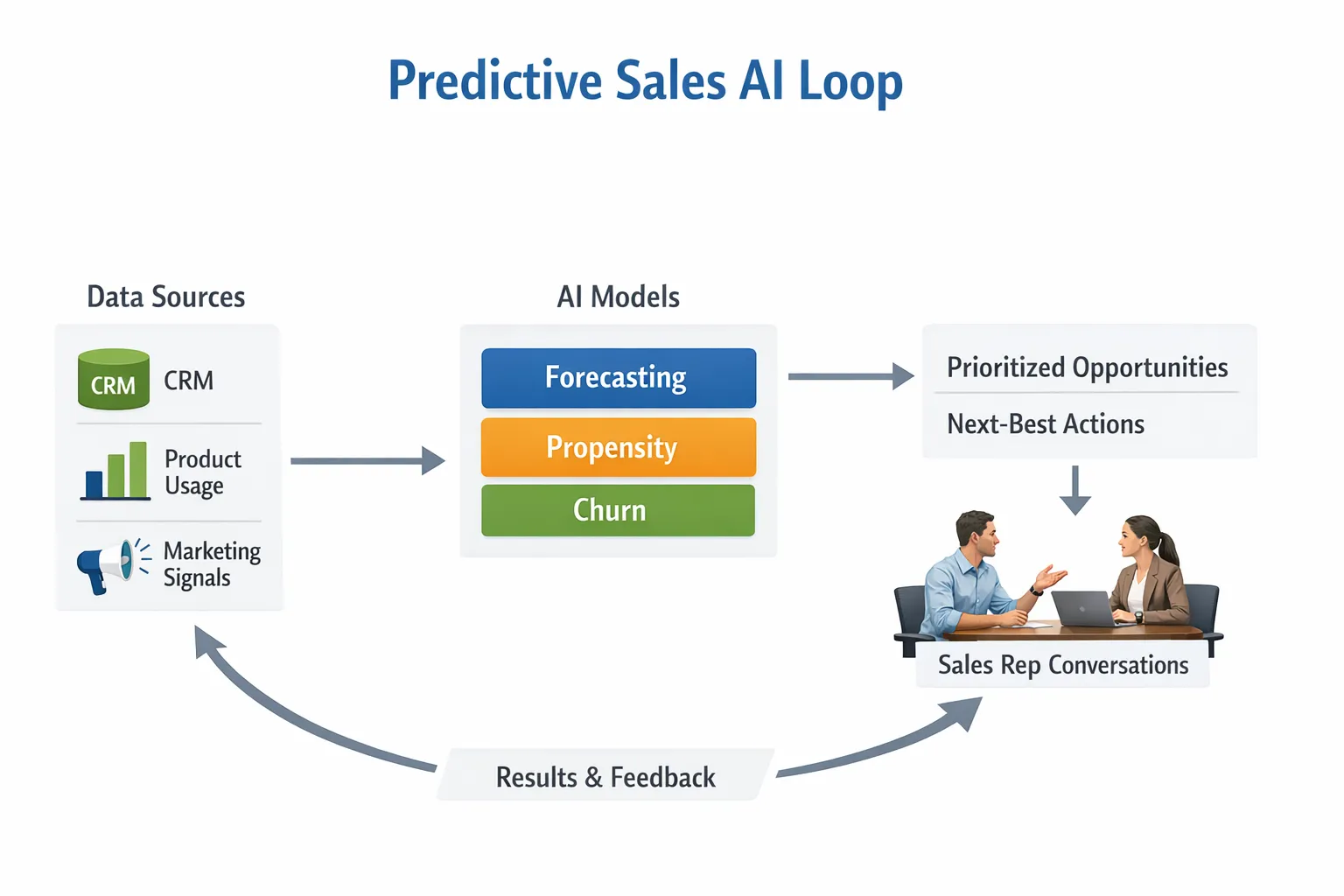
Predictive sales AI uses statistical and machine learning models to estimate outcomes and recommend actions. In practice you will see two high-value use cases:
- Forecasting, estimating revenue by period, risk by opportunity, and likelihood of closing. This helps leaders allocate resources and set realistic targets.
- Next best actions, recommending the most effective step at the account or opportunity level. This could be who to contact, what message to send, or when to escalate.
Forecasts answer “what is likely,” next best actions answer “what to do next.” The magic happens when you connect both, then train your team to act on the insight with consistency.
Why this matters now
Budgets are tight, buyer groups are larger, and deal cycles are slower. Predictive sales AI gives leaders visibility into risk early, and gives reps specific guidance that reduces idle time and guesswork. The result is a more reliable forecast and a playbook that scales across teams, not just top performers.
Core building blocks for predictive forecasting
Strong forecasting depends on high-quality data, appropriate modeling, and the right metric for your business. Even a straightforward approach can outperform manual rollups if you get the basics right.
- Inputs, pipeline history, stage transitions, opportunity metadata, pricing, product usage, marketing touchpoints, seasonality, and rep capacity.
- Methods, time series for aggregate forecasts, classification or survival models for deal-level probabilities.
- Cadence, weekly retraining, daily scoring, and ongoing data hygiene.
Here are common error metrics and how to think about them:
| Metric | What it measures | Good for | Caveat |
|---|---|---|---|
| MAPE | Average percent error vs actuals | Executive rollups | Skews high on small numbers |
| WAPE | Weighted error across all items | Portfolio view of many SKUs or segments | Requires consistent weighting logic |
| MAE | Average absolute error in currency | Sales leadership reviews | Less intuitive as a percentage |
| RMSE | Penalizes large misses more | Volatile new products | Sensitive to outliers |
Choose one primary metric and one secondary metric, report them consistently, and evaluate changes with enough data to be statistically meaningful.
From forecasts to next best actions
Next best action engines combine predicted outcomes with constraints and business rules to recommend what your team should do right now.
- Signals, probability to win, time since last contact, stakeholder coverage, product usage trends, intent, and risk.
- Objective, maximize expected revenue or margin, minimize churn, or hit a territory quota while respecting workload.
- Policy, guardrails on frequency caps, compliance, brand tone, and channel sequencing.
You can start simple. A rules plus scoring approach often gets early wins, for example, prioritize deals with high predicted value, low recent activity, and missing economic buyer. Over time you can adopt uplift modeling or reinforcement learning to optimize the action itself, not just the target list.
The Revenue Playbook Loop: predictions into behaviors
Predictions only pay off when people change what they do. A reliable operating loop looks like this:
1) Predict, refresh forecasts and deal risk scores. Generate a prioritized list of opportunities and recommended next steps.
2) Plan, managers review the list, set targets for the week, and agree on the handful of behaviors that matter most.
3) Practice, reps rehearse the high-impact moments, objection handling, and message delivery before live calls.
4) Perform, reps execute next best actions in the field, and log outcomes consistently.
5) Prove, analytics attribute impact to actions, learn what works by segment, feed improvements back to the model.
Scenario IQ focuses on the step many teams skip, practice. With AI roleplay simulations, personalized scenarios, real-time feedback, and performance dashboards, you can turn recommendations into repeatable conversations that close deals.
An implementation roadmap you can run in 90 days
A pragmatic path, built for RevOps and enablement leaders:
- Weeks 1 to 3, data readiness. Define forecast scope and units, standardize stage definitions, verify field completeness, and set the target metric. Establish a weekly scoring job.
- Weeks 4 to 6, first predictions. Produce a baseline forecast and deal risk scores. Publish a prioritized list each Monday. Configure a small set of business rules for next best actions.
- Weeks 7 to 9, training and change management. Launch AI roleplay in Scenario IQ for two to three core scenarios, for example, multi-threading an account, price increase conversations, or reviving stalled deals. Use real-time feedback and daily tips to build habits.
- Weeks 10 to 12, measure and iterate. Compare forecast accuracy to last quarter, track adoption, and evaluate outcome lift in a pilot group before broader rollout.
Signals beyond your CRM
Some of the best leading indicators live outside your CRM. Product review sites, community threads, and technical forums often surface pain and timing signals earlier than email responses.
- Buyer intent and community conversations can trigger relevant next best actions, for example, a technical post from a champion indicates timing for a value proof or a hands-on demo.
- Competitive chatter can inform message selection and objection prep for your reps.
If Reddit discussions are part of your go-to-market, a tool that can help is Redditor AI, which can turn Reddit conversations into customers by finding relevant threads and engaging at scale. Use this kind of external signal to enrich your scoring and to create sharper practice scenarios for your team.
Training the frontline to act on AI recommendations
Even the best recommendation fails if the rep is not confident delivering it. Scenario-based training closes that gap.
- Make it personal, adapt difficulty by role and skill level so new reps build fundamentals and experienced reps sharpen advanced discovery.
- Practice under pressure, simulate real objections and multi-stakeholder dynamics so reps learn to navigate ambiguity before live calls.
- Coach in the moment, real-time feedback on clarity, listening, and objection handling helps reps internalize the next best action and the why behind it.
- Track what improves, progress analytics and performance dashboards show which behaviors correlate with wins, so you can double down on what matters.

Governance, security, and trust
Adopt a risk-aware posture from day one. Define what data models can access, keep PII protected, and set clear human oversight points. The NIST AI Risk Management Framework is a useful reference for mapping risks, controls, and monitoring. For enablement and coaching, ensure your training platform meets enterprise security expectations, including data isolation and permissions that align to your org structure.
Scenario IQ supports enterprise-grade security and team-focused learning, so leaders can safely scale scenario-based training without compromising data governance.
Measuring impact the right way
Move beyond anecdotes. Establish a small set of outcome, behavior, and quality metrics.
- Outcome, forecast error trend, win rate by stage, average sales cycle, deal slippage, pipeline coverage by segment, and expansion revenue.
- Behavior, next best action adoption rate, multi-threading coverage, meeting-to-opportunity conversion, and time to first follow-up.
- Quality, coaching activity, scenario completion rates, time to proficiency by role, and call or email quality scores.
Design simple experiments. Pilot NBA recommendations with one region, compare to a lookalike region, and use the results to justify scale up.
A quick example
A midmarket team wants to improve Q1 forecast reliability and reduce stalled deals. They start with three inputs, stage velocity, time since last meaningful activity, and presence of an economic buyer. A basic model flags 22 percent of late-stage deals as at risk. NBA rules suggest next steps, add a senior sponsor, ask for a mutual close plan, or schedule a technical validation.
Managers then deploy two weeks of AI roleplay on Scenario IQ focused on mutual close plans and price increase framing. Reps practice the specific lines, the order of questions, and how to respond when a CFO asks for a longer term or deeper discount. Within four weeks, the pilot group increases mutual close plan adoption and reduces deal slippage. The next release of the model incorporates the new behavioral data and improves risk detection.
Common pitfalls to avoid
- Treating AI outputs as truth, not as decision support. Keep humans in the loop, especially for outliers and high-value deals.
- Overfitting to last quarter’s pattern. Reassess feature importance regularly, especially when your pricing or product changes.
- Pushing too many recommendations. Limit to a tiny number of high-impact actions per rep per day, then coach to mastery.
- Skipping practice. If reps only see a score, not a play, adoption drops. Pair every recommendation with a talk track and scenario.
How Scenario IQ helps you operationalize predictive selling
Scenario IQ turns AI guidance into day-to-day selling behaviors. Teams use:
- AI-powered roleplay simulations that mirror your pipeline and scenarios.
- Personalized training paths and customizable skill levels that match each role.
- Real-time feedback, adaptive guidance, and daily actionable tips to reinforce the right habits.
- Progress tracking analytics and performance dashboards so leaders see what is working.
- Enterprise-grade security and team-focused learning that scales across regions and segments.
When your forecasting and next best actions are paired with consistent practice, you get a forecast you can defend and a frontline that executes with confidence.
Frequently Asked Questions
What is the difference between predictive forecasting and next best action? Forecasting estimates likely outcomes like revenue or win probability. Next best action recommends the specific step to take next to improve that outcome.
How accurate do models need to be to be useful? Even modest accuracy improvements can pay off if they surface risk earlier and drive better behavior. Focus on consistent measurement and decision impact, not perfection.
Do we need deep learning to start? No. Well engineered features and classical models often beat manual forecasts. You can add complexity later as your data matures.
How do we handle data quality issues? Start with the fields that are reliable, like stage, amount, and last activity. Improve hygiene through coaching and by making it easy for reps to log meaningful outcomes.
Will reps trust AI recommendations? They will when recommendations are relevant, lightweight, and paired with coaching. Scenario-based practice plus real-time feedback builds confidence and adoption.
How do we keep buyers’ data safe? Use least privilege access, anonymize sensitive fields, and follow a recognized framework for risk management. Choose training platforms with enterprise-grade security.
What should we measure to prove ROI? Track forecast error, win rate, cycle time, and adoption of recommended actions. Run controlled pilots before scaling.
Turn predictions into consistent wins
If you want your forecast to hold and your team to act on next best actions with confidence, the missing piece is practice. Scenario IQ gives you AI roleplay simulations, real-time feedback, and analytics that turn recommendations into revenue. See how it fits your enablement strategy at Scenario IQ.