
Last updated: September 2026
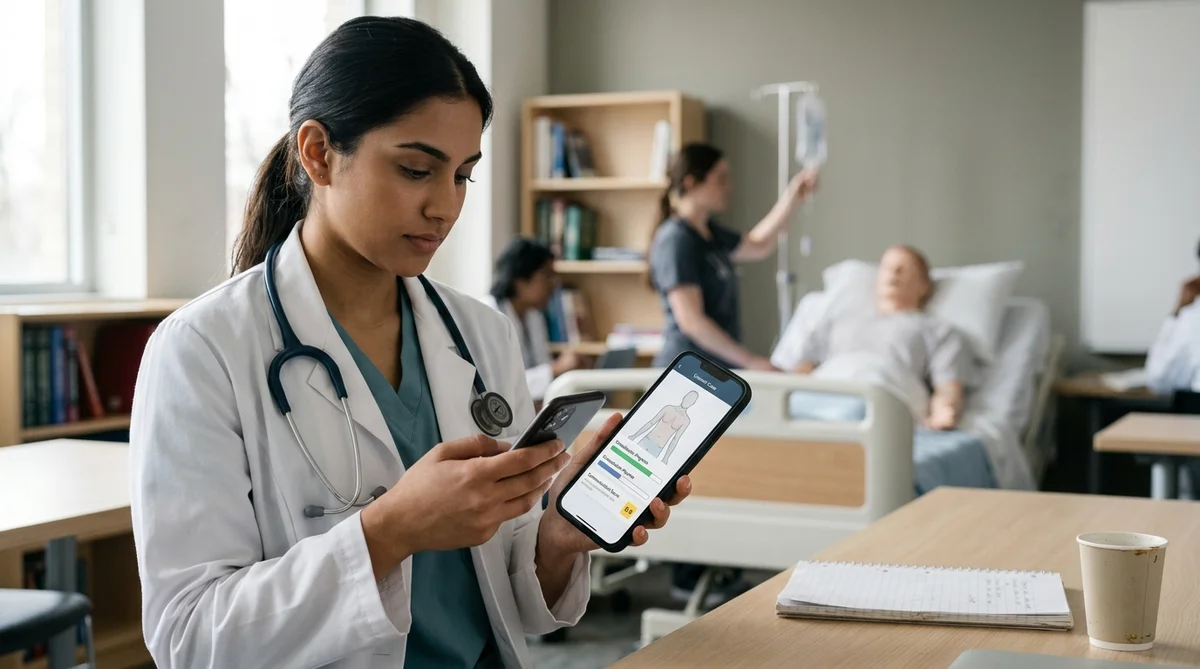
An OSCE practice app is a digital tool designed to simulate the Objective Structured Clinical Examination by providing virtual patient encounters and procedural checklists. These platforms allow students to practice clinical reasoning and communication skills in a low stakes environment before sitting high stakes exams. In the first quarter of 2026, the UK Nursing and Midwifery Council reported an overall pass rate of 78 percent for the 3,009 candidates who sat the exam (Source: nmc.org.uk).
Key takeaways
- OSCE design is mapped to the Shows How level of Miller's Pyramid of Clinical Competence (1990) to evaluate performance in a simulated setting.
- The 2026 NMC OSCE structure consists of 10 stations, including four linked APIE stations and four clinical skills stations.
- UK nursing candidates face a standard fee of 794 pounds, making high quality preparation tools a financial necessity for many.
- Individual test centers have reported first-attempt pass rates as low as 26 percent, highlighting the need for consistent practice outside of the classroom.
- Most digital apps use generic rubrics that might not match the specific marking criteria of individual medical schools or local regulatory bodies.
How did the OSCE become the gold standard?
The Objective Structured Clinical Examination was first described by Ronald Harden in 1975 as a method to improve the validity and reliability of clinical performance assessments. It was a direct response to traditional long case exams, which were often criticized for being too subjective and inconsistent between different examiners. By breaking the exam into multiple stations with standardized marking, Harden ensured that every student faced the same challenges under the same conditions (Source: ncbi.nlm.nih.gov).
Today, this format is the global benchmark for licensing in medicine and nursing. It doesn't just test what a student knows, but how they apply that knowledge in real time. For those preparing for these high pressure moments, using an AI roleplay training platform can provide the repetitive, low pressure practice needed to build muscle memory. This type of simulation helps bridge the gap between reading a textbook and standing in front of a real patient.
What makes the 2026 NMC OSCE structure unique?
The NMC OSCE structure for 2026 consists of 10 stations that test a wide range of competencies. These include four linked APIE stations, which stand for Assessment, Planning, Implementation, and Evaluation, alongside four clinical skills stations and two stations focusing on professional values and evidence-based practice (Source: nmc.org.uk). This structure requires a student to maintain a continuous narrative of care for a patient across multiple stages of treatment.
Practicing for APIE stations is often the most difficult part of exam prep because the stations are interdependent. If a student makes an error in the Assessment phase, it can cascade into the Planning and Evaluation phases. Many students find that using a virtual patient simulation helps them understand these dependencies. By practicing the full sequence repeatedly, they learn to spot their own errors before they reach the final Evaluation station. This is a significant part of soft skills training for teachers in 2026 classrooms who are now incorporating these tools into formal curricula.
Why do first attempt pass rates vary between centers?
In the first quarter of 2026, the Nursing and Midwifery Council reported that first-attempt pass rates at individual test centers ranged from 26 percent to 49 percent (Source: nmc.org.uk). This wide variance suggests that the environment and the specific preparation methods used by candidates at different locations significantly impact their success. While the overall pass rate is much higher at 78 percent, the initial hurdle remains a major challenge for many internationally educated nurses and UK graduates alike.
Scenario IQ is an AI-driven scenario-based simulation training platform for sales, customer service, support, medical and nursing education, and university student training. By providing a consistent, standardized environment for practice, platforms like Scenario IQ help eliminate the luck of the draw that can happen during peer-to-peer practice. When students rely only on friends for feedback, they often miss the subtle clinical errors that an AI trained on specific rubrics will catch every time. This consistency is essential for bringing those lower first-attempt pass rates up to the national average.
How does Miller's Pyramid define effective app practice?
OSCE design is frequently mapped to Miller’s Pyramid of Clinical Competence, a four-level framework established in 1990. The levels include Knows, Knows How, Shows How, and Does, with OSCEs specifically targeting the Shows How level of performance in a simulated environment (Source: ncbi.nlm.nih.gov). An effective OSCE practice app must focus on this third tier by requiring students to demonstrate their skills rather than just answering multiple-choice questions.
Many digital tools fail because they stay at the Knows How level, providing information without requiring performance. To move up the pyramid, a student needs to engage in active roleplay. This is why gamification in corporate training has become so popular, it encourages active participation and repetition. In a clinical context, this means the app should prompt the student to speak out loud, perform physical steps in the correct order, and respond to changing patient data in real time. This active engagement is what builds the competence required for the final Does level in real world practice.
The hidden risk of rubric divergence in digital tools
Rubric divergence occurs when the marking criteria used in a practice app don't align with the specific checklists used by an examiner. Most apps use generic or national rubrics, but many medical schools and international regulatory bodies, such as those for the PLAB 2 or USMLE Step 2 CS, have localized variations. If a student practices with a tool that uses a slightly different checklist, they might accidentally skip a step that their specific examiner considers mandatory.
Students should look for an OSCE practice app that allows for the customization of marking sheets. It's not enough to just practice a cardiovascular exam, you need to practice the cardiovascular exam exactly as your university marks it. This is similar to how a medical school interview practice guide must be tailored to specific institutional values. Without this alignment, a student might feel confident during practice but fail on the day because they didn't meet a specific, localized requirement that the app didn't include.
Addressing data privacy and voice recording security
Data privacy is a major concern that many third-party apps don't explicitly address, especially regarding voice recordings. Most modern OSCE apps use voice-to-text technology to evaluate communication skills, meaning the app is recording and storing sensitive student data. Students and universities must verify whether these apps comply with healthcare-specific data standards or general data protection regulations like GDPR.
Before choosing a platform, check if the provider explicitly states how they handle performance data. Many apps use these recordings to train their own AI models, which can be a privacy risk if the data isn't properly anonymized. Using modern training evaluation methods for 2026 involves ensuring that all digital footprints are secure and that student performance history isn't accessible to unauthorized parties. Security should be a primary factor in the selection process, not an afterthought.
Why is medical school OSCE data so hard to find?
While the NMC provides transparent pass rate statistics for nursing, specific aggregate pass rate data for medical school OSCEs is rarely publicly available. This lack of data makes it difficult for medical students to benchmark their performance against their peers on a national level. Most medical schools keep their OSCE results internal, which creates a transparency gap in the medical education sector.
This data gap is one reason why medical students often feel more anxiety about their finals than nursing students. Without a clear national average to aim for, they must rely entirely on internal university feedback. This environment makes standardized practice tools even more valuable. By using a platform that provides objective scores based on clinical guidelines, medical students can get a sense of their standing even without national statistics. It's about creating a personal benchmark in the absence of a public one.
Does AI practice lead to higher pass rates?
There is currently a lack of peer-reviewed evidence or independent comparative studies demonstrating whether AI-based app practice leads to higher pass rates than traditional face-to-face peer practice. While the technology is promising, most of the evidence is anecdotal or provided by the app developers themselves. This doesn't mean the tools don't work, but it means students should use them as a supplement to, rather than a replacement for, traditional methods.
The most successful candidates usually combine multiple types of preparation. They might use an AI roleplay training platform for solo practice during their commute and then meet with a group for physical skill practice in a lab. This blended approach ensures that they cover both the communication and the tactile aspects of the exam. As the technology matures, we expect to see more formal studies that measure the direct ROI of these digital simulations in clinical education.
FAQ
What is the standard fee for the NMC OSCE in the UK? The standard fee for sitting the NMC OSCE in the UK is 794 pounds as of 2026. If a candidate doesn't pass on their first attempt, a reduced resit fee of 397 pounds applies if they only need to retake seven or fewer stations. This high cost places significant pressure on students to pass on their first try, making the choice of a high quality OSCE practice app a critical financial decision. Candidates should ensure their chosen tool covers all 10 stations to maximize their chances of success and avoid the cost of a resit.
How many stations are in the 2026 nursing OSCE? The 2021 and 2026 NMC OSCE structure consists of 10 stations in total. These are divided into four linked APIE stations, which cover Assessment, Planning, Implementation, and Evaluation, plus four clinical skills stations. The final two stations focus on professional values and evidence-based practice. This variety ensures that the candidate is a well rounded professional who can handle both the technical and ethical aspects of nursing. Each station is timed and marked against a specific rubric that students must follow precisely to earn full marks.
Are voice recordings in OSCE apps kept private? Many third-party OSCE apps don't explicitly state their compliance with healthcare-specific data standards, which can be a concern for students. When you use an app that records your voice for communication practice, that data is often processed in the cloud. It's vital to check the privacy policy to see if recordings are anonymized or used for AI training. High quality platforms will offer enterprise-grade security to ensure that your performance data and voice samples are protected and not shared with outside parties without your clear consent.
Can an app replace practicing with a real partner? While an OSCE practice app provides excellent solo practice and objective feedback, it can't fully replace the experience of working with a real human partner. Physical clinical skills, like palpation or sterile dressing changes, require tactile feedback that a screen simply can't provide. However, apps are superior for practicing history taking and clinical reasoning because they don't get tired and can provide instant, unbiased feedback. The best strategy is to use AI for the communication and planning stations while using physical lab time for the manual skills stations.
Why is there no national pass rate for medical OSCEs? Unlike the Nursing and Midwifery Council, which publishes aggregate data for all candidates, medical schools in the UK and elsewhere typically keep their OSCE pass rates private. Each medical school often writes its own stations and rubrics, making a direct national comparison difficult. This lack of transparency means medical students have less benchmark data to work with during their preparation. Using a standardized practice platform can help bridge this gap by giving students a consistent way to measure their progress against established clinical guidelines used across the country.
Scenario IQ provides the AI-driven scenario-based simulation training your team needs to master high-stakes clinical interactions. Whether you are a university looking to standardize student feedback or an individual preparing for the 2026 NMC OSCE, our platform offers the adaptive guidance and real-time analytics to ensure you are ready for exam day. Start building your clinical confidence with our customizable roleplay simulations today.