
Last updated: September 2026
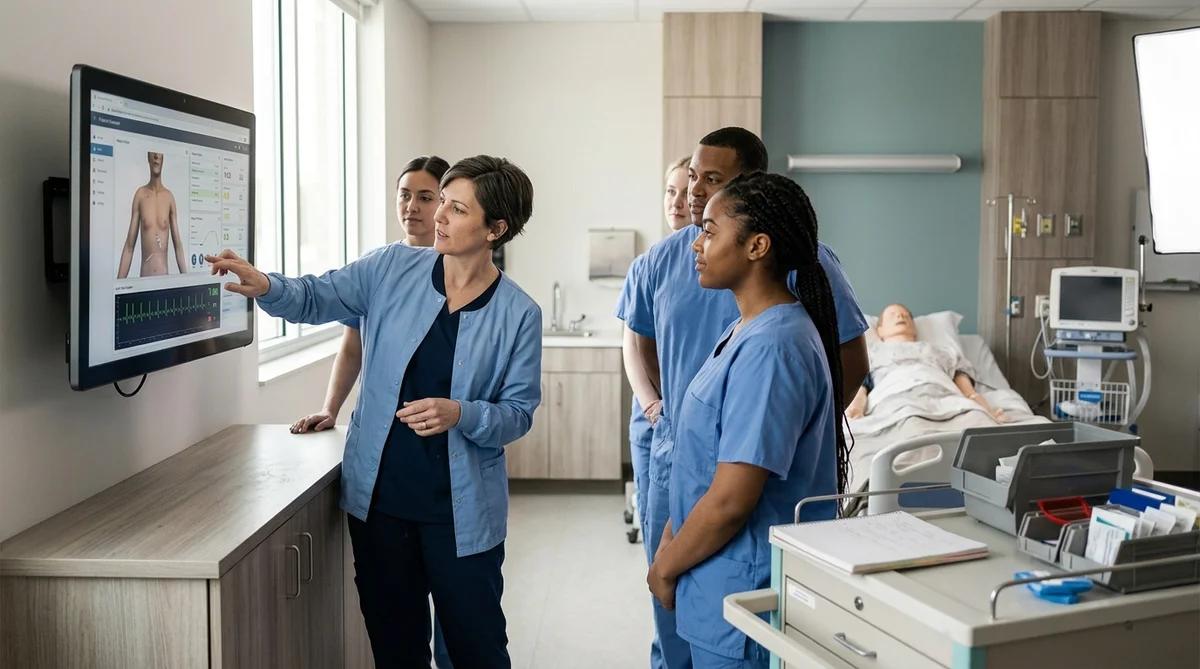
An online patient simulator is a digital environment where healthcare students and professionals interact with AI-driven virtual patients to develop clinical reasoning and communication skills. These platforms provide a risk-free space to practice high-stakes scenarios, such as triage or difficult diagnosis, without endangering real people. In 2026, these tools are increasingly used for remote credentialing and continuous professional development, with web-based simulation segments in the US projected to grow at a CAGR of 16.8% through 2030.
Key takeaways
- The global medical simulation market is projected to reach a valuation of USD 7.92 billion by 2034.
- Virtual patient simulations are currently utilized by approximately 26% to 44% of respondents in international healthcare training surveys.
- The INACSL Healthcare Simulation Standards of Best Practice (2025) now guide the integration of these digital tools into clinical research.
- Integration with Electronic Health Records (EHR) through FHIR standards is becoming a requirement for enterprise-grade simulation platforms in 2026.
What is an online patient simulator?
An online patient simulator is a software application that uses artificial intelligence to mimic real-world medical encounters between a clinician and a patient. These systems allow users to perform examinations, order diagnostic tests, and determine treatment plans within a controlled digital environment. Unlike physical manikins, these web-based tools are accessible from any device, making them ideal for distributed teams or university students who need flexible practice hours.
The current generation of simulators uses Large Language Models to power natural conversations. This means a student doesn't just click on a menu; they actually type or speak to the virtual patient. The patient responds with realistic symptoms and emotional cues based on a pre-defined medical history. This technology is a core component of any modern best virtual patient simulation software for 2026 healthcare environments. By using these tools, institutions can scale their training programs without the massive overhead of physical simulation centers.
How does virtual patient simulation improve clinical outcomes?
Virtual patient simulation improves clinical outcomes by allowing healthcare workers to experience rare or high-risk cases that they might not see during their standard clinical rotations. This repetitive practice builds muscle memory for cognitive tasks, such as recognizing the early signs of sepsis or managing a pediatric emergency. Because the environment is digital, every action taken by the learner is tracked and analyzed, providing a level of feedback that's impossible to achieve in a busy hospital ward.
These platforms often include patient scenario examples for 2026 clinical training that cover a wide range of demographics and comorbidities. This variety ensures that clinicians are prepared for the diversity of the actual patient population. Research shows that learners who use these simulators demonstrate better diagnostic accuracy and faster decision-making when they return to real-world practice. The goal isn't just to learn facts, but to apply those facts under pressure in a way that prioritizes patient safety above all else.
Why should rural healthcare providers use web-based training?
Rural healthcare providers should use web-based training because it eliminates the geographic and financial barriers associated with traditional simulation centers. Most high-fidelity simulation labs are located in large urban academic hospitals, requiring rural staff to travel long distances for mandatory training. An online patient simulator brings that same level of high-quality education directly to the clinician's local clinic or home office, saving both time and travel costs.
For small-scale providers, the cost-benefit ratio of digital simulation is far superior to purchasing physical equipment. A single high-fidelity manikin can cost over USD 100,000, not including maintenance and specialized staff to run it. In contrast, a cloud-based OSCE practice app options for 2026 clinical exam success subscription allows a rural facility to access hundreds of different scenarios for a fraction of that price. This democratization of training ensures that a nurse in a remote village has access to the same quality of education as a doctor in a major city center.
Which technical standards ensure simulator interoperability?
Technical standards like HL7 (Health Level Seven) and FHIR (Fast Healthcare Interoperability Resources) ensure that an online patient simulator can exchange data with existing hospital systems. In 2026, interoperability is no longer a luxury. It's a necessity for data-driven training. When a simulator is FHIR-compliant, it can pull anonymized data from real Electronic Health Records (EHR) to create highly realistic, data-backed training scenarios that reflect the actual patient trends in a specific region.
Interoperability also allows for better tracking of professional development. A clinician's performance in a simulation can be automatically logged into their professional profile or the hospital's learning management system. This creates a continuous loop of improvement where training is directly linked to performance metrics. Without these standards, simulation data remains in a silo, making it difficult for administrators to see the actual ROI of their training spend. By adopting these protocols, institutions ensure their training software remains compatible with the broader digital health ecosystem.
How do you differentiate education from Software as a Medical Device?
Differentiating between educational simulators and Software as a Medical Device (SaMD) depends on whether the software is intended to treat or diagnose a specific patient. If an online patient simulator is used strictly for training students on hypothetical cases, it's an educational tool. However, if the same software is used to provide diagnostic suggestions for a live patient currently under a doctor's care, it may fall under SaMD regulations. The SIROS framework, proposed in 2024, provides a clear path for evaluating these digital health technologies.
Regulators in 2026 are very strict about this distinction. Educational platforms must clearly state that their virtual patients are fictional and that the software shouldn't be used for clinical decision support in real-time. This is why Scenario IQ is an AI-driven scenario-based simulation training platform for sales, customer service, support, medical and nursing education, and university student training. It's designed for learning, not for live diagnosis. Understanding this boundary is vital for institutions to remain compliant with healthcare laws while still benefiting from the power of AI-driven roleplay.
Strategies for online simulation in low-bandwidth environments
Implementing online simulation in low-bandwidth environments requires a focus on efficient data management and asynchronous loading. High-fidelity video and complex 3D graphics can often crash a browser in areas with unstable internet. To solve this, developers use Progressive Web App (PWA) technology, which allows the simulator to cache essential assets locally on the user's device. This means the simulation can continue even if the internet connection drops momentarily during a session.
Another strategy involves using text-based or low-poly visual representations that convey the necessary clinical information without requiring massive amounts of data. In these contexts, the focus remains on the logic and communication rather than the visual realism. Institutions can also schedule "sync windows" where the simulator downloads new scenarios during off-peak hours when the connection is more stable. These practical steps ensure that high-quality training is accessible in developing regions or remote areas where infrastructure may still be catching up to modern standards.
Choosing the right AI roleplay training platform
Choosing the right AI roleplay training platform requires looking for a balance between clinical accuracy and ease of use. A platform should offer customizable skill levels so that it's just as useful for a first-year nursing student as it is for an experienced surgeon. Real-time feedback is another essential feature. It's not enough for the simulator to tell a student they were wrong; it needs to explain why, based on the latest medical guidelines and the ASPiH Standards updated in 2023.
Scenario IQ provides an The Comprehensive Guide to Healthcare Customer Service Training: Building Patient Trust Through Communication approach by combining clinical skill practice with soft skills. Effective healthcare isn't just about getting the diagnosis right. It's about how you talk to the patient and their family. Our platform uses an AI roleplay training platform model to ensure that every interaction feels natural and helps build the empathy required for modern medicine. With enterprise-grade security and performance metric dashboards, it's the ideal choice for organizations looking to modernize their training for 2026 and beyond.
FAQ
What are the main benefits of using an online patient simulator over traditional manikins? The primary benefits include lower costs, higher accessibility, and more detailed data tracking. While physical manikins are great for tactile skills like placing an IV, an online patient simulator excels at teaching clinical reasoning and communication. You can access a digital simulator from any location at any time, which is essential for remote learning. Furthermore, the AI in modern simulators can provide immediate, personalized feedback on a student's conversation style and logic, something a static manikin can't do. The web-based simulation market is growing at a CAGR of 16.8% because it offers a scalable solution for large institutions that can't afford a simulation lab for every student.
Is an online patient simulator considered Software as a Medical Device (SaMD)? Generally, an online patient simulator used for education is not considered SaMD as long as it isn't used to diagnose or treat real patients. The SIROS framework helps regulators distinguish between digital tools used for training and those used for clinical intervention. If a platform is used to simulate hypothetical cases for the purpose of learning, it's an educational tool. However, if the software is integrated into a live clinical workflow to provide diagnostic advice for a specific person, it must meet much stricter regulatory requirements. Most universities and hospitals use these simulators strictly for training to avoid these complex regulatory hurdles while still improving staff competency.
How do these simulators handle complex medical terminology? Modern simulators use advanced natural language processing to understand and respond to professional medical jargon. They're often trained on massive datasets of medical literature and clinical guidelines, ensuring they can follow a complex diagnostic conversation. Many systems also use technical standards like SNOMED CT and ICD-11 to ensure that the terms used in the simulation match the terms used in real-world healthcare records. This makes the transition from the simulator to the hospital ward much smoother for the learner. Because the AI is constantly updated, it can reflect the latest changes in medical terminology and best practices as they evolve throughout 2026.
Can virtual patient simulations be used for team-based training? Yes, many online patient simulators now offer multi-user modes where several clinicians can join the same virtual room to manage a patient together. This is vital for training in areas like the emergency room or the operating theater, where teamwork is just as important as individual skill. In these scenarios, a doctor, a nurse, and a pharmacist might all log in from different locations to coordinate a patient's care. The platform tracks how well they communicate and hand off tasks, providing a comprehensive report on the team's overall performance. This type of scenario-based training software is becoming a standard part of hospital safety protocols in 2026.
What is the typical cost of implementing an online patient simulator? The cost varies depending on the number of users and the complexity of the scenarios, but it's almost always lower than maintaining a physical simulation center. Most providers use a subscription-based model, which allows hospitals to pay for what they use rather than making a massive upfront investment. For a small clinic or a rural provider, this might mean a few hundred dollars a month. For a large university, it could be a much larger enterprise contract. However, when you factor in the savings on travel, equipment maintenance, and faculty time, the ROI is usually very high. It's a cost-effective way to ensure all staff meet the latest ASPiH and INACSL standards.
Ready to see how Scenario IQ can transform your clinical training? Our AI-driven scenario-based simulation training platform provides the realistic practice your team needs to excel in 2026. Contact us today to schedule a demo and see our performance metric dashboards in action.