

Sales coaching has always had a data problem. Managers hear a handful of calls, skim a few emails, and rely on rep self-reporting to understand what is really happening in the field. Meanwhile, buying cycles speed up, product lines expand, and prospects expect consultative conversations across phone, video, chat, and email.
Natural language processing AI changes that by turning everyday customer interactions into coaching signals you can act on. Instead of coaching from memory or anecdote, you can coach from patterns: which objections show up most, where deals stall, what top performers do differently, and how quickly new reps are improving.
What “natural language processing AI” means in sales coaching
Natural language processing (NLP) is the branch of AI that helps computers understand, analyze, and generate human language. In a sales environment, NLP typically works on:
- Spoken language, after it is converted into text (speech-to-text)
- Written language, like emails, chat, support tickets, and meeting notes
Modern NLP often includes “large language models” (LLMs), which can summarize conversations, draft messages, and evaluate responses against a rubric. Classic NLP techniques still matter too, especially for reliable pattern detection (keywords, entities, intent classification).
If you want a reputable baseline definition, IBM’s overview of NLP is a helpful reference for how NLP systems interpret language and extract meaning from text data.
Why NLP is a big leap forward for sales coaching
Traditional coaching is limited by time and sampling. Even strong managers can only observe a small slice of rep activity. NLP expands the coaching surface area without asking managers to spend hours listening to recordings or reading threads.
More importantly, NLP changes the type of coaching you can deliver:
- From reactive coaching (“that call went poorly”) to preventative coaching (“this objection is rising in early-stage deals, let’s train it this week”)
- From generic coaching (“ask better questions”) to specific coaching (“you asked two closed questions after price came up, try a discovery pivot and confirm impact”)
- From inconsistent coaching (dependent on manager style) to standardized coaching (aligned rubrics and measurable skills)
The NLP signals that matter most for coaching
Not every language signal is equally useful. The best coaching programs focus on signals that map directly to behaviors you can practice.
| NLP signal | What it detects | Example coaching action |
|---|---|---|
| Talk-to-listen ratio (on transcript) | Whether the rep dominates the conversation | Practice a discovery sequence and “pause and confirm” moments |
| Question quality | Open vs closed questions, follow-up depth | Coach on 2–3 high-impact follow-ups tied to the ICP |
| Objection themes | Common friction points (price, timing, competitor) | Build a weekly objection drill and track improvement |
| Sentiment and emotional cues | Frustration, confidence, uncertainty (imperfect but directional) | Coach de-escalation language and empathy statements |
| Topic coverage | Whether key topics were addressed (ROI, security, timeline) | Provide a checklist and run a scenario that stresses missing areas |
| Competitive mentions | Competitors, comparisons, feature gaps | Create a battlecard roleplay focused on differentiation |
| Next-step clarity | Whether a specific mutual action plan was set | Coach on closing language and calendar anchoring |
A practical takeaway: prioritize signals tied to repeatable behaviors, then build training loops that let reps rehearse those behaviors until they stick.
Where NLP fits in a modern sales coaching system
Most teams get the best results when NLP supports coaching in three layers.
1) Insight layer: Understand what is happening at scale
NLP helps you summarize and categorize what is occurring across:
- Calls and video meetings (after transcription)
- Email threads
- Website chat and inbound conversations
- Support interactions that impact renewals and expansion
This layer answers questions like:
- What objections are trending this month?
- Which segments are most likely to ask about security or compliance?
- Are reps consistently messaging value, or drifting into features?
2) Coaching layer: Turn insights into specific feedback
Good coaching is precise. NLP makes precision easier by pointing to moments that matter:
- The exact turn where the rep missed a buying signal
- The phrasing that escalated tension
- The moment the rep introduced pricing too early
This is also where consistency improves. If your organization defines what “great discovery” means, NLP-supported coaching can reinforce that definition across teams and managers.
3) Practice layer: Convert feedback into behavior change
Insights and feedback do not create performance on their own. Reps need practice, ideally in realistic scenarios that match their market.
This is where AI roleplay training is especially valuable: reps can rehearse responses, get immediate feedback, and repeat until the skill is automatic.
NLP for roleplay coaching: why practice beats post-call critique
Post-call coaching is valuable, but it is still a “live-fire” learning model. The rep learns after the outcome is already determined.
NLP-enabled roleplay flips the script:
- Reps can practice before the next high-stakes meeting
- Coaching can be personalized based on the objections and gaps each rep is showing
- Feedback can be delivered in the moment, while the rep is still engaged
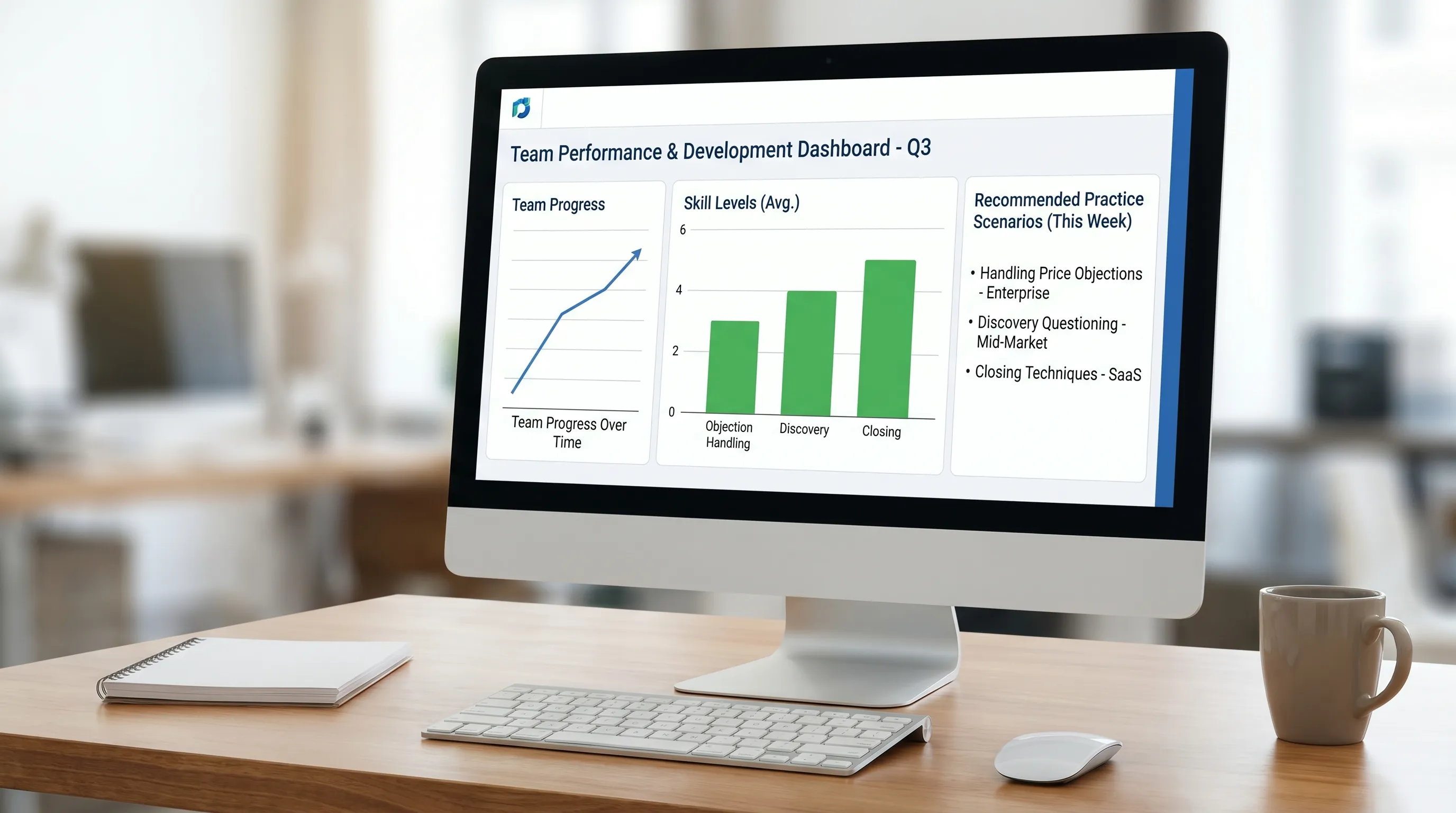
Scenario IQ is designed for this practice layer: AI-powered roleplay simulations, personalized training scenarios, and real-time feedback that helps reps build confidence and handle objections. It also supports progress tracking analytics so leaders can see improvement trends without guessing.

Use cases: NLP-driven coaching across the revenue team
NLP is not only for account executives. The same underlying capability, understanding language at scale, can support different roles.
SDR and BDR teams
- Improve opening messaging and personalization
- Practice handling common deflections (“send me info”, “not a priority”)
- Reinforce qualification frameworks through roleplay
Account executives
- Strengthen discovery depth and multi-threading
- Rehearse procurement and legal conversations
- Practice competitive positioning and value-based pricing language
Customer success and account management
- Detect churn risk language patterns earlier
- Coach renewal conversations and expansion discovery
- Practice de-escalation and expectation setting
Support and service teams
- Improve empathy and clarity under pressure
- Coach compliance language when required
- Reduce escalations through consistent communication patterns
How to roll out natural language processing AI for sales coaching (without chaos)
The biggest implementation mistake is treating NLP as a “plug it in and magic happens” tool. You will get far better results if you set it up like an operational system.
Start with a coaching rubric, not a model
Define the behaviors you want:
- What does strong discovery look like for your ICP?
- What objection responses are approved and effective?
- What does a good next step sound like?
Then use NLP to measure and reinforce those behaviors.
Choose a narrow pilot that proves value
Pick a use case where performance improvement is easy to observe, such as:
- Objection handling for one product line
- Onboarding a new cohort of reps
- Improving next-step setting at the end of first calls
Create a closed loop: insight, practice, reassess
The goal is not “better reports.” The goal is behavior change.
A simple operating rhythm looks like this:
- Review trends weekly (top objections, missed topics, deal friction)
- Assign targeted roleplay practice aligned to the trends
- Track whether the targeted behaviors show up more often in real conversations
Address governance early (privacy, consent, and access)
Sales and service conversations often contain sensitive customer information. Any NLP program should clarify:
- What data is used for training and evaluation
- Who can access transcripts and coaching outputs
- How long data is retained
- How you handle redaction and compliance requirements
Scenario IQ notes enterprise-grade security as part of its platform positioning, which matters when training touches customer-facing communication.
Measuring ROI: what to track (and what to ignore)
One reason teams struggle with coaching ROI is that they only look at lagging metrics. NLP makes it easier to track leading indicators that predict revenue outcomes.
| Metric type | What to track | Why it matters |
|---|---|---|
| Leading (skill) | Objection-handling score, discovery coverage, next-step clarity | Shows whether behavior is improving before pipeline updates |
| Leading (activity quality) | Consistency of key talk tracks, reduction in risky phrases | Indicates message discipline and reduced deal variance |
| Lagging (business) | Win rate, sales cycle length, expansion rate, churn | Confirms whether coaching improvements translate to outcomes |
| Enablement efficiency | Time-to-ramp, manager coaching hours per rep | Measures whether AI support reduces the cost of improvement |
What to ignore at first: overly complex sentiment scoring as a “truth.” Sentiment can be useful directionally, but it is rarely the best primary KPI.
Common pitfalls (and how to avoid them)
Treating AI feedback as a verdict
NLP outputs should be coachable prompts, not final judgments. The strongest programs keep humans in the loop for calibration and context.
Coaching to the metric instead of the customer
If reps feel they are being graded on superficial markers (keyword stuffing, scripted phrasing), they will game the system. Prevent this by anchoring evaluation to outcomes like clarity, relevance, and next-step quality.
Inconsistent enablement content
If different managers teach different standards, NLP insights can create confusion rather than clarity. A shared rubric and shared practice scenarios reduce that risk.
Tool sprawl across workflows
Coaching is only part of the rep’s work. Many teams pair roleplay training with productivity copilots that help reps draft follow-ups, summarize meetings, and prepare account plans inside the tools they already use. For example, an AI copilot that integrates directly with Microsoft 365 and Google Workspace can reduce busywork and keep reps focused on selling, see CoreGPT Apps for Microsoft 365 and Google Workspace.
What “better sales coaching” looks like with Scenario IQ
Sales coaching improves when it is:
- Frequent (short practice sessions beat occasional deep dives)
- Personalized (based on each rep’s gaps and deal realities)
- Safe to fail (practice before the real conversation)
- Measurable (progress tracking that supports manager action)
Scenario IQ’s approach aligns with that model through AI-driven scenario-based training, adaptive simulations, real-time feedback, and actionable analytics. Rather than relying only on post-call critique, teams can build a repeatable practice habit that improves confidence, objection handling, and communication.
Frequently Asked Questions
What is natural language processing AI in sales coaching? Natural language processing AI analyzes spoken and written customer conversations (calls, emails, chats) to identify patterns like objections, topic coverage, and messaging quality, then turns those patterns into coaching and practice recommendations.
Does NLP replace sales managers and coaches? No. NLP improves coaching leverage by surfacing moments and trends that managers cannot catch consistently. The best results come from human-led coaching supported by AI insights and structured practice.
What data do you need to start using NLP for coaching? Many teams start with call transcripts and a coaching rubric. You can expand later to email, chat, and support interactions, as long as you address consent, privacy, and access controls.
How do you measure whether NLP-driven coaching is working? Track leading indicators (objection-handling performance, next-step clarity, discovery coverage) alongside lagging outcomes (win rate, cycle length, churn). Look for consistent skill improvement before expecting major revenue shifts.
Is AI roleplay useful for experienced reps, or only new hires? It helps both. New hires use it to ramp faster, experienced reps use it to sharpen competitive responses, practice pricing conversations, and stay consistent when new products or messaging roll out.
Build a coaching loop that actually changes behavior
If you want NLP insights to translate into better revenue outcomes, connect analysis to practice. Scenario IQ helps teams run that loop with AI roleplay simulations, personalized scenarios, real-time feedback, and progress analytics.
Explore Scenario IQ at scenarioiq.ai to see how AI-driven training can strengthen objection handling, confidence, and sales and service performance.