

Confidence is one of the most talked about outcomes in sales training, and one of the least measured. Most teams feel it in the room (reps speak up more, handle pushback with less hesitation), but struggle to translate that into a repeatable metric they can track over time and tie to outcomes.
A practical way forward is to treat confidence like any other performance variable: define it, measure it from multiple angles, and report the change using a consistent formula.
Why confidence is hard to measure (and why it still matters)
In sales, “confidence” usually blends two related concepts:
- Self-efficacy: a rep’s belief that they can execute a specific selling behavior (for example, “I can negotiate price without discounting immediately”).
- Composure under pressure: staying effective when a buyer challenges, rejects, or stalls.
Psychology research has long linked self-efficacy to performance across work contexts. For example, a well-cited meta-analysis found a meaningful relationship between self-efficacy and work-related performance outcomes (Stajkovic & Luthans, 1998). In other words, confidence is not just “nice to have,” it can be a leading indicator for skill application.
The measurement challenge is that confidence is partly internal (beliefs) and partly external (observable behavior). If you only measure self-report, you risk optimism bias. If you only measure behavior, you miss mindset shifts that predict future behavior.
The Simple Confidence Gains Model (3 metrics, 1 score)
Use three components, each scored from 0 to 100. Then compute gains from baseline to follow-up.
Component A: Role Confidence (self-report)
This is a short survey that measures confidence in specific sales moments, not general confidence.
Good items are scenario-based and behavior-specific:
- “I can open a discovery call and set a clear agenda.”
- “I can ask budget/timeline questions without sounding pushy.”
- “I can handle ‘Your price is too high’ without discounting immediately.”
- “I can recover quickly when I get interrupted or challenged.”
Use a 0 to 10 scale per item, then convert to 0 to 100.
If you want a theoretical grounding for self-efficacy, the American Psychological Association provides an accessible overview of the concept and why it matters (APA on self-efficacy).
Component B: Role Competence (observed performance)
This is a structured score from practice interactions (live roleplays, call reviews, or AI roleplay simulations). The key is consistency in scoring.
Score the same core behaviors each time:
- Opening and agenda setting
- Questioning quality (open vs leading, depth, follow-ups)
- Value articulation (clarity, relevance to buyer needs)
- Objection handling (acknowledge, probe, respond, confirm)
- Next step control (clear ask, mutual plan)
Each category can be 0 to 5, converted to 0 to 100.
Component C: Pressure Response (stability under objection)
This captures the part most teams mean when they say “confidence.” It measures whether the rep’s performance holds up when the buyer pushes back.
One simple method: include a planned “pressure moment” in the assessment, then score:
- Time to first effective response (hesitation and verbal clutter)
- Emotional control markers (defensiveness, over-talking, apologizing for price)
- Recovery quality (did they return to discovery/value, or spiral into features/discounting?)
Convert to a 0 to 100 score.
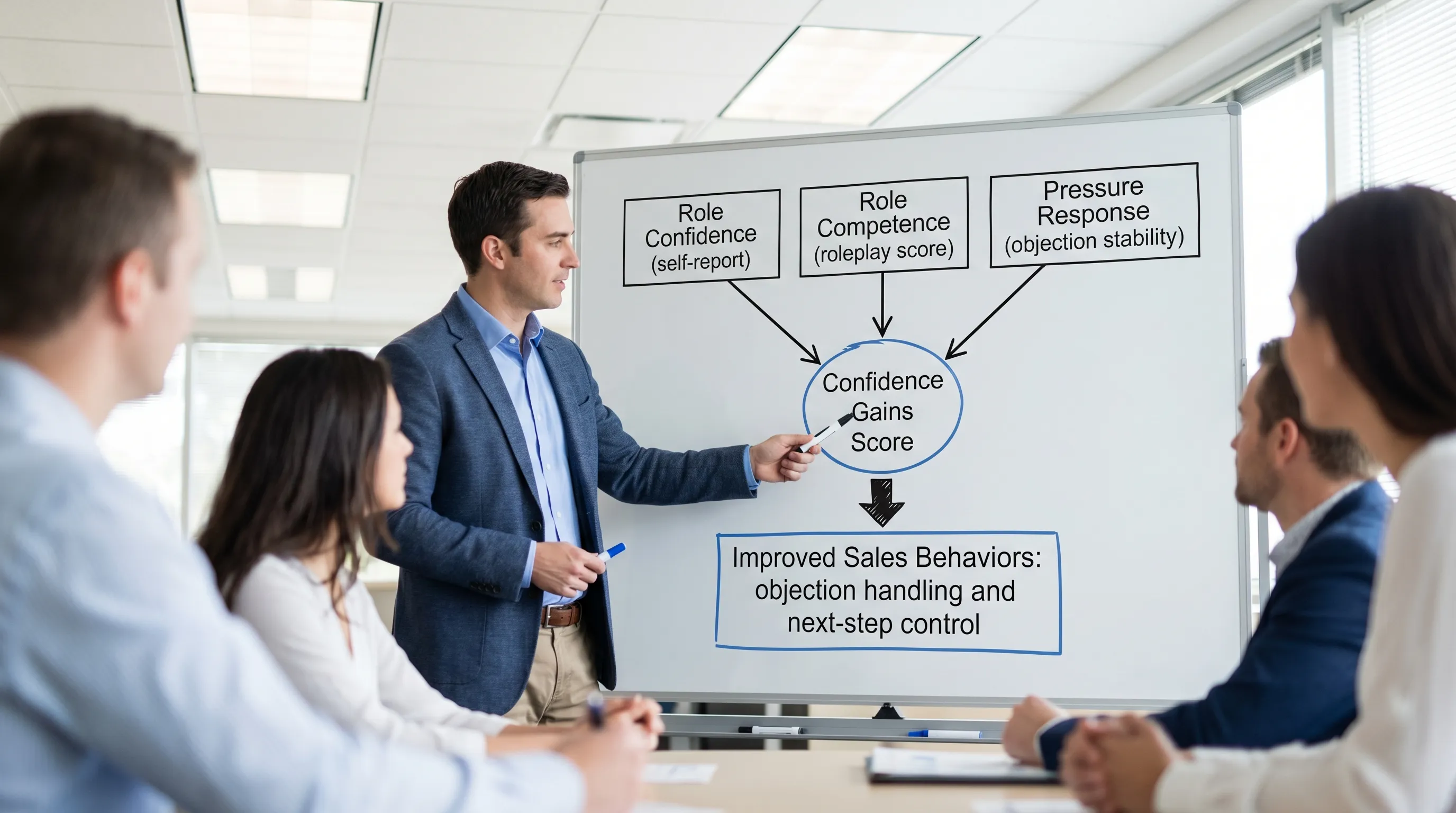
The scoring method: Confidence Gains Score (CGS)
Start by calculating each component’s change from baseline to follow-up. Then compute a weighted average.
A straightforward default weighting that works well in sales training:
- Role Confidence: 30% (important, but subjective)
- Role Competence: 50% (most predictive, observable)
- Pressure Response: 20% (key in real deals)
You can adjust weights based on your training goals (for example, increase Pressure Response if the team struggles with objections).
CGS formula
- CGS = 0.3(ΔConfidence) + 0.5(ΔCompetence) + 0.2(ΔPressure)
Where each Δ is the follow-up score minus the baseline score (0 to 100 scale).
Model summary table
| Component | What it measures | How to collect | Typical cadence | Why it matters |
|---|---|---|---|---|
| Role Confidence | Belief in ability to execute specific moments | 8 to 12 item survey | Baseline + every 30 to 60 days | Predicts willingness to attempt skills in real calls |
| Role Competence | Execution quality in a consistent scenario | Structured rubric scoring | Weekly or biweekly sampling | Most direct evidence that training changed behavior |
| Pressure Response | Stability during objections or buyer challenge | “Pressure moment” score | Baseline + monthly | Captures composure, reduces freeze/discount reactions |
How to run the measurement in 14 days (baseline to first read)
You do not need a quarter to get signal. You need consistency.
Step 1: Pick one sales moment to measure
Examples:
- Handling “We’re happy with our current vendor.”
- Discovery that leads to a next step.
- Price objection without discounting.
The narrower the moment, the cleaner your confidence measurement.
Step 2: Build a baseline assessment
In the same week:
- Run the short confidence survey.
- Run a roleplay assessment (live or simulated) using the same prompt for everyone.
- Insert the same pressure moment for everyone.
Step 3: Train and practice (the intervention)
Over the next one to two weeks, focus on practice reps, not content consumption. Confidence gains come from repeated exposure plus feedback.
AI roleplay can help here because it makes practice frequent and consistent. Platforms like Scenario IQ are designed around AI-powered roleplay simulations, personalised training scenarios, and real-time feedback, which are the conditions you need to create measurable changes in competence and pressure response.
Step 4: Re-test with the same setup
Keep the scenario structure the same. If you change the scenario dramatically, you are measuring a different skill.
A worked example (what “good” looks like)
Here is a sample rep’s baseline and follow-up after two weeks of focused practice.
| Metric | Baseline | Follow-up | Change (Δ) |
|---|---|---|---|
| Role Confidence (survey) | 62 | 74 | +12 |
| Role Competence (rubric) | 55 | 70 | +15 |
| Pressure Response (objection stability) | 48 | 60 | +12 |
CGS = 0.3(12) + 0.5(15) + 0.2(12) = 3.6 + 7.5 + 2.4 = 13.5 points
A 10+ point lift in two weeks is often a strong early signal, especially if Competence moves with Confidence.
Add one safeguard: measure calibration (confidence vs competence)
A common failure mode in training is “confidence inflation,” when self-report rises but execution does not.
Track a simple calibration gap:
- Calibration Gap = Role Confidence score minus Role Competence score
Interpretation:
- Gap near 0: confidence and skill are aligned.
- Positive gap (for example +20): reps feel confident but are not executing at the same level (risk of poor calls).
- Negative gap (for example -15): reps execute better than they feel (coaching opportunity to increase ownership and consistency).
This is also where consistent practice feedback matters. Real-time feedback loops reduce the chance that reps “feel better” without changing behavior.
What to report to leadership (without overpromising)
Confidence metrics are most useful when you report them as leading indicators that connect to operational outcomes.
A clean monthly reporting package:
- CGS trend over time (team average and distribution)
- Calibration Gap trend (are reps getting more accurate about their skill?)
- Skill-specific movement (for example, price objection competence +18)
- Operational correlate (one relevant KPI, like meeting-to-opportunity conversion or discount rate)
Be careful with causal claims. Confidence gains do not automatically “cause revenue,” but they often show whether training is changing the behaviors that drive revenue.
Where AI roleplay fits (and why it improves measurement)
Traditional roleplay measurement struggles with rater inconsistency and limited practice volume. AI roleplay improves the measurement conditions:
- Standardized scenarios: everyone gets the same baseline prompt, making comparisons fairer.
- Higher practice frequency: more reps, more reps, more data points.
- Immediate feedback: tighter loop between attempt and correction.
- Progress tracking analytics: easier to visualize skill movement over time.
Scenario IQ specifically positions itself around adaptive simulations, real-time feedback, and progress tracking analytics, which map directly onto the Competence and Pressure Response components of this model.
Common pitfalls (and quick fixes)
Pitfall: Measuring “confidence” with one vague question
If you ask, “How confident are you in sales?” you will get noise.
Fix: measure confidence by sales moment and behavior.
Pitfall: Changing the scenario every time
Variety is great for learning, but it makes measurement messy.
Fix: keep one “benchmark scenario” constant for testing, and use other scenarios for practice.
Pitfall: Only measuring after the training ends
You miss early signals and cannot adjust.
Fix: do baseline, then quick follow-up in 14 to 30 days, then monthly.
Frequently Asked Questions
What is the best way to measure confidence gains in sales training? Combine self-report confidence for specific sales moments with observed roleplay performance and a pressure response score, then track the change over time.
How often should we measure confidence gains? Run a baseline, then a follow-up in 14 to 30 days for early signal. After that, monthly measurement works well for most teams.
What if reps report higher confidence but their roleplay scores do not improve? Track a calibration gap (confidence minus competence). A widening gap suggests confidence inflation, and you should increase structured practice and feedback.
Can AI roleplay be used for confidence measurement? Yes, AI roleplay can standardize scenarios, increase practice volume, and provide consistent feedback and analytics, which improves confidence and competence tracking.
Turn confidence into a trackable training outcome
If you want to stop relying on anecdotal feedback like “the team feels better,” build your baseline assessment and start tracking CGS and calibration in the next two weeks. Then, reinforce the gains with frequent practice and fast feedback.
To operationalize this with less admin burden, explore Scenario IQ for AI-driven roleplay simulations, personalised scenarios, real-time feedback, and analytics that help you monitor progress across individuals and teams.