
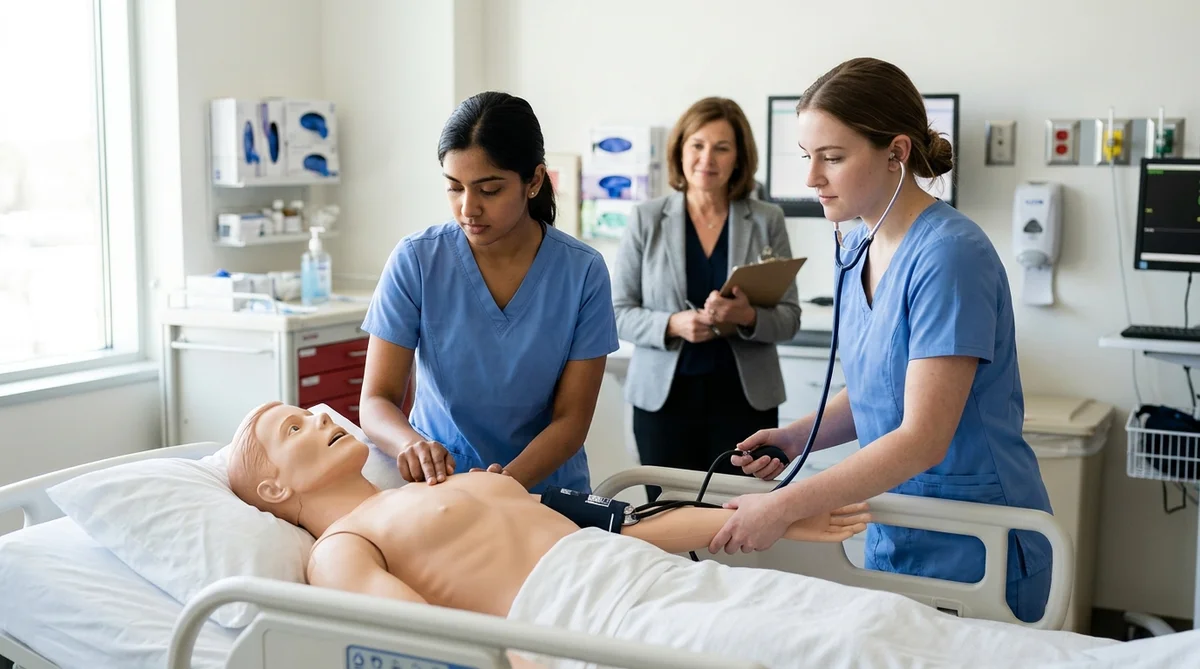
A nursing simulation lab is a controlled environment where students practice clinical skills using high-fidelity manikins and virtual patient simulations to bridge the gap between theory and practice. These labs reduce clinical errors by providing a risk-free space for repetitive training, often resulting in a 30% improvement in student confidence and procedural accuracy before they enter a real-world hospital setting.
What is a Nursing Simulation Lab and Why is it Essential?
The nursing simulation lab serves as the bridge between the lecture hall and the hospital floor. In these specialized facilities, nursing students and practicing professionals engage in hands-on learning that mimics real-life healthcare scenarios. The objective is not merely to teach technical tasks, such as inserting an IV or catheter, but to foster critical thinking, clinical judgment, and effective communication under pressure. Unlike traditional clinical rotations, where a student may or may not encounter a specific rare condition, a simulation lab allows educators to ensure every learner experiences high-stakes, low-frequency events.
As healthcare becomes increasingly complex, the demand for highly skilled nurses has never been greater. The simulation lab provides a safe environment where mistakes do not result in patient harm. This psychological safety allows learners to explore the consequences of their actions, receive immediate feedback, and refine their techniques until they reach a level of mastery. This is particularly vital for soft skills training for college students, as bedside manner and empathetic communication are just as critical as technical proficiency.
How Does a Nursing Simulation Lab Improve Patient Safety?
Patient safety is the cornerstone of modern healthcare, and the nursing simulation lab is its primary training ground. By simulating adverse events—such as cardiac arrest, allergic reactions, or post-operative hemorrhaging—nursing programs can prepare students to react instinctively and correctly. Research consistently shows that teams who train in high-fidelity simulations exhibit better coordination and faster response times in actual clinical emergencies.
The use of standardized protocols within the lab ensures that students are not just learning how to perform a task, but how to perform it according to the highest safety standards. For instance, many labs now integrate electronic health record (EHR) training into their simulations, forcing students to document their actions in real-time, which reduces the risk of transcription errors in the field. Furthermore, the ability to record and replay simulation sessions allows students to witness their own performance objectively, identifying subtle errors in hand hygiene or patient identification that might otherwise go unnoticed.
Key Components of a High-Fidelity Simulation Environment
To create a truly immersive experience, a nursing simulation lab must incorporate several layers of technology and environmental design. These components range from physical hardware to sophisticated software platforms that manage the logic of the scenario.
- High-Fidelity Manikins: These are sophisticated robotic patients that breathe, have pulses, blink, and react to medications. They can exhibit physiological changes such as cyanosis or pupil dilation, providing immediate physical cues to the learner.
- The Control Room: This is where the simulation technician or faculty member operates the manikin and monitors the scenario. It is usually separated from the lab by a one-way mirror, allowing the instructor to see the students without being a distracting presence.
- Audio-Visual Integration: Cameras and microphones capture every movement and word spoken during the simulation. This data is essential for the debriefing process.
- Virtual Patient Simulation: Beyond physical manikins, many modern labs utilize software-based virtual patient simulation to allow students to practice diagnostic reasoning and communication from any location.
| Feature | Low-Fidelity | Mid-Fidelity | High-Fidelity |
|---|---|---|---|
| Equipment | Task trainers (e.g., an arm for IV practice) | Basic manikins with heart/lung sounds | Fully interactive robotic manikins |
| Realism | Focuses on one specific skill | Anatomically correct but limited interaction | Full physiological response and environmental realism |
| Best For | Initial skill acquisition | Procedural flow and basic assessment | Critical thinking and crisis management |
Integrating AI and Virtual Patient Simulation into the Curriculum
While physical manikins are excellent for tactile skills, the communication aspect of nursing often requires a different approach. This is where an AI roleplay training platform like Scenario IQ becomes invaluable. By using AI-driven scenarios, nursing programs can provide students with unlimited opportunities to practice patient intake, family education, and interdisciplinary communication. Scenario IQ allows students to interact with a virtual patient who responds dynamically to their questions, helping them prepare for the nuances of human interaction.
This technology is particularly effective for OSCE prep strategies, where students are evaluated on their ability to communicate clearly and empathetically under the observation of examiners. By practicing with AI roleplay, students can refine their verbal cues and de-escalation techniques before they ever step into the formal testing environment or a physical lab. Scenario IQ’s real-time feedback ensures that students know exactly where their communication fell short, whether it was a lack of empathy or a failure to ask a critical follow-up question.
Can Virtual Simulation Replace Traditional Nursing Labs?
The question of whether virtual tools can replace physical labs is a topic of ongoing debate in nursing education. However, the prevailing consensus is that the two should be viewed as complementary rather than mutually exclusive. Virtual simulations offer scalability and accessibility; a student can run through a scenario fifty times on their laptop until they have the logic of the diagnosis perfectly memorized. Physical labs, conversely, provide the haptic feedback necessary for motor skill development.
A hybrid approach is often the most effective. Students may first complete a series of virtual scenarios on Scenario IQ to master the cognitive aspects of a patient encounter. Once they have demonstrated proficiency in the virtual realm, they move to the physical nursing simulation lab to apply those cognitive skills while physically manipulating equipment. This tiered approach ensures that lab time—which is often expensive and limited—is used most efficiently.
The Role of Structured Debriefing in Learner Outcomes
The simulation itself is only half of the learning process; the other half occurs during the debriefing. Debriefing is a structured conversation that takes place immediately after the simulation ends. It is a time for reflection, where students can discuss what they felt, what they did, and why they made specific choices. This process is often guided by established frameworks such as the Kirkpatrick Model, which helps educators evaluate the effectiveness of the training at different levels, from initial reaction to long-term behavioral change.
Effective debriefing requires a non-judgmental atmosphere. Instructors use the video footage captured during the session to point out specific moments of success or areas for improvement. This is also where students can practice difficult conversations training, reflecting on how they handled a simulated patient's grief or a colleague's error. Without a thorough debrief, much of the learning potential of a simulation lab is lost, as students may walk away with incorrect assumptions about their performance.
Designing a Future-Proof Nursing Simulation Lab
As we look toward the future, the nursing simulation lab is evolving to be more than just a room with a manikin. Future-proof labs are incorporating augmented reality (AR) and virtual reality (VR) to place students in even more diverse environments, such as a crowded emergency room or a rural home-health setting. These technologies allow for "interprofessional education" (IPE), where nursing, medical, and pharmacy students can all participate in the same simulation from different locations.
| Metric for Success | Description | Target Outcome |
|---|---|---|
| Clinical Judgment Score | Measured via validated rubrics during simulation | Increase in critical thinking scores over time |
| Time to Intervention | The speed at which a student recognizes and treats a symptom | Reduction in time for life-saving actions |
| Communication Accuracy | Correctness of SBAR handoffs and patient education | 100% accuracy in critical data transmission |
Furthermore, data analytics are playing a larger role in lab management. By tracking student performance across multiple simulations, faculty can identify patterns of weakness in the entire cohort and adjust the classroom curriculum accordingly. Scenario IQ’s performance metric dashboards are a prime example of how data can be used to visualize progress and ensure that every student is meeting the required competency benchmarks before graduation.
FAQ
What is the main purpose of a nursing simulation lab? The primary purpose is to provide a safe, controlled environment where students can practice clinical skills and decision-making without the risk of harming real patients. It bridges the gap between theoretical knowledge and practical application.
How often do nursing students use the simulation lab? While it varies by program, most nursing students spend between 10% and 25% of their clinical hours in a simulation lab. Some states allow up to 50% of clinical hours to be replaced by high-fidelity simulation.
What is the difference between a task trainer and a high-fidelity manikin? A task trainer is a static model designed for practicing a single skill, like an arm for blood draws. A high-fidelity manikin is a computerized, full-body robot that mimics human physiological responses like breathing and heart rate.
Is simulation as effective as real clinical experience? Research, including the landmark NCSBN National Simulation Study, has shown that high-quality simulation can be just as effective as traditional clinical hours in preparing students for practice, provided the lab is properly equipped and debriefing is structured.
What role does AI play in nursing simulation? AI is used to power virtual patients that can converse with students, providing realistic communication practice. It also helps in generating personalized feedback and tracking long-term performance trends across a student's education.
Investing in a modern nursing simulation lab is an investment in the future of healthcare. By combining the physical realism of high-fidelity manikins with the cognitive depth of Scenario IQ’s AI-driven simulations, educators can ensure their graduates are not only technically skilled but also communicatively competent and ready for the challenges of modern medicine.