

Scaling sales and service training is rarely a “more seats in the system” problem. The real bottleneck is getting every rep enough practice, enough feedback, and enough consistency to perform well in real conversations, without creating an unsustainable coaching workload for managers.
That is why the comparison of LMS vs AI roleplay training is showing up more often in enablement and L&D discussions. Both can scale, but they scale different parts of learning.
Quick definitions: LMS vs AI roleplay training
An LMS (Learning Management System) is primarily designed to deliver and manage learning content: courses, modules, quizzes, certifications, assignments, and completion tracking. It is a backbone system for administering training programs.
AI roleplay training (sometimes called virtual roleplay training) focuses on skill practice through realistic simulations, typically conversation-based, with real-time feedback and performance analytics. Instead of watching content about how to handle objections, learners actually practice handling objections.
What “scales better” really means for teams
When leaders ask what scales better, they often mean one (or more) of these:
- Time-to-competency: How quickly can new hires become independently effective?
- Practice volume: Can people safely practice more than they could with live coaching?
- Feedback coverage: Can every rep get meaningful feedback, not just the loudest or most visible?
- Consistency: Do people learn and apply the same messaging and standards across regions and managers?
- Measurement: Can you connect training behavior to proficiency and business outcomes?
- Operational load: Can the program run without turning managers into full-time trainers?
An LMS scales operationally very well. AI roleplay training tends to scale behavior change better (especially in customer-facing roles).
Where an LMS scales best (and why it still matters)
For many organizations, an LMS is non-negotiable because it excels at a few core jobs.
1) Compliance, certifications, and auditability
If you need to prove that people completed training, passed assessments, and acknowledged policies, an LMS is built for that. This is one reason standards like SCORM and xAPI exist in the eLearning ecosystem (see the ADL Initiative for background on these standards).
2) Repeatable onboarding and knowledge distribution
An LMS is a strong “single source of truth” for:
- Product knowledge
- Policies and procedures
- Updated messaging
- Process changes
If training is primarily about information transfer, an LMS scales efficiently.
3) Admin and governance at enterprise scale
Enrollment rules, learning paths, role-based assignments, and completion reports are where an LMS shines. In large orgs, this administrative structure is often the difference between “training exists” and “training actually reaches people.”
Where LMS-based training often stops scaling (for sales and service skills)
Sales and service performance is not just what people know. It is what they can do, under pressure, in a live conversation.
1) Content consumption is not skill execution
A rep can complete a module on discovery questions and still struggle to:
- Ask the right follow-ups
- Handle interruptions
- Navigate pricing pressure
- De-escalate an upset customer
LMS quizzes can confirm knowledge recall, but conversation quality requires practice.
2) The coaching bottleneck
Most teams rely on managers for roleplays and feedback. But as headcount grows:
- Coaching becomes uneven (some reps get more, some get less)
- Quality varies by manager skill and time
- Feedback can become delayed or superficial
This is where “scaling training” becomes “scaling coaching,” and many programs stall.
3) Limited personalization in traditional courseware
Static modules rarely adapt to skill level in a meaningful way. Beginners need foundational prompts and confidence-building repetitions. Advanced reps need tougher scenarios, sharper objection handling, and higher standards.
Where AI roleplay training scales better
AI roleplay training is designed around a simple truth: customer-facing capability improves through reps (repetitions) plus feedback.
1) Practice on demand, not calendar dependent
AI simulations allow people to practice:
- Before a call block
- After receiving new messaging
- When launching a new product
- When moving into a new segment
This reduces reliance on scheduling a live roleplay partner, which is often the biggest friction point.
2) Consistent, real-time feedback at team scale
A well-designed AI roleplay system can provide immediate guidance on:
- Structure (opening, agenda, discovery, close)
- Objection handling patterns
- Clarity and confidence
- Adherence to your playbook
The key scaling advantage is that feedback is available to everyone, not just those who happen to get manager attention.
3) Personalised training scenarios that match the job
Teams rarely need generic roleplays. They need scenarios that mirror:
- Their industry and buyer type
- Their product and packaging
- Their policies and service standards
- Their most common objections
AI-driven scenarios can be tailored to role, segment, and skill level, which helps training feel relevant and reduces “checkbox learning.”
4) Analytics that show proficiency trends, not just completions
LMS reporting typically answers: “Did they finish?”
AI roleplay analytics can help answer:
- “What skills are improving?”
- “Where is the team stuck?”
- “Which objections are most problematic?”
- “Who is ready for more advanced training?”
That is a very different kind of scalability: you can steer the program based on performance signals, not assumptions.
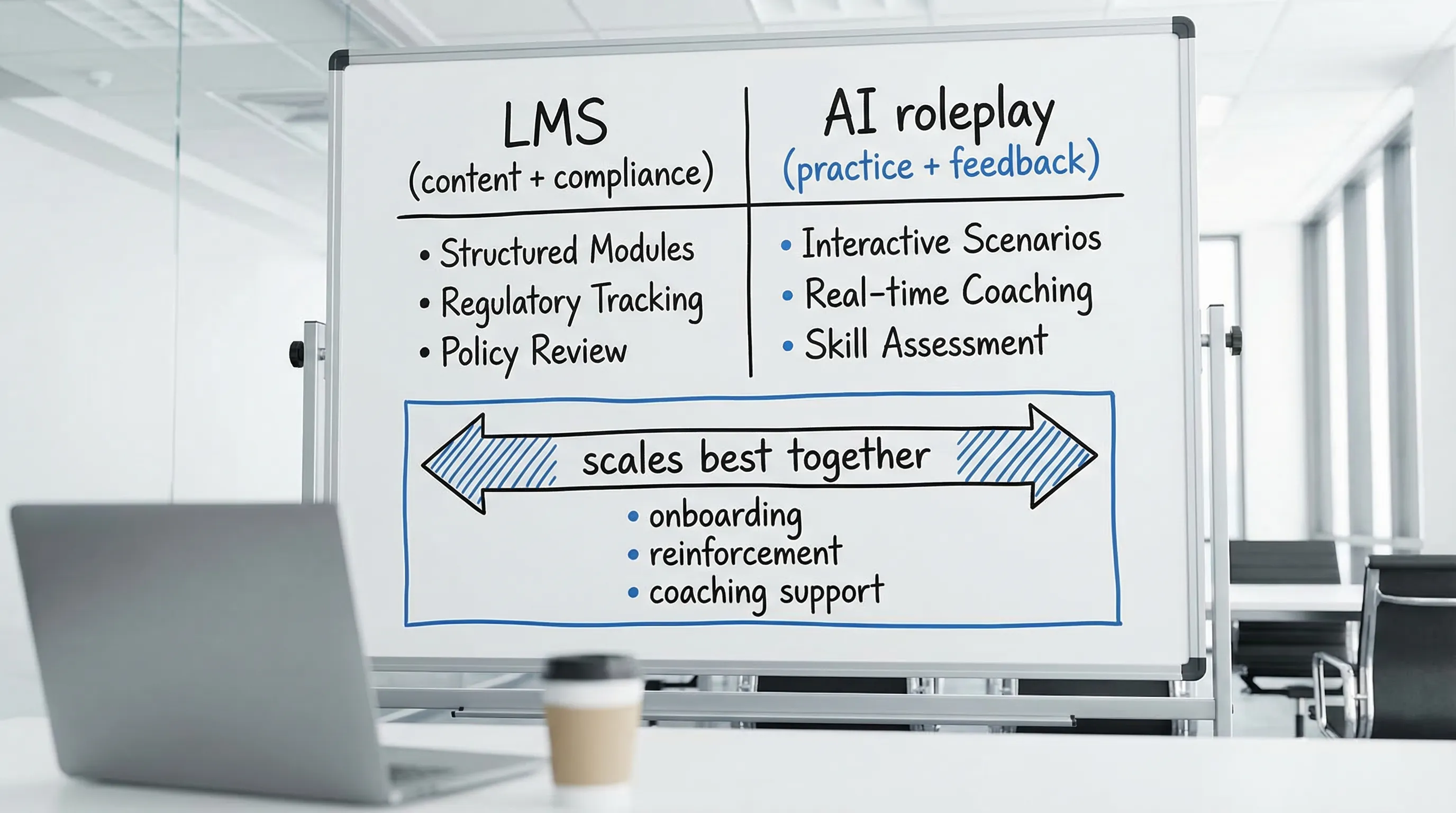
Side-by-side: LMS vs AI roleplay training for scaling teams
| Dimension | LMS | AI roleplay training |
|---|---|---|
| Best at | Content delivery, compliance, tracking completions | Conversation practice, skill reinforcement, feedback loops |
| Scales by | Standardization and administration | Repetition and feedback at high volume |
| Personalization | Usually limited (static paths, basic branching) | Often adaptive by skill level and scenario difficulty |
| Feedback | Quizzes, manager review (if added) | Real-time guidance and coaching-style feedback |
| Proof of progress | Completion and assessment scores | Skill metrics, trends, scenario performance data |
| Manager workload | Can still be high for true coaching | Can reduce dependence on managers for baseline practice |
| Risk if used alone | “Checked the box” without behavior change | Practice without governance if scenarios are poorly designed |
| Ideal use | Onboarding foundations, policy, product knowledge | Objections, discovery, de-escalation, negotiation, QA readiness |
The strongest answer for most orgs: a hybrid training stack
For revenue teams, the most scalable model is often:
- LMS for knowledge and compliance (what we must know)
- AI roleplay for practice and coaching (what we must be able to do)
This aligns with how modern training evaluation is typically discussed: completions are not the end goal, performance is. Frameworks like the Kirkpatrick Model emphasize measuring beyond participation, including behavior change and results.
Example: how hybrid looks in a sales onboarding flow
A practical pattern that scales:
- LMS: product fundamentals, ICP overview, pricing basics, security and compliance
- AI roleplay: discovery practice, qualification, objection handling, competitive positioning
- Manager: targeted calibration (listening to a smaller set of high-value roleplays instead of starting from zero)
Example: how hybrid looks in customer service training
- LMS: policies, workflows, tools training, escalation rules
- AI roleplay: empathy, de-escalation, call control, refund and exception conversations
- QA lead or manager: spot checks and coaching on the highest-risk interactions
Common concerns about AI roleplay training (and how to handle them)
AI roleplay scales powerfully, but implementation matters. Here are the most common concerns and what good programs do differently.
“Will simulations feel unrealistic?”
They can, if scenarios are generic. Relevance comes from using your actual moments that matter:
- Your top objections
- Your product constraints
- Your service policies
- Your tone and brand standards
The best results come when teams treat scenario design like enablement content, not like a one-time setup task.
“How do we keep coaching consistent and fair?”
Define clear rubrics. Whether you are evaluating discovery quality or de-escalation, you need shared definitions of “good.” AI feedback is most useful when aligned to a consistent rubric and messaging standards.
“What about privacy and security?”
This is a vendor and governance question. Look for enterprise-grade security controls and align your usage policy with internal requirements. (If you operate in regulated environments, involve security and compliance early.)
“Can people game the system?”
They can game completion metrics in any system, including an LMS. Skill practice reduces this risk when you measure performance patterns over time, not one-off attempts. The answer is not perfection, it is trend-based measurement and targeted manager review.
What to measure when scaling training (so you can prove it worked)
If you want training to scale, pick metrics that capture adoption, proficiency, and outcomes.
| Metric type | What to track | Why it matters |
|---|---|---|
| Adoption | Active learners, practice frequency, scenario attempts | Confirms the program is actually being used |
| Proficiency | Skill scores by rubric area, improvement over time | Shows whether practice changes capability |
| Readiness | Pass thresholds for key scenarios | Helps gate graduation from onboarding or new launches |
| Business outcomes | Conversion rate, CSAT, handle time, escalation rate (role-dependent) | Connects skill changes to results |
A practical tip: decide upfront which outcomes are realistic to influence in 30 to 60 days (often leading indicators like better objection handling consistency) and which will take longer (like win rate).
Choosing what scales better for your team: a decision guide
If you must pick one primary investment, base it on where your bottleneck is.
LMS-first makes sense when:
- You have urgent compliance, certification, or audit requirements
- The main gap is product knowledge and process clarity
- You need standardized onboarding at high volume
AI roleplay-first makes sense when:
- Managers are the coaching bottleneck
- Your biggest gaps are conversational (objections, discovery, empathy, negotiation)
- You want measurable skill improvement, not just course completion
- You need consistent practice across regions, shifts, or distributed teams
Hybrid makes sense when:
- You need knowledge plus performance (common in sales and service)
- You want to reduce ramp time and increase confidence
- You want analytics that can guide enablement priorities
Where Scenario IQ fits
Scenario IQ is built for organizations that want to scale conversation practice with AI-powered roleplay simulations, personalised training scenarios, real-time feedback, and progress tracking analytics. If your training goal is better calls, better service interactions, and stronger objection handling, this approach complements an LMS by adding the practice layer that traditional courseware typically lacks.
Frequently Asked Questions
Is AI roleplay training meant to replace an LMS? Not usually. An LMS is still useful for compliance, certifications, and structured onboarding content. AI roleplay training is typically the practice and coaching layer that helps teams apply what they learned.
What teams benefit most from AI roleplay training? Sales, customer success, customer support, and any role where performance depends on conversation quality (discovery, objection handling, de-escalation, negotiation, and retention).
Does LMS training improve sales performance? It can, especially for product knowledge and process clarity. But sales performance often requires behavior change, which is better supported through repetition and feedback, not just content completion.
What should I look for in an AI roleplay training platform? Look for realistic, customisable scenarios, adaptive feedback, clear analytics, role and skill-level flexibility, and security that matches your organization’s requirements.
How do you roll out AI roleplay training without overwhelming the team? Start with a small set of high-impact scenarios (top objections or top service escalations), set a simple practice cadence, and use analytics to identify where to refine coaching and content.
CTA: Build scalable practice, not just scalable content
If your LMS is doing its job but your team still struggles in live conversations, you do not need more modules, you need more reps with feedback. Scenario IQ helps teams practice the moments that determine revenue and customer experience using AI-driven simulations, real-time coaching, and measurable progress.
Explore Scenario IQ to see how AI roleplay training can scale performance across your sales and service teams.