

Bad leads are expensive. They waste SDR time, flood your CRM with noise, and create a false sense of pipeline health that breaks at forecast time.
Lead generation AI can fix that, but only if you use it as a system, not a shortcut. The teams that see a real lift in lead quality treat AI like an operating model: better data in, clearer definitions of quality, smarter qualification paths, and continuous coaching so reps convert what marketing generates.
This playbook shows how to build that model.
What “lead generation AI” actually means (and where it fits)
Lead generation AI is the set of machine learning and generative AI capabilities used to:
- Identify accounts and contacts that match your ICP
- Detect buying intent and prioritize outreach
- Personalize messaging and improve response rates
- Qualify and route leads faster
- Improve conversion through better conversations (calls, discovery, follow-up)
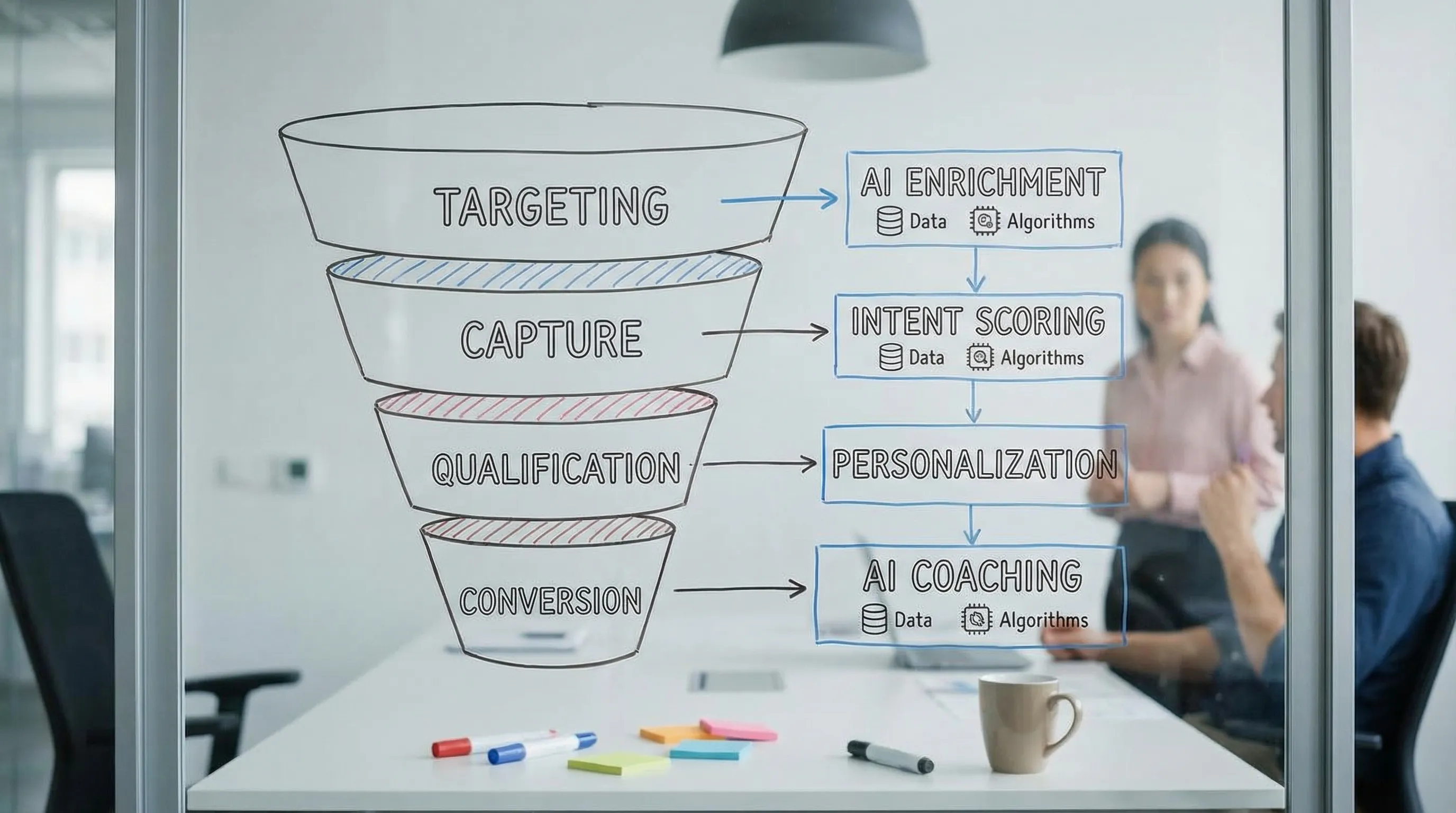
Some of that happens before a lead ever becomes an MQL (targeting and intent). Some happens after (qualification and conversion). If your headline goal is higher-quality leads, you have to treat qualification and conversion as part of lead generation, not a separate “sales problem.”
Define “high-quality lead” using signals you can measure
Teams often say they want “better leads” but can’t agree on what “better” means. Start by writing a measurable definition that sales and marketing both sign.
A practical definition is: a high-quality lead is contactable, fits the ICP, shows verified intent, and can be progressed to a sales next step within a defined SLA.
Here are common quality signals you can operationalize.
| Quality signal | What it indicates | Examples of data sources | How AI helps |
|---|---|---|---|
| ICP fit | Relevance and potential value | Firmographics, technographics, CRM history | Pattern detection, lookalike modeling, enrichment matching |
| Buying intent | Likelihood of active evaluation | Website behavior, content engagement, 3rd-party intent (if used) | Intent clustering, anomaly detection, prioritization |
| Readiness | Timing and urgency | Demo requests, pricing views, high-intent pages | Propensity scoring, next-best-action suggestions |
| Contactability | Ability to reach the person | Email/phone validity, deliverability data | Validation, dedupe, confidence scoring |
| Sales progressability | Ability to advance stage | Discovery notes, call outcomes, objection patterns | Conversation insights, qualification prompts, coaching |
When you build your lead gen AI stack, optimize for these signals, not vanity metrics like raw lead volume.
The playbook: lead generation AI for higher-quality leads
1) Start with ICP clarity, not a model
AI cannot rescue a fuzzy ICP. Before you score anything, align on:
- The segments you win in (industry, size, geo, regulatory environment)
- The “must-have” attributes (tech stack, maturity, budget proxy)
- The buying committee roles you need for momentum
- Disqualifiers that should stop outreach early
Then translate ICP into fields you can actually store. If “modern RevOps team” is part of your ICP, define the measurable proxy you will use (for example, CRM type, marketing automation presence, headcount in revenue roles).
2) Build a first-party signal engine (your best intent data)
The fastest way to improve lead quality is to treat your own digital signals as intent, and make them usable.
Focus on capturing and normalizing:
- High-intent web events (pricing page, comparison pages, integration pages)
- Form interactions (start vs submit, drop-off points)
- Content journeys (topic clusters that correlate with closed-won)
- Product signals (if PLG or trials are relevant)
AI adds value here by grouping messy behavior into meaningful “intent clusters” (for example, “security evaluation” vs “implementation planning”), which is much more actionable than raw pageviews.
3) Fix your data quality before you automate decisions
If you have duplicate accounts, inconsistent industries, and missing role data, AI will amplify the mess.
Use AI-supported enrichment and hygiene to:
- Standardize company names and domains
- Merge duplicates using probabilistic matching
- Validate emails and phones (and store confidence)
- Normalize job titles into role categories (SDR-friendly buckets)
If you operate in regulated environments, include privacy and compliance reviews early. For risk management guidance that applies to AI systems broadly, see the NIST AI Risk Management Framework.
4) Use predictive scoring, but keep it explainable
Predictive lead scoring can raise quality by prioritizing leads that look like past opportunities that converted. The mistake is treating the score as truth.
A strong approach is:
- Score at both account and lead level
- Keep a small set of human-readable drivers (top reasons the score is high)
- Re-train on a consistent cadence (quarterly is common) and monitor drift
- Separate “fit” from “intent” so reps know how to act
If a rep sees “High fit, low intent,” the next best action is different than “Medium fit, high intent.” Your AI should support that decision, not bury it.
5) Personalize outreach with AI, but don’t let it invent facts
Generative AI can improve response rates by helping your team write faster and tailor messaging to role, industry, and pain.
Quality guardrails matter more than creativity. Use rules like:
- Only reference claims you can verify from your data (no guessing)
- Prefer “reasoned hypotheses” over assertions (“Teams like yours often see…”)
- Require a human review step for outbound at scale
- Maintain an approved library of proof points and case snippets
This is also where brand and compliance teams should be involved. The FTC’s business guidance is a useful place to sanity-check marketing and automation claims.
6) Improve inbound qualification with adaptive questions
Higher-quality leads often come from asking better questions, at the right time, with minimal friction.
Instead of long forms, use progressive qualification:
- Ask 1 to 2 essentials upfront (email, company)
- Then adapt follow-ups based on behavior (pricing visitor vs blog visitor)
- Route “unknown but high intent” to a fast human touch
AI can help decide which question to ask next based on predicted conversion impact, but keep it transparent. If the system is gating too hard, you will reduce volume without raising quality.
7) Speed-to-lead and routing are part of lead quality
A lead that could have been great becomes “low quality” when you respond too late or route it incorrectly.
Operationalize:
- Clear SLAs by lead type (demo request vs content download)
- Smart routing based on segment and expertise
- A fallback path when ownership is unclear (no orphan leads)
AI can recommend routing and next steps, but you still need clean rules of engagement so reps trust the process.
8) Train for conversion: where lead gen AI most teams underinvest
Even with perfect targeting and scoring, lead quality is ultimately tested in conversations. If SDRs cannot:
- Open calls confidently
- Ask structured discovery questions
- Handle objections without getting defensive
- Set a clear next step
Then “good leads” will look like “bad leads” in the CRM.
This is where AI roleplay training belongs in a lead generation AI playbook. With Scenario IQ, teams can practice realistic sales and service conversations through AI-powered roleplay simulations, receive real-time feedback, and track progress with analytics and performance dashboards. Instead of hoping reps improve by osmosis, you can intentionally train the exact moments where high-intent leads are won or lost.
Examples of scenarios that directly improve lead quality outcomes:
- Responding to a demo request from a skeptical buyer who “just wants pricing”
- Re-qualifying an inbound lead that looks like a student or competitor
- Handling the classic objection: “We’re already using another vendor”
- Setting next steps when the lead is interested but not the decision-maker
When training is scenario-based and measurable, you reduce false positives (leads that never progress) and increase the percentage of leads that become real opportunities.
9) Measure quality with a full-funnel scorecard
If you only measure MQL volume, you will optimize the wrong thing.
Track lead quality with metrics tied to downstream outcomes:
- MQL to SQL conversion rate (by source and segment)
- SQL to opportunity conversion rate
- Opportunity win rate by lead source
- Time-to-first-touch and time-to-first-meeting
- “Recycled lead” rate and top recycle reasons
Then close the loop. Use AI to summarize patterns in loss notes, objections, and disqualification reasons, and feed those insights back into:
- Targeting rules
- Form logic and qualification paths
- Scoring model features
- Rep training scenarios
Common failure modes (and how to avoid them)
Over-automation that reduces trust
If reps feel AI is assigning junk leads or forcing robotic scripts, they stop following the system. Keep humans in control of final outreach decisions, and make scores interpretable.
Biased or outdated models
Models trained on last year’s wins might ignore emerging segments or new product positioning. Monitor drift and keep a human review cadence.
“Personalization” that is just fluff
AI-written lines that say nothing (“I noticed you’re a leader in innovation…”) get ignored. Personalization should connect to a plausible problem, a relevant trigger, or a verified fact.
Confusing volume with quality
If lead volume goes down after tightening qualification, that is not automatically a failure. Judge by cost per qualified opportunity and pipeline efficiency.
A simple reference architecture (so you can plan your stack)
You do not need dozens of tools. You need a clean flow from signals to decisions to conversations.
| Layer | Purpose | Output you want |
|---|---|---|
| Data foundation | Clean accounts, leads, events | Accurate identities, deduped CRM, validated contacts |
| Intent and scoring | Prioritize what matters | Fit score, intent score, reasons why |
| Activation | Execute outreach and routing | Correct owner, fast response, relevant messaging |
| Conversation quality | Qualify and convert | Better discovery, objection handling, next steps |
| Analytics loop | Improve continuously | Source ROI, model improvements, training priorities |
Scenario-based AI training fits in the “conversation quality” layer, and it often becomes the multiplier that makes the rest of the system pay off.
Frequently Asked Questions
What is lead generation AI? Lead generation AI is the use of machine learning and generative AI to find, prioritize, qualify, and convert leads using data signals, scoring, personalization, and automated workflows.
Will AI replace SDRs for lead generation? In most B2B motions, AI augments SDRs rather than replaces them. It can prioritize accounts, draft messaging, and speed qualification, but humans still win trust and run discovery.
How do I know if my AI lead scoring is working? Evaluate downstream metrics such as MQL to SQL, SQL to opportunity, win rate by score band, and speed-to-lead. If scores do not correlate with these, retrain or adjust features.
What data is most important for higher-quality leads? First-party intent (your website and product signals), clean firmographics, accurate role mapping, and reliable contactability signals typically have the biggest impact.
How does AI sales training relate to lead generation quality? Lead “quality” is proven in conversations. If reps improve discovery, objection handling, and next-step setting, more leads become real opportunities, raising your effective lead quality.
Turn better leads into more pipeline with Scenario IQ
If you are upgrading your lead generation AI stack but still seeing leads stall at the first call, the gap is often conversation execution.
Scenario IQ helps teams practice the exact qualification and objection moments that decide whether a lead becomes pipeline. Explore Scenario IQ to see how AI roleplay simulations, real-time feedback, and analytics can help your team convert more of the right leads into meetings and revenue.