

Revenue teams are getting hit from two sides at once: buyers expect faster, more personalized interactions, and leadership expects more pipeline, higher win rates, and better retention with the same (or smaller) headcount. That pressure is exactly why AI is showing up everywhere in sales and service workflows.
This introduction to AI is designed for revenue teams (sales, SDR, account management, customer success, support) who want the core concepts without equations. The goal is practical clarity: what AI is, what it is not, where it reliably helps, where it breaks, and how to start using it responsibly.
What “AI” actually means in revenue work
In business conversations, “AI” often lumps together several different technologies. For revenue teams, it helps to separate three layers:
1) Automation (rules-based)
Automation is “if this, then that.” It is deterministic.
- Example: If a lead submits a demo form, create an opportunity and assign it to an SDR.
Automation is powerful, but it cannot learn from new patterns unless you change the rules.
2) Machine learning (predictive patterns)
Machine learning (ML) learns patterns from historical data to make predictions or classifications.
- Example: A model predicts which open opportunities are most likely to close this quarter based on past deal attributes.
ML typically performs best when the task is clearly defined, the data is structured, and outcomes are measurable.
3) Generative AI (content and conversation)
Generative AI creates text, images, audio, or code. The most common generative AI for revenue teams today is the large language model (LLM), which generates text and can hold a conversation.
- Example: Draft a follow-up email, summarize a call, or roleplay a pricing objection.
Generative AI feels like a teammate, but it is not “thinking” in the human sense. It is generating likely sequences of words based on patterns in training data and the context you provide.
A plain-English glossary (the terms you keep hearing)
| Term | What it means (no math) | Revenue team example |
|---|---|---|
| Model | The “brain” that produces outputs | An LLM that writes an email draft |
| Training | How a model learned patterns (usually earlier, done by the vendor) | Vendor trained a model on large text datasets |
| Inference | Using the model right now to generate an output | You paste notes and get a call summary |
| Prompt | Your instruction to the model | “Write a follow-up focused on ROI and next steps” |
| Context window | How much information the model can consider at once | Too much call history can be truncated |
| Hallucination | Confident but incorrect output | Invented product feature or wrong policy |
| Grounding | Anchoring outputs in trusted sources | Restrict answers to your knowledge base |
| RAG (retrieval augmented generation) | A common method to pull in relevant documents before generating | Answer pricing questions using approved collateral |
| Fine-tuning | Customizing a model’s behavior using your examples | Match your tone or objection-handling style |
Why revenue teams should care: AI changes “time to competence”
Most sales and service orgs do not lose deals because the team lacks effort. They lose because:
- discovery misses key questions
- messaging is inconsistent
- objections trigger defensive reactions
- reps struggle to adapt to different buyer personas
- managers cannot coach every interaction
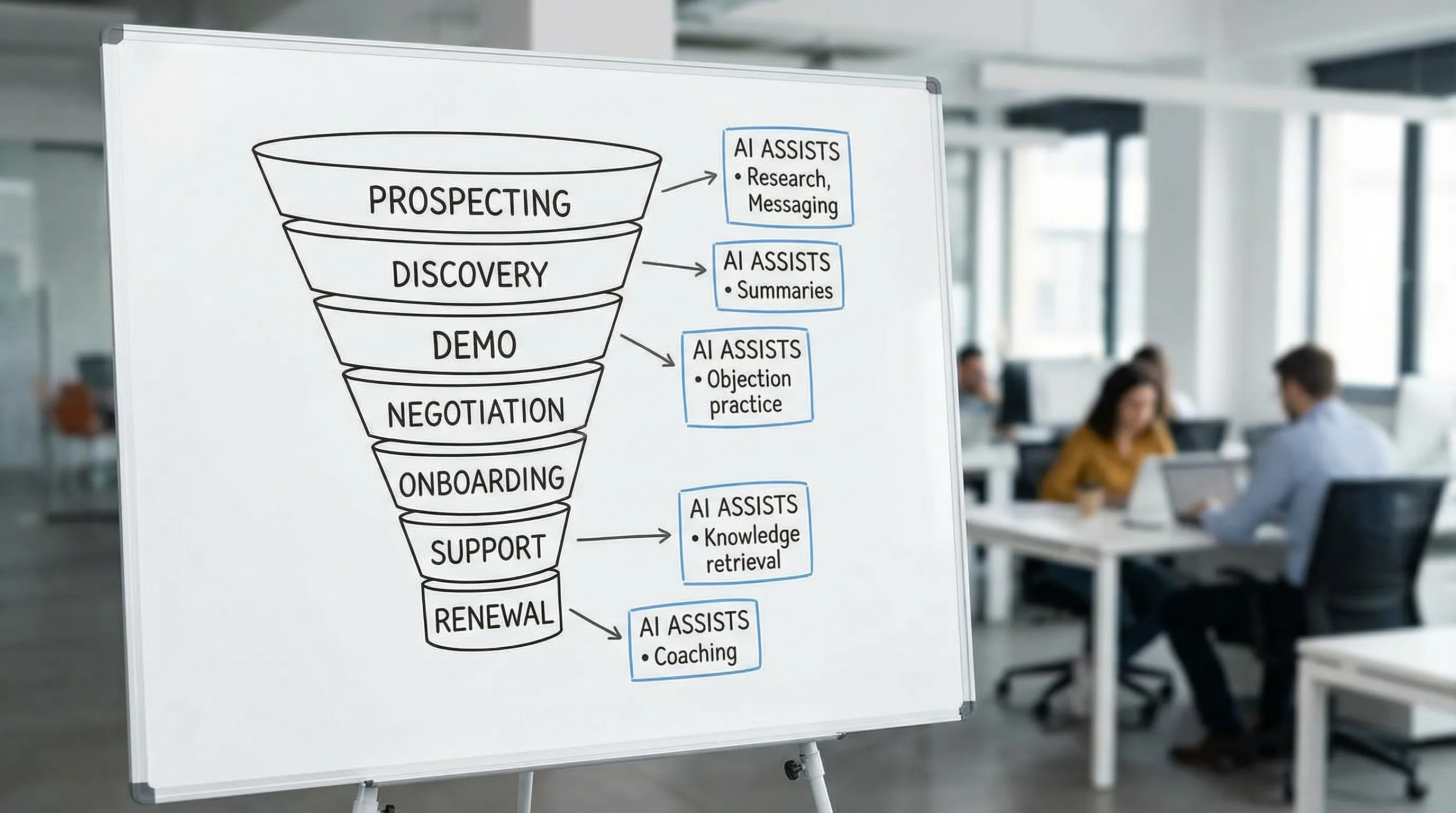
AI can compress the time it takes to build these skills by providing practice, feedback, and repetition at scale. This is where scenario-based training and coaching become high leverage.
What AI is good at (and what it is bad at)
Think of AI as a strong assistant for language-heavy work, especially when a task has clear inputs and a “good enough” output is valuable.
Strong fits for AI in revenue workflows
- Summarizing: calls, tickets, meeting notes
- Drafting: emails, talk tracks, knowledge base articles
- Rewriting: shorten, clarify, match tone, localize
- Classifying: intent, sentiment, ticket categories, lead routing
- Practicing: roleplay scenarios, objection handling, negotiation drills
- Coaching signals: highlight moments where reps interrupted, skipped steps, or missed a question (depending on the system and data)
Weak fits (or “handle with care”)
- Anything requiring perfect factual accuracy without verification (policies, pricing, legal terms)
- High-stakes decisions without human review (rejecting customers, compliance determinations)
- Sensitive personalization that could cross privacy boundaries
- Long-range reasoning where a chain of assumptions can quietly drift
The risk is not that AI is “always wrong.” The risk is that it can be wrong in ways that look right.
Common AI use cases for sales and service teams
Sales (SDR, AE, AM)
Pipeline creation and conversion
- outreach messaging variants for different personas
- call preparation briefs from CRM notes and prior conversations
- discovery question suggestions based on industry and role
Deal execution
- objection handling practice (pricing, switching, security, timing)
- meeting summaries and next-step drafts
- proposal language review for clarity and consistency
Customer success and support
Faster resolution and better experience
- summarize long ticket histories
- draft responses using approved guidance
- suggest troubleshooting steps from internal docs
Retention and expansion
- identify renewal risk signals from conversation patterns
- create QBR outlines and customer update drafts
The simplest mental model: “AI works when inputs are clean and the goal is clear”
You do not need data science to apply this. Just ask two questions:
1) Do we know what good looks like? (For example, a strong discovery call structure.) 2) Can the AI see enough relevant context? (For example, a persona, product, and scenario constraints.)
If the answer is yes to both, AI often delivers immediate value.
AI roleplay: why it is different from reading a playbook
Playbooks are static. Real conversations are not.
Roleplay works because it forces reps to:
- choose words in the moment
- navigate pushback
- recover from missteps
- build confidence through repetition
AI roleplay scales what the best managers do: create realistic scenarios, give quick feedback, and track progress over time.
Tools like Scenario IQ focus on AI-powered roleplay simulations with personalized scenarios, real-time feedback, and progress tracking analytics. That combination matters because practice without feedback plateaus, and feedback without repetition does not stick.

Understanding risk and governance (without slowing everything down)
AI adoption in revenue orgs tends to fail in two ways:
- Shadow AI: reps use tools on their own, paste sensitive customer info, and nobody can audit it.
- Over-control: security reviews take months, so the org gets no learning and no ROI.
The middle path is a lightweight governance model that enables safe usage.
A practical risk checklist for revenue teams
| Risk | What it looks like in sales/service | Mitigation that usually works |
|---|---|---|
| Hallucinations | AI invents a feature, SLA, or policy | Require citations to approved docs, add human review for outbound messages |
| Data leakage | Customer info pasted into an unapproved tool | Use approved platforms, access controls, and clear data handling rules |
| Brand and compliance drift | Messaging violates tone, claims, or regulated language | Use templates, approved phrases, and review workflows |
| Bias and unfair outcomes | Lead scoring or prioritization disadvantages certain segments | Regular audits, documented criteria, and human override |
| Over-reliance | Reps stop learning fundamentals | Use AI for coaching and practice, not just auto-writing |
For a structured approach, the NIST AI Risk Management Framework is a widely referenced starting point.
How to evaluate an AI tool for revenue enablement
Skip the hype. Evaluate based on behavior in your real scenarios.
1) Does it improve skills or just produce content?
Content generation is useful, but skill improvement shows up in conversion rates, handle time, CSAT, and renewal outcomes.
Look for systems that provide:
- realistic simulations
- feedback aligned to a rubric
- repeatable practice loops
- analytics that managers can act on
2) Can you control scenarios and skill levels?
Revenue teams need consistency across onboarding and coaching, plus flexibility by role and segment.
If a tool lets you customize scenarios and adjust difficulty, it is more likely to work for:
- new hires
- mid-performers leveling up
- top performers practicing edge cases (procurement, security reviews, legal objections)
3) Does it support team rollout and measurement?
AI adoption is a change-management project.
The best signal is whether you can answer:
- Who used it?
- What skills did they practice?
- Did performance metrics move?
A simple, no-math starting plan (30 days)
Week 1: Pick one behavior to improve
Choose a single skill that is close to revenue impact, such as:
- discovery depth
- pricing objection handling
- support escalation conversations
Define what “good” looks like in plain language.
Week 2: Create scenarios that mirror your reality
Build scenarios around your:
- target personas
- common objections
- typical deal constraints (budget, timing, security)
Keep them narrow at first. Narrow scenarios create clearer feedback.
Week 3: Practice + feedback loops
Roll out short sessions (10 to 15 minutes). Frequency beats intensity.
Managers should spot-check outputs and coach patterns, not individual word choices.
Week 4: Measure one leading indicator and one lagging indicator
Examples:
- Leading indicator: number of roleplays completed, improvement in rubric score
- Lagging indicator: meeting-to-opportunity conversion, first-call resolution, time to ramp
If you cannot measure it, you cannot scale it.
For broader industry context on adoption and impact, the Stanford AI Index is a helpful annual reference.
The mindset shift: AI is a force multiplier for fundamentals
AI will not fix unclear positioning, weak qualification, or a broken handoff process. But when your fundamentals are sound, AI can amplify them.
For revenue teams, the highest-leverage pattern is:
- standardize the skill (what great looks like)
- simulate the conversation (practice under pressure)
- give immediate feedback (what to change next time)
- track progress (so coaching is targeted)
If you want an approachable way to start, Scenario IQ is built around AI-driven scenario training with adaptive guidance, real-time feedback, and analytics, so teams can build confidence and consistency without waiting for the next live call to practice.