

Most organizations already have the raw material for better coaching: assessment scores, call reviews, roleplay performance, customer feedback, manager observations, completion data, and sales or service outcomes. The challenge is not collecting more data. The challenge is turning training data into coaching plans that are specific enough to change behavior.
That shift matters because coaching is where learning becomes performance. A rep may complete a negotiation module, a service agent may pass a product knowledge quiz, and a manager may see a green dashboard, yet none of that guarantees better conversations with customers. Better coaching plans connect the dots between what people practiced, how they performed, where they struggled, and what they should do next.
For sales enablement, customer service training, and employee skill development teams, the goal is simple: use data to coach the right skill, for the right person, at the right time.
Start with the performance outcome, not the dashboard
Training data becomes useful when it is tied to a clear business or behavioral outcome. Before reviewing reports, decide what success should look like in real conversations.
For a sales team, the target may be improving discovery quality, handling pricing objections, or increasing follow-up consistency. For a customer service team, it may be de-escalating frustrated customers, resolving issues faster, or improving empathy. For managers, it may be giving clearer feedback or conducting better coaching conversations.
This is where many coaching programs go wrong. They start with available metrics, such as course completion or quiz scores, then try to infer coaching needs. A better approach is to define the desired behavior first, then identify the data that proves whether that behavior is happening.
The Kirkpatrick Model is a useful reminder that learning should be evaluated beyond participation. Strong coaching plans consider not only whether people liked the training or passed a knowledge check, but whether they changed behavior and improved results.
A practical starting question is: What must this employee do differently in the next customer, prospect, or teammate conversation?
Know which training data actually helps coaching
Not every metric deserves equal attention. Some data tells you that training happened. Other data shows whether a skill is improving. The most useful coaching plans prioritize skill and behavior signals over activity alone.
| Data type | What it tells you | Coaching value |
|---|---|---|
| Completion data | Whether someone finished required training | Low to moderate, useful for accountability |
| Knowledge checks | Whether someone understands concepts | Moderate, useful for identifying knowledge gaps |
| AI roleplay results | How someone applies skills in realistic scenarios | High, useful for targeted practice |
| Real-time feedback themes | Which behaviors need improvement during practice | High, useful for immediate coaching focus |
| Manager observations | What happens in live work situations | High, especially when structured consistently |
| Customer or prospect feedback | How interactions are perceived externally | High, useful for service and sales quality |
| Outcome metrics | Whether performance improved after coaching | High, useful for validating impact |
A coaching plan based only on completion data might say, Alex completed objection handling training. A coaching plan based on richer training data might say, Alex understands the pricing framework but avoids asking follow-up questions when a buyer challenges value. The second version is coachable because it identifies the specific behavior to practice.
This is where AI simulations and virtual roleplay training can create better inputs. Instead of waiting for high-stakes customer conversations to reveal a skill gap, teams can use simulated practice to observe how employees respond in realistic moments and receive feedback quickly.
Separate symptoms from root causes
Training data often reveals symptoms first. A sales rep loses deals after pricing discussions. A support agent receives lower satisfaction scores on escalations. A new manager struggles to keep one-on-ones productive.
Those symptoms matter, but they are not yet coaching plans. To coach effectively, you need to diagnose the root cause.
For example, weak objection handling could come from several different issues. The employee may lack product knowledge, miss emotional cues, fail to ask clarifying questions, or become defensive under pressure. Each root cause requires a different coaching response.
A simple diagnostic framework can help managers interpret the data more accurately.
| Performance symptom | Possible root cause | Better coaching focus |
|---|---|---|
| Gives generic answers to objections | Limited discovery or poor listening | Practice clarifying questions before responding |
| Sounds confident in training but struggles live | Low confidence under pressure | Use repeated roleplay with increasing difficulty |
| Completes modules but shows little behavior change | Training is not being reinforced | Add short practice sessions and manager follow-up |
| Scores well on product knowledge but loses customer trust | Weak empathy or tone control | Coach language, pacing, and acknowledgment |
| Improves briefly, then regresses | No reinforcement loop | Add progress tracking and recurring feedback |
This step is especially important for fairness. If a manager jumps from poor outcome to poor performer, coaching becomes vague and demotivating. If the manager identifies the skill gap behind the outcome, coaching becomes actionable.
Turn data into coaching priorities
Once you understand the root cause, the next step is prioritization. Most employees cannot improve five skills at once. Better coaching plans focus on one or two high-impact behaviors at a time.
A useful way to prioritize is to compare two dimensions: impact and urgency. Impact asks how much the skill affects performance. Urgency asks how soon the skill needs to improve.
| Coaching priority | When to use it | Example |
|---|---|---|
| High impact, high urgency | Coach immediately | A service agent repeatedly escalates frustrated customers unnecessarily |
| High impact, lower urgency | Build into a development plan | A sales rep needs stronger executive-level discovery skills |
| Lower impact, high urgency | Give quick corrective feedback | An employee uses an outdated process phrase in customer calls |
| Lower impact, lower urgency | Monitor, but do not over-coach | Minor presentation style preferences |
This keeps coaching focused. A manager may notice many things in training data, but the plan should target the behavior most likely to improve real performance.
For team training, the same logic applies at scale. If analytics show that 70 percent of a team struggles with the same scenario type, the answer is not only individual coaching. It may be time to adjust the training program, update messaging, or create a team practice session around that scenario.
Build a coaching plan around evidence, practice, and reinforcement
A strong coaching plan should be specific enough that the employee knows exactly what to practice and the manager knows exactly what to observe. It should also include a feedback loop so progress can be measured.
The most effective coaching plans usually include these elements:
- Target behavior: The specific skill or behavior the employee needs to improve.
- Evidence: The training data, roleplay result, or observation that supports the coaching focus.
- Practice activity: The scenario, simulation, or live-work exercise the employee will use to improve.
- Feedback method: How the employee will receive guidance, such as AI-generated feedback, manager coaching, or peer review.
- Success measure: The metric or observation that will show improvement.
- Review cadence: When progress will be checked and the plan adjusted.
Here is what that looks like in practice.
| Coaching plan element | Example for sales | Example for customer service |
|---|---|---|
| Target behavior | Ask two follow-up questions before responding to price concerns | Acknowledge emotion before offering a solution |
| Evidence | AI roleplay feedback shows early pitching during pricing objections | Simulation feedback shows low empathy score in escalation scenarios |
| Practice activity | Complete three pricing objection roleplays at intermediate difficulty | Practice two frustrated-customer simulations per week |
| Feedback method | Review real-time feedback themes with manager | Compare AI feedback with supervisor observation |
| Success measure | Improved objection handling score and better discovery notes | Higher escalation handling score and fewer unnecessary transfers |
| Review cadence | Weekly for three weeks | Twice weekly for two weeks |
Notice that the plan does not say get better at objections or improve empathy. Those statements are too broad. The plan names the behavior, the evidence, and the next practice step.
Use AI simulations to make coaching more consistent
One of the hardest parts of coaching is consistency. Different managers may evaluate the same conversation differently. Employees may get more or less practice depending on manager availability. Live customer interactions are unpredictable, which makes it hard to compare performance fairly.
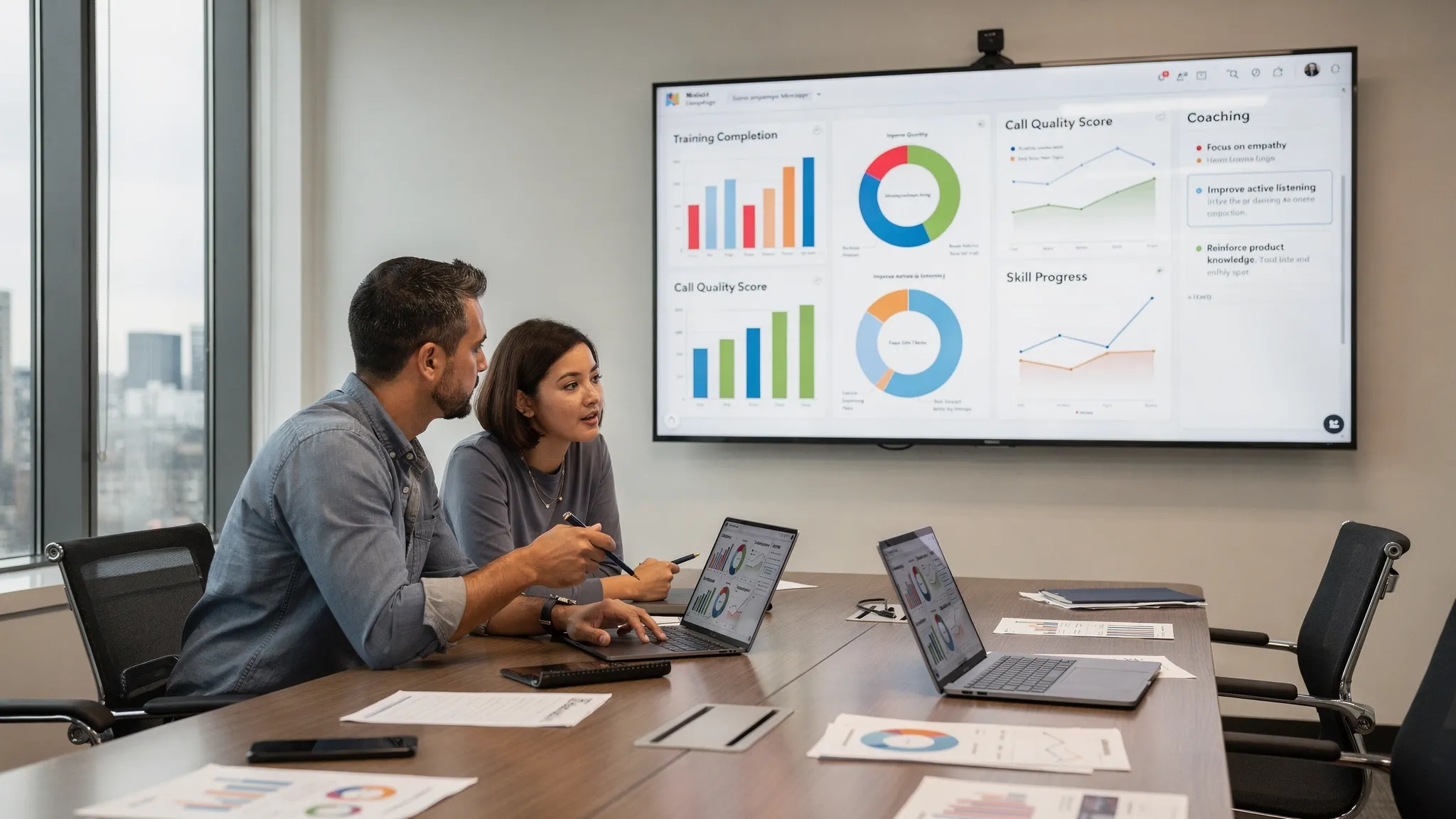
AI-powered roleplay simulations help solve this by giving employees a consistent environment to practice key scenarios. In a platform such as Scenario IQ, teams can use AI-driven scenarios, personalized training, real-time feedback, adaptive guidance, progress tracking analytics, and performance metric dashboards to support more structured coaching.
The value is not that AI replaces the manager. The value is that it gives managers better coaching inputs. Instead of relying only on memory, anecdotal feedback, or occasional call reviews, managers can see patterns across practice sessions.
For example, an AI training platform may help reveal that an employee consistently performs well in opening conversations but struggles when the customer becomes skeptical. That insight allows the manager to coach the moment of difficulty, not the entire conversation.
AI simulations are especially useful when teams need to practice situations that are high-stakes, infrequent, or emotionally challenging. These might include renewal risk conversations, upset customers, compliance-sensitive explanations, negotiation moments, or difficult internal feedback discussions.
Combine individual coaching with team-level learning
Training data should improve both one-on-one coaching and broader team training. If only one employee struggles with a skill, an individual coaching plan makes sense. If many employees struggle with the same behavior, the issue may be systemic.
Team-level data can help leaders answer important questions:
- Are employees struggling with the same scenario because the training content is unclear?
- Are new hires receiving enough practice before live customer conversations?
- Do experienced employees need advanced simulations instead of basic refreshers?
- Are managers reinforcing the same skills after formal training ends?
- Are certain objections, customer emotions, or service issues becoming more common?
This is where performance dashboards and analytics become valuable for learning leaders. They help identify whether a problem belongs in individual coaching, manager enablement, team training, or process improvement.
For example, if a few sales reps struggle to explain value, coach those reps. If the entire team struggles to explain value after a pricing change, update the messaging and build new practice scenarios. If customer service agents struggle with a new policy, improve the knowledge base and simulate policy explanation conversations.
Better coaching plans do not exist in isolation. They feed a continuous learning system.
Make feedback timely, specific, and behavior-based
Data loses value when feedback arrives too late. If an employee practices a scenario on Monday and receives vague feedback three weeks later, the learning moment is gone.
Effective coaching feedback should be timely, specific, and tied to observable behavior. The Society for Human Resource Management notes the importance of ongoing performance conversations rather than relying only on infrequent reviews, as reflected in its resources on managing employee performance.
In training contexts, this means managers should avoid feedback such as be more confident or improve your communication. Those comments may be true, but they do not tell the employee what to do next.
More useful feedback sounds like this: In the roleplay, you responded to the pricing concern before asking what budget range the buyer had planned for. In the next simulation, pause and ask one clarifying question before explaining value.
That kind of feedback works because it is concrete. It identifies the moment, the behavior, and the next action.
Reinforce with short practice loops
A coaching plan is not a one-time conversation. Skill development requires repetition, feedback, and adjustment. Short practice loops are often more effective than occasional long training sessions because they keep the target behavior active in the employee's mind.
A simple weekly coaching loop can include five stages.
| Stage | Purpose | Example |
|---|---|---|
| Review | Look at recent training data | Check roleplay scores and feedback themes |
| Focus | Select one behavior to improve | Clarify before responding to objections |
| Practice | Use a scenario or live-work exercise | Complete two AI roleplays this week |
| Feedback | Discuss what improved and what still needs work | Manager reviews feedback and gives one recommendation |
| Measure | Compare results over time | Track improvement in scenario score and live observation |
This loop keeps coaching manageable. Managers do not need to create a new plan every week. They need to keep the plan alive through regular practice and evidence-based adjustment.
Scenario-based training is particularly effective here because it gives employees a safe space to practice before the stakes are real. A new service agent can practice calming an angry customer without risking customer satisfaction. A sales rep can test a new objection response without jeopardizing an active deal.
Use coaching data responsibly
As training data becomes more detailed, organizations need clear rules for how it will be used. Employees are more likely to engage with AI simulations and feedback tools when they understand that the goal is development, not surveillance.
Responsible use starts with transparency. Tell employees what data is collected, why it matters, who can access it, and how it will influence coaching. Managers should use training data to support growth conversations, not to label people unfairly.
Security and governance also matter, especially for enterprise teams using AI training platforms. The NIST AI Risk Management Framework offers a useful reference point for organizations thinking about trustworthy AI, risk, transparency, and accountability.
For coaching, the principle is straightforward: use data to improve decisions, but keep humans accountable for context, judgment, and support.
Measure whether the coaching plan worked
The final step is to evaluate progress. A coaching plan should never be considered successful just because it was completed. It worked only if the target behavior improved and, over time, contributed to better performance.
Measurement should include both leading and lagging indicators. Leading indicators show whether the employee is practicing and improving the skill. Lagging indicators show whether that improvement is affecting business outcomes.
| Indicator type | Examples | Why it matters |
|---|---|---|
| Leading indicators | Roleplay score improvement, feedback theme reduction, practice frequency | Shows whether skill development is happening |
| Behavior indicators | Manager observation, call review notes, customer conversation quality | Shows whether training is transferring to work |
| Outcome indicators | Win rate, customer satisfaction, resolution quality, retention, productivity | Shows whether coaching supports business goals |
Be careful not to over-attribute results. A sales win rate may change because of market conditions, lead quality, pricing, or territory differences. Customer satisfaction may shift because of product issues or policy changes. Training data is powerful, but it should be interpreted alongside business context.
The best coaching plans use multiple signals. If roleplay performance improves, manager observations confirm the behavior, and outcome metrics move in the right direction, you have stronger evidence that coaching is working.
Common mistakes to avoid
Even with good data, coaching plans can fail if the process is too complex or too generic. Watch for these mistakes:
- Coaching too many skills at once: Focus creates momentum. Pick the highest-impact behavior first.
- Using data without context: A low score is a starting point, not a complete diagnosis.
- Confusing activity with improvement: More training does not always mean better performance.
- Giving vague feedback: Employees need observable behaviors and next steps.
- Ignoring managers: Data helps, but managers still need the skills to coach effectively.
- Skipping reinforcement: Without repeated practice, most training fades before behavior changes.
A better approach is to keep coaching plans simple, evidence-based, and iterative. The data should make coaching clearer, not heavier.
Frequently Asked Questions
What training data is most useful for coaching plans? The most useful training data shows applied behavior, not just participation. Roleplay performance, real-time feedback themes, manager observations, customer interaction quality, and progress trends are usually more actionable than completion data alone.
How often should coaching plans be updated? Coaching plans should be reviewed regularly, often weekly or biweekly for active skill development. The cadence depends on the urgency of the skill gap, the employee's role, and how quickly new data becomes available.
Can AI replace manager coaching? AI can support coaching by providing simulations, feedback, and analytics, but it should not replace manager judgment. Managers still provide context, encouragement, accountability, and connection to real workplace goals.
How do you avoid overwhelming employees with training data? Focus on one or two behaviors at a time. Share the most relevant evidence, explain why it matters, and give the employee a clear practice activity. Too much data can reduce clarity and motivation.
How can training data improve team training, not just individual coaching? When multiple employees struggle with the same scenario or skill, the data may point to a team-wide training need. Leaders can use those patterns to update content, create new AI-driven scenarios, or run focused team practice sessions.
Turn better data into better coaching
Training data becomes valuable when it changes what managers and employees do next. The best coaching plans are not long documents or generic development goals. They are focused, evidence-based action plans that connect practice to performance.
Scenario IQ helps organizations make that connection through AI-powered roleplay simulations, personalized training scenarios, real-time feedback, adaptive guidance, progress tracking analytics, and team-focused learning. If your sales, service, or training teams need a more practical way to build confidence and improve performance, explore how Scenario IQ can help turn training insights into measurable skill growth.