

Empathy is the skill that keeps customer conversations productive when emotions run high, the situation is messy, or the customer simply feels unheard. It is also one of the most coachable parts of service and sales performance, because empathy shows up as observable behaviors: what you ask, what you reflect back, how you pace the conversation, and what you do next.
This guide breaks empathy down into trainable components, then shows how to practice them in realistic scenarios (including AI roleplay training) and measure progress without turning agents into robots.
What “empathy” means in customer conversations (and what it does not)
In a support or service setting, empathy is not “being nice,” agreeing with the customer, or apologizing repeatedly. It is the ability to accurately understand what the customer is experiencing and communicate that understanding in a way that reduces friction and builds trust.
A practical definition for training is:
Empathy = Recognition + Validation + Curiosity + Alignment + Action
- Recognition: Identify the customer’s emotion and goal.
- Validation: Acknowledge the experience without overpromising.
- Curiosity: Ask targeted questions that move the issue forward.
- Alignment: Confirm you and the customer share the same definition of success.
- Action: Take the next best step and narrate it clearly.
Why this matters: empathy is a leading indicator. When a customer feels understood, they share better information, accept solutions more readily, and are less likely to escalate.
The empathy behaviors you can actually coach
Empathy gets easier to train when you score it as behaviors, not personality. Use a small set of behaviors that are easy to observe in calls, chats, or in-person interactions.
| Empathy behavior | What it sounds like (examples) | Common pitfall to coach out |
|---|---|---|
| Emotion labeling | “It sounds like you’re frustrated because the delivery date changed.” | Guessing wildly or labeling too intensely (“You’re furious!”) |
| Reflecting meaning | “So the biggest issue is that you can’t present this to your client today, right?” | Repeating words instead of meaning (“You said you can’t present today.”) |
| Legitimize the concern | “That makes sense. If I were in your shoes, I’d want clarity too.” | Making it about yourself or turning it into a story |
| Ownership language | “I’m going to take responsibility for getting this unstuck.” | Passive voice (“This should be resolved soon.”) |
| Clear next step narration | “Here’s what I can do now, and what will happen after this call.” | Vague reassurance with no timeline or path |
If you want one simple rubric: coach for accuracy (did they understand the real issue?), calm (did they de-escalate?), and progress (did the conversation move forward?).
A simple empathy framework agents can use under pressure
When customers are upset, long scripts fail. Teach a short sequence that works in 20 to 40 seconds.
The L.A.S.T. loop (Listen, Acknowledge, Solve, Thank)
This classic service structure works well when you keep it concrete:
- Listen: Let the customer finish the first story without interrupting.
- Acknowledge: Name the emotion and impact.
- Solve: Ask one clarifying question, propose the next step.
- Thank: Appreciate the info or patience (once, not repeatedly).
Example (phone or live chat):
“Thanks for walking me through that. I can hear how frustrating this is, especially with your deadline today. Let me confirm one detail so I choose the fastest fix: are you seeing the error after you click ‘Submit’ or before? Great, here’s what we’ll do next…”
Nonviolent Communication (NVC) as an advanced option
For teams handling emotionally charged conversations (billing disputes, cancellations, complaints), many leaders borrow from Nonviolent Communication, popularized by Marshall Rosenberg. The structure separates observations, feelings, needs, and requests, which helps keep agents calm and specific. If you want to explore the model, start with the Center for Nonviolent Communication.
How to train empathy: the 5-part practice system
Empathy improves fastest when training combines three things: targeted skill drills, realistic scenarios, and tight feedback loops.
1) Start with “moments that matter” (not generic roleplays)
Collect 10 to 20 real situations where empathy breaks down. Examples:
- Customer is angry about a delayed resolution
- Customer repeats themselves because they feel ignored
- Customer says “I’m done” and threatens to churn
- Customer is polite, but clearly disappointed
- Customer is confused and embarrassed (high sensitivity)
Each scenario should include:
- The customer’s goal
- The emotion under the words
- Constraints (policy, technical limits, timelines)
- A realistic win condition (what “good” looks like)
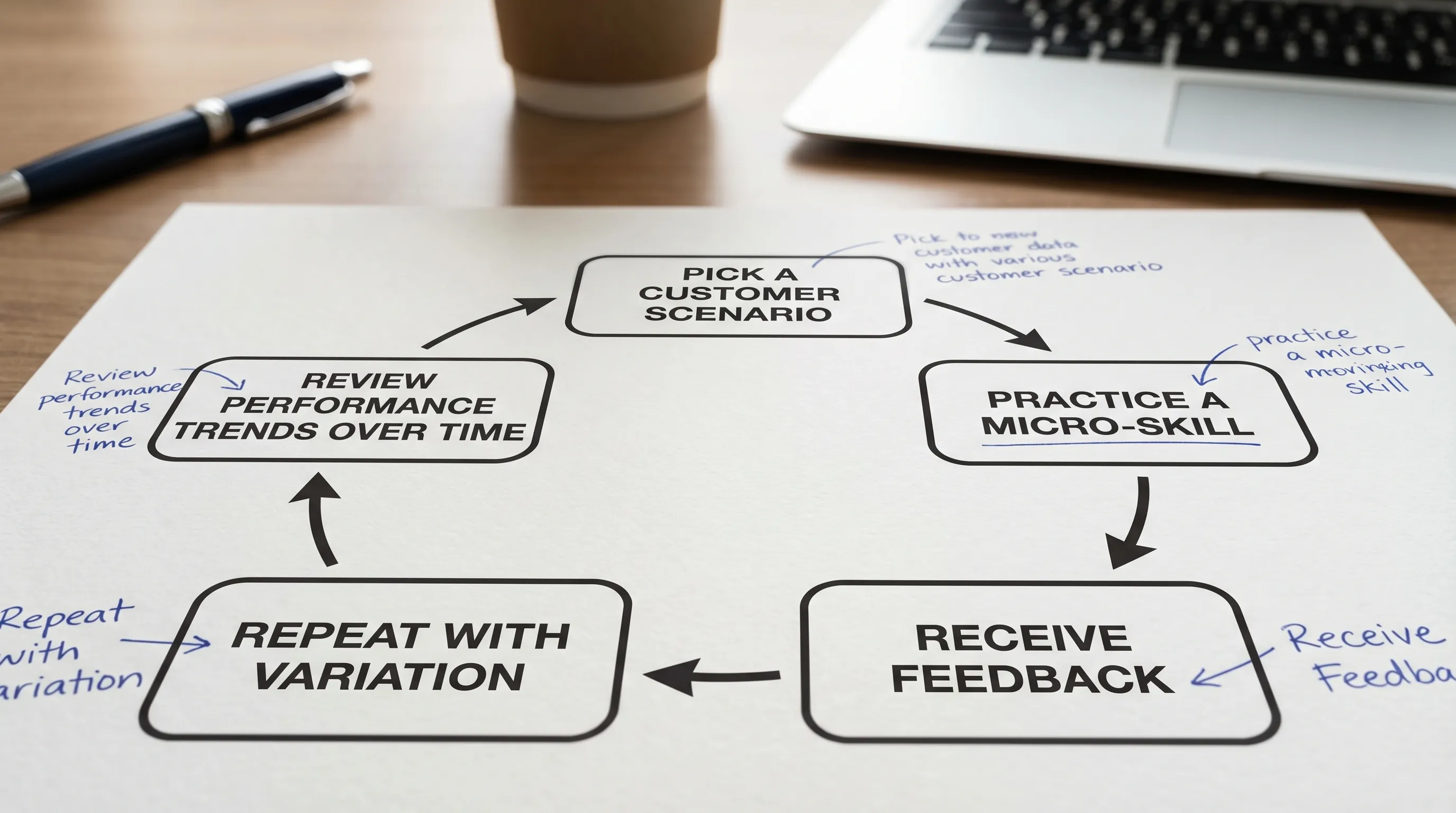
2) Teach one micro-skill per session
Empathy training fails when you ask agents to improve everything at once. Pick one micro-skill and run repetitions.
Good micro-skills for weekly cycles:
- Emotion labeling without exaggeration
- Reflecting impact (business impact, personal impact)
- Asking one high-quality clarifying question
- “No, but” phrasing that preserves dignity
- Calm pacing and interruption control
Coaching tip: if the agent improves one micro-skill, the whole call often improves.
3) Use deliberate practice: short reps, immediate feedback
Run 5 to 8 minute drills with immediate scoring. You are building muscle memory.
A simple drill format:
- Give the agent a scenario prompt and a starting line
- Agent responds for 30 to 60 seconds
- Coach scores only the target micro-skill
- Agent repeats with one adjustment
This is where AI-driven scenarios can help, because you can generate many variations of the same underlying situation without burning out supervisors.
4) Add realistic roleplay simulations (including AI roleplay)
Human roleplays are useful, but they have limitations:
- The “customer” is rarely consistent across reps
- It is hard to scale across teams and shifts
- Feedback depends heavily on the coach’s availability
AI simulations can fill the repetition gap by providing consistent roleplay practice, varied difficulty, and immediate feedback.
For example, an AI training platform like Scenario IQ is designed for AI-powered roleplay simulations and personalised training scenarios with real-time feedback and progress tracking analytics. The practical win for empathy training is volume: more reps, more realistic edge cases, and faster coaching cycles, especially for distributed teams.
When using AI roleplay for empathy, make sure the scenario design includes:
- Emotion cues (subtle disappointment vs open anger)
- Constraints (policy limits, shipping timelines, refund rules)
- A clear rubric (what empathy looks like in that situation)
- Skill levels that adapt as agents improve
5) Measure progress with a scorecard that reflects empathy outcomes
If you only measure empathy as “did they say sorry,” you will get scripted apologies. Measure what matters.
| What to measure | How to measure it | Why it maps to empathy |
|---|---|---|
| Understanding accuracy | QA checks for correct problem summary and impact | Customers feel heard when you state the real issue |
| De-escalation | Fewer escalations, calmer tone markers in QA | Empathy reduces emotional temperature |
| Customer effort | Shorter back-and-forth, fewer repeats | Feeling understood lowers repetition |
| Resolution momentum | Clear next steps, fewer stalled tickets | Empathy is not just warmth, it drives progress |
If you do use CSAT or NPS, treat them as lagging indicators. Pair them with QA markers so you can coach specific behaviors.
A 4-week empathy training plan you can run with any team
You can run this plan with frontline support, account management, or sales teams that handle objections and complaints.
| Week | Focus | Practice type | Manager coaching focus |
|---|---|---|---|
| 1 | Recognition | Emotion labeling, summarizing the goal | Accuracy over speed |
| 2 | Validation | Legitimize concern + ownership language | Remove defensive phrasing |
| 3 | Curiosity + alignment | One clarifying question + confirm success criteria | Ask fewer, better questions |
| 4 | Action under constraints | Offer options, set expectations, close the loop | Confidence without overpromising |
Run each week as: short teaching (10 minutes), reps (20 minutes), review (10 minutes). If you support multiple channels (phone, chat, email), do at least one rep in each.
How to coach empathy without making people sound fake
Empathy can sound inauthentic when teams memorize phrases. The fix is to coach intent and structure, then let agents use their own words.
Replace scripts with “sentence stems”
Sentence stems give structure while leaving room for natural language:
- “It sounds like the hardest part is ___.”
- “Given , I can see why you’d feel .”
- “To make sure I solve the right problem, can I confirm ___?”
- “Here’s what I can do right now, and what happens next.”
Ban two common habits
- Premature solutioning: jumping to the fix before acknowledging emotion and impact.
- Policy dumping: hiding behind rules instead of explaining the reason and the path forward.
Coach for tone, pacing, and timing
In many escalations, the words are fine, but the timing is off. Teach agents to validate first, then solve. Even a 5 second pause to let the customer finish can change the outcome.
Designing empathy scenarios that match your real world constraints
Empathy training becomes credible when it matches how your business actually operates.
Include constraints such as:
- Limited refund windows
- Shipping carrier delays you cannot control
- Compliance requirements
- Technical limitations and realistic timelines
- Tiered support boundaries (what must be escalated)
Then train agents to communicate constraints empathetically:
“I can’t change the carrier’s scan history, but I can open a trace today and set a callback for tomorrow at 10 a.m. so you are not chasing us.”
That is empathy plus action.
Frequently Asked Questions
Can empathy be trained, or is it a personality trait? Empathy shows up as behaviors (listening, reflecting, validating, clarifying, aligning, acting). Behaviors can be trained, practiced, and measured, even if personalities differ.
What is the difference between empathy and sympathy in customer service? Empathy communicates understanding and focuses on what the customer needs next. Sympathy often communicates pity and can feel passive. Customers usually want progress, not pity.
How long does it take to improve empathy skills? Teams often see noticeable improvement within 2 to 4 weeks when training includes frequent short reps, immediate feedback, and consistent scoring.
Does AI roleplay actually help with empathy? It can, if scenarios include realistic emotions and constraints, and if feedback is tied to an empathy rubric (accuracy, validation, progress). AI is especially useful for high-volume repetitions and consistent practice.
How do you measure empathy without encouraging scripted apologies? Score for understanding accuracy, de-escalation, customer effort reduction, and clear next steps. Avoid scoring “did they say sorry” as a primary metric.
Build empathy at scale with AI-driven roleplay training
If you want empathy to improve reliably across a team, you need more than a coaching memo or a phrase list. You need consistent practice, realistic scenarios, and feedback that agents can apply on the next rep.
Scenario IQ supports AI-powered roleplay simulations, personalised training scenarios, real-time feedback, and progress tracking analytics so teams can practice empathy in the situations that actually cause escalations, churn, or lost deals.
Explore Scenario IQ at scenarioiq.ai to see how AI-driven scenarios can help your team build confidence and handle tough customer conversations with clarity and care.