

Most coaching programs fail for a simple reason: the goals sound motivating, but they are not measurable in the same system that produces wins. If you tell a rep to “be better at discovery,” you might get effort, but you will not reliably get a higher win rate.
Coaching goals that show up in win rates work backwards from deal outcomes, translate into observable behaviors, and then get tracked as leading indicators long before revenue is booked.
This guide shows a practical, sales-leader-friendly way to set coaching goals that connect directly to win rates, without turning your managers into full-time analysts.
What “shows up in win rates” actually means
Win rate is a lagging metric. It changes only after enough deals move through your pipeline. That is why coaching goals must focus on leading indicators that are (1) coachable, (2) observable, and (3) tightly tied to a specific point of failure in your pipeline.
A coaching goal “shows up in win rates” when:
- You can explain which stage conversion it improves.
- You can measure progress weekly (not quarterly).
- You can prove reps are doing the behavior consistently (not just “knowing” it).
Win rate, defined (and the two versions you should track)
Most teams use:
- Overall win rate = Closed-won deals / (Closed-won + Closed-lost)
But for coaching, you also want:
- Stage-to-stage conversion rate (for example, Discovery to Proposal, Proposal to Close)
Overall win rate tells you “are we winning?” Stage conversion tells you “where we are losing,” which is what coaching can actually fix.
Step 1: Pick the win-rate problem, not the coaching theme
Start with a specific business problem statement, not a skill label.
Examples of useful win-rate problems:
- “We are getting to proposal, but losing late to ‘no decision.’”
- “We win SMB, but mid-market win rate drops after technical validation.”
- “We lose competitive deals where pricing is similar.”
Examples of not specific enough:
- “Reps need to improve objection handling.”
- “We should coach confidence.”
Those may be true, but they are not diagnosable.
A quick diagnostic that takes 30 minutes
Pull the last 30 to 50 closed-lost deals (or the last month/quarter, depending on volume) and tag them by:
- Loss stage
- Loss reason (as recorded)
- Deal type (segment, ACV band, product line, new vs expansion)
You are looking for one pattern you can coach into.
Step 2: Convert the win-rate problem into 1 to 2 “keystone behaviors”
“Keystone behaviors” are high-leverage actions that, when done consistently, improve multiple outcomes (conversion, deal quality, sales cycle, and ultimately win rate).
If you pick too many behaviors, you get compliance theatre. If you pick too few, you may miss the real constraint. For most teams, 1 to 2 behaviors per rep per 4 to 6 week sprint is the sweet spot.
Here are common win-rate problems and the behaviors that usually move them:
| Win-rate symptom | Likely constraint | Keystone behavior to coach | Where it should show up |
|---|---|---|---|
| Late-stage losses to “no decision” | Weak mutual plan, unclear next steps | Confirm decision process + build a mutual action plan | Proposal to Close conversion |
| Lots of “ghosting” after first call | Low relevance, shallow discovery | Ask depth discovery questions tied to outcomes and cost of inaction | Discovery to Next Meeting conversion |
| Discounts rising, win rate flat | Value not quantified early | Quantify impact, tie to business metrics, anchor value before price | Proposal acceptance, discount rate |
| Competitive losses with feature parity | Weak differentiation | Reframe around differentiated outcomes, use proof points and customer stories | Evaluation to Proposal conversion |
| High pipeline, low win rate | Poor qualification | Confirm ICP fit and disqualify faster | Overall win rate, cycle time |
The goal is not to find the one “perfect” behavior, it is to pick the behavior most likely to relieve the bottleneck you can see in your data.
Step 3: Make the behavior observable (so it can be coached)
A behavior is coachable only if two people can listen to the same call and agree whether it happened.
Compare these two goals:
- Not observable: “Improve discovery.”
- Observable: “By minute 10, confirm primary business problem, current workaround, measurable impact, and decision process, then summarize back and get verbal agreement.”
Use a simple coaching scorecard
Create a 5 to 8 line scorecard for the keystone behavior. Each line is a binary or 1 to 3 scale.
Example (for “build a mutual action plan”):
- Decision criteria discussed (yes/no)
- Decision process confirmed (yes/no)
- Stakeholders named and roles clarified (yes/no)
- Timeline tied to a business event (yes/no)
- Next meeting outcome defined (yes/no)
This scorecard becomes your leading indicator.
Step 4: Define the leading indicators that predict win rate
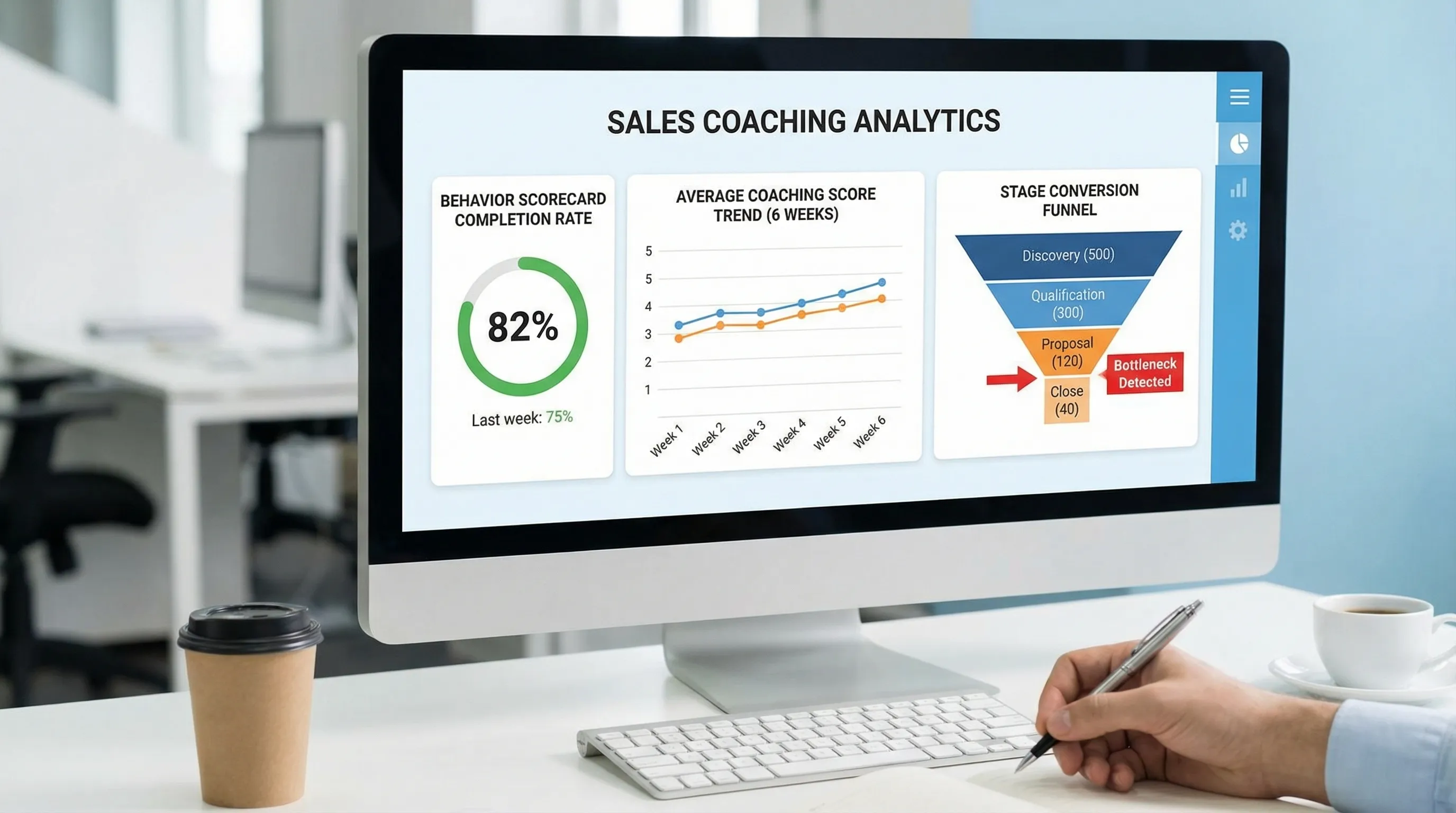
To connect coaching to win rates, you need at least one leading indicator that updates weekly.
The easiest pattern is:
- One behavior metric (did they do it?)
- One quality metric (how well did they do it?)
- One pipeline metric (did it change stage conversion?)
Here is a practical mapping you can adapt:
| Coaching focus | Behavior metric (weekly) | Quality metric (weekly) | Pipeline metric (bi-weekly to monthly) |
|---|---|---|---|
| Discovery depth | % of calls with full problem + impact + decision process captured | Discovery scorecard average | Discovery to Next Step conversion |
| Objection handling | # of objection reps practiced | Roleplay or call score on handling | Proposal to Close conversion in deals with objections |
| Value articulation | % of opportunities with quantified impact in notes/CRM | Manager review score of value case | Discount rate, Proposal acceptance |
| Mutual action plans | % of late-stage opps with documented plan | Plan completeness score | Late-stage slippage, No-decision rate |
If you cannot measure it weekly, it is not a coaching goal, it is a hope.
Step 5: Write the coaching goal with a “line of sight” to the funnel
Use a goal format that makes the chain explicit:
Goal template:
“Improve [keystone behavior] as measured by [leading indicator] from [baseline] to [target] by [date], to improve [stage conversion] for [deal type], which should lift win rate over the next [cycle length].”
Example goal (AE, late-stage no-decision)
“Over the next 6 weeks, increase mutual action plan completeness from 40% to 80% on stage 3+ opportunities, measured weekly via the plan scorecard, to improve Proposal to Close conversion for mid-market new business.”
Example goal (SDR, weak first-to-second meeting conversion)
“Over the next 4 weeks, raise discovery call structure adherence from 55% to 85% (scorecard-based) to improve Discovery to Next Meeting conversion for inbound leads.”
Notice what is missing: “increase win rate by 10%.” That is the outcome. Your coaching goal is the controllable driver.
Step 6: Build a coaching plan that forces practice, not just feedback
Coaching goals fail when the plan is only retrospective (“listen to calls”) instead of practice-based (“rehearse the moment”). The best managers do both.
A simple weekly cadence:
- 10 minutes: review leading indicators and pick one moment to fix
- 15 minutes: practice (roleplay the exact objection, scenario, or decision-step conversation)
- 10 minutes: apply (rep writes the new talk track they will use this week)
- 5 minutes: commitment (what will be different on the next 3 calls?)
Why practice matters (and why it is usually missing)
Reps often understand the feedback but cannot execute under pressure. Execution requires repetition and realistic scenarios, especially for objection handling, negotiation, and multi-threading.
This is where scenario-based practice can accelerate results, because it gives reps more “at-bats” without waiting for live opportunities.
For example, Scenario IQ provides AI-powered roleplay simulations with real-time feedback and progress analytics, so managers can assign targeted practice aligned to the coaching goal, then track improvement over time. If your goal is “handle pricing pushback without discounting,” you want practice data weekly, not just a post-mortem on the next lost deal.
Step 7: Set targets you can defend (baseline, target, timeframe)
A good target is ambitious enough to change outcomes, but grounded enough to be credible.
Use this quick method:
- Baseline: sample 10 to 20 recent calls per rep (or per cohort) and score them.
- Target: aim for a meaningful jump (often 15 to 30 points on a percentage-based scorecard) depending on current maturity.
- Timeframe: 4 to 6 weeks for one behavior sprint, long enough to learn, short enough to sustain focus.
If your sales cycle is long, do not panic. You can still measure coaching progress weekly via leading indicators, then watch win rate follow later.
Step 8: Run coaching like an experiment (so you can attribute the lift)
You do not need perfect causality, but you do need enough rigor to avoid random conclusions.
A lightweight attribution approach:
- Pick a cohort (team, segment, or 6 to 10 reps)
- Run a 4 to 6 week coaching sprint on one behavior
- Compare pre and post on:
- leading indicator trend
- the stage conversion the behavior should affect
- a secondary metric (discount rate, cycle time, no-decision)
If you can, keep another cohort “business as usual” for comparison. Even imperfect controls make the story more believable.
Step 9: Make the goal visible, and make follow-through easy
The hidden killer of coaching goals is not resistance, it is forgetting. Reps leave a 1:1 motivated, then return to a chaotic week.
To reduce drop-off:
- Put the goal in writing in a shared place (CRM note, enablement doc, coaching workspace)
- Define the next three real opportunities where the rep will apply it
- Require one short weekly reflection: “what happened when you used it?”
If you want that reflection to be consistent and professional (especially in regulated environments or formal performance contexts), a tool like an AI letter generator for professional coaching follow-ups can help managers and reps quickly draft clear recap notes, commitments, or improvement plans without starting from scratch.
Common mistakes that prevent coaching from affecting win rates
Mistake 1: Coaching to generic competencies
Competencies like “executive presence” matter, but they are hard to connect to a stage bottleneck. If win rate is the goal, start from the funnel constraint.
Mistake 2: Measuring only activity
More calls do not automatically equal higher win rates. Activity metrics can support coaching, but the center must be behavior quality and conversion.
Mistake 3: Too many goals at once
If a rep has three coaching goals, they have zero. Limit to 1 to 2 behaviors per sprint.
Mistake 4: No practice loop
Feedback without rehearsal rarely changes performance. Practice is where confidence and fluency are built.
Mistake 5: Ignoring deal type differences
A behavior that lifts SMB may not lift enterprise. Segment your goals by motion, deal size, or buyer type when possible.
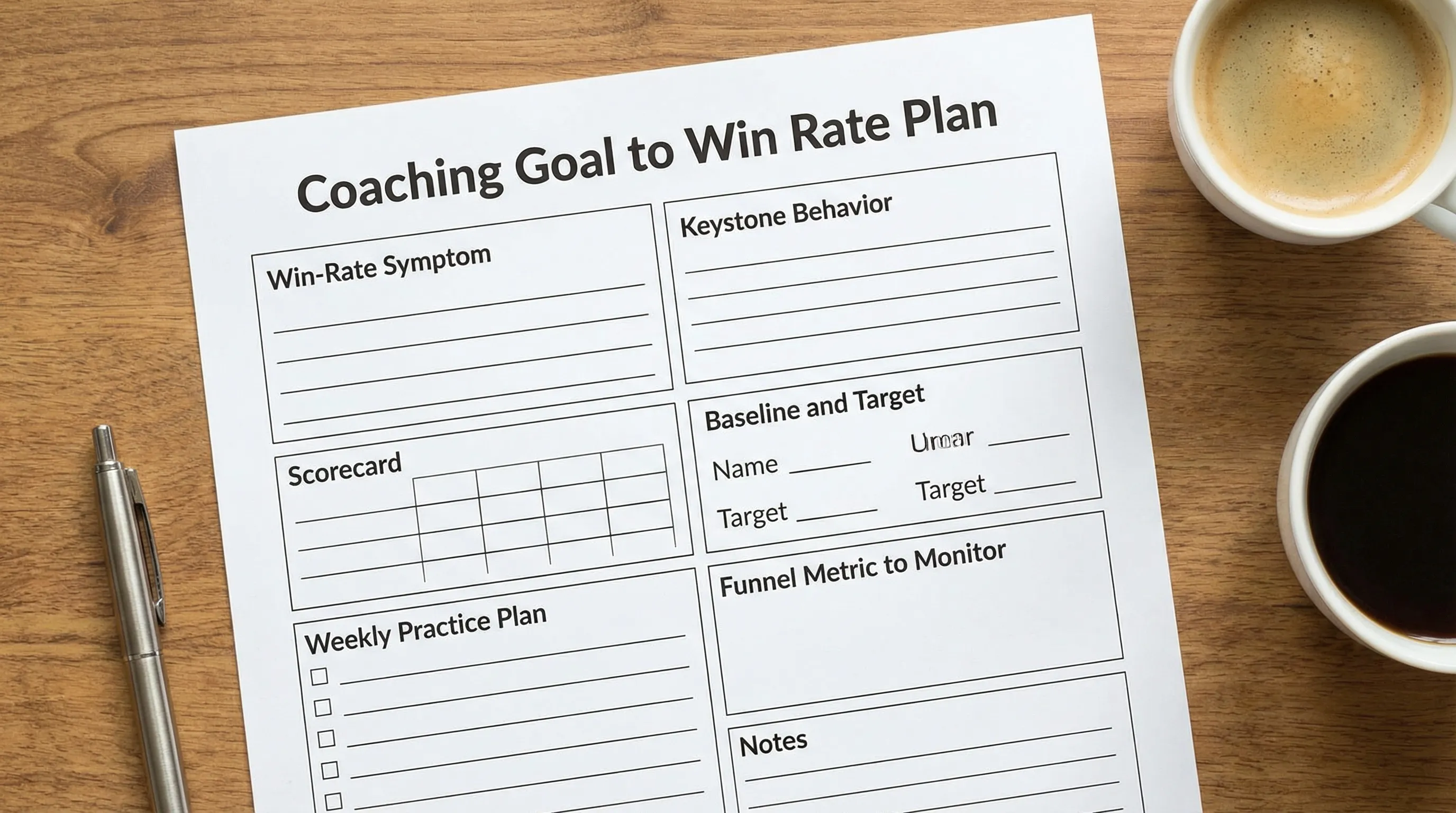
A one-page “win-rate coaching goal” worksheet (copy/paste)
Use this in your next manager sync:
- Win-rate symptom (what you see):
- Where it occurs (segment, stage, deal type):
- Keystone behavior to change:
- Observable definition (what “good” looks like):
- Scorecard lines (5 to 8):
- Baseline score:
- Target score and timeframe:
- Practice plan (weekly):
- Expected funnel impact (stage conversion):
- Review date (what we will decide then):
Frequently Asked Questions
What is the best coaching goal if we want to increase win rate fast? The best goal targets the biggest visible funnel bottleneck, then focuses on one observable behavior that improves a specific stage conversion (not “win rate” directly).
How long does it take for coaching improvements to show up in win rates? Leading indicators can move within 1 to 2 weeks, stage conversion often within 2 to 6 weeks, and win rate typically follows your average sales cycle length.
Should coaching goals be the same for every rep? Not usually. Keep the win-rate problem consistent for a cohort, but tailor the behavior goal to each rep’s baseline and specific gaps.
How do we measure coaching goals without overwhelming managers? Use a short scorecard (5 to 8 lines), sample a small number of calls each week, and track one pipeline conversion metric tied to the coaching focus.
What is a leading indicator that predicts win rate? Examples include discovery scorecard averages, mutual action plan completeness, objection handling quality scores, and the percentage of opportunities with quantified impact documented.
Can AI roleplay replace manager coaching? It should complement it. AI roleplay can provide frequent practice and consistent feedback, while managers focus on prioritization, deal context, and reinforcing the behavior in live opportunities.
Turn coaching goals into measurable performance gains with Scenario IQ
If you want coaching goals to translate into win-rate lift, you need consistent practice, clear feedback, and progress tracking that managers can actually use week to week.
Scenario IQ supports that workflow with AI-powered roleplay simulations, personalized scenarios, real-time feedback, and analytics for progress tracking across teams. To see how scenario-based practice can reinforce your next coaching sprint, explore Scenario IQ and align training to the funnel metrics you care about most.