

Most sales onboarding fails for one simple reason: new reps spend too much time consuming information and not enough time practicing the conversations that actually move deals forward.
Scenario-based practice flips that ratio. Instead of hoping knowledge transfers into performance, you build performance directly through repeated, guided reps of real selling moments (discovery, objection handling, pricing, next steps). With an AI training platform like Scenario IQ, you can scale that practice across the team with consistent feedback, personalised scenarios, and clear progress tracking.
Why scenario-based practice ramps reps faster
Traditional onboarding often looks like product training, CRM training, and shadowing. Those pieces matter, but they do not guarantee that a rep can:
- Ask strong discovery questions in your market
- Navigate common objections without discounting
- Handle silence, ambiguity, or a skeptical stakeholder
- Close for the next step clearly and confidently
Scenario-based practice compresses time-to-competency because it creates a tight learning loop:
- A rep tries a realistic scenario
- They get immediate feedback on what to change
- They repeat until the behavior becomes reliable
This is especially important in modern sales orgs where teams are distributed and managers have limited coaching bandwidth.
The core onboarding problem: knowledge is not the bottleneck
Most new reps can learn your pitch deck. Fewer can apply it under pressure.
The bottleneck is “in-the-moment performance,” the ability to choose the right words, sequence, tone, and next step while a buyer pushes back. That capability is built through practice, not exposure.
This is also where onboarding often becomes inconsistent. One rep gets lots of roleplay time with a great manager, another rep gets mostly asynchronous content and a few rushed call reviews.
Scenario IQ addresses this inconsistency by giving every rep access to:
- AI-powered roleplay simulations that replicate real conversations
- Personalised training scenarios aligned to role, industry, and skill level
- Real-time feedback and adaptive guidance while they practice
- Progress tracking analytics so managers can see skill gains, not just course completion
A practical onboarding framework built around scenarios
The fastest ramp comes from treating onboarding as a performance program, not a content program. Here is a field-tested structure you can adapt.
Step 1: Define “ramp” as observable behaviors (not time or modules)
Before you build a single scenario, define what a ramped rep can reliably do. Keep it specific and measurable.
Examples of onboarding competencies:
- Run a 20-minute discovery call that produces a clear problem statement and success criteria
- Deliver your value proposition in under 45 seconds without jargon
- Handle your top 5 objections and still advance the deal
- Confirm next steps with a calendar commitment
A simple scorecard keeps onboarding aligned across managers.
| Competency area | Observable behaviors | Evidence you can collect |
|---|---|---|
| Discovery | Asks situational and impact questions, confirms priorities | Scenario scores, call recordings |
| Objection handling | Acknowledges, clarifies, responds, checks for resolution | Scenario pass rate on objections |
| Messaging | Uses approved positioning, avoids feature dumping | Transcript review, AI feedback |
| Next steps | Sets mutual action plan, confirms timeline and owner | Scenario outcomes, pipeline hygiene |
Step 2: Map your “critical conversations” across the buyer journey
List the 8 to 15 moments that determine whether a rep wins or loses. These are your scenario library.
Common critical conversations:
- First-touch outbound call or inbound lead response
- Discovery with a skeptical buyer
- Demo transition (moving from needs to solution)
- Pricing and procurement pushback
- Competitive comparison
- Security, legal, or IT objections
- Renewal or expansion conversation (for account teams)
If you sell into multiple industries, create variations that preserve the same skill but shift the context (stakeholders, terminology, compliance concerns).
Step 3: Build scenarios that reflect your reality (not generic roleplay)
Scenario quality determines training impact. High-performing onboarding scenarios share a few traits:
- A clear role and setting (who the rep is, who the buyer is, why they are talking)
- A specific objective (book a meeting, confirm pain, qualify out, secure next step)
- One primary skill focus (do not test everything at once)
- Real constraints (tight timeline, budget sensitivity, existing vendor, internal politics)
With Scenario IQ, you can deliver personalised, scenario-based practice at the rep level, then adjust difficulty using customisable skill levels and adaptive feedback.
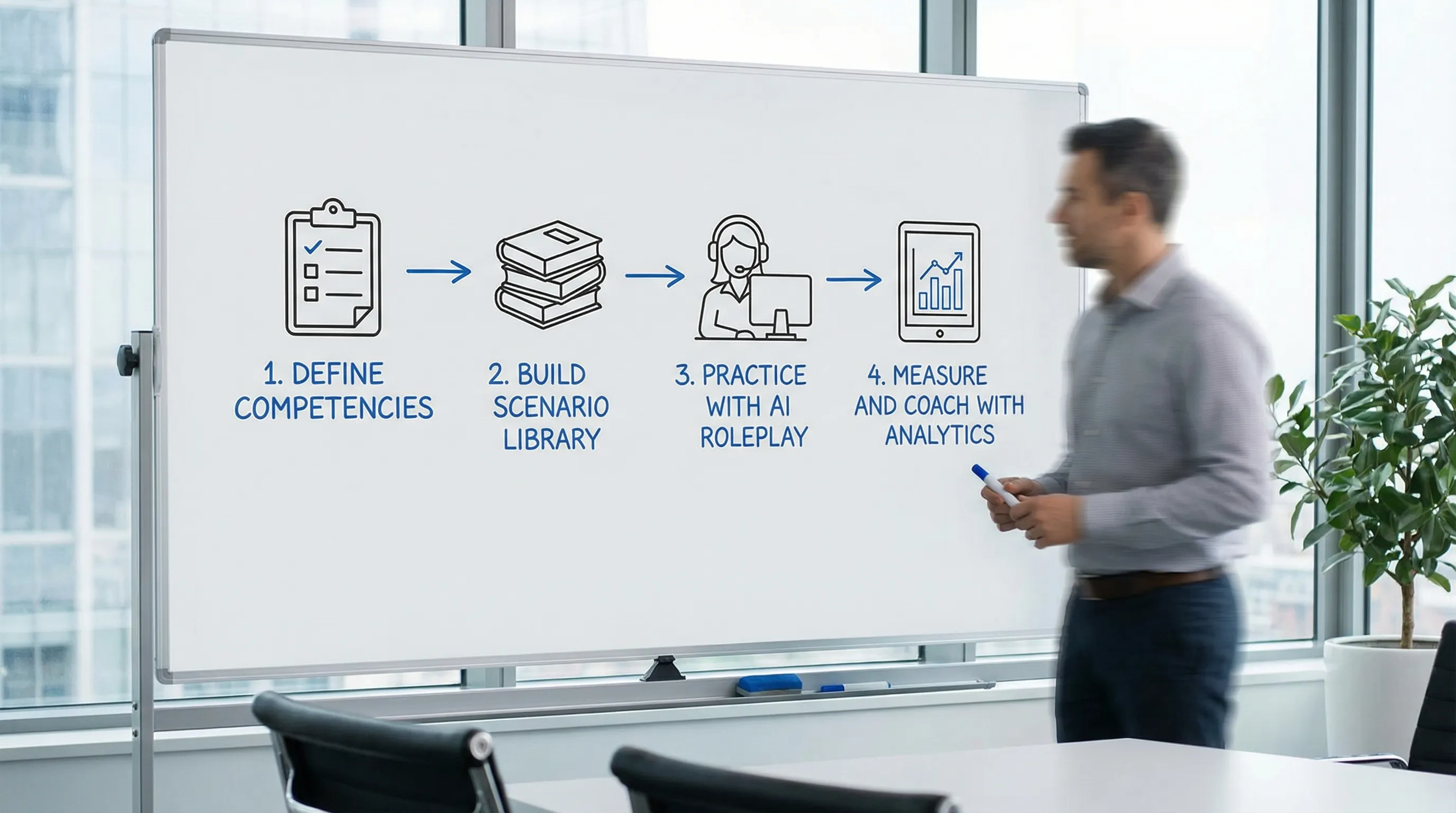
Step 4: Create a weekly practice cadence that managers can actually sustain
Consistency beats intensity. Instead of one big roleplay session, build a small rhythm.
A practical cadence for new reps:
- 3 to 5 short AI roleplays per week (10 to 15 minutes each)
- 1 manager review touchpoint focused on patterns (not every detail)
- 1 live roleplay or call review for nuance and team learning
This approach gives reps repetition, gives managers leverage, and creates measurable progress.
A 30-60-90 day onboarding plan that uses scenarios
You do not need dozens of scenarios on day one. Start with a tight set, then expand.
Days 1 to 30: Confidence and fundamentals
Focus: messaging, discovery basics, and clean next steps.
Recommended scenario set:
- Value prop delivery and meeting agenda
- Discovery call opener and first 5 questions
- “We are just looking” inbound brush-off
- Common pain exploration (industry-specific)
- Next step close with calendar confirmation
Success targets to track:
- Rep completes a defined number of practice sessions
- Scenario feedback shows improvement in talk track structure
- Manager sees fewer “feature dumps” and stronger questioning
Days 31 to 60: Objections and deal motion
Focus: handling pushback while advancing the deal.
Recommended scenario set:
- Price pushback (without discounting)
- “Send me info” and other stalls
- Competitive comparison
- Stakeholder alignment (multi-threading)
- Qualification and disqualification conversations
Success targets to track:
- Higher pass rate on objection scenarios
- Improved consistency of next steps
- Faster movement from first meeting to second meeting
Days 61 to 90: Realism, complexity, and autonomy
Focus: complex deals and edge cases.
Recommended scenario set:
- Security and compliance objections
- Procurement negotiation basics
- Executive conversation (outcomes, ROI, risk)
- Renewal risk or expansion pitch (if applicable)
Success targets to track:
- Scenario performance stays strong as difficulty increases
- Reps show consistent behavior across varied contexts
- Managers spend less time on basics and more on strategy
How Scenario IQ makes this scalable for teams
Scenario-based onboarding can be run with humans alone, but it is hard to do consistently at scale. Managers get busy, roleplays become sporadic, and feedback varies.
Scenario IQ is designed to reduce that friction with:
- AI roleplay simulations that let reps practice anytime
- Real-time feedback so reps can correct issues immediately
- Adaptive feedback and guidance that evolves with the rep’s skill level
- Team-focused learning so onboarding stays consistent across cohorts
- Progress tracking analytics and performance metric dashboards so leaders can see what is improving and where coaching is needed
- Daily actionable tips that keep practice moving between coaching sessions
- Enterprise-grade security for organisations that need stricter controls
The most valuable shift is that onboarding becomes measurable. You are no longer guessing whether training “landed,” you can see whether the skills are improving.

What to measure if you want faster ramp (and less guesswork)
“Ramp time” is the outcome. To improve it, measure leading indicators that reflect skill.
Here is a simple measurement model that pairs training signals with sales outcomes.
| What you measure | Why it matters | Example signal |
|---|---|---|
| Practice consistency | Repetition drives fluency | Sessions per week per rep |
| Scenario proficiency | Predicts call performance | Pass rate by scenario type |
| Skill breakdown | Targets coaching precisely | Weakness in discovery vs objections |
| Time-to-first proficiency | Shows onboarding efficiency | Days until rep passes core scenarios |
| Conversion milestones | Connects training to revenue motion | Lead to meeting, meeting to next step |
Use analytics to answer these questions:
- Which objections are slowing new reps down most?
- Which managers or teams produce faster skill gains?
- Which scenarios correlate with better meeting outcomes?
Common mistakes that slow onboarding (and how to fix them)
Mistake 1: Practicing scripts instead of skills
If reps memorize lines, they crumble when the buyer deviates. Scenario practice should focus on skills like clarifying, reframing, and confirming next steps.
Fix: design scenarios with varied buyer personalities and changing context, while scoring the same core skill.
Mistake 2: Waiting too long to introduce objections
Many onboarding programs delay objections until reps “know the product.” In reality, objections start in the first interaction.
Fix: introduce light objections in week one (timing, relevance, “already have a vendor”), then increase difficulty.
Mistake 3: Feedback that is vague or inconsistent
“Sounded good” does not help a rep improve.
Fix: standardize a rubric (structure, clarity, questioning, next-step close) and use real-time feedback plus manager coaching to reinforce it.
Mistake 4: Treating onboarding as separate from ongoing coaching
Onboarding should transition naturally into continuous enablement.
Fix: keep the scenario library alive. Add new scenarios based on current pipeline realities and emerging competitive threats.
Frequently Asked Questions
What is scenario-based practice in sales onboarding? Scenario-based practice is structured roleplay built around realistic selling situations (discovery, objections, pricing, next steps). Reps practice the conversation, get feedback, and repeat until performance becomes consistent.
How many scenarios do new reps need to ramp faster? Start with 8 to 12 core scenarios that cover your critical conversations, then expand as reps progress. Depth and repetition matter more than having a huge library.
How often should new reps do roleplay practice? A sustainable baseline is 3 to 5 short practice sessions per week, plus one manager coaching touchpoint. Consistency is more effective than occasional long sessions.
How do you measure whether onboarding is working? Track leading indicators like scenario pass rates, skill breakdowns, and time-to-proficiency, then connect them to outcomes like meeting conversion and progression to next steps.
Can Scenario IQ work for customer service onboarding too? Yes. The same scenario-based approach applies to service and support, for example de-escalation, policy explanations, empathy, and resolution next steps, especially when paired with real-time feedback and analytics.
Bring scenario-based onboarding to your team with Scenario IQ
If you want to onboard new reps faster, focus less on content completion and more on measurable conversation skills. Scenario-based practice gives new hires a safe place to build confidence, and it gives leaders a clear view of readiness.
Scenario IQ helps you operationalize that approach with AI-powered roleplay simulations, personalised scenarios, real-time feedback, and progress tracking analytics.
Explore Scenario IQ and see how scenario-based practice can fit your onboarding program: Scenario IQ.