
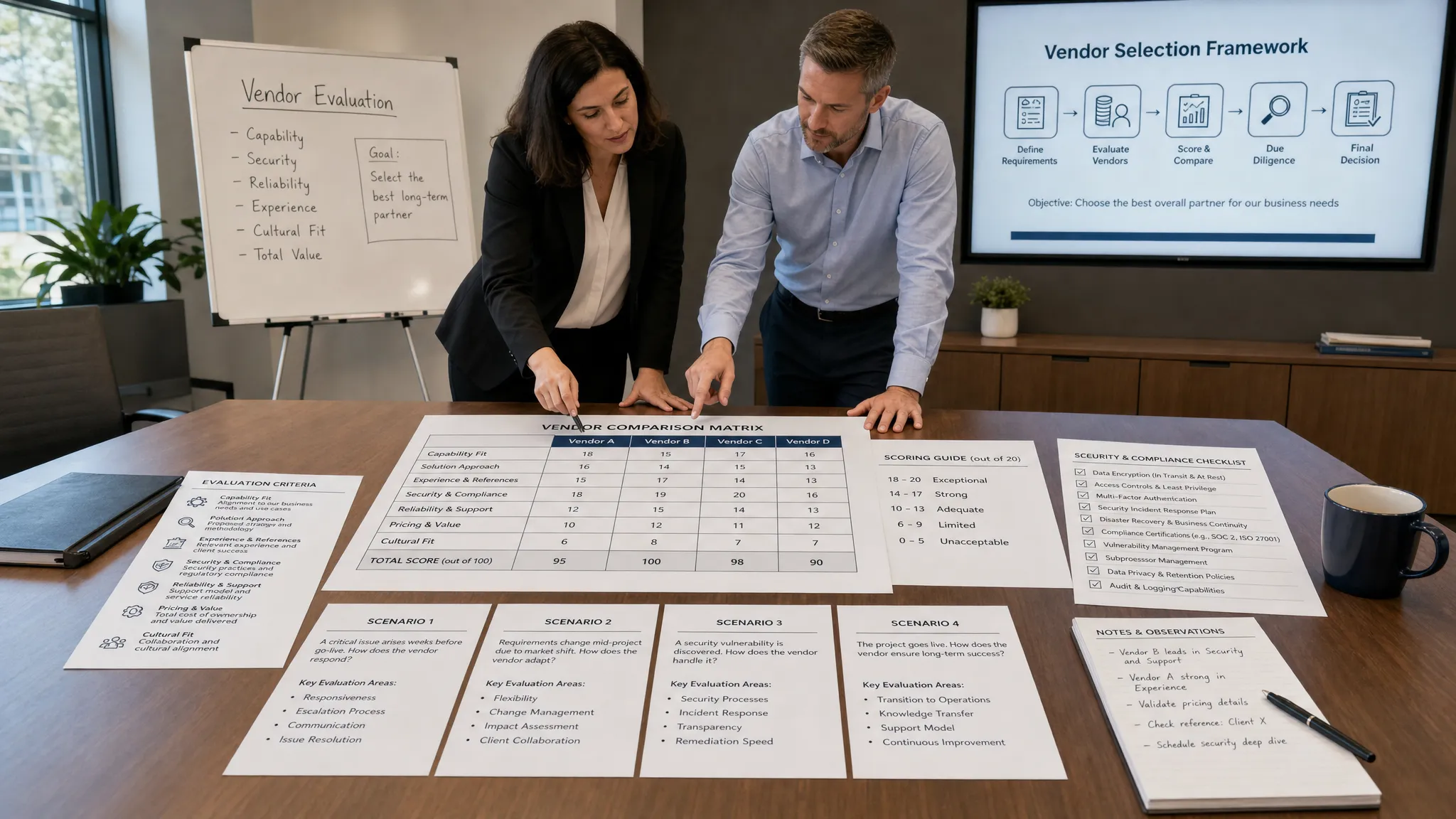
Selecting an AI service company for training is not just a technology decision. It is a performance decision that affects how quickly your sales reps, service agents, managers, and customer-facing teams build confidence in real conversations.
The best provider is not necessarily the one with the most impressive demo or the longest feature list. The right partner should help people practice realistic situations, receive useful coaching, improve over time, and connect learning activity to measurable business outcomes.
For sales and service organizations, that usually means better objection handling, stronger discovery, faster ramp time, more consistent customer experiences, and fewer coaching gaps between managers and frontline teams.
This guide gives you a practical framework to evaluate an AI service company for training, compare vendors fairly, and run a pilot that reveals whether the solution will actually work for your team.
Start with the training problem, not the AI
AI training projects often fail when teams start with the question, “What can this tool do?” A better starting point is, “What behavior do we need people to improve?”
For example, a sales leader may want reps to handle pricing objections without discounting too quickly. A customer service leader may want agents to de-escalate frustrated customers while following policy. A revenue enablement team may need new hires to practice discovery calls before speaking with real prospects.
In each case, the AI is only valuable if it creates enough realistic practice, gives useful feedback, and helps managers see who is improving.
Before evaluating providers, define the business context clearly. This will help you avoid buying a general AI tool that is not built for training outcomes.
| Evaluation question | Why it matters | Example evidence to request |
|---|---|---|
| What skills need improvement? | Prevents vague training goals | Skill map, competency model, manager input |
| Who will use the platform? | Shapes scenario design and adoption | User personas, role types, team structure |
| What conversations matter most? | Ensures simulations match real work | Sales calls, support escalations, renewal conversations |
| How will success be measured? | Connects training to business value | Ramp time, QA scores, win rates, CSAT, confidence scores |
| Who will coach the learners? | Clarifies manager involvement | Coaching workflows, reporting views, review process |
This upfront clarity makes vendor conversations much more productive. Instead of asking, “Do you have AI roleplay?” you can ask, “Can your system simulate a renewal call with a skeptical customer, adapt to the rep’s responses, and score whether they uncovered the business impact before discussing price?”
What a strong AI service company should provide
A credible AI service company for training should combine three capabilities: learning design, AI simulation quality, and operational measurement.
The learning design layer ensures the training reflects real competencies, not random chatbot conversations. The AI simulation layer gives learners scalable practice with realistic responses. The measurement layer helps leaders understand progress and decide where coaching is needed.
If any of these layers is weak, the program suffers. Great AI without learning design becomes a novelty. Strong content without adaptive simulation feels static. Analytics without clear coaching actions creates dashboards that no one uses.

When comparing vendors, look for signs that the company understands training as a behavior change process. The provider should be able to explain how practice, feedback, repetition, and manager reinforcement work together.
Evaluate scenario realism and roleplay quality
Scenario quality is one of the most important selection criteria. Learners will only take AI training seriously if the roleplay feels close to the conversations they actually face.
A weak scenario sounds generic. It may ask predictable questions, accept shallow answers, or fail to challenge the learner. A strong scenario reflects the buyer, customer, product context, emotional tone, and difficulty level of a real interaction.
For sales teams, realistic roleplay might include budget hesitation, competitor comparisons, internal stakeholder concerns, timing objections, or unclear decision criteria. For service teams, it may include frustrated customers, compliance boundaries, refund policies, technical confusion, or escalation triggers.
Ask each vendor how scenarios are created and customized. You want to understand whether the system can reflect your roles, customer segments, industry language, and desired behaviors.
Useful questions include:
- Can scenarios be personalized for different roles, experience levels, and customer types?
- Can the simulation adjust difficulty based on learner performance?
- Can managers or enablement teams align scenarios with current priorities?
- Can the AI respond naturally when the learner takes an unexpected path?
- Can the platform support both sales and service conversations if your teams need both?
Scenario IQ, for example, focuses on AI-powered roleplay simulations and personalized training scenarios. When evaluating any provider, including Scenario IQ, the key is to test those scenarios against your actual frontline conversations rather than relying only on a polished demo.
Assess the quality of feedback
Feedback is where AI training becomes coaching. A roleplay session that simply says “good job” or gives a generic score will not change behavior. Learners need specific, actionable feedback they can apply in the next attempt.
Good AI feedback should identify what the learner did well, where they missed an opportunity, and how to improve. It should be tied to the skill being practiced, such as asking better discovery questions, acknowledging customer emotion, summarizing needs, or confirming next steps.
For managers, feedback should also be consistent enough to support coaching at scale. If every rep gets a different interpretation of the same behavior, the platform can create confusion. If the criteria are transparent and aligned with your coaching model, it can reinforce the same standards across the team.
The best evaluation method is to run the same scenario with multiple test users and compare the feedback. Look for specificity, fairness, and usefulness. Does the system explain why the response was strong or weak? Does it offer better language? Does it encourage the learner to try again?
This is especially important for customer-facing teams because conversation quality is nuanced. A rep may use the right words but sound dismissive. An agent may solve the issue but fail to show empathy. A strong AI training platform should help learners notice those details.
Look for personalization and adaptive learning
Training impact improves when practice matches the learner’s current skill level. New hires may need structured guidance and simpler scenarios. Experienced reps may need tougher objections, more complex stakeholders, or more subtle feedback.
Personalization should not mean every learner gets a completely isolated path with no consistency. It means the platform adapts practice while still reinforcing the same core competencies.
When evaluating providers, ask how the system adjusts to different users. Can it provide custom skill levels? Can it recommend what to practice next? Can it give daily actionable tips or guidance based on recent performance? Can it support team-wide learning while still helping each person progress individually?
Adaptive training is particularly valuable for sales and service teams because skill gaps are rarely identical. One rep may struggle with discovery. Another may be strong in discovery but weak in closing. One agent may need help de-escalating emotion, while another needs help explaining policy clearly.
A strong AI service company should make those differences visible and coachable.
Review analytics that managers will actually use
Analytics are often presented as a major benefit of AI training, but not all dashboards are helpful. The goal is not to track activity for its own sake. The goal is to identify readiness, improvement, and coaching priorities.
Useful analytics answer practical management questions:
- Who is practicing consistently?
- Which skills are improving?
- Where are learners getting stuck?
- Which scenarios create the most difficulty?
- Which teams need additional coaching?
- Are training improvements connected to operational metrics?
Progress tracking analytics and performance dashboards can help leaders move from anecdotal coaching to evidence-based coaching. Instead of waiting for a lost deal or poor QA review, managers can see skill risks earlier and intervene.
However, be careful with vanity metrics. A high number of completed simulations does not automatically mean better performance. Time spent in training is useful only if it leads to stronger behavior.
A good provider should help you interpret the data and turn it into action. Ask what managers see, how progress is measured, and whether insights are easy to use during one-on-one coaching sessions.
Examine security, privacy, and AI governance
Any platform that handles training conversations, employee performance data, customer examples, or business context needs serious review. This is especially important if your scenarios include sales strategy, customer objections, pricing discussions, regulated workflows, or support policies.
Security and governance should be evaluated before the pilot, not after procurement is almost complete.
At minimum, ask providers how they handle data protection, user permissions, retention, model usage, and administrative controls. If they claim enterprise-grade security, ask for documentation rather than accepting the phrase at face value.
You can also use external frameworks to guide your evaluation. The NIST AI Risk Management Framework is a helpful reference for thinking about AI governance across risk identification, measurement, and management. For organizations formalizing AI oversight, ISO/IEC 42001 provides a management system standard for artificial intelligence. Technical teams may also find the OWASP Top 10 for Large Language Model Applications useful when reviewing application risks.
You do not need every buyer on the team to become an AI security expert. But you do need clear answers from the vendor and alignment with your internal security, legal, and compliance requirements.
Test implementation support and change management
A training platform does not create behavior change by itself. Adoption depends on how easily the tool fits into daily routines, how managers reinforce it, and whether learners understand why it matters.
During evaluation, ask what happens after the contract is signed. How does the provider help configure scenarios? How are managers onboarded? What does a successful launch plan look like? How quickly can teams begin practicing? What support is available if adoption is low?
This is where many buyers underestimate the difference between a software vendor and a training partner. The platform can have excellent AI, but if managers do not use the insights, or if scenarios do not reflect current business priorities, the program may lose momentum.
Strong providers should be able to describe a practical rollout plan. They should also help you start focused. For example, you might begin with one team, one conversation type, and three measurable skills before expanding across the organization.
Use a structured scoring matrix
A scoring matrix helps reduce bias during vendor selection. Without one, teams may overvalue a slick demo, a familiar brand, or one feature that does not matter much to the overall training goal.
The weights below are only a starting point. Adjust them based on your organization’s priorities.
| Category | Suggested weight | What to evaluate |
|---|---|---|
| Scenario realism | 20% | Relevance, conversation depth, industry fit, adaptability |
| Feedback quality | 20% | Specificity, coaching usefulness, alignment with competencies |
| Personalization | 15% | Skill levels, adaptive guidance, learner-specific recommendations |
| Analytics | 15% | Progress tracking, manager visibility, performance insights |
| Security and governance | 15% | Data handling, access controls, documentation, AI risk practices |
| Implementation support | 10% | Onboarding, configuration, launch planning, support model |
| User experience | 5% | Ease of use for learners, managers, and admins |
The scoring process should involve the people who will actually use the platform. Include sales or service leaders, enablement, frontline managers, IT, security, and a sample of learners.
Each stakeholder will notice different things. Learners can tell you whether the simulation feels credible. Managers can judge whether feedback is coachable. Security teams can review risk. Enablement can assess whether the platform supports the broader training strategy.
Run a pilot that measures learning transfer
A pilot should test whether the platform changes behavior, not just whether users log in.
Choose a focused use case with a clear before-and-after comparison. For example, you might test how well reps handle pricing objections, how effectively service agents de-escalate upset customers, or how consistently new hires follow a discovery framework.
Before the pilot begins, define the baseline. This might include manager assessments, QA scores, call review findings, roleplay scores, or self-reported confidence. Then have participants complete a set of AI roleplay sessions over a defined period.
At the end, compare performance against the baseline. Look for signs that learners are using better language, asking stronger questions, following the process more consistently, or improving confidence.
The Kirkpatrick Model is a useful way to think about training evaluation. It encourages teams to look beyond learner satisfaction and consider learning, behavior, and results. For AI training, this matters because a tool can be enjoyable without producing measurable performance improvement.
A good pilot should answer these questions:
- Did learners practice the right skills?
- Did feedback help them improve between attempts?
- Did managers gain useful coaching insight?
- Did the platform fit into the team’s workflow?
- Is there evidence of behavior change outside the simulation?
If the answer to these questions is unclear, extend the pilot or narrow the use case before making a larger commitment.
Watch for red flags during evaluation
Some warning signs appear early if you know what to look for. Be cautious if a provider focuses heavily on AI buzzwords but cannot explain the learning methodology behind the product.
Another red flag is overpromising. AI training can improve practice, consistency, and coaching visibility, but it should not be sold as a magic replacement for managers, enablement teams, or human judgment.
Be careful if the vendor cannot show how scenarios are customized, how feedback is generated, or how data is protected. Also watch for analytics that look impressive but do not translate into coaching actions.
Finally, pay attention to user experience. If learners find the tool awkward, unrealistic, or punitive, adoption will suffer. AI training works best when people feel safe practicing difficult conversations before they happen with real customers.
How Scenario IQ fits into the evaluation
Scenario IQ is designed for AI-driven, personalized scenario-based training across sales, service, and other team environments. Its capabilities include AI-powered roleplay simulations, personalized training scenarios, real-time feedback, adaptive guidance, daily actionable tips, customizable skill levels, progress tracking analytics, team-focused learning, performance metric dashboards, and enterprise-grade security.
If you are evaluating Scenario IQ alongside other providers, use the same criteria recommended in this guide. Test the realism of the roleplays, review the usefulness of the feedback, examine the analytics available to managers, and confirm that the platform aligns with your security and implementation requirements.
The strongest buying decision comes from matching your team’s highest-value conversations to a platform that helps people practice them repeatedly, receive guidance in the moment, and improve with measurable visibility.
Frequently Asked Questions
What is an AI service company for training? An AI service company for training provides AI-enabled tools or services that help employees practice skills, receive feedback, and improve performance. In sales and service environments, this often includes roleplay simulations, personalized scenarios, coaching insights, and analytics.
How do I know if an AI training platform is realistic enough? Test it with real examples from your business. Ask experienced reps, agents, and managers to complete scenarios and rate whether the AI responses reflect actual customer behavior, objections, emotional tone, and complexity.
What metrics should I use to evaluate AI training success? Useful metrics include skill improvement, scenario scores, manager coaching observations, confidence changes, ramp time, QA scores, conversion rates, customer satisfaction, and consistency in following your sales or service process.
Should AI replace human coaching? No. AI is most effective when it increases practice opportunities and gives managers better insight. Human coaches are still essential for context, judgment, motivation, and reinforcement.
How long should an AI training pilot run? A focused pilot often needs enough time for learners to complete multiple practice sessions and improve across attempts. The right duration depends on team size and use case, but the pilot should include baseline measurement, repeated practice, and post-pilot evaluation.
Ready to evaluate AI training with confidence?
Choosing the right AI service company for training comes down to one question: will this help your people perform better in the conversations that matter most?
Scenario IQ helps teams practice realistic sales and service scenarios, receive real-time feedback, and track progress with actionable analytics. If your organization wants to build confidence, improve communication, and create more consistent customer-facing performance, explore Scenario IQ and see how AI roleplay training can support your team’s goals.