
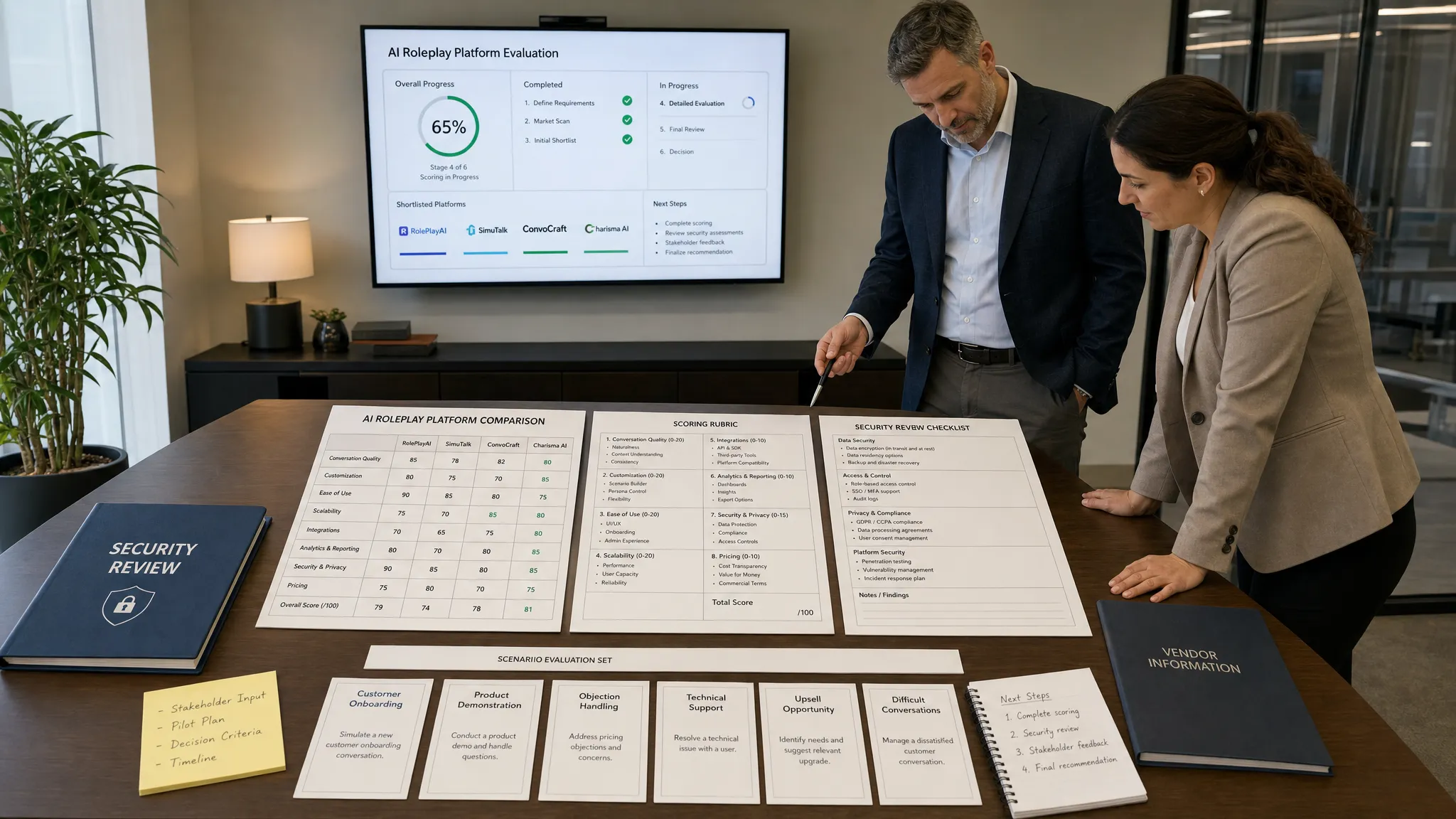
Choosing an AI platform for roleplay training is not the same as buying another enablement tool. The platform will influence how your team practices high-stakes conversations, how managers coach, and how quickly new behaviors show up in real customer interactions.
For sales and service leaders, the promise is compelling: realistic practice at scale, personalized feedback, and measurable improvement without requiring a manager to sit in every mock call. But the market is crowded, and many tools look impressive in a demo while falling short once teams need accurate scenarios, trusted scoring, and adoption across busy reps or agents.
The right choice starts with a clear evaluation framework. Instead of asking which vendor has the most AI features, ask which AI platform will help your team build confidence, handle objections, communicate clearly, and improve the metrics that matter.
Start with the conversations that decide performance
Before comparing vendors, define the real conversations your team needs to master. Roleplay training works best when it is anchored to specific moments where performance affects revenue, retention, satisfaction, or risk.
For a sales team, that might include discovery calls, pricing objections, competitive displacement, late-stage negotiation, procurement pushback, or renewal risk. For a service team, it may include frustrated customers, policy explanations, escalation prevention, technical troubleshooting, or empathy during sensitive situations.
A useful exercise is to identify the five conversations your best performers handle well and your average performers struggle with. Those scenarios should become the foundation of your evaluation. If a platform cannot model those moments realistically, its analytics and dashboards will not matter much.
Strong roleplay programs usually focus on a small set of high-value skills first, such as:
- Asking better discovery questions without sounding scripted
- Responding to objections with confidence and empathy
- Explaining complex information in simple language
- De-escalating emotional customer conversations
- Closing next steps without creating pressure or confusion
This focus also helps you avoid a common buying mistake: choosing a generic conversation simulator when you actually need roleplay training tied to your team’s market, customers, policies, and performance standards.

Know what an AI roleplay platform should actually do
An AI platform for roleplay training should do more than generate a chatbot conversation. At minimum, it should create realistic practice environments, adapt to the learner’s responses, provide actionable feedback, and help leaders see where skill gaps exist across the team.
The best systems combine simulation, coaching, and measurement. A rep or agent enters a scenario, interacts with an AI customer or prospect, receives feedback in the moment or after the session, and can repeat the exercise until their performance improves. Managers can then review progress, identify patterns, and coach with evidence instead of relying only on call shadowing or anecdotal feedback.
This matters because roleplay is only useful when practice translates into behavior change. The Kirkpatrick Model is a widely used training evaluation framework that encourages teams to look beyond learner satisfaction and measure behavior change and business outcomes. That same principle applies here: do not buy a platform only because learners like it. Buy it because it helps them perform better.
Evaluation criteria for choosing the right platform
The most useful way to compare vendors is to separate exciting AI capabilities from the fundamentals that determine whether the tool will work in your organization. Use the criteria below as a practical checklist during demos, pilots, and procurement conversations.
| Evaluation area | What strong looks like | Red flags to watch for |
|---|---|---|
| Scenario realism | Scenarios reflect your customers, objections, products, tone, and complexity | Generic prompts that feel like classroom exercises |
| Adaptive conversation | The AI responds naturally to different learner choices and does not force one fixed script | The interaction breaks when the learner goes off-script |
| Feedback quality | Feedback is specific, timely, tied to skills, and easy to act on | Vague scores or compliments without coaching guidance |
| Personalization | Practice adapts to role, skill level, experience, and learning goals | Every learner receives the same exercise regardless of need |
| Analytics | Leaders can track progress, patterns, and readiness signals | Dashboards show completion only, not skill improvement |
| Manager enablement | Managers can use outputs for coaching conversations and team planning | The tool removes managers from the process instead of helping them coach |
| Security and governance | Data handling, access controls, and AI risk practices are clear | Vendor cannot explain where data goes or how it is protected |
| Adoption experience | The platform is easy to use, fast to access, and relevant to daily work | Learners see it as extra admin with little payoff |
1. Scenario quality matters more than scenario quantity
A large library of scenarios can be useful, but only if the scenarios are credible. A poorly designed roleplay with unrealistic customer behavior can train the wrong habits. The learner may become better at passing the simulation while still struggling in the real conversation.
During vendor evaluation, ask to see a scenario built around one of your actual use cases. For example, give the vendor a common objection, a target persona, and the outcome you want the learner to achieve. Then observe whether the AI customer behaves in a way that resembles your market.
Look for nuance. A strong simulation should be able to represent uncertainty, skepticism, confusion, urgency, emotional frustration, or competing priorities. It should also allow different paths to success. In real conversations, there is rarely one perfect script. Your platform should reward good judgment, not just memorization.
If your team operates across multiple roles or industries, customization becomes even more important. Sales development reps, account executives, customer success managers, support agents, and frontline service teams all need different practice contexts. A one-size-fits-all simulator will quickly lose relevance.
2. Feedback should be immediate, specific, and coachable
Feedback is where roleplay training either becomes a performance engine or turns into a novelty. The best AI roleplay platforms do not simply tell a learner they performed well or poorly. They explain what happened, why it mattered, and what to try next.
Useful feedback is usually tied to a clear rubric. For example, a discovery call scenario might evaluate question quality, listening, problem diagnosis, value connection, objection handling, and next-step clarity. A customer service scenario might evaluate empathy, issue identification, policy explanation, tone, resolution ownership, and escalation judgment.
The feedback should also be understandable to managers. If the platform produces scores that leaders cannot interpret or coach against, it will not improve performance. Ask vendors to show both the learner view and the manager view. A learner needs guidance, while a manager needs patterns that help prioritize coaching time.
A simple test is to review a completed roleplay and ask: could a manager use this output to run a better one-on-one coaching conversation? If the answer is no, the feedback layer is not strong enough.
3. Personalization keeps practice relevant
Teams rarely improve at the same pace. New hires need foundational practice. Experienced reps may need advanced negotiation or executive conversation training. Service agents may need targeted help with empathy, speed, or policy accuracy.
A strong AI platform should allow training to adapt to different skill levels and needs. This does not mean every session must be completely unique. It means the learner should not be stuck in practice that is too easy, too advanced, or unrelated to their real role.
Personalization can show up in several ways: tailored scenarios, adjustable difficulty, adaptive feedback, repeat practice on weak areas, and guidance that changes as the learner improves. The goal is to create productive challenge. If training is too easy, people disengage. If it is too difficult, they lose confidence.
For managers, personalization also helps reduce coaching waste. Instead of assigning the same roleplay to everyone, leaders can focus practice where each person is most likely to improve.
4. Analytics should measure readiness, not just activity
Completion rates are easy to track, but they do not prove readiness. A team can complete every assigned module and still be unprepared for a difficult customer conversation. When choosing an AI platform, look for analytics that connect practice to skill development.
Good roleplay analytics should help answer questions like: Which objections are causing the most difficulty? Are new hires improving week over week? Which teams are struggling with empathy, confidence, or closing next steps? Are managers assigning the right practice? Is performance improving after coaching?
This is where performance metric dashboards and progress tracking become valuable. The objective is not to create surveillance. The objective is to give leaders enough insight to coach earlier, reinforce the right behaviors, and identify readiness gaps before customers experience them.
Here is a practical scorecard you can adapt for platform comparison:
| Criterion | Suggested weight | What to verify during evaluation |
|---|---|---|
| Scenario realism and customization | 20% | Can the platform reflect your actual buyer or customer conversations? |
| Feedback and coaching quality | 20% | Does feedback explain what to improve and how to improve it? |
| Adaptive learning and personalization | 15% | Can difficulty and guidance adjust by role, level, or performance? |
| Analytics and reporting | 15% | Can leaders see skill trends, progress, and team-level gaps? |
| Security and governance | 15% | Are data protection, access, and AI practices clearly documented? |
| Learner experience and adoption | 10% | Will busy employees actually use it consistently? |
| Implementation fit | 5% | Can your team launch without excessive complexity? |
The weights are only a starting point. A regulated enterprise may weight security higher. A fast-growing sales team may prioritize onboarding speed and manager visibility. A customer service organization may place more weight on consistency, empathy, and escalation handling.
5. Security and governance cannot be an afterthought
Roleplay training may involve sensitive information: customer scenarios, internal messaging, product positioning, competitive strategy, or employee performance data. Any AI platform that touches those areas needs a serious security and governance review.
At minimum, ask how the platform handles data storage, access controls, retention, user permissions, and administrative visibility. If employees will practice with realistic customer examples, clarify whether personally identifiable information should be removed before scenarios are created.
You should also ask how the vendor approaches AI risk. The NIST AI Risk Management Framework is a helpful reference for thinking about trustworthy AI, including validity, reliability, safety, security, transparency, and accountability. You do not need every stakeholder to become an AI governance expert, but your buying process should include legal, IT, security, and business owners early enough to avoid delays later.
For enterprise teams, security is not just a procurement checkbox. It affects whether the platform can be adopted widely, whether managers trust the outputs, and whether employees feel safe practicing real-world conversations.
6. Adoption depends on workflow fit
Even the best roleplay technology fails if it feels disconnected from daily work. Employees are more likely to practice when sessions are short, relevant, and clearly tied to performance. Managers are more likely to support the platform when it makes coaching easier, not heavier.
During evaluation, pay attention to how quickly a learner can start a session, complete it, understand feedback, and try again. Also consider whether the platform supports team-focused learning, manager assignments, progress visibility, and ongoing reinforcement.
Daily actionable tips can be especially useful because skill development rarely happens in one long session. People improve through repetition, reflection, and small behavior changes over time. If the platform helps learners practice consistently in manageable moments, adoption is more likely to last beyond the launch period.
How to run a smart pilot before buying
A pilot should test whether the platform improves readiness, not whether the demo was impressive. Keep the pilot focused enough to measure and realistic enough to reveal adoption barriers.
Start with one team, one or two critical conversation types, and a clear baseline. For example, you might pilot objection handling for account executives, de-escalation for support agents, or discovery quality for new sales hires. Assign practice over a defined period, review analytics weekly, and ask managers to use the feedback in coaching.
A strong pilot plan should include:
- A defined business problem, such as poor objection handling or inconsistent customer de-escalation
- A specific learner group with a manager who is committed to coaching
- A small set of realistic scenarios tied to actual performance expectations
- Baseline and follow-up measures, such as rubric scores, manager assessments, or quality review results
- Learner and manager feedback on usability, relevance, and confidence
Avoid judging the pilot only by login rates. Activity is useful, but it is not enough. Look for evidence that learners are improving across repeated attempts, managers have better coaching conversations, and the team can identify skill gaps sooner than before.
Questions to ask every vendor
A polished demo can hide weak fundamentals. Use direct questions to reveal whether the platform can support your actual training goals.
| Vendor question | Why it matters |
|---|---|
| Can you build a scenario from one of our real customer situations? | Tests customization and relevance |
| How does the AI respond when a learner goes off-script? | Reveals whether the simulation is truly adaptive |
| What does feedback look like for the learner and the manager? | Shows whether coaching is actionable |
| Can training adapt by role, skill level, or performance? | Determines personalization depth |
| What analytics show progress beyond completion? | Separates readiness measurement from activity tracking |
| How are employee and scenario data protected? | Supports security and procurement review |
| What does implementation typically require from our team? | Clarifies launch effort and internal ownership |
| How should we measure success after 30, 60, and 90 days? | Tests whether the vendor understands outcomes |
The best vendors will answer these questions with examples, not vague assurances. They should be able to show how the platform fits your learning strategy, not just how the AI works.
Common mistakes to avoid
One mistake is overvaluing novelty. AI roleplay can feel exciting the first time a learner interacts with it, but novelty fades quickly. What remains is the quality of the scenarios, the usefulness of the feedback, and the discipline of coaching.
Another mistake is replacing manager coaching instead of improving it. AI can scale practice and surface insights, but managers still play a critical role in reinforcement, accountability, and real-world application. Choose a platform that helps managers coach better.
A third mistake is launching too broadly too soon. If you roll out to every team without clear scenarios, ownership, or success measures, adoption may look strong at first and then decline. It is usually better to prove value in one high-priority use case, refine the program, and expand from there.
Finally, do not ignore change management. Learners need to understand why they are practicing, how feedback will be used, and how the platform will help them succeed. If employees believe the tool is only a scoring mechanism, they may resist. If they see it as a safe place to improve before real conversations, they are more likely to engage.
Where Scenario IQ fits in the decision
Scenario IQ is built for AI-driven, personalized scenario-based training that helps teams improve communication, confidence, and performance. For organizations evaluating roleplay training, the platform brings together AI-powered roleplay simulations, personalized training scenarios, real-time feedback, progress tracking analytics, adaptive feedback and guidance, customisable skill levels, daily actionable tips, and team-focused learning.
That combination is especially relevant if your goal is to move beyond one-off training and create continuous practice for sales and service teams. Rather than relying only on workshops or occasional manager-led roleplays, teams can practice realistic conversations more consistently and use performance insights to guide coaching.
As with any platform decision, the right next step is to compare your highest-priority use cases against the capabilities you need most: scenario realism, feedback quality, analytics, security, and adoption fit.
Frequently Asked Questions
What is an AI platform for roleplay training? It is a training platform that uses AI to simulate realistic conversations, provide feedback, and help employees practice skills such as sales discovery, objection handling, customer service, de-escalation, and communication.
How is AI roleplay different from traditional roleplay? Traditional roleplay depends on managers, trainers, or peers being available. AI roleplay allows learners to practice more often, receive consistent feedback, repeat scenarios, and generate performance data that managers can use for coaching.
What should I look for first when evaluating vendors? Start with scenario realism and feedback quality. If the conversations do not match your real customer situations or the feedback is not actionable, the platform is unlikely to improve performance.
Can AI roleplay replace human coaching? No. AI roleplay can scale practice and make coaching more data-informed, but managers still need to reinforce behaviors, interpret context, and connect practice to real customer outcomes.
How do you measure ROI from roleplay training? Track leading indicators such as repeated practice, skill score improvement, manager coaching efficiency, and readiness trends. When possible, connect those improvements to business outcomes such as conversion rates, ramp time, customer satisfaction, escalation rates, or retention.
Is security important for roleplay training platforms? Yes. These platforms may process employee performance data, internal messaging, customer-like scenarios, and sensitive business context. Security, access control, data retention, and AI governance should be part of the buying process.
Build a roleplay program your team will actually use
The best AI platform for roleplay training is not the one with the flashiest demo. It is the one that helps your people practice the conversations that matter, receive feedback they can use, and build confidence before they are in front of real customers.
If your team is ready to make roleplay more personalized, measurable, and scalable, explore Scenario IQ and see how AI-powered simulations, real-time feedback, adaptive guidance, and progress analytics can support stronger sales and service performance.