
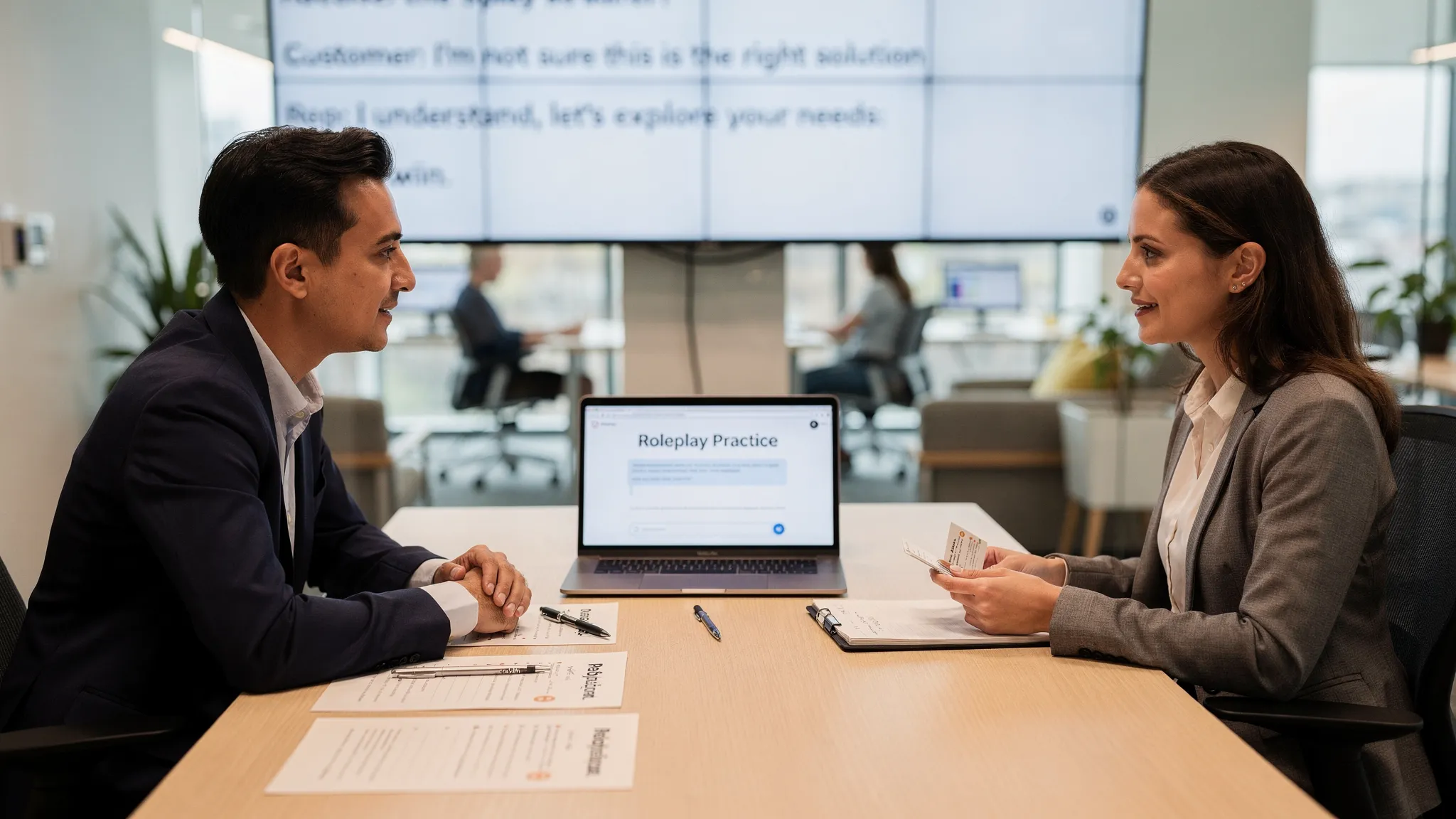
New reps do not need easier training. They need safer practice spaces where they can make realistic mistakes, receive useful feedback, and try again before a real customer is on the line.
That distinction matters. A new sales rep can memorize the pitch and still freeze when a prospect says, “We already use your competitor.” A customer service rep can pass a knowledge check and still stumble when a frustrated customer interrupts, escalates, or asks for an exception. The gap is rarely information alone. It is confidence under pressure.
A safer practice space gives reps a place to build that confidence without risking revenue, customer trust, or the rep’s sense of belonging. Done well, it becomes a repeatable training environment where managers can coach earlier, reps can improve faster, and teams can standardize what “ready” actually looks like.
Why safe practice matters for new reps
New reps face a high-pressure learning curve. They are trying to absorb product knowledge, company messaging, systems, team norms, customer expectations, and performance goals all at once. When their first real test happens in front of a customer, the stakes are too high for genuine experimentation.
That is why psychological safety is so important in onboarding and early ramp. Google’s Project Aristotle identified psychological safety as a key dynamic of effective teams. In a training context, this means reps need to believe they can ask basic questions, practice imperfectly, and receive coaching without being labeled as incapable.
But psychological safety does not mean lowering standards. The best practice environments are both supportive and demanding. They give reps room to fail, then help them understand exactly what to improve. A safe practice space should reduce fear, not reduce accountability.
For sales and service leaders, this creates a practical question: how do you design training that feels real enough to prepare reps, but safe enough that they are willing to stretch?
What a safer practice space looks like
A safer practice space is not just a roleplay session on a calendar. It is a structured environment with clear expectations, realistic scenarios, timely feedback, and a progression path. Reps know what skill they are practicing, what good looks like, and how their performance will be used.
The table below outlines the core design principles.
| Principle | What it means in practice | What happens if it is missing |
|---|---|---|
| Realistic | Scenarios reflect actual customer conversations, objections, emotions, and constraints. | Reps perform well in training but struggle in live calls. |
| Low-risk | Early practice is separated from formal performance judgment. | Reps hide uncertainty and avoid practicing difficult moments. |
| Structured | Each scenario has a goal, skill focus, and feedback criteria. | Roleplay becomes vague, awkward, or overly subjective. |
| Progressive | Difficulty increases as reps build confidence and capability. | New reps are overwhelmed too early or underchallenged too long. |
| Measurable | Managers can track progress across skills, not just completion. | Training activity happens, but readiness remains unclear. |
The strongest practice spaces combine human coaching with technology. Managers bring context, judgment, and encouragement. AI simulations can add consistency, repetition, personalization, and real-time feedback at a scale that live coaching alone often cannot sustain.

Start with the conversations that carry the most risk
Many onboarding programs begin with product overviews, internal tools, and process checklists. Those are necessary, but they do not always prepare reps for the moments that determine customer trust.
To build a safer practice space, start by identifying the conversations where new reps are most likely to struggle. For a sales team, that may include discovery calls, pricing objections, competitor comparisons, procurement pushback, or late-stage stakeholder alignment. For a customer service team, it may include billing disputes, refund requests, angry customers, policy exceptions, or complex handoffs.
Choose scenarios based on actual business risk, not just what is easiest to train. Listen to call recordings, review manager notes, analyze lost deals or escalations, and ask experienced reps where they see new hires struggle. Then turn those moments into practice scenarios.
A strong scenario should include a customer context, a rep objective, an emotional tone, a likely objection, and a success standard. For example, instead of “practice discovery,” use “a budget-conscious operations leader is evaluating three vendors and believes your solution may be too complex for their team.” That gives the rep something realistic to navigate.
Separate early practice from formal evaluation
One of the fastest ways to make practice unsafe is to score every early attempt as if it were a final exam. New reps need to know when they are learning and when they are being assessed.
During the first phase of practice, managers should emphasize coaching over grading. That does not mean feedback should be soft or vague. It means feedback should be framed as skill development: “Here is what you tried, here is how the customer may have heard it, and here is a stronger next move.”
This distinction is especially important in group settings. Public roleplay can be useful, but it can also create anxiety for reps who are still learning the basics. Early practice should offer private or small-group options before asking reps to perform in front of a wider team.
Leaders can also make practice safer by being transparent about how data will be used. If roleplay sessions are recorded, scored, or reviewed, reps should know who can see the results and what decisions those results influence. Trust grows when expectations are clear.
Make roleplay realistic, not theatrical
Traditional roleplay often fails because it feels artificial. One person pretends to be a customer, another pretends to be a rep, and both are aware that the scene is not quite real. The result is often either too easy, too awkward, or too dependent on the manager’s acting skills.
Better roleplay is grounded in real customer behavior. It includes hesitation, interruptions, vague needs, emotional reactions, and incomplete information. In sales, the buyer may not reveal the true objection immediately. In service, the customer may be upset about the symptom but not yet clear about the root problem.
AI-powered roleplay simulations can help create this realism by giving reps repeatable practice with different customer personalities, skill levels, and conversation paths. Instead of waiting for a manager to schedule another mock call, reps can practice more frequently and receive adaptive feedback while the learning moment is still fresh.
This is especially valuable for new reps because confidence often comes from repetition. One practice conversation may introduce a skill. Ten variations help the rep own it.
Use a simple scenario blueprint
A clear scenario design keeps practice focused. Without structure, managers may give feedback on too many things at once, and reps may leave unsure what actually mattered.
Use a lightweight blueprint like this when creating practice scenarios.
| Scenario element | Example |
|---|---|
| Customer context | Mid-market company evaluating a new service provider after a poor vendor experience. |
| Rep goal | Understand the customer’s problem, confirm urgency, and earn agreement on next steps. |
| Primary challenge | The customer is skeptical because a previous vendor overpromised. |
| Skill focus | Active listening, credibility building, and objection handling. |
| Success criteria | Rep asks relevant follow-up questions, validates concern, avoids defensiveness, and proposes a clear next step. |
This format works for sales performance, customer service training, and broader employee skill development. It also helps managers compare progress across reps because everyone is practicing against a shared standard.
Give feedback that reps can use immediately
Feedback is where many practice environments break down. New reps do not improve from hearing “good job” or “be more confident.” They improve when feedback is specific, timely, and tied to a behavior they can repeat.
Effective feedback should answer three questions: What happened? Why did it matter? What should the rep try next?
For example, a manager might say, “When the customer mentioned budget, you moved straight to discounting. That may signal that price is flexible before you understand the concern. Next time, ask what they are comparing the cost against before discussing options.”
Real-time feedback can make this process even stronger. When reps receive guidance shortly after a practice conversation, they can connect the feedback to the exact moment where the skill appeared. This helps prevent weak habits from becoming routine.
Keep early feedback narrow. A new rep may have ten things to improve, but they can usually focus on only one or two at a time. Prioritize the skill that will have the biggest impact on the next conversation.
Increase difficulty in stages
A safe practice space should not stay comfortable forever. If scenarios never become more challenging, reps may feel confident but remain unprepared. The goal is to build readiness through progressive pressure.
Think of difficulty in three stages.
| Stage | Practice focus | Example scenario |
|---|---|---|
| Foundation | Message clarity, process, basic questioning, and product understanding. | A friendly prospect wants to understand whether the solution fits their use case. |
| Pressure | Objections, emotion, competing priorities, and time constraints. | A skeptical buyer challenges the price and says a competitor is cheaper. |
| Judgment | Ambiguity, tradeoffs, stakeholder dynamics, and complex decision-making. | A customer has multiple needs, limited budget, and conflicting internal opinions. |
This progression keeps practice safe because reps are not thrown into the hardest simulation on day one. It also keeps standards high because each stage requires more judgment and adaptability.
Customizable skill levels are useful here. A rep who has mastered basic discovery can move into harder objection handling, while another rep can keep practicing foundational skills without being rushed through the same path.
Build manager and peer rituals around practice
Technology can create consistent practice opportunities, but culture determines whether reps actually use them. If practice is treated as punishment, reps will avoid it. If practice is treated as part of professional development, reps will lean in.
Managers should normalize practice by making it part of the weekly operating rhythm. Short drills can happen before team meetings. New hires can practice common objections before live calls. Managers can review one skill trend each week and coach the team around it.
Peer practice also matters. Experienced reps can share how they handle difficult moments, while new reps can learn that even top performers refine their approach. The safest teams are not the ones where nobody struggles. They are the ones where people can talk honestly about struggle and improve together.
A few simple rituals can change the tone of training:
- Start practice sessions by naming the skill, not the person being judged.
- Ask managers or senior reps to model an imperfect first attempt.
- Celebrate useful mistakes that reveal a coaching opportunity.
- End each session with one specific behavior to try next.
These rituals help reps see practice as a growth tool rather than a performance trap.
Track progress without creating surveillance
Analytics can make training more effective, but only if reps trust the system. If every practice score feels like a permanent mark against them, new reps may optimize for looking good instead of getting better.
The key is to track progress in ways that support coaching. Managers should look for patterns across skills, scenarios, and cohorts. Are new reps consistently struggling with pricing conversations? Are service reps improving de-escalation skills after practice? Are certain scenarios producing confidence gains while others create repeated friction?
Useful metrics may include scenario completion, skill improvement over time, feedback themes, confidence ratings, and manager coaching notes. Performance metric dashboards can help leaders see where training is working and where reps need more support.
The purpose of analytics should be clarity. Reps should understand their growth path, managers should know where to coach, and leaders should see whether onboarding is building real capability.
Protect customer data and rep trust
Safer practice spaces are not only psychologically safe. They also need to be operationally safe. Training scenarios should avoid exposing sensitive customer information unless it has been properly anonymized and approved for training use.
This matters when teams use real call examples, CRM notes, support tickets, or account histories to create scenarios. The more realistic the training, the more carefully leaders need to handle data privacy, access controls, and internal governance.
For organizations using an AI training platform, enterprise-grade security and clear data practices are important considerations. Reps should be able to practice in a secure environment, and leaders should be confident that training content is handled responsibly.
Common mistakes to avoid
Even well-intentioned teams can make practice feel unsafe. The most common mistake is waiting until a rep fails with a customer before giving them meaningful practice. By then, the rep may already feel embarrassed, and the business may have lost an opportunity.
Another mistake is making roleplay too generic. If every rep receives the same scenario regardless of role, territory, segment, or skill level, the training will feel disconnected from their actual work. Personalised training is more effective because it meets reps where they are and helps them build toward the conversations they will actually face.
Teams should also avoid feedback overload. New reps need clarity, not a long list of everything they did wrong. A safer practice space narrows attention to the next best improvement.
Finally, do not confuse confidence with readiness. A rep may sound polished and still miss customer signals. Practice should test listening, judgment, and adaptability, not just delivery.
Frequently Asked Questions
What is a safe practice space for new reps? A safe practice space is a structured training environment where new reps can practice realistic customer conversations, make mistakes, receive feedback, and improve before handling high-stakes live interactions.
How can roleplay help new sales reps ramp faster? Roleplay gives new sales reps repeated exposure to discovery questions, objections, pricing concerns, and buyer emotions. This helps them build confidence and improve decision-making before real opportunities are at risk.
Should roleplay be scored? Roleplay can be scored, but early practice should focus on coaching first. Scores are most useful when reps understand the criteria, trust how the data will be used, and receive specific guidance on how to improve.
How do AI simulations support safer training? AI simulations can provide consistent, realistic, and repeatable practice scenarios. They can also deliver real-time feedback, adapt to skill levels, and help managers track progress across individuals and teams.
What should managers measure in new rep practice? Managers should measure skill growth, scenario completion, confidence trends, feedback themes, and readiness for specific customer conversations. The goal is to guide coaching, not to create fear around practice.
Create safer, smarter practice for every new rep
New reps build confidence when they can practice the moments that matter before those moments become customer-facing. A safer practice space gives them room to learn, while still holding them to clear standards.
Scenario IQ helps teams create AI-driven, personalised scenario-based training with roleplay simulations, real-time feedback, adaptive guidance, progress tracking analytics, and team-focused learning. If your organization wants to improve sales performance, customer service training, and employee skill development, safer practice is a powerful place to start.
Explore Scenario IQ to see how AI roleplay training can help your reps practice with confidence and perform when it counts.