
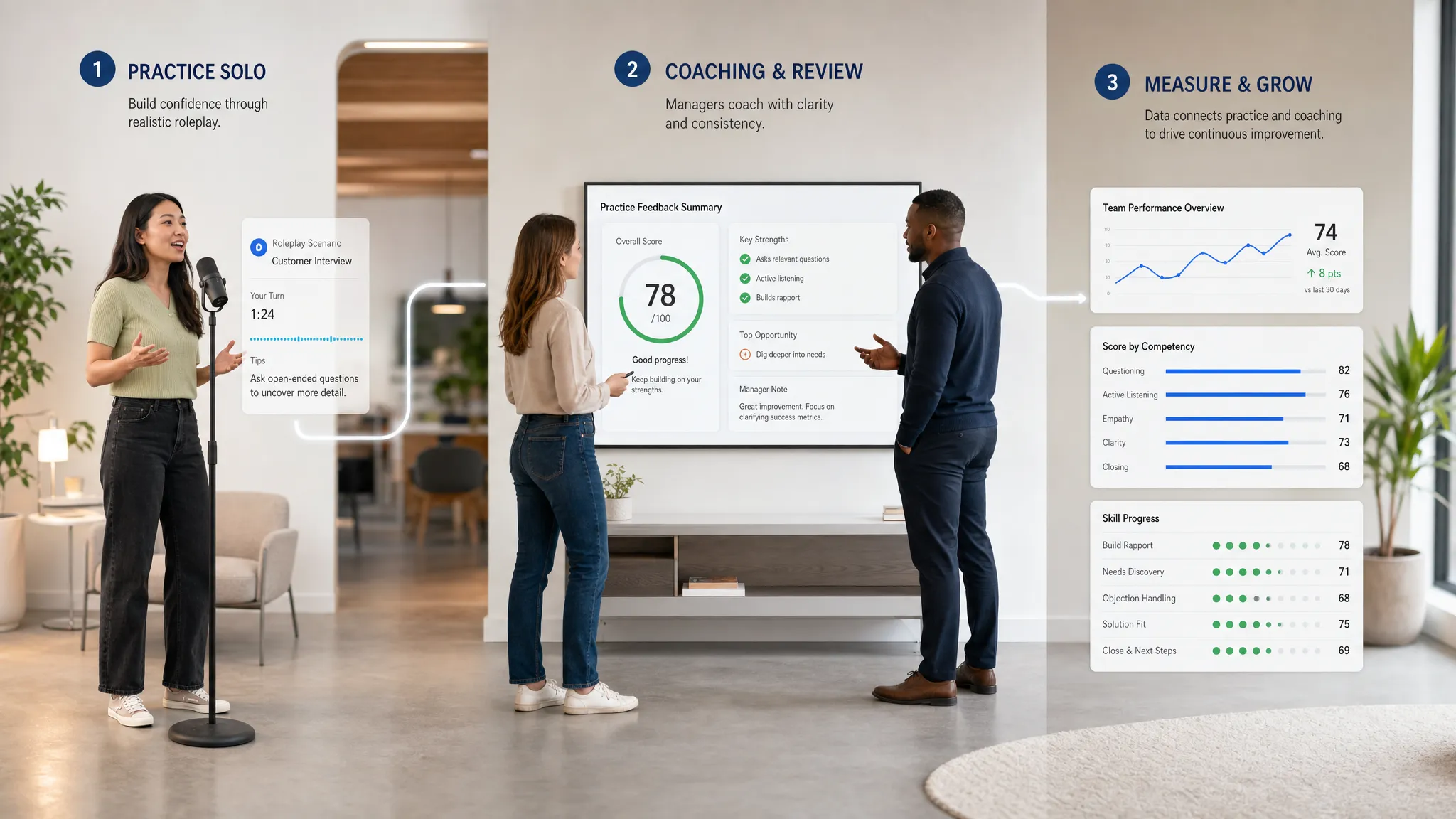
AI is changing how teams learn, practice, and make decisions together. But the biggest gains do not come from adding another chatbot to the workflow. They come from using AI to strengthen the habits that already drive performance: coaching, feedback, collaboration, and shared accountability.
In this article, “Teams AI” refers broadly to AI that helps teams work and improve together, including roleplay training platforms, coaching assistants, feedback tools, and analytics that support managers and employees. It is not limited to a single collaboration app. For sales and service organizations, this matters because performance depends on live human conversations, where confidence, judgment, tone, and timing can make or break an outcome.
The opportunity is clear. The Microsoft 2024 Work Trend Index reported that AI use at work has become mainstream, with many employees adopting tools faster than organizations can formalize best practices. The challenge now is not whether teams will use AI. It is whether leaders can channel it into better coaching, stronger collaboration, and measurable behavior change.
Why Coaching and Collaboration Need a New Operating Model
Traditional coaching often depends on manager availability. A sales manager may review a few calls, join pipeline meetings, and offer advice after deals are lost. A service leader may notice quality issues only after customer escalations surface. In both cases, feedback is valuable, but it is often delayed, inconsistent, and hard to scale across a growing team.
Collaboration has similar friction. Team members share tips in meetings, Slack threads, CRM notes, or informal conversations, but knowledge is scattered. High performers may have winning talk tracks that never become team standards. New hires may repeat avoidable mistakes because they lack safe opportunities to practice before speaking with customers.
Teams AI can help by making coaching more continuous and collaboration more structured. Instead of relying only on occasional manager observation, AI can create practice scenarios, provide real-time feedback, surface patterns across team performance, and help managers focus their time where it matters most.
The goal is not to replace human coaching. The goal is to give managers and teams better visibility, more practice opportunities, and a common language for improvement.
How Teams AI Supports Better Coaching
It makes practice frequent, safe, and realistic
Coaching improves when people can practice before the stakes are high. In sales and service roles, that means rehearsing discovery calls, objection handling, renewals, complaint resolution, pricing conversations, and escalation scenarios.
AI-powered roleplay simulations make this easier because team members can practice on demand. A rep does not need to wait for a manager to be free. A support agent does not need to learn only from live customer pressure. They can rehearse difficult conversations in a controlled environment, make mistakes privately, and improve through repetition.
This is especially useful for conversations that do not happen every day but carry high risk when they do. Examples include handling an angry enterprise customer, responding to a budget freeze, explaining a service failure, or navigating a competitive displacement.
Scenario-based AI training works best when it reflects the real situations teams face. Generic practice is helpful, but personalized scenarios based on role, skill level, customer type, and business context are far more effective. That is where Teams AI can move beyond static scripts and create adaptive training experiences.
It gives feedback while the learning moment is fresh
Feedback loses power when it arrives days or weeks after the moment. Real-time feedback helps learners connect behavior to outcome while the conversation is still clear in their mind.
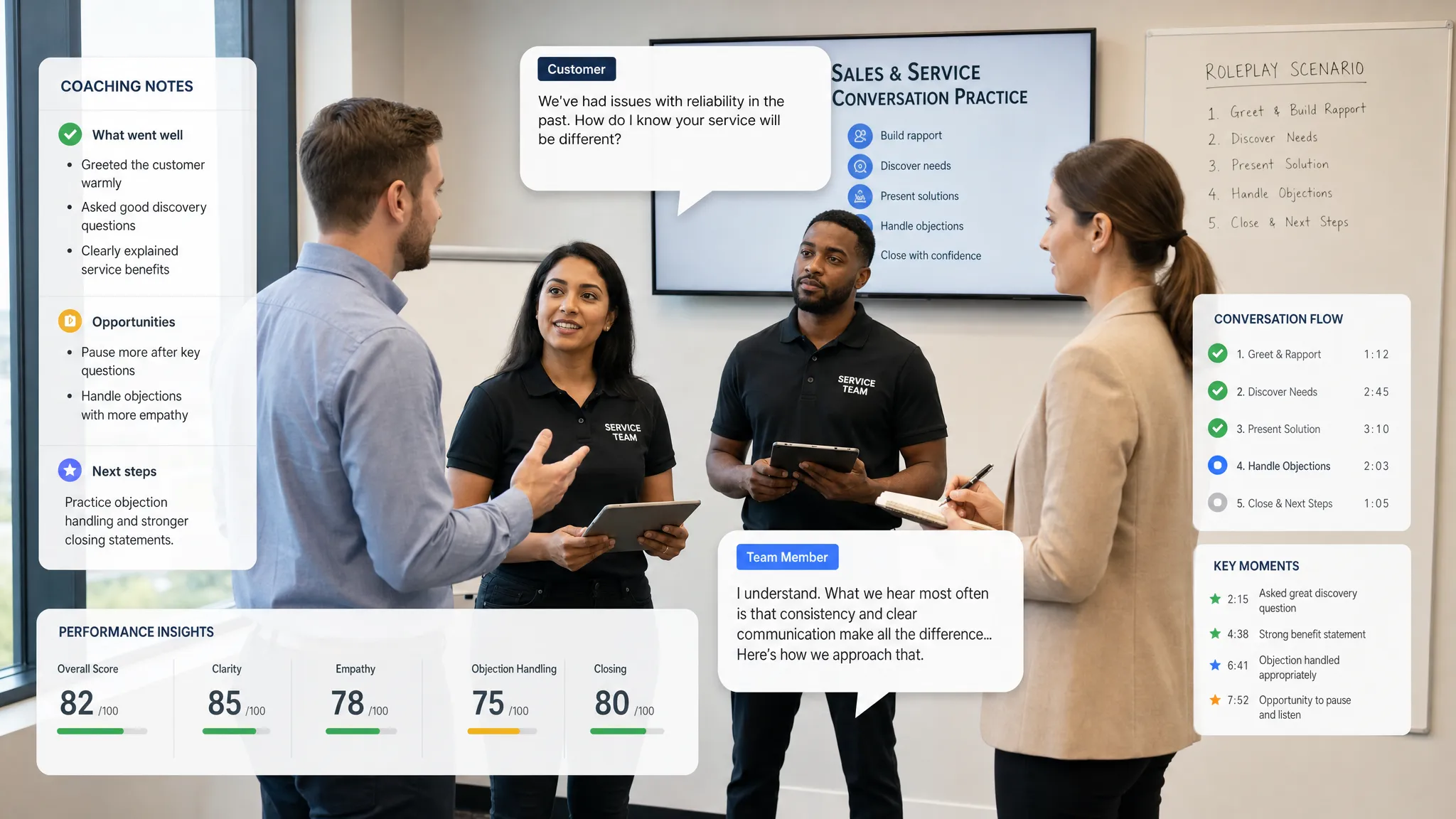
For example, an AI coaching system can help identify whether a rep asked enough discovery questions, acknowledged a customer concern, rushed to pitch too early, or failed to confirm next steps. In service settings, it can help reinforce empathy, clarity, compliance with process, and resolution quality.
This does not mean every AI suggestion should be treated as final. Human managers still need to interpret context and coach with judgment. But AI can accelerate the feedback loop by giving team members immediate signals and giving managers a more informed starting point.
It personalizes development at scale
One of the hardest parts of coaching is that different people need different help. One rep may struggle with confidence. Another may speak fluently but miss buying signals. A customer service agent may be empathetic but unclear when explaining policies.
Teams AI can support personalized development by adapting practice and feedback to each individual. Instead of giving everyone the same training module, AI can recommend scenarios, difficulty levels, and improvement areas based on observed performance.
For managers, this is a major shift. Coaching becomes less about guessing who needs help and more about reviewing evidence. Progress tracking analytics and performance dashboards can show which skills are improving, which behaviors are inconsistent, and which team members may need more support.
How Teams AI Improves Collaboration
It creates a shared language for performance
Teams collaborate better when they agree on what “good” looks like. Without a shared standard, coaching can become subjective. One manager may praise persistence, another may prioritize active listening, and another may focus on closing urgency.
AI-supported training helps define observable behaviors. For example, a team might measure whether someone opened with a clear agenda, asked customer-centered questions, summarized needs accurately, handled objections with evidence, or ended with a confirmed next step.
When everyone practices against the same criteria, feedback becomes easier to understand and easier to apply. Managers can coach more consistently, peers can learn from one another, and new hires can ramp with clearer expectations.
It turns individual learning into team intelligence
A common problem in sales and service organizations is that learning stays trapped at the individual level. One person figures out how to handle a new objection. Another develops a better way to calm frustrated customers. A third learns which questions reveal urgency. But unless those insights are captured and shared, the team does not benefit.
Teams AI can help convert individual practice into collective improvement. If several reps struggle with the same objection, leaders can create a team coaching session around it. If top performers consistently use certain discovery patterns, those patterns can inform future scenarios. If service agents show repeated difficulty with a policy explanation, enablement teams can update training content.
This is where AI becomes more than a productivity tool. It becomes a learning system that helps the team improve together.
It supports asynchronous collaboration
Not every team works in the same room or time zone. Hybrid and distributed teams often struggle to maintain coaching consistency because feedback, practice, and peer learning happen unevenly.
Teams AI can support asynchronous collaboration by making practice available anytime and giving managers a record of progress. Team members can complete scenarios before a group session, review feedback independently, and arrive ready to discuss patterns rather than starting from scratch.
This can make team meetings more valuable. Instead of using meeting time to deliver generic training, leaders can focus on discussion, roleplay debriefs, peer examples, and real customer challenges.
Traditional Coaching vs. Teams AI-Supported Coaching
| Coaching area | Traditional approach | Teams AI-supported approach |
|---|---|---|
| Practice frequency | Limited by manager availability and team schedules | On-demand simulations and repeatable scenarios |
| Feedback timing | Often delayed until a review, meeting, or call debrief | Real-time or near real-time feedback after practice |
| Personalization | Based on manager observation and manual notes | Adaptive scenarios based on role, skill level, and progress |
| Team visibility | Difficult to compare patterns across individuals | Analytics can reveal trends, gaps, and improvement areas |
| Collaboration | Informal sharing through meetings or messages | Shared rubrics, team insights, and structured coaching themes |
| Manager role | Primary source of feedback and practice | Strategic coach who uses AI insights to prioritize support |
The best approach blends both sides. AI provides scale and consistency. Managers provide context, judgment, motivation, and accountability.
Practical Use Cases for Sales and Service Teams
Teams AI is most useful when it is connected to real business moments. For sales and service leaders, the following use cases are especially practical.
Objection handling practice
Sales reps can rehearse common objections such as pricing concerns, competitor comparisons, lack of urgency, internal approval delays, and budget freezes. AI roleplay allows them to test different responses, receive feedback, and build confidence before live calls.
Customer escalation training
Service teams can practice difficult conversations involving delayed orders, billing disputes, outages, account confusion, or frustrated customers. The focus is not only on solving the issue, but also on tone, empathy, and clarity.
New hire ramping
New hires often need repeated practice before they feel confident with customer conversations. AI scenarios can help them build fluency faster by exposing them to realistic situations before they take on full responsibility.
Manager coaching preparation
Managers can use performance insights to prepare more focused coaching sessions. Instead of asking, “How do you think that went?” they can review specific behaviors, repeated challenges, and measurable progress.
Cross-functional alignment
Sales, customer success, support, and enablement teams can use AI-generated insights to identify recurring customer questions or objections. This helps improve messaging, training materials, and handoffs between departments.
According to McKinsey’s analysis of generative AI’s economic potential, customer operations, sales, and marketing are among the functions where generative AI may create meaningful productivity gains. But those gains depend on thoughtful implementation. AI needs to be tied to workflows, coaching behaviors, and measurable outcomes, not just introduced as a novelty.
How to Implement Teams AI Without Overwhelming Your Team
A successful Teams AI rollout should feel practical, not disruptive. The goal is to enhance how people already learn and collaborate, not bury them in another system.
Start with one high-impact coaching problem. For example, a sales team might choose discovery quality or objection handling. A service team might choose de-escalation or resolution clarity. Narrow focus helps leaders prove value and avoid vague adoption goals.
Next, define what good performance looks like. This may include talk tracks, behavioral rubrics, customer experience standards, or specific skills. AI feedback is most useful when it is aligned with clear expectations.
Then introduce realistic scenarios. Scenarios should reflect actual customer segments, common objections, service issues, product questions, and conversation difficulty levels. Over time, training can become more personalized as the system learns where individuals and teams need practice.
Managers should remain central to the process. AI can provide feedback and analytics, but managers turn those insights into motivation, priorities, and accountability. The most effective leaders use AI to prepare better coaching conversations, not to avoid them.
Finally, build a rhythm around the tool. Weekly practice, monthly skill reviews, team debriefs, and targeted coaching sessions can make AI part of the learning culture. Without a rhythm, even the best platform can become another underused technology.
Metrics That Show Whether Teams AI Is Working
Teams AI should improve measurable behaviors and business outcomes. Leaders should avoid tracking only login activity or completed modules. Those metrics can show adoption, but not necessarily performance improvement.
| Metric | What it reveals | Why it matters |
|---|---|---|
| Scenario completion rate | Whether the team is practicing consistently | Practice volume is a leading indicator of skill development |
| Skill improvement over time | Whether feedback is translating into better performance | Shows if coaching is producing behavior change |
| Common coaching gaps | Where multiple team members struggle | Helps leaders prioritize enablement and team training |
| Manager coaching activity | Whether managers are using insights in follow-up | Connects AI practice to human coaching |
| Ramp time for new hires | How quickly new team members reach readiness | Shows impact on onboarding efficiency |
| Customer conversation outcomes | Changes in conversion, resolution, satisfaction, or escalation trends | Links training to business performance |
The right metrics depend on the team. A sales organization may focus on win rates, discovery quality, and next-step conversion. A service organization may focus on first-contact resolution, escalation reduction, customer satisfaction, and policy clarity.
Guardrails for Trustworthy Teams AI
AI-supported coaching needs trust. If employees feel monitored instead of developed, adoption will suffer. Leaders should be transparent about how AI is used, what data is reviewed, and how insights support growth.
Privacy and security also matter, especially for organizations handling customer conversations, employee performance data, or regulated information. Enterprise-grade security, clear access controls, and responsible data practices should be part of the evaluation process for any AI training platform.
Bias is another consideration. AI feedback should be reviewed and calibrated, especially when evaluating communication style, tone, or confidence. Teams should avoid turning AI scores into rigid judgments without human context.
The healthiest coaching cultures treat AI as a support system. It provides practice, feedback, and visibility. People provide empathy, nuance, and leadership.
Where Scenario IQ Fits
Scenario IQ is built for organizations that want AI-driven, scenario-based training to improve communication, confidence, and team performance. For sales and service teams, that means giving people a safe place to practice realistic conversations, receive real-time feedback, and track progress over time.
The platform supports AI-powered roleplay simulations, personalized training scenarios, adaptive feedback and guidance, progress tracking analytics, team-focused learning, customizable skill levels, daily actionable tips, performance metric dashboards, and enterprise-grade security.
In practical terms, Scenario IQ helps teams move from occasional coaching to continuous improvement. Managers gain clearer insight into where people need support, while team members get more opportunities to practice the conversations that matter most.
Frequently Asked Questions
What is Teams AI? Teams AI refers to AI tools that help groups learn, communicate, collaborate, and improve performance together. In coaching contexts, this can include roleplay simulations, feedback systems, progress analytics, and adaptive training.
Can Teams AI replace managers or coaches? No. AI can support coaching by providing practice, feedback, and performance insights, but managers still provide context, judgment, encouragement, and accountability.
How does Teams AI help sales teams? It helps sales teams practice discovery, objection handling, negotiation, closing conversations, and follow-up discipline. It can also reveal skill gaps and help managers coach more consistently.
How does Teams AI help customer service teams? It gives service teams a safe environment to practice de-escalation, empathy, policy explanation, and resolution clarity. This can build confidence before agents handle difficult live interactions.
What should leaders look for in an AI coaching platform? Leaders should look for realistic scenarios, personalization, real-time feedback, analytics, team-level visibility, security, and the ability to support manager-led coaching workflows.
Build a More Coachable, Collaborative Team
Teams AI works best when it supports the human behaviors that already drive performance: practice, feedback, reflection, and collaboration. With the right approach, AI can help managers coach more effectively and help teams build confidence before critical customer conversations.
If your organization wants to improve sales and service performance through AI roleplay training, personalized scenarios, real-time feedback, and actionable analytics, explore Scenario IQ.