

Quality assurance (QA) in contact centers has always been a balancing act: evaluate enough interactions to be fair and accurate, without slowing down operations or overwhelming your QA team. Traditional sampling (for example, scoring a handful of calls per agent per month) often misses the moments that matter most, like the rare compliance slip, the pattern behind repeat escalations, or the “almost good” conversations that could have been saved with better discovery and objection handling.
That’s exactly where artificial intelligence call center tools are changing the game. When used well, AI expands QA coverage, improves scoring consistency, and turns evaluations into faster coaching loops that actually lift customer experience and revenue outcomes.
What “raising QA” really means in a modern call center
A higher QA score is not the end goal. Better QA should translate into outcomes leaders care about:
- More consistent customer experiences across agents and shifts
- Better adherence to critical requirements (disclosures, authentication, consent, escalation rules)
- Stronger communication behaviors (empathy, clarity, confidence, correct expectations)
- Fewer repeat contacts and escalations
- More effective sales behaviors (discovery, positioning, handling objections, closing)
The problem with many QA programs is not that the rubric is wrong. It’s that the system can’t observe enough interactions, consistently enough, to drive behavior change.
What artificial intelligence call center tools do (beyond “transcription”)
AI in QA typically combines several capabilities:
Speech-to-text and interaction summaries
AI can transcribe calls (and sometimes chats) and generate structured summaries. This is useful, but by itself it does not raise QA unless the summaries connect to coaching and measurable standards.
Automated quality scoring
Instead of manually listening to full calls, AI can detect whether key behaviors occurred, such as:
- Identity verification steps
- Required disclosures
- Talk-to-listen balance
- Dead air, interruptions, and overtalk
- Use of prohibited phrases (or missing required phrases)
- Sentiment signals and escalation risk
Conversation intelligence and trend discovery
AI tools can surface patterns you would not catch from small samples, like recurring product confusion, a competitor being mentioned more often, or a policy explanation that consistently triggers frustration.
Agent assistance and real-time guidance
Some systems provide in-the-moment prompts (for example, reminders about steps or knowledge-base suggestions). This impacts QA because it can prevent mistakes, not just report them.
Coaching enablement
The strongest programs use AI outputs to generate targeted coaching tasks, then verify whether performance changed over time.
7 ways AI call center tools raise QA (practically, not theoretically)
1) They expand coverage from “samples” to “reality”
Manual QA usually reviews a small fraction of conversations. AI can evaluate far more interactions, which means:
- Fewer blind spots
- Less dependence on luck (whether a “bad” call happened to be sampled)
- More confidence that QA represents day-to-day performance
This expanded coverage is especially valuable for compliance-heavy environments, where the cost of missing one interaction can be high.
2) They improve scoring consistency (and reduce evaluator drift)
Human evaluators can score differently based on experience, fatigue, or interpretation of rubric language. AI does not eliminate the need for human judgment, but it can:
- Standardize checks for objective criteria (required disclosures, verification steps)
- Flag rubric “edge cases” for human review
- Reduce month-to-month drift by applying the same detection logic consistently
A good model here is “AI does the broad screening, humans do the nuanced evaluation.”
3) They accelerate feedback loops from weeks to days (or hours)
QA often fails because it is slow. If an agent gets feedback two weeks after a call, the moment is gone and the behavior has already repeated.
With AI-supported QA, teams can move toward:
- Faster identification of coaching opportunities
- Shorter time-to-coach
- More frequent micro-coaching based on recent interactions
That speed matters for onboarding, new product launches, policy changes, and peak seasons.
4) They surface the “why” behind performance gaps
Many QA programs catch errors but struggle to explain patterns. AI can cluster issues across thousands of interactions, helping you answer questions like:
- Which objections are most common this month, and how do top performers respond?
- Which policy explanations trigger the longest calls?
- Where do escalations typically start, pricing, delivery, refunds, cancellations?
This turns QA into an operational lens, not just a scorecard.
5) They connect QA to outcomes like CSAT, FCR, and revenue
Raising QA is easier when you can prove which behaviors matter. AI can help correlate conversation behaviors to outcomes, for example:
- Lower transfer rates when agents confirm next steps clearly
- Higher first-contact resolution (FCR) when agents ask stronger clarifying questions early
- Better conversion when discovery is thorough and objections are addressed explicitly
Even if you do not run advanced modeling, basic segmentation (top vs. bottom performers) can reveal which behaviors to coach first.
6) They scale coaching without scaling headcount
A common blocker to better QA is simply bandwidth. AI reduces time spent on low-value tasks (like searching for calls or doing first-pass compliance checks), freeing QA leaders and supervisors to spend more time on:
- Coaching conversations
- Calibration sessions
- Improving the rubric
- Updating training materials
If you want QA to raise performance, your team needs time for coaching, not just auditing.
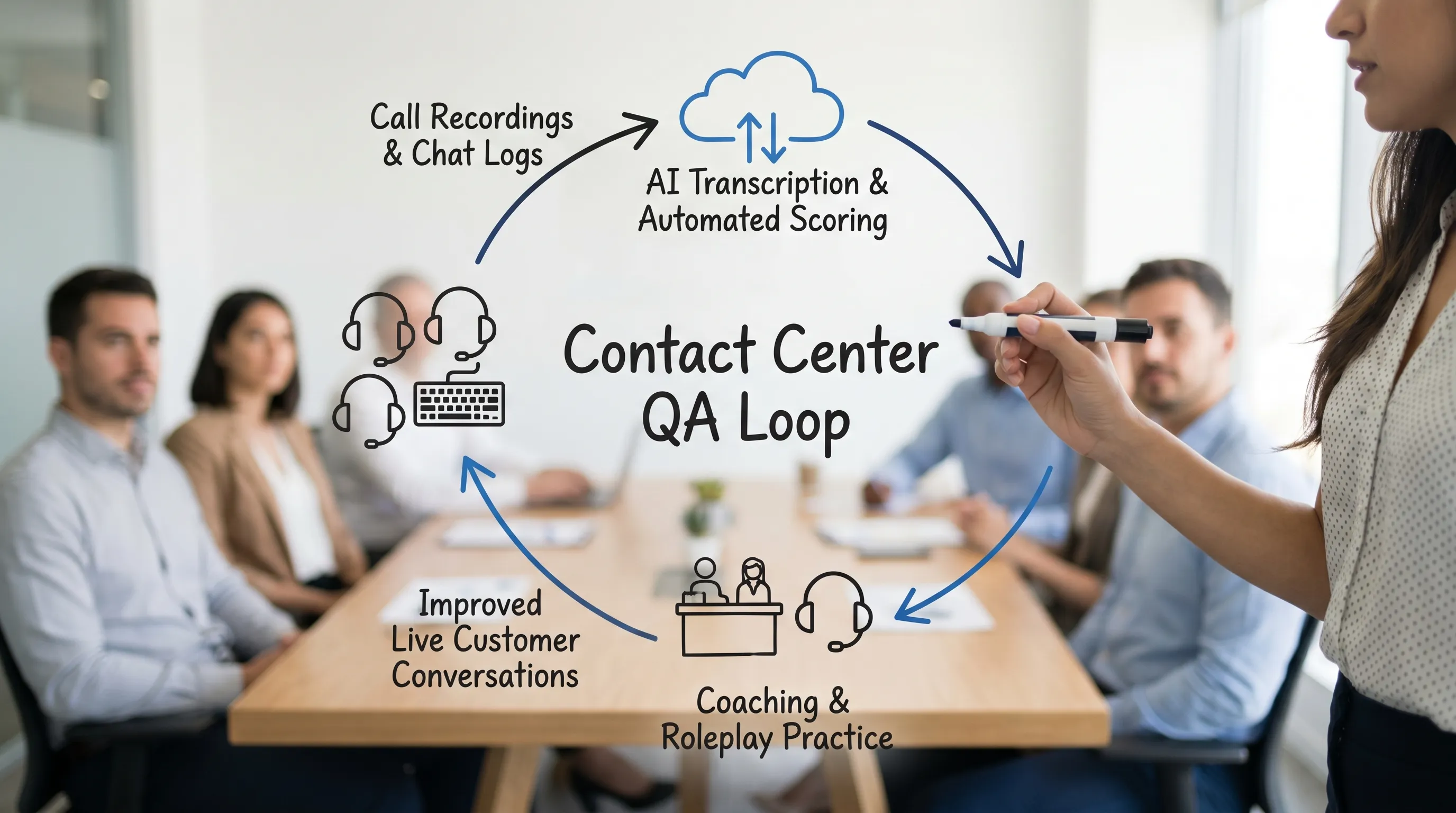
7) They create a closed-loop system (QA findings become training, then re-measurement)
The most effective QA programs treat evaluation as the start, not the finish. After AI flags a skill gap, you need a structured way to practice it.
This is where scenario-based training is especially effective: agents practice the exact moments that drive QA up or down (for example, authentication, de-escalation, cancellation saves, pricing objections), then go back into production and get measured again.
Manual QA vs AI-supported QA: what actually changes
| QA element | Manual-only approach | AI-supported approach |
|---|---|---|
| Coverage | Limited sample of interactions | Much broader coverage, often near-complete |
| Consistency | Depends on evaluator calibration | More consistent detection of objective criteria |
| Speed | Feedback may take days or weeks | Faster flagging and prioritization |
| Root-cause visibility | Hard to see patterns across teams | Trend detection across many interactions |
| Coaching scalability | Supervisor bandwidth is the limiter | Coaching time increases by reducing admin work |
| Compliance monitoring | Risk of missed issues | Systematic flagging plus human review |
AI does not remove the need for skilled QA leaders. It changes where humans spend their time.
Implementation: how to adopt AI QA without breaking trust (or compliance)
AI-driven QA touches sensitive customer conversations, so governance matters as much as model performance.
Start with a rubric that is “AI-ready”
If a rubric is vague, AI outputs will be hard to trust and harder to coach from. Strong rubrics have:
- Clear definitions (what counts as “confirmed next steps”?)
- Observable criteria (what must be said or done?)
- Examples of pass/fail behaviors
Build a calibration workflow, not a one-time test
Treat AI scoring like a new evaluator that needs calibration. Best practice is to:
- Compare AI results to human scoring on the same set of interactions
- Review false positives and false negatives
- Adjust thresholds and definitions
- Repeat periodically, especially after product/policy changes
Use privacy and risk frameworks to guide deployment
If you operate in regulated industries, consider aligning internal governance with recognized frameworks like the NIST AI Risk Management Framework. It’s not a contact-center-specific rulebook, but it’s helpful for structuring risk controls, accountability, and monitoring.
Don’t skip change management
Agents will rightfully ask: “How is this used?” and “Is this fair?” Adoption improves when you are transparent about:
- What is being measured
- How coaching works
- What escalates to human review
- How performance trends are tracked over time
Turning QA insights into better customer experience (and brand outcomes)
One overlooked benefit of AI QA is that it can reveal gaps in your broader customer journey: confusing offers, unclear website promises, mismatched expectations, or inconsistent messaging between marketing and service.
When QA consistently shows the same misunderstanding (for example, pricing, eligibility, delivery timelines), it may not be an agent problem. It may be a messaging problem.
In those cases, partnering with specialists who combine strategy, creative, and automation can help align the whole funnel. For example, an AI-powered digital marketing and design agency can help ensure what customers see before they contact you matches what your team can deliver, reducing friction that shows up later as long calls, low CSAT, and QA issues.
Where Scenario IQ fits: using AI roleplay to raise QA through practice
AI scoring can tell you what happened. But improving QA requires changing what happens next.
Scenario IQ focuses on the practice side of the equation: AI-driven, personalized scenario-based training designed to build confidence and communication skills through realistic roleplay. Instead of relying only on classroom sessions or generic call reviews, teams can practice the exact interactions that drive QA outcomes.
Relevant capabilities include:
- AI-powered roleplay simulations to rehearse real customer moments
- Personalised training scenarios aligned to your workflows and skill goals
- Real-time feedback so agents can adjust immediately
- Adaptive feedback and guidance that changes based on performance
- Progress tracking analytics to monitor improvement over time
- Team-focused learning for consistent performance across groups
- Enterprise-grade security for organizational requirements
A practical approach many teams take is: use AI QA to identify the top 3 to 5 behaviors lowering scores, then turn those into targeted roleplay scenarios. That creates a closed loop between measurement and improvement.
A simple playbook to raise QA with AI (without overcomplicating it)
Define success metrics before you roll out
Pick a small set of metrics and stick to them long enough to see trend changes, such as:
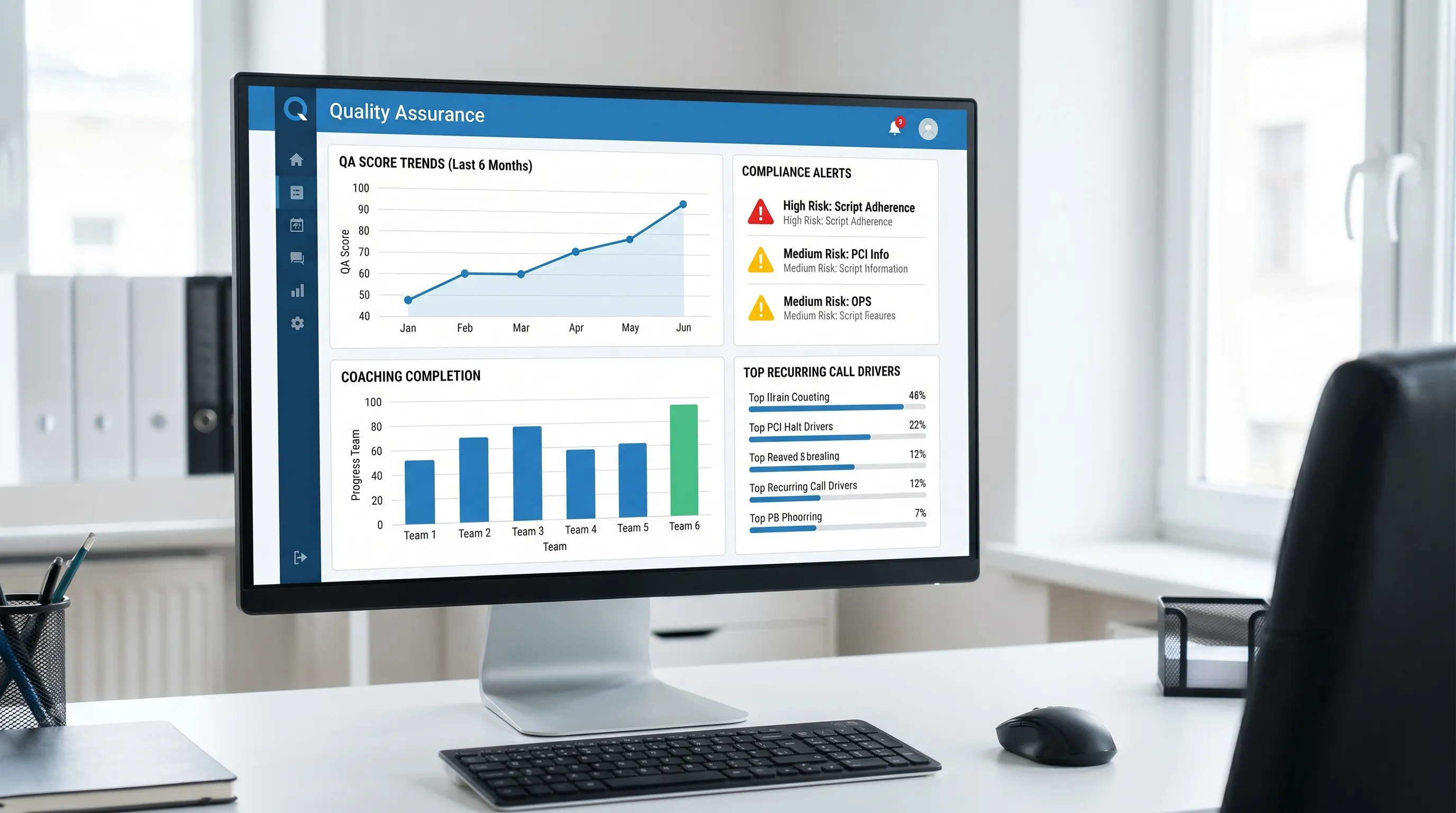
- QA score distribution (not just the average)
- Critical error rate (compliance misses)
- Coaching completion rates
- Repeat-contact rate (proxy for FCR)
- Escalation rate
Prioritize “high-impact moments”
Not every rubric item deserves equal attention. Common high-impact categories include:
- Authentication and disclosures
- Empathy and de-escalation
- Discovery questions
- Objection handling
- Clear next steps and expectations
Build a measurable coaching cadence
AI helps most when it leads to consistent coaching behaviors, not just more data. Keep the process lightweight and repeatable.
| Step | What you do | What “good” looks like |
|---|---|---|
| Detect | AI flags interactions and themes | A short weekly list of top issues by team |
| Validate | Humans review edge cases | Clear agreement on what counts as pass/fail |
| Coach | Short, behavior-specific coaching | One skill focus per session |
| Practice | Roleplay the same moment repeatedly | Agents improve within a session, not weeks |
| Re-measure | Track score and outcome movement | Fewer repeats of the same errors |
Frequently Asked Questions
What is an artificial intelligence call center QA tool? An AI QA tool uses capabilities like speech-to-text, automated checks, and analytics to evaluate customer interactions at scale and highlight coaching and compliance opportunities.
Will AI replace human QA evaluators? In most teams, no. AI typically handles high-volume screening and consistent checks, while humans focus on nuanced scoring, calibration, coaching, and improving the rubric.
How do AI call center tools improve compliance? They can systematically flag missing required steps (like disclosures or verification), detect risky language, and route exceptions to human review faster than manual sampling.
What’s the biggest mistake teams make when rolling out AI for QA? Treating AI scoring as “set it and forget it.” Without ongoing calibration, clear rubric definitions, and change management, trust and accuracy can degrade.
How do you turn QA insights into agent skill improvement? Pair measurement with structured practice. Use QA trends to identify the highest-impact behaviors, then coach and rehearse those moments using targeted roleplay until performance improves.
Raise QA by turning insights into practice
If your QA program is catching issues but not changing outcomes, the missing link is often repetition and feedback in realistic scenarios. Scenario IQ helps teams practice the exact conversations that drive QA performance, from handling objections to improving service recovery, with AI roleplay simulations, real-time feedback, and progress analytics.
Explore how AI roleplay training can support your QA goals at Scenario IQ.