

Forecasts are only as good as the pipeline behind them. If deals sit in the wrong stage, close dates drift, or reps “feel good” about opportunities that have not been qualified, your forecast becomes a guess, not a plan. AI sales forecasting software improves pipeline accuracy by replacing gut feel with probability, enforcing data discipline, and continuously recalibrating forecasts as buyer behavior changes.
What “pipeline accuracy” actually means
Pipeline accuracy is not the same thing as “having a lot of deals” in CRM. It means your pipeline reflects reality closely enough that leaders can make reliable decisions about hiring, inventory, cash flow, and targets.
In practice, pipeline accuracy usually comes down to four measurable questions:
- Stage accuracy: Are deals in the stage that matches what the buyer has actually done (not what the rep hopes will happen)?
- Close date accuracy: Do close dates converge as the deal progresses, or do they keep slipping?
- Value accuracy: Are amounts realistic, properly scoped, and consistent with comparable deals?
- Probability accuracy: Does the predicted win rate align with actual conversion by stage, segment, and rep?
AI sales forecasting software directly targets all four by using historical patterns, current deal signals, and real-time updates.
Why traditional forecasting breaks down
Most teams start with spreadsheet rollups, rep commits, and manager judgment. That can work early on, but it tends to degrade as volume grows and sales cycles vary.
Common failure points include:
- Human bias: Optimism bias, end-of-quarter pressure, and “happy ears” in discovery can inflate confidence.
- Inconsistent stage definitions: Teams say “proposal sent,” but it can mean anything from a quote emailed to a fully negotiated redline.
- CRM hygiene gaps: Outdated close dates, missing next steps, and stale opportunities create noise.
- Segment differences: SMB vs enterprise, inbound vs outbound, and new product lines behave differently, but manual forecasts often treat them similarly.
AI sales forecasting software is designed to absorb complexity and reduce those distortions.
How AI sales forecasting software improves pipeline accuracy
1) It turns pipeline into probabilities, not opinions
Modern AI forecasting models typically predict the likelihood of a deal closing by learning from your historical outcomes. Instead of treating every stage as a fixed probability (for example, “Stage 3 equals 50%”), AI estimates probability based on what actually correlates with wins in your data.
This improves accuracy because it accounts for variables such as:
- Deal age and velocity (how quickly it is moving)
- Product mix and discounting behavior
- Stakeholder engagement and meeting cadence
- Rep and team performance patterns
- Buyer actions that historically precede wins
The result is a forecast grounded in observed patterns, not a generic stage-based assumption.
2) It detects pipeline risk early (before the slip)
A major pipeline accuracy issue is not that deals are lost, it is that they silently deteriorate while staying in the forecast.
AI sales forecasting software often improves accuracy by flagging risk signals such as:
- No activity in X days
- Close date pushed multiple times
- Deal stalled in stage longer than typical for that segment
- Next step missing or repeatedly rescheduled
- Unusual discount requests or late-stage scope changes
These risk indicators prompt earlier intervention (or earlier removal from the forecast), tightening the gap between forecasted and actual revenue.
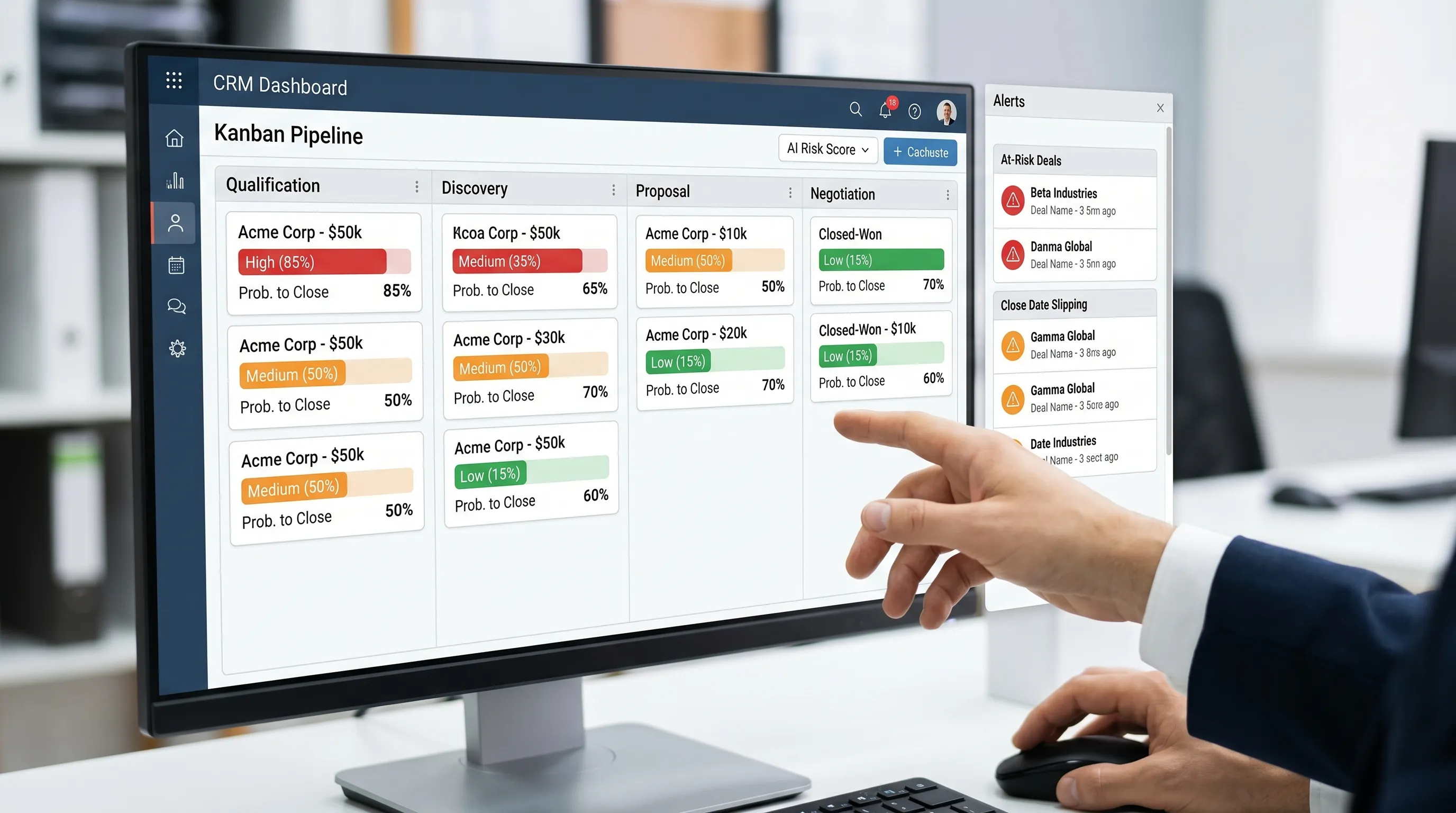
3) It continuously updates forecasts as the pipeline changes
Traditional forecasts tend to be “snapshot-based” (weekly commits, monthly rollups). AI forecasting is often more dynamic, recalculating projections as new data arrives.
That matters because pipeline is not static. A single new stakeholder added, a legal review initiated, or a competitor mention can materially change the probability of winning, and AI systems can adjust faster than manual processes.
4) It reduces the impact of inconsistent rep judgment
Even strong teams have variability in how reps qualify, how they interpret buyer signals, and how they set close dates.
AI forecasting tools improve pipeline accuracy by standardizing the forecast logic. Reps can still contribute context, but the predicted outcome is less dependent on confidence levels and more dependent on deal evidence.
5) It improves stage discipline with data-backed definitions
Pipeline accuracy collapses when stages are vague. AI forecasting often forces teams to get explicit about what “counts” as progress.
Some tools do this implicitly (by showing that deals without certain signals rarely win), and some do it explicitly (by prompting required fields, suggested next steps, or warnings when a stage change is not supported by activity).
Over time, stage progression becomes more consistent and the forecast becomes more trustworthy.
6) It supports scenario planning (best case, base case, downside)
A single-number forecast can hide risk. Many AI sales forecasting software platforms let you model multiple outcomes using probabilistic forecasting.
This improves operational accuracy because leaders can plan for:
- A downside scenario where at-risk deals slip
- A base case aligned to historical conversion
- A best case where high-intent deals close faster
Even if the final number is similar, the confidence and planning quality typically improve.
Manual forecasting vs AI forecasting (what changes in practice)
| Forecasting approach | What it relies on | Typical outcome | Pipeline accuracy impact |
|---|---|---|---|
| Rep commit | Individual confidence and recollection | Over-optimistic late-stage calls | Close dates and probabilities skew high |
| Spreadsheet rollup | Manual updates and static assumptions | Slow to reflect real pipeline change | Stale opportunities inflate forecast |
| Stage-based probability | Fixed % per stage | Ignores segment and deal differences | Mis-estimates probability in mixed pipelines |
| AI sales forecasting software | Historical outcomes + current deal signals | Dynamic, evidence-based projections | Better probability accuracy and earlier risk detection |
What data AI forecasting needs to be accurate
AI does not magically fix a messy pipeline. It amplifies whatever reality your data represents. To get real pipeline accuracy gains, you need a foundation that is at least consistent.
Key inputs typically include:
- Clean opportunity stages and timestamps
- Close dates with revision history (or at least consistent updates)
- Activity data (meetings, emails, calls) where appropriate and compliant
- Product, pricing, and discount fields
- Win-loss outcomes and reasons (even if high level)
If you want a simple starting point, Salesforce’s overview of forecasting covers core concepts and terminology that most tools build on: Salesforce sales forecasting guide.
How to evaluate AI sales forecasting software for pipeline accuracy
Accuracy is not just “does it predict revenue.” It is also “does it improve the quality of the pipeline that feeds the prediction.”
Use these evaluation angles in demos and trials:
Forecasting methodology and explainability
Ask how the tool produces probability and what variables matter most. You want enough transparency to coach and intervene.
Calibration and backtesting
Look for the ability to compare predicted vs actual performance over time (by segment, region, product line). Without this, “AI” can become a black box you cannot trust.
Pipeline hygiene support
Does it surface stale deals, inconsistent stage movement, and close-date drift? These features often drive the biggest real-world accuracy gains.
CRM integration and workflow fit
If reps have to do extra work, adoption drops and accuracy suffers. The best system is one that fits the way your team already operates.
Security and governance
Forecasts are sensitive. Enterprise-grade security and permissioning are not “nice to have,” they are table stakes.
Limitations to know (so you do not over-trust the forecast)
AI forecasting is powerful, but it is not immune to common pitfalls:
- Garbage in, garbage out: If reps do not update stages or close dates, accuracy will be capped.
- Major business changes: New pricing, new ICP, or a new go-to-market motion can reduce model relevance until it learns the new pattern.
- Small data environments: Very low deal volume can limit model performance, especially in niche segments.
- Correlation vs causation: AI can identify patterns, but leaders still need judgment on what actions to take.
A good vendor will be upfront about these boundaries and offer tooling to monitor model drift.
The overlooked factor: training affects forecasting accuracy
Even the best AI sales forecasting software ultimately depends on the behaviors that create pipeline data: discovery quality, qualification consistency, objection handling, and next-step discipline.
If reps struggle to run effective discovery calls, they may:
- Advance deals without confirming stakeholders and criteria
- Set close dates based on hope instead of process
- Miss risks that should reduce probability earlier
That is why many teams pair forecasting improvements with skill development. Scenario-based practice is especially relevant because it targets the moments that shape pipeline reality (qualification, negotiation, and risk handling).
At Scenario IQ, we focus on AI roleplay training that builds those behaviors through personalized simulations and real-time feedback. If you want pipeline accuracy to improve at the source (not just in the forecast layer), explore Scenario IQ.
Frequently Asked Questions
What is AI sales forecasting software? AI sales forecasting software uses machine learning and pipeline signals to estimate future revenue more dynamically than manual or fixed stage-based methods.
How does AI improve pipeline accuracy specifically? It improves stage, close date, value, and probability accuracy by learning from historical outcomes, detecting risk signals early, and updating projections as deal conditions change.
Will AI forecasting fix bad CRM hygiene? Not by itself. It can highlight issues (stale deals, slipping close dates), but teams still need disciplined processes and coaching to keep data accurate.
Is AI forecasting only for large sales teams? No. Smaller teams can benefit too, but results depend on deal volume and consistent CRM usage. The best fit is a team ready to standardize stages and keep pipeline current.
Improve forecasting by improving the conversations behind the numbers
If your forecast is off, it is often because the sales conversations that shape your pipeline are inconsistent. Scenario IQ helps teams practice discovery, qualification, and objection handling with AI roleplay simulations, personalized scenarios, and real-time feedback so your pipeline reflects real buyer intent.
Learn more at Scenario IQ.