

Price objections are rarely about price. They are usually about uncertainty: uncertainty that the solution will work, that the timing is right, that stakeholders will agree, or that the rep truly understands the buyer’s priorities. The fastest way to reduce that uncertainty is not another slide deck, it’s rehearsal in realistic conversations.
This guide gives you field-tested roleplay scenarios for handling price objections, plus a simple coaching rubric so you can turn “We’re too expensive” into a productive next step.
What a “price objection” is really telling you
When a buyer pushes back on price, they are often asking one of these hidden questions:
- “Compared to what?” They are benchmarking you against a competitor, a DIY option, or “doing nothing.”
- “What am I risking?” They fear switching costs, implementation pain, or career risk.
- “Do you understand my business?” If discovery was shallow, price becomes the safest objection.
- “Can I trust your numbers?” ROI claims that are vague or ungrounded trigger skepticism.
- “How flexible is your process?” They are testing whether discounting is your only move.
A strong price conversation improves trust, clarifies value, and protects margin.
The non-negotiables before you roleplay price objections
Roleplays fail when reps practice clever lines instead of the underlying skills. Before running scenarios, align your team on these fundamentals.
Anchor to outcomes, not features
Buyers don’t pay for “capabilities,” they pay for results (time saved, risk reduced, revenue gained). This is a core principle behind value-based selling, and it’s echoed widely in sales research and practice. If you want a strategic overview on selling value instead of lowering price, Harvard Business Review has several useful perspectives on competing beyond price.
In roleplays, require reps to name:
- The buyer’s desired outcome
- The business impact if nothing changes
- The cost (or risk) of delay
Diagnose the type of price objection
Not all price objections should be handled the same way. Train reps to identify the type first, then respond.
| Objection type | What it sounds like | What it usually means | Best rep objective |
|---|---|---|---|
| Budget constraint | “It’s not in the budget.” | Budget is real, or priority is unclear | Quantify impact, find a path (timing, scope, approval) |
| Comparisons | “Your competitor is cheaper.” | Value differentiation is not clear | Reframe to total value and risk, clarify like-for-like |
| Procurement pressure | “We need 15% off.” | They are doing their job | Trade, don’t cave (terms, scope, timeline) |
| Sticker shock | “That’s higher than I expected.” | Expectations were set incorrectly | Re-anchor with outcomes, confirm fit, re-scope if needed |
| Trust gap | “Prove it’s worth it.” | Claims feel unproven | Use proof, references, pilot, success plan |
Teach one “spine” framework for consistency
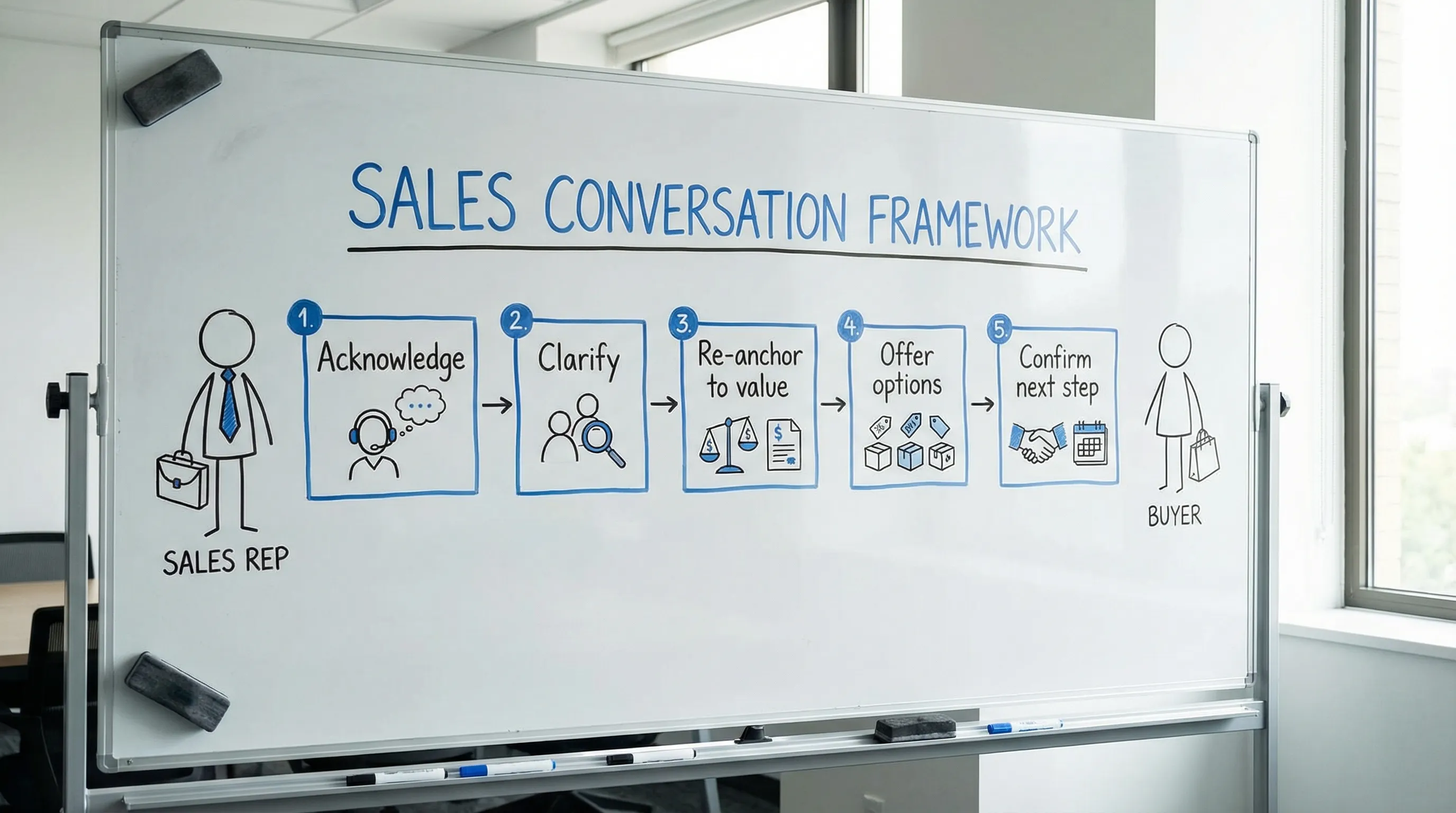
Give reps a repeatable structure that works across scenarios. A practical spine:
1) Acknowledge (without conceding) 2) Clarify (what’s driving the concern) 3) Re-anchor to value (outcomes, cost of inaction, proof) 4) Offer options (scope, terms, timeline, success plan) 5) Confirm next step (mutual plan)
In roleplays, score the rep on whether they follow the spine, not whether they “won the argument.”
Roleplay scenarios that work (with scripts and coaching notes)
The scenarios below are designed to feel like real calls, including ambiguity, competing priorities, and stakeholder dynamics.
| Scenario | Buyer’s price line | Your rep’s goal | What not to do | “Good” sounds like |
|---|---|---|---|---|
| 1. “Too expensive” (early) | “This seems pricey.” | Discover what “pricey” is compared to, confirm priority | Rush to discount | “Compared to what, and what would you need to see to justify it?” |
| 2. Competitor cheaper | “Vendor X is 25% less.” | Make the comparison apples-to-apples, reframe to risk/value | Attack competitor | “Let’s map what’s included and the cost if adoption fails.” |
| 3. Budget is real | “We literally don’t have budget.” | Explore timing, scope, and internal tradeoffs | Push aggressively | “If we could show ROI in 90 days, would that change priority?” |
| 4. Procurement squeeze | “Send your best and final.” | Hold value, trade for concessions | Discount with no trade | “If we improve price, which term or scope lever can you move?” |
| 5. CFO wants proof | “Show me the numbers.” | Build a quantified business case and validation plan | Make up ROI | “Let’s use your baseline metrics and agree on measurement.” |
| 6. “We’ll build it ourselves” | “We can do this in-house.” | Surface hidden costs, timeline, and opportunity cost | Insult their team | “How will you resource it, and what slips if it takes 6 months?” |
Scenario 1: “This is too expensive” (early-stage sticker shock)
Setup: You are 15 minutes into a discovery call. The buyer has described the problem but hasn’t tied it to an urgent business outcome.
Buyer persona: Head of Sales Enablement, mid-market. Measured on ramp time and quota attainment.
Buyer says: “I like what I’m seeing, but that’s more than we expected.”
Win condition: Rep clarifies the benchmark, connects to a measurable outcome, and proposes a next step (not a discount).
Sample dialogue (short):
Buyer: “That’s more than we expected.”
Rep: “Totally fair. When you say ‘more than expected,’ what were you comparing it to, a different tool, or a different outcome?”
Buyer: “Honestly, I thought it would be closer to our LMS add-on.”
Rep: “Got it. If we were priced like an add-on, we’d behave like an add-on. Earlier you mentioned reps struggle with objections and ramp. If we could reduce ramp time and improve confidence in price conversations, what would that be worth per rep per quarter?”
Coach it: The rep did not argue price. They clarified the reference point, then re-anchored to outcomes.
Scenario 2: “Your competitor is cheaper” (apples-to-apples comparison)
Setup: The buyer has a competitive quote. They are trying to compress you into a commodity box.
Buyer persona: VP Sales, late-stage evaluation, wants speed.
Buyer says: “Vendor X is 25% cheaper. Match it.”
Win condition: Rep reframes to total value and risk, and proves differentiation without trashing the competitor.
Sample dialogue (short):
Rep: “Thanks for being direct. Before we talk numbers, can we confirm we’re comparing the same scope? What does their offer include around scenario personalization, feedback quality, and how you’ll measure progress?”
Buyer: “They have roleplays too.”
Rep: “Makes sense. Where teams usually see the gap is in how quickly reps improve and how confidently managers can coach. If we align on the outcomes you care about, for example fewer lost deals from price pushback and faster readiness, we can decide whether 25% cheaper is actually lower cost.”
Coach it: The rep uses a neutral tone, clarifies scope, and ties back to measurable outcomes.
Scenario 3: “It’s not in the budget” (budget is real, priority is flexible)
Setup: The buyer is interested but budget cycles are tight.
Buyer persona: Customer Support Director. Measured on CSAT and escalations.
Buyer says: “We don’t have budget this quarter.”
Win condition: Rep explores timing, scope, and an internal business case without pressuring.
Sample dialogue (short):
Rep: “Understood. When you say no budget, is it that the budget is allocated, or that the problem isn’t prioritized yet?”
Buyer: “Allocated. We’re maxed out.”
Rep: “If we could target one high-impact scenario, like de-escalation and refund requests, and show improvement in a set time window, would you be open to a smaller start and a plan for next quarter?”
Coach it: The rep creates a path forward (scope and timeline) instead of forcing a discount.
Scenario 4: Procurement pressure (trade, don’t cave)
Setup: You are in legal/procurement review. A procurement manager applies a standard discount push.
Buyer persona: Procurement Manager. Incented to reduce cost and enforce terms.
Buyer says: “We need 15% off or this won’t get approved.”
Win condition: Rep maintains value, offers conditional concessions, and protects margin.
Sample dialogue (short):
Rep: “I hear you. I can look at price, but I’ll need a lever on your side as well. If we adjust pricing, could you commit to a longer term, faster signature, or a defined rollout scope so we can plan resources?”
Buyer: “Maybe. What do you need?”
Rep: “If we can do a 24-month term and signature by Friday, I can take a proposal internally. Does that work?”
Coach it: This trains commercial discipline: discounts are exchanged for something concrete.
Scenario 5: CFO skepticism (prove value without making up ROI)
Setup: The CFO joins late and challenges your business case.
Buyer persona: CFO. Low patience for vague claims.
Buyer says: “Show me this pays back. I don’t buy the ROI math.”
Win condition: Rep uses the buyer’s baseline metrics, proposes a measurement plan, and offers proof points (case studies, pilot, references) without exaggeration.
Sample dialogue (short):
Rep: “That’s fair. Rather than using generic assumptions, can we use your baseline? For example, average deal size, win rate, and how often deals stall on price. If we agree on those inputs, we can model a range and define how we’ll measure improvement over 60 to 90 days.”
CFO: “I’ll consider it if measurement is real.”
Rep: “Great. I’ll send a one-page success plan that defines metrics, who owns what, and what ‘go/no-go’ looks like.”
Coach it: The rep avoids “trust me” ROI and instead co-creates a measurable plan.
Scenario 6: “We’ll build it ourselves” (DIY objection)
Setup: A technical stakeholder claims they can replicate your solution.
Buyer persona: RevOps or IT leader. Proud of internal capability.
Buyer says: “We can build training scenarios in-house.”
Win condition: Rep respects the capability, then surfaces hidden costs: time, maintenance, content quality, adoption, coaching overhead.
Sample dialogue (short):
Rep: “You probably can. The question is whether it’s the best use of your team’s time. How long would it take to build, test, and maintain scenarios, plus a feedback loop that helps reps improve week over week?”
Buyer: “A few months, maybe.”
Rep: “If it takes 3 to 6 months, what’s the cost of reps continuing to lose deals on price objections during that time? If we can help you start training now and prove impact, that might be the cheaper option even if the line item is higher.”
Coach it: The rep reframes “build vs buy” into a time-to-impact and opportunity-cost discussion.
How to run price-objection roleplays so they actually change behavior
Make the roleplay feel real (constraints beat creativity)
The most useful scenarios add constraints that mirror real deals:
- The buyer is rushed and impatient.
- There is a competitor quote.
- The buyer’s preferred outcome is unclear.
- Procurement has a policy (for example, net-60 terms).
- A new stakeholder enters and resets the conversation.
Constraint-based practice forces reps to learn composure, questioning, and value anchoring.
Score the conversation with a simple rubric
Use a consistent rubric so reps know what “good” looks like and managers can coach quickly.
| Skill | What good looks like | Evidence to listen for |
|---|---|---|
| Acknowledge | Calm, respectful, no defensiveness | “That’s fair” / “I understand” (without discounting) |
| Clarify | Asks 1 to 2 focused questions | “Compared to what?” / “What would need to be true?” |
| Value re-anchor | Connects to buyer outcomes and impact | Quantified or specific business impact |
| Options | Offers paths without eroding value | Scope, timing, terms, success plan |
| Next step | Aligns on a concrete action | Meeting, success plan, stakeholder review |
Train managers to coach the moment that matters
In most price-objection calls, the turning point is one sentence. Help managers coach to that sentence:
- Where did the rep lose control of the frame?
- Which question should have come next?
- Did the rep trade value for speed (discounting to “move on”)?
Using AI roleplay to scale price-objection practice
Live manager-led roleplays are effective, but they don’t scale well across teams and time zones. AI roleplay can fill the repetition gap so reps get more at-bats.
With Scenario IQ, teams can practice AI-powered roleplay simulations using personalised training scenarios, receive real-time feedback, and track improvement through progress analytics. The goal is not to replace human coaching, it’s to multiply practice so coaching time goes further.
A prompt template you can adapt for AI roleplay
Use this structure when building a scenario:
- Role: “You are a skeptical VP Sales evaluating a training platform.”
- Context: “You already have an LMS. You had a bad implementation last year. You care about measurable performance.”
- Objection: “You think it’s overpriced and you have a cheaper quote.”
- Behavior rules: “You will not accept discounting immediately. You will respond positively to quantified impact and a clear success plan.”
- Win criteria: “Rep clarifies benchmark, ties to outcomes, offers options, and lands a next step.”

What to measure over time (so training ties to revenue)
Avoid vanity metrics like “roleplays completed.” Track skill signals that connect to real outcomes:
| Metric | What it indicates | How to use it |
|---|---|---|
| Clarifying questions asked | Control and diagnosis | Coach reps who jump to defense |
| Discount rate (in practice) | Commercial discipline | Reinforce trading, not conceding |
| Value statements per call | Ability to re-anchor | Improve discovery and business impact language |
| Next-step quality | Deal control | Ensure every objection ends with a plan |
| Scenario difficulty progression | Skill growth | Increase difficulty as competence rises |
Frequently Asked Questions
What is the best way to respond to a price objection? Start by acknowledging, then ask a clarifying question to understand what “too expensive” means, and re-anchor to business outcomes before offering options.
Should sales reps discount when a buyer says the competitor is cheaper? Not automatically. First confirm scope and outcomes, then differentiate on total value and risk. If you discount, trade for something concrete like term length or timeline.
How do you roleplay price objections without making it awkward? Use realistic constraints (competitor quote, procurement policy, rushed buyer) and score a consistent rubric. Keep roleplays short, repeatable, and focused on one skill.
What should managers listen for during price objection practice? Whether the rep clarifies the objection, ties value to measurable outcomes, avoids defensiveness, and ends with a mutually agreed next step.
Can AI roleplay help teams handle price objections? Yes. AI roleplay can increase repetition and consistency, provide real-time feedback, and make it easier to track progress across reps and teams.
Build a team that stays confident on price
If your team’s default response to “too expensive” is discounting, the fix is not more talk tracks, it’s more realistic practice and better feedback loops.
Scenario IQ helps teams run AI roleplay training with personalised scenarios, real-time feedback, and analytics that show who is improving and where coaching should focus. Explore Scenario IQ and see how AI-driven scenarios can help your reps handle price objections with confidence: Scenario IQ.