

Sales and service teams do not fail because they do not “know” what to do. They fail because they cannot execute consistently in real conversations, under pressure, with real customer emotions, timelines, and objections.
That is exactly where modern AI training programs can outperform traditional enablement. When designed well, they turn training into repeatable practice, personalized coaching, and measurable behavior change, not a one-time workshop.
What “AI training programs” mean for sales and service (in practice)
An effective AI training program is not a library of videos with a chatbot attached. It is a system that helps reps practice the moments that matter, get feedback in real time, and improve week over week.
For sales and service, that typically includes:
- Scenario-based practice (discovery calls, demos, renewal conversations, escalations, complaint resolution)
- Objection handling and de-escalation (price pushback, competitor comparisons, angry customers)
- Communication fundamentals (tone, clarity, active listening, empathy, next-step control)
- Manager coaching enablement (consistent scorecards, coaching prompts, and progress visibility)
The end goal is measurable performance improvement: higher conversion, higher CSAT, lower handle time (where appropriate), better retention, fewer escalations, and faster ramp for new hires.
Start with outcomes, not features: the “conversation outcomes map”
Designing an AI training program goes smoother when you begin with a simple map:
- Business outcome: What metric needs to move?
- Conversation outcome: What should happen in the call?
- Observable behaviors: What must the rep say or do?
- Practice scenario: What situation creates that behavior?
- Feedback criteria: How will you score it consistently?
This avoids a common failure mode: launching AI roleplay because it is exciting, but not tying practice to the specific moments that drive pipeline and customer experience.
Example: mapping a business outcome to a trainable scenario
If your business outcome is “increase renewal rates,” the conversation outcome might be “confirm value, surface risk, and secure next-step commitment.” That becomes a scenario like: “Renewal call, champion is supportive but mentions a CFO review and a competitor quote.”
Now you can score behaviors such as:
- Did the rep quantify impact and outcomes?
- Did they uncover decision criteria and timeline?
- Did they address the competitor objectively?
- Did they confirm a mutual action plan?
Step 1: Define your competency model for sales and service
You do not need a 40-skill taxonomy to start, but you do need shared definitions. A practical model usually includes 6 to 10 competencies that apply across roles, plus role-specific add-ons.
Here is a lightweight structure you can use:
| Competency | Sales example behavior | Service example behavior | How it shows up in scenarios |
|---|---|---|---|
| Discovery and diagnosis | Asks targeted, layered questions | Identifies root cause, confirms constraints | Customer is vague or contradictory |
| Objection handling | Reframes price to value, validates concern | De-escalates, proposes options | Customer pushes back emotionally |
| Clarity and structure | Sets agenda, summarizes, confirms next step | Explains steps, sets expectations | Customer is rushed or distracted |
| Empathy and tone | Acknowledges risk and urgency | Uses calm, validating language | Customer is upset or anxious |
| Product and policy accuracy | Positions right fit and limitations | Applies policy without sounding rigid | Edge-case request or exception |
| Closing and commitment | Advances stage, books next meeting | Secures confirmation, prevents repeat contact | Customer is non-committal |
Your AI training program should explicitly train these competencies through repeated scenarios, not just “general roleplays.”
Step 2: Build a scenario library that reflects reality (not best-case calls)
Teams learn fastest when scenarios resemble the messy, imperfect situations reps actually face.
A strong scenario library usually includes:
The “top 10” scenarios
Pick the 10 conversations that most influence revenue or customer outcomes. Examples:
- First-call discovery with an unclear problem
- Demo with a skeptical technical stakeholder
- Price objection with procurement pressure
- Customer escalation after a missed expectation
- Renewal risk call after low product usage
The “hard mode” variations
Once the base scenario works, create variations that force adaptability:
- Customer is impatient, talkative, or distrustful
- Missing information, conflicting stakeholders, or tight timelines
- Competitive mention, budget freeze, legal/security review
Guardrails: what reps must not do
For service teams especially, include “do not” constraints (promising refunds, admitting fault inappropriately, violating policy). These constraints can be built into scenario instructions and scoring.
Step 3: Design feedback that changes behavior (not just scores)
If feedback is vague, reps cannot improve. If feedback is overly rigid, reps will game it.
Aim for feedback that is:
- Specific: tied to an utterance or missed moment
- Actionable: tells the rep what to try next time
- Prioritized: 1 to 3 improvements per session, not 15
- Consistent: the same behavior should score similarly across attempts
A helpful pattern is: observation, impact, next attempt.
Example:
- Observation: “You responded to the price objection by repeating the list price.”
- Impact: “That keeps the conversation anchored on cost instead of outcomes.”
- Next attempt: “Ask one question to surface the decision criteria, then re-anchor on measurable value.”
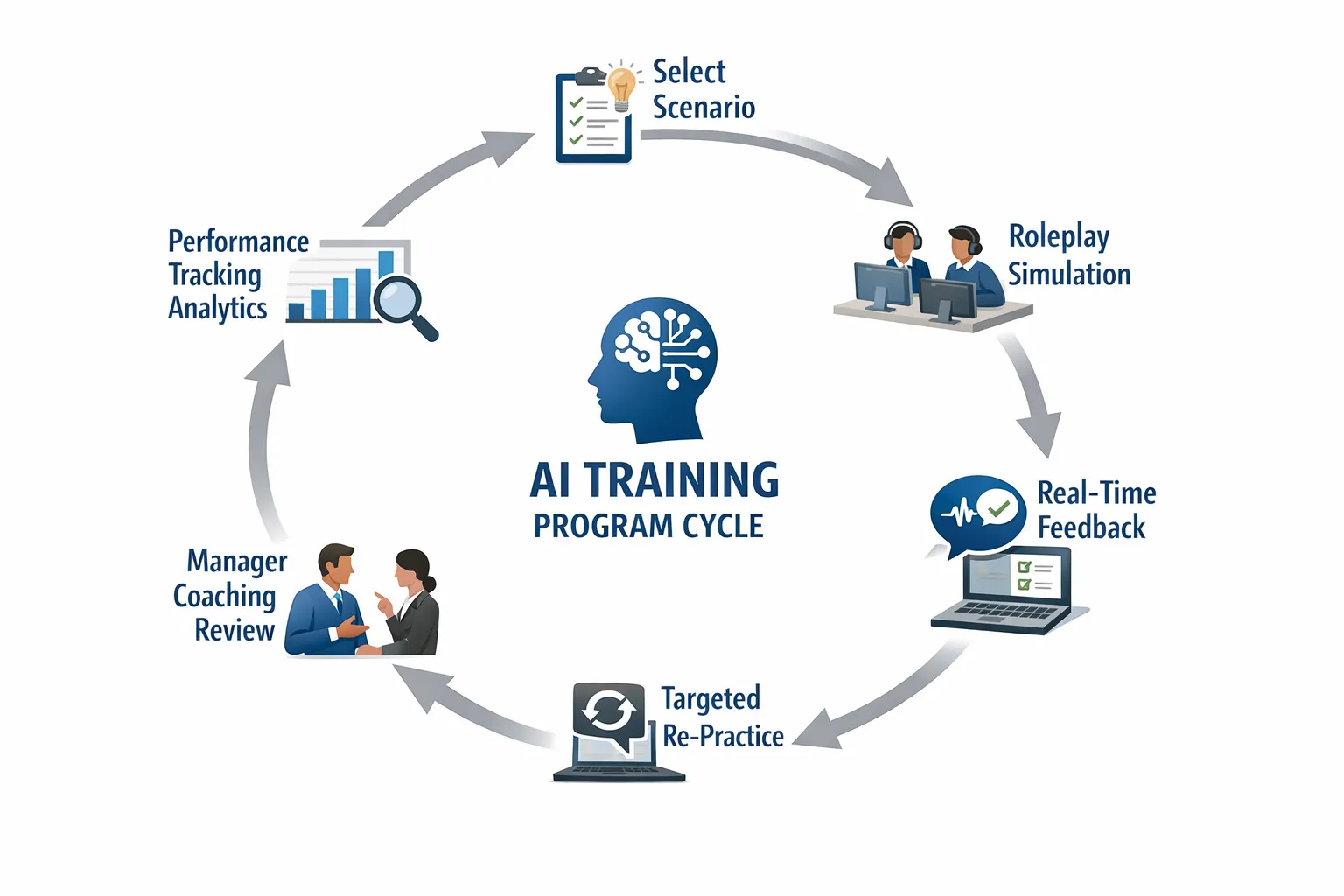
Platforms like Scenario IQ are built around AI roleplay simulations with real-time feedback and progress tracking analytics, which fits this feedback-first approach, as long as you align scoring to your competency model.
Step 4: Personalization rules that keep training relevant
Personalization is where AI training programs can shine, but only if you define what “personalized” means.
Use personalization in three practical ways:
Personalize by role and segment
A BDR, AE, CSM, and support rep should not share the same default scenarios. Even within sales, mid-market and enterprise conversations differ.
Personalize by proficiency level
Design “skill levels” so learners get the right difficulty at the right time:
- New hire: simple scenarios, clear prompts, fewer variables
- Intermediate: more ambiguity, stronger objections, multiple stakeholders
- Advanced: negotiation, complex de-escalations, competitive traps
Personalize by performance signals
If analytics show a rep consistently misses agenda-setting, they should see more scenarios that punish weak structure and reward strong framing.
Step 5: Create a coaching loop for managers (the multiplier effect)
AI practice alone is not the program. The program is AI practice plus coaching, reinforcement, and accountability.
A simple manager loop looks like this:
- Reps complete short practice sessions each week
- Managers review progress trends and 1 to 2 sample transcripts
- Managers assign one targeted “replay” scenario
- Rep repeats the scenario and tracks improvement over time
This is where progress tracking and performance dashboards become useful, because they reduce coaching guesswork and help managers focus on the highest-leverage behavior.
If you want a research-backed framing for reinforcement, you can align your program evaluation to the Kirkpatrick Model (reaction, learning, behavior, results), and ensure you measure behavior change, not just completion.
Step 6: Pick metrics that reflect skill transfer, not activity
Do not mistake “minutes trained” for capability. A clean measurement approach includes both leading and lagging indicators.
| Metric type | What to track | Why it matters | Common pitfall |
|---|---|---|---|
| Leading (training) | Scenario attempts, improvement over attempts, time-to-proficiency | Shows practice volume and learning curve | Tracking attempts without quality |
| Leading (behavior) | Score trends by competency, talk-to-listen balance (if relevant), objection handling pass rate | Captures skill transfer signals | Over-indexing on one proxy metric |
| Lagging (business) | Win rate, conversion rate by stage, renewal rate, CSAT, escalations | Validates impact | Ignoring seasonality and pipeline mix |
| Coaching health | Manager review frequency, coaching actions completed | Ensures reinforcement | Treating coaching as optional |
A useful rule: if a metric cannot influence coaching actions, it is probably not a great operational metric.
Step 7: Build trust: safety, privacy, and governance
Sales and service training often touches sensitive information. Even if scenarios are simulated, learners need clarity on how data is handled and how performance is used.
At minimum, define:
- Data boundaries: what is captured (and what is not)
- Usage policy: coaching and development versus punitive evaluation
- Access controls: who can view team versus individual performance
- Security expectations: enterprise-grade security requirements, vendor review, and internal compliance checks
If your organization operates in regulated environments, involve security and legal early, not after rollout.
Step 8: Roll out in 30 days with a pilot that proves value
AI training programs succeed when the rollout is operationally simple.
A practical pilot plan:
Choose one team and one workflow
Example: inbound service escalation handling, or sales discovery for a single segment.
Set a clear success definition
Pick 2 to 3 indicators, for example:
- Competency score improvement in “de-escalation”
- Fewer escalations to tier 2
- Higher QA scores or better customer sentiment
Keep practice small and frequent
Short sessions (for example, 10 to 15 minutes) tend to fit real schedules better than long training blocks. This also aligns with the broader idea of spaced repetition, a well-supported learning principle discussed widely in learning science.
Ship the minimum scenario set, then expand
Start with 5 to 10 scenarios. Improve them based on rep feedback, manager observations, and analytics, then scale.
Common design mistakes (and how to avoid them)
Mistake 1: Treating AI roleplay as a one-time onboarding asset
Fix: Design the program as an ongoing cycle, with weekly practice and manager reinforcement.
Mistake 2: Scoring everything
Fix: Focus scoring on the competencies that drive outcomes. Limit feedback to the highest-impact moves.
Mistake 3: Training generic scripts
Fix: Train decision-making. Give reps realistic constraints, tradeoffs, and customer behavior.
Mistake 4: Not updating scenarios as your business changes
Fix: Add a monthly scenario review tied to product changes, new objections, and win-loss insights.

Where Scenario IQ fits in a modern AI training program
If you are building scenario-based training, you generally need four capabilities: realistic simulations, personalization, feedback that drives improvement, and analytics that support coaching.
Scenario IQ positions itself around AI-powered roleplay simulations, personalized training scenarios, real-time feedback, and progress tracking analytics, with team-focused learning and enterprise-grade security. That combination aligns well with the program design approach above because it supports both practice (rep side) and reinforcement (manager side) without relying on occasional live roleplays.
To keep implementation honest and effective, validate any platform against your own competency model and success metrics first, then scale based on pilot results.
Frequently Asked Questions
What are AI training programs for sales and service? AI training programs use AI-driven simulations and feedback to help reps practice real conversations (discovery, objections, escalations) repeatedly, with coaching insights and progress tracking. The best programs focus on behavior change that shows up in customer outcomes and revenue metrics.
How do you measure whether an AI sales training program works? Measure both leading indicators (improvement in scenario performance, competency scores, time-to-proficiency) and lagging indicators (conversion rates, win rate, renewals, CSAT, escalations). Tie metrics to specific coaching actions so improvements are operational, not theoretical.
How many scenarios do we need to start? Usually 5 to 10 high-impact scenarios are enough for a pilot. Start with the conversations that most affect revenue or customer satisfaction, then add variations once the base scenarios reliably drive improvement.
Will reps trust AI feedback? Trust increases when feedback is specific, consistent, and clearly positioned for development. Communicate how data will be used, keep early coaching supportive, and show reps their improvement over multiple attempts.
Is AI roleplay only for sales teams? No. Service and support teams often benefit just as much, especially for de-escalation, expectation-setting, policy conversations, and handling emotionally charged interactions.
Build an AI training program your team will actually use
If you want a practical way to turn your highest-stakes conversations into repeatable practice, Scenario IQ is designed for AI roleplay training with personalized scenarios, real-time feedback, and analytics that support coaching.
Explore how it can fit your enablement strategy at Scenario IQ.