

CSAT can change faster than most customer service metrics, because it is heavily influenced by what customers feel in the moment: empathy, clarity, speed, and whether the agent takes ownership. The quickest way to improve those behaviors is not another slide deck. It is repeated, realistic roleplay that turns “I know what to say” into “I can say it under pressure.”
Below are customer service roleplay scenarios designed to improve CSAT quickly, plus a simple scoring rubric and a short practice format you can run with any team.
Why roleplay improves CSAT quickly
Roleplay works because it targets the exact skills that show up on CSAT verbatims:
- Customers reward empathy and respect, even when you cannot fully give them what they want.
- Customers penalize uncertainty, long silences, and vague next steps.
- Customers remember whether the agent owned the outcome, or pushed them elsewhere.
It also builds confidence. When agents have already practiced the hardest moments (billing disputes, policy constraints, escalation demands), they hesitate less and communicate more clearly.
From a CX research perspective, reducing perceived effort is a powerful lever. The well known “Stop Trying to Delight Your Customers” argument highlights that removing friction often matters more than trying to wow customers in the moment (Harvard Business Review).
Set up your roleplays to move CSAT (not just “train”)
Before you run scenarios, align on what you are trying to change. CSAT improves fastest when practice is tied to a small set of observable behaviors.
Pick 3 to 5 CSAT drivers to score
Choose the drivers that match your common low CSAT comments. Most teams can start with:
- Empathy and tone: acknowledges emotion without sounding scripted
- Ownership: “I will handle this” instead of “you need to contact…”
- Clarity: plain language, no jargon, short sentences
- Next steps: timeframes, what will happen, what the customer should expect
- Resolution quality: correct solution, correct policy application
Use a simple rubric (and keep it consistent)
A lightweight rubric helps you coach the same way across managers and teams.
| CSAT driver | 1 = Needs work | 3 = Meets standard | 5 = Excellent | What “excellent” sounds like |
|---|---|---|---|---|
| Empathy and tone | Ignores emotion, defensive | Polite, acknowledges | Validates emotion, stays calm | “That is frustrating. Thanks for your patience, I’m going to take ownership and get this fixed.” |
| Ownership | Passes customer around | Handles most steps | Owns outcome end to end | “I’ll stay with you on this and follow up by 3 pm.” |
| Clarity | Long, confusing, jargon | Understandable | Concise, structured | “Here are the two options. I recommend option A because…” |
| Next steps | No timeframe | Basic timeframe | Specific, proactive | “You’ll get an email confirmation in 10 minutes, and I’ll check back tomorrow.” |
| Resolution quality | Incorrect or incomplete | Correct | Correct plus prevents repeat | “I fixed the issue and updated your settings so it doesn’t happen again.” |
Tip: score in the same order every time (empathy, ownership, clarity, next steps, resolution). Agents learn the pattern and improve faster.

Customer service roleplay scenarios that improve CSAT quickly
Each scenario below includes: setup, what the customer says, what success looks like, and common traps that typically lead to low CSAT.
Scenario 1: “Your delivery is late and I needed it for an event”
Setup: The customer ordered expedited shipping. The tracking shows a delay.
Customer says: “This is unacceptable. I paid extra and now it’s not here.”
Success looks like:
- Acknowledges urgency and impact
- States what you can do right now (refund shipping, reroute, replacement)
- Gives a clear timeline and a follow up commitment
Common CSAT traps: blaming the carrier, overpromising, or offering a generic apology with no action.
Scenario 2: Billing dispute, “I was charged twice”
Setup: The system shows two pending charges, one will drop in 3 to 5 business days.
Customer says: “You took my money twice. Fix it today.”
Success looks like:
- Confidently explains pending vs posted charges in plain language
- Offers a concrete next step (case number, email confirmation)
- If appropriate, offers a goodwill credit or expedites review according to policy
Common CSAT traps: sounding unsure, using finance jargon, or giving timelines without proof of action.
Scenario 3: Product outage or bug after an update
Setup: A known incident is impacting multiple customers.
Customer says: “It broke after your update. I can’t work.”
Success looks like:
- Acknowledges impact and apologizes without debating fault
- Shares status transparently (what you know, what you do not)
- Provides a workaround or mitigation if available
- Sets an expectation for the next update and offers to notify
Common CSAT traps: pretending it is isolated, dumping technical details, or refusing to give any estimate at all.
Scenario 4: Policy limitation, refund not allowed
Setup: Customer is outside the refund window.
Customer says: “I want a refund. I don’t care about your policy.”
Success looks like:
- Validates disappointment
- Explains the policy briefly, then moves to options (credit, exchange, plan change)
- Frames options as helping the customer, not protecting the company
Common CSAT traps: repeating policy multiple times, sounding robotic, or offering options without recommending the best fit.
Scenario 5: “I’ve contacted you three times already” (repeat contact)
Setup: Prior tickets exist, with inconsistent notes.
Customer says: “No one helps. I’m done.”
Success looks like:
- Starts with ownership and apology for the experience
- Summarizes what happened so far (proves you listened)
- Creates a single plan with one accountable owner
- Sets a follow up time you will meet
Common CSAT traps: asking the customer to re explain everything, or blaming another team.
Scenario 6: Long hold time complaint at the start of the call
Setup: Customer waited 20 minutes.
Customer says: “Finally. Do you always make people wait this long?”
Success looks like:
- Quick, sincere acknowledgement
- Transitions fast into solving the issue
- Avoids excuses; offers an alternative channel if helpful
Common CSAT traps: over apologizing for too long or defending staffing decisions.
Scenario 7: Customer threatens to leave (cancellation / churn)
Setup: Customer is unhappy with value or had a bad support experience.
Customer says: “Cancel my account today.”
Success looks like:
- Confirms intent and reason without being pushy
- Addresses the root issue, offers a relevant alternative
- If cancellation proceeds, makes it smooth (low effort), confirms next steps
Common CSAT traps: arguing, guilt language, or making cancellation hard.
Scenario 8: The customer wants an escalation immediately
Setup: Customer demands “a manager” before you have details.
Customer says: “I’m not talking to you. Get me your supervisor.”
Success looks like:
- Stays calm, acknowledges request
- Uses a respectful bridge to gather essentials: “I can absolutely involve a manager. First, so we don’t waste your time, what happened?”
- If escalation is needed, sets expectations (wait time, what manager can do)
Common CSAT traps: refusing escalation outright or transferring with no context.
Scenario 9: Customer has an accessibility or language barrier need
Setup: Customer struggles to follow complex steps.
Customer says: “I don’t understand. Can you explain it differently?”
Success looks like:
- Uses short sentences and checks understanding
- Offers alternative formats (email summary, step by step guide)
- Avoids making the customer feel at fault
Common CSAT traps: speaking faster, repeating the same phrasing, or sounding impatient.
Scenario 10: High emotion customer who is personally insulting
Setup: Customer uses insults, but not explicit threats.
Customer says: “You people are useless. Are you even trained?”
Success looks like:
- Does not mirror tone
- Names the goal and sets a boundary: “I want to help. If we keep it respectful, I can resolve this faster.”
- Moves to a clear plan and next step
Common CSAT traps: snapping back, passive aggressive phrasing, or threatening disconnection too early.
Talk tracks that consistently lift CSAT
Most agents do not need “more words.” They need a repeatable structure they can use in every scenario.
Here are two practical templates that work across channels.
The EON method: Empathize, Own, Next step
This is a fast pattern for chats, emails, and calls.
| Step | Goal | Example phrases |
|---|---|---|
| Empathize | Validate emotion and impact | “I can see why that’s frustrating.” “Thanks for flagging this.” |
| Own | Make accountability explicit | “I’m going to take ownership and get this sorted.” |
| Next step | Reduce uncertainty | “Here’s what I’ll do now…” “You’ll receive an update by…” |
The “two options” close
When policy or constraints exist, options improve perceived control.
Use: “I can offer Option A (fastest) or Option B (best long term). Based on what you told me, I recommend A.”
This avoids the low CSAT pattern of dumping choices on the customer without guidance.
Run a 20-minute CSAT roleplay sprint (weekly)
You do not need hour long workshops to see movement. Many teams get quick wins with a short cadence that focuses on one scenario family at a time.
| Sprint segment | Time | What happens | Output |
|---|---|---|---|
| Brief | 3 min | Define scenario, success criteria, and rubric focus | One clear target behavior |
| Roleplay round 1 | 6 min | Agent handles scenario, coach scores live | Baseline score |
| Debrief | 5 min | Agent self reflects first, coach adds 1 improvement | One behavior to change |
| Roleplay round 2 | 6 min | Same scenario, higher difficulty (angrier customer, less info) | Improved score + confidence |
If you do this weekly for 6 to 8 weeks, you typically see fewer “felt rushed,” “didn’t listen,” and “no resolution” comments, which are common CSAT killers.
Measure whether roleplay is working (fast)
CSAT is your headline metric, but it is lagging and can be noisy. Pair it with 2 to 3 operational indicators that move earlier.
A practical set:
- QA rubric pass rate on empathy, ownership, and next steps
- First contact resolution (FCR) or “resolved in one touch” proxy
- Reopen rate or repeat contact within 7 days
If you want a broader business case, Bain & Company has long reported that increasing retention can significantly impact profitability (Bain insights). While CSAT is not retention, it is often an upstream driver.
How AI roleplay makes these scenarios easier to scale
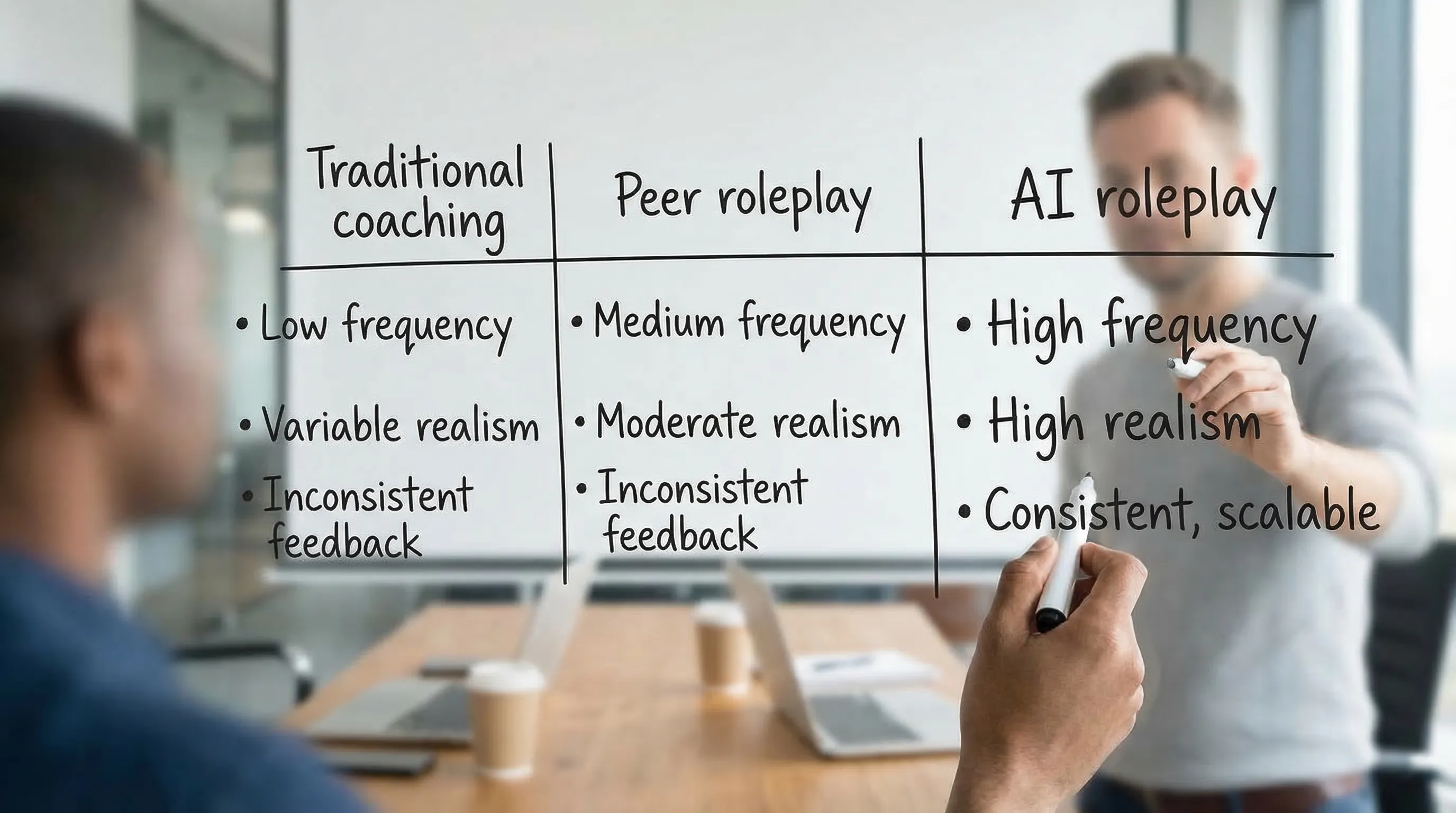
Traditional roleplay breaks down when:
- Managers do not have time to run consistent practice
- Scenarios are unrealistic or too “nice”
- Feedback varies by coach
- Remote teams cannot practice together
An AI training platform can help by running scenario based simulations on demand and giving consistent feedback.
Scenario IQ, for example, provides AI-powered roleplay simulations, personalised training scenarios, real-time feedback, and progress tracking analytics designed to help teams practice high impact conversations more often. If you are trying to improve CSAT quickly across a team (not just a few top performers), more reps with consistent scoring is usually the fastest path.
Learn more at Scenario IQ.
Frequently Asked Questions
How many roleplay scenarios do we need to improve CSAT quickly? Start with 8 to 12 scenarios that match your top contact reasons and your most common low CSAT verbatims. Depth (repetition) beats variety early.
How often should customer service teams do roleplay? Weekly is a strong baseline. Even 20 minutes per week per agent can build habit and improve confidence, especially if you repeat the same scenario twice with coaching.
Should roleplay be scripted or improvised? Use a light structure (like Empathize, Own, Next step) but avoid full scripts. Customers can hear memorized lines. Structure improves consistency without sounding robotic.
How do you score roleplay fairly across different coaches? Use a shared rubric with clear “what good sounds like” examples, score the same 3 to 5 behaviors every time, and calibrate coaches monthly with the same recorded scenario.
Can AI roleplay replace coaching? It is best as a multiplier. AI roleplay can provide more practice reps and consistent feedback, while managers focus on coaching judgment, context, and team specific policies.
Want to practice these scenarios at scale?
If you want your team to run these customer service roleplay scenarios on demand, with consistent scoring and real time feedback, explore Scenario IQ’s AI driven training approach.
Get started here: Scenario IQ or request a roleplay demo.