

Custom AI development can feel like a black box: vague promises, unpredictable timelines, and budgets that swing wildly between “small pilot” and “enterprise transformation.” The fastest way to reduce risk is to treat AI like any other product investment, define the scope precisely, plan delivery in phases, and budget around the real cost drivers (data, integration, and ongoing operations).
This guide walks through the basics you need to scope a custom AI initiative, estimate a realistic timeline, and build a budget that will survive procurement, security review, and executive scrutiny.
What “custom AI development” actually means (and why it matters for scope)
“Custom AI” can describe very different levels of effort. Clarifying which of these you mean is the first scope decision, because each tier changes data needs, delivery time, and operational complexity.
| Custom AI approach | What you are building | Typical when you need it | Biggest hidden cost |
|---|---|---|---|
| Prompting and orchestration on a foundation model | Prompts, tools, guardrails, retrieval (RAG), workflows | Fast internal copilots, search, Q&A over company docs | Integration, evaluation, and safety controls |
| Fine-tuning or adapters | A model specialized on your style, domain, or task | Repeated, narrow tasks (classification, tone, structured outputs) | Data curation and governance approvals |
| Training a model from scratch | A new model architecture or full pretraining | Rare, usually only for very large orgs with unique data and constraints | Compute, staffing, and ongoing research-grade maintenance |
Most businesses succeed with the first two. “Training from scratch” is usually not a budget basic, it is a strategic bet.
Scope basics: how to define the right first version
A strong scope does two things at once:
- It is specific enough that engineering, security, and legal can approve it.
- It is small enough that you can validate value before scaling.
Start with outcomes, not features
Avoid scoping a solution like “build an AI assistant for sales.” That invites endless requirements. Instead, scope around an outcome:
- Reduce time-to-competency for new reps
- Improve objection-handling consistency
- Increase QA scores in customer support
- Decrease average handling time without lowering CSAT
These are measurable and map to training, workflow, or decision-support systems.
Write the “use case contract” (the shortest document that prevents rework)
Before anyone selects a model, write a one-page contract for the use case. It should answer:
| Question | Example of a good answer |
|---|---|
| Who uses it? | New SDRs in their first 60 days, plus managers for coaching |
| What decisions does it influence? | Recommends talk tracks and next best responses, does not send messages autonomously |
| What data is allowed? | Approved enablement docs, anonymized transcripts, product FAQs |
| What is out of scope? | Lead scoring, pricing approval, contract language generation |
| What does “good” look like? | 20% improvement in roleplay rubric score within 4 weeks |
This document becomes your north star when stakeholders try to add “just one more feature.”
Inventory your data reality (not your data aspirations)
Custom AI projects rarely fail because of model quality alone. They fail because the data is fragmented, inaccessible, low quality, or blocked by privacy constraints.
Validate these early:
- Ownership and access: Who controls the systems you need (CRM, ticketing, LMS, knowledge base)?
- Permissions and PII: What personal data is involved, and what is your minimization plan?
- Labeling needs: Do you need graded examples, rubrics, or human feedback?
- Freshness: Will the AI break when policies, pricing, or product details change?
If your AI depends on internal documents, retrieval quality and content governance become part of the scope, not an afterthought.
Define success metrics you can measure in production
A model can look great in demos and disappoint in real life. Choose metrics that reflect user impact and operational quality.
Common metric categories:
- Business metrics: revenue lift, conversion rate, retention, CSAT, compliance score
- Operational metrics: time saved, handle time, ticket deflection, time-to-competency
- Quality and safety metrics: hallucination rate in tested scenarios, policy violations, escalation rate
If you are building anything that generates customer-facing content, add governance and testing standards early. The NIST AI Risk Management Framework is a widely referenced baseline for thinking about risk, controls, and accountability.
Decide build vs buy as part of scoping
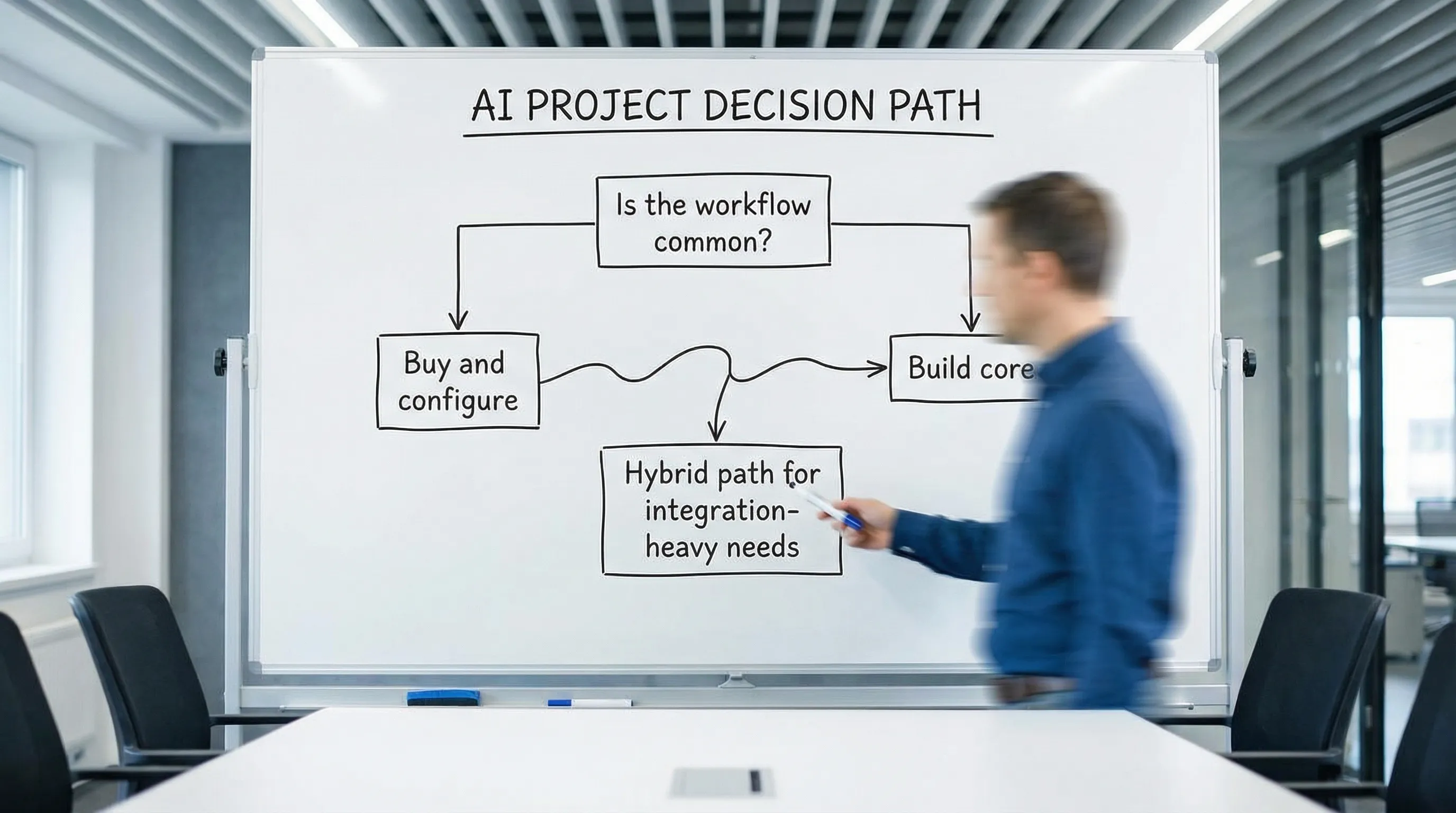
A surprising number of “custom AI” initiatives are actually “we need this workflow for our team.” If a product already solves most of the problem, your custom work should focus on integration and configuration.
A practical build vs buy lens:
| If this is true… | You likely should… |
|---|---|
| The workflow is common (training, coaching, roleplay, analytics) | Buy and configure |
| You need deep integration into 3 to 5 internal systems | Buy plus integration, or hybrid |
| You have unique IP, regulatory constraints, or a proprietary process | Build the core, buy surrounding tooling |
| You cannot clearly define success metrics yet | Run a pilot with a proven product first |
For example, if your goal is sales and service communication performance, a specialized platform like Scenario IQ can reduce custom build scope by providing AI roleplay simulations, real-time feedback, personalized scenarios, and progress tracking analytics, while you focus your effort on aligning training content and measurement.
Timeline basics: what a realistic delivery plan looks like
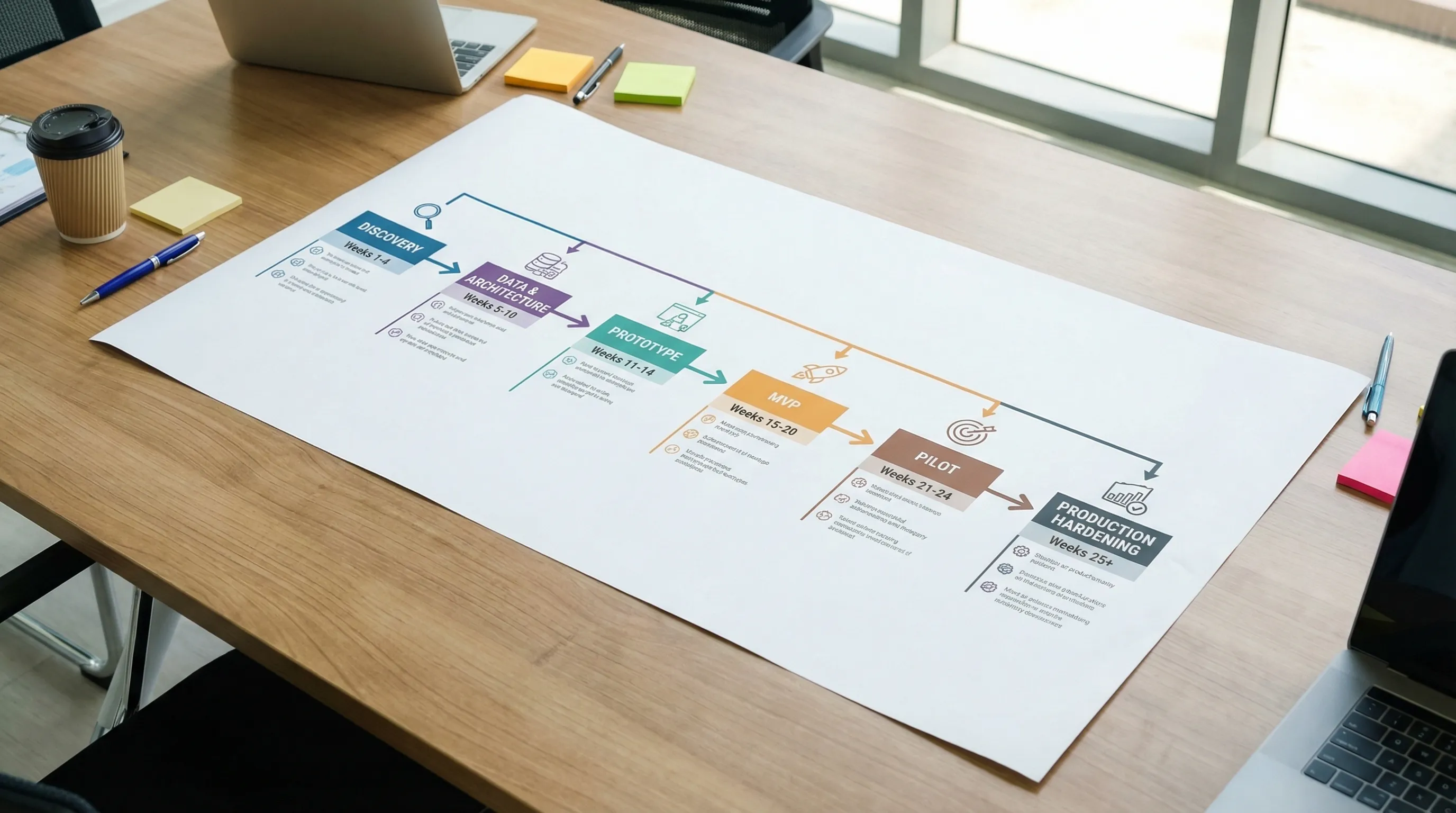
Timelines vary by data readiness, approval cycles, and integration complexity. The most reliable approach is a phased plan with clear exit criteria.
Typical phases for custom AI delivery
| Phase | Goal | Typical duration | Exit criteria |
|---|---|---|---|
| Discovery and scoping | Confirm use case contract, risks, metrics, stakeholders | 1 to 3 weeks | Signed scope, success metrics, data access plan |
| Data and architecture | Identify sources, design retrieval/training approach, security review | 2 to 6 weeks | Data pipeline plan, threat model, evaluation plan |
| Prototype (POC) | Prove feasibility on a narrow slice | 2 to 5 weeks | Demo plus measurable quality on test set |
| MVP build | Build the usable product with guardrails | 4 to 10 weeks | Working MVP, logging, basic monitoring, user onboarding |
| Pilot and iteration | Validate value with real users | 4 to 8 weeks | Metric movement, feedback incorporated, go/no-go |
| Production hardening | Reliability, cost controls, compliance, incident response | 2 to 6 weeks | SLOs, monitoring, governance, runbooks |
In many organizations, security and legal approvals are on the critical path, not model training. Plan for reviews, vendor assessments, and red-teaming. If you are deploying LLM features, the OWASP Top 10 for LLM Applications is a useful way to frame common failure modes (prompt injection, data leakage, insecure plugins) during threat modeling.
What usually stretches timelines
The same issues show up across teams and industries:
- Unclear ownership: Nobody owns the metric, the data, and the change management.
- Integration complexity: Authentication, permissions, and audit logs take longer than expected.
- Evaluation gaps: No agreed test set, no rubric, no definition of “safe enough.”
- Content drift: Policies and product info change, but the AI has no update process.
A timeline that ignores these risks is not aggressive, it is fragile.
Budget basics: what you are really paying for
AI budgets are often mis-modeled as “model cost + a few engineers.” In practice, budget follows the full lifecycle: building, deploying, monitoring, improving, and governing.
The main cost drivers
| Cost driver | What increases cost | How to control it without cutting corners |
|---|---|---|
| Data work | Messy sources, labeling needs, access issues | Start with fewer sources, invest in governance and content hygiene early |
| Engineering and integration | Multiple systems, complex permissions, real-time requirements | Prioritize one workflow, ship an MVP, integrate deeper after proving value |
| Model usage (inference) | High volume, long context, frequent retries | Use retrieval thoughtfully, cache, set limits, measure cost per outcome |
| Evaluation and QA | No rubric, no test set, no automated checks | Define acceptance tests, automate regression suites, add human review loops |
| Security and compliance | Sensitive data, strict audit requirements | Minimize PII, implement logging, access controls, and clear data retention |
| MLOps and maintenance | No monitoring, no update process | Budget for monitoring, incident response, and continuous improvement |
Expect budget ranges to be wide (and learn how to narrow them)
If you ask, “How much does custom AI development cost?” the honest answer is: it depends, and it depends on factors you can measure.
A practical way to budget is to estimate in bands based on complexity:
- Low complexity: Single use case, limited integrations, existing clean content base, small user group.
- Medium complexity: Multiple data sources, role-based access, measurable business metrics, moderate scale.
- High complexity: Regulated data, strict auditability, many integrations, high volume usage, strong reliability requirements.
Instead of trying to lock a single number upfront, procure in phases. Fund discovery and a prototype with explicit exit criteria, then fund MVP and rollout after the pilot proves value.
Budget checklist (what stakeholders will ask you to include)
Most finance and security reviewers will want to see these line items addressed, even if you do not disclose exact numbers:
- People: product owner, engineering, data, security, SMEs, change management
- Infrastructure: environments, secrets management, logging, monitoring
- Vendor costs: model/API usage, vector database, evaluation tools (if used)
- Governance: policies, audit trails, documentation, training
- Ongoing operations: incident response, model updates, prompt updates, content refresh
If you are comparing custom build to a specialized platform, include the internal labor you avoid. For sales and service training, the “real” savings often come from faster rollout, consistent coaching, and measurable progress tracking, not just lower model costs.
A simple way to de-risk your custom AI plan
If you want a plan that is both credible and actionable, use this structure:
Phase 1: Discovery (narrow the problem)
Focus on one high-value workflow, define metrics, confirm data access, and decide build vs buy with evidence.
Phase 2: Prototype (prove feasibility)
Validate that you can hit a quality bar on a realistic test set, and confirm you can meet security expectations.
Phase 3: MVP and pilot (prove value)
Ship to a controlled group, measure the outcome metric, and iterate based on real usage.
Phase 4: Production (earn trust)
Add reliability, monitoring, governance, and a long-term ownership model.
This approach makes your timeline and budget defensible because each step buys down a specific risk.
Frequently Asked Questions
How long does custom AI development take? Most teams can reach a usable MVP in a few months if data access and approvals are smooth. Complex integrations, compliance reviews, and evaluation requirements can extend timelines.
What is the biggest mistake when scoping custom AI development? Starting with a broad assistant concept instead of a single workflow tied to a measurable outcome. Vague scope leads to unclear requirements, weak evaluation, and endless iteration.
Do we need to fine-tune a model to get good results? Not always. Many use cases perform well with retrieval (RAG), strong prompts, and good evaluation. Fine-tuning can help when outputs must follow strict formats or a consistent domain style.
How do we estimate a budget before we know everything? Budget in phases. Fund discovery and a prototype first, set exit criteria, then commit to MVP and rollout after you have real metrics on quality, risk, and usage.
When should we buy instead of build? When the workflow is common and the value comes from execution and adoption (training, coaching, analytics). Buying reduces time-to-value, and custom work can focus on integrations and content alignment.
Want faster time-to-value for sales and service performance?
If your goal is to improve how teams handle objections, build confidence, and communicate consistently, you may not need to build a full custom training system from scratch.
Scenario IQ provides AI-driven, personalized scenario-based training with roleplay simulations, real-time feedback, progress tracking analytics, and enterprise-grade security. You can focus on the scenarios that matter to your business and start measuring performance improvements sooner, with less custom engineering risk.