

Every sales call and support interaction contains signals about what customers want, what they fear, and what makes them say “yes” (or “not today”). The challenge is that most organizations treat those conversations as disposable, a recording is saved somewhere, a few calls get reviewed, and the rest of the insight disappears.
Conversational analytics changes that. It turns customer conversations into structured, searchable data so you can spot patterns across thousands of interactions, coach consistently, and make decisions based on what customers actually say.
What is conversational analytics?
Conversational analytics is the process of capturing, transcribing, and analyzing customer conversations (calls, video meetings, chats, emails) to extract insights that improve performance.
In practice, it helps teams answer questions like:
- What objections show up most often, and which responses overcome them?
- Where do deals stall, and what language precedes drop-off?
- Which support behaviors correlate with better resolution and higher satisfaction?
- What competitors are being mentioned this month, and why?
While conversational analytics started in contact centers (quality monitoring, compliance, agent coaching), it is now equally relevant for sales teams, customer success, and revenue operations.
How conversational analytics works (high-level)
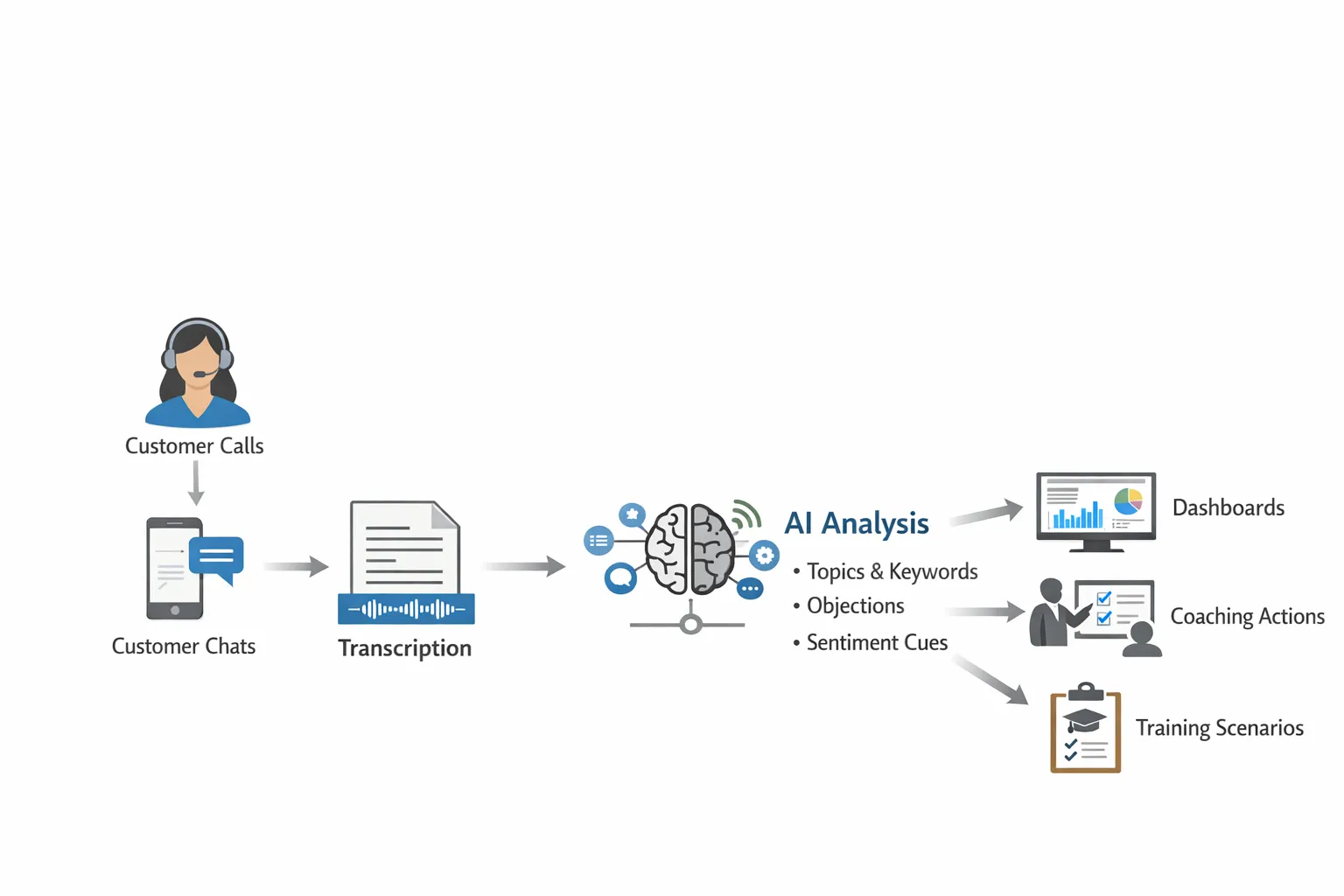
Most platforms follow a similar workflow:
- Conversation capture: Recording calls or ingesting chat and email logs.
- Transcription: Converting audio to text with speech-to-text (and separating speakers).
- Analysis: Using natural language processing (NLP) and AI models to detect topics, intents, sentiment cues, questions, and conversation structure.
- Surfacing insights: Dashboards, searchable libraries, scorecards, and alerts.
- Action: Coaching, playbook updates, enablement, QA, and process changes.
Modern systems increasingly use large language models (LLMs) to summarize calls, identify themes, and draft coaching notes. The best results still depend on good governance and a clear plan for what you will do with the insights.
The types of insights you can pull from every call
Conversational analytics is most valuable when it moves beyond “interesting data” to actionable insight. Here are common categories and what they enable.
1) Customer intent and motivation
Even when two prospects ask the same question, the underlying intent can differ. One person may be validating fit, another may be looking for a reason to disqualify you.
Conversational analytics helps you detect:
- Buying intent signals (timeline language, budget framing, urgency)
- Use case patterns by segment or industry
- Success criteria and decision dynamics (committee, champions, procurement)
2) Objections, risks, and friction points
Objections are often the most repeatable “gold” in your conversations, because they cluster.
When you can quantify objections, you can:
- Update talk tracks and battlecards based on real frequency
- Identify which objections correlate with lost deals
- Spot enablement gaps (teams consistently mishandling the same moment)
3) Conversation quality and skill behaviors
A lot of sales and service performance comes down to behaviors that are measurable, for example clarity, structure, listening, and next-step discipline.
Examples of behavioral signals:
- Talk-to-listen ratio
- Question quality and discovery depth
- Interruptions and pacing
- Confirmation and summarization behaviors (“So what I’m hearing is…”)
- Empathy cues in service conversations
These indicators are most useful when connected to outcomes, not when used as standalone “scores.”
4) Competitive and market intelligence
Your customers will tell you what they are comparing, what features they care about, and what “good” sounds like in their own words.
Conversational analytics can flag:
- Competitor mentions and the reasons behind them
- Product gaps and recurring feature requests
- Pricing sensitivity language by segment
5) Compliance and risk signals
In regulated environments, conversational analytics can support consistent QA and compliance review by detecting specific phrases, disclosures, or risky statements.
If you record calls, make sure you understand consent and disclosure requirements applicable to your region and industry. In the US, call recording laws vary by state. A practical overview is available from the Reporters Committee for Freedom of the Press.
A practical framework: turn “insights” into decisions
To keep conversational analytics from becoming a dashboard that people stop checking, tie it to decisions you actually need to make. The table below maps common insight types to operational actions.
| Insight type | Example you can measure | What you can do with it |
|---|---|---|
| Objection patterns | “Too expensive” appears in 38% of mid-market calls | Build a pricing conversation module, update ROI proof points, run targeted coaching |
| Discovery quality | Calls with at least 3 high-quality questions convert more often | Standardize a discovery checklist, coach question ladders, refine call guides |
| Next-step discipline | “Calendarized next step” missing on a high share of calls | Train a closing loop, update CRM prompts, coach end-of-call language |
| Competitive intel | Competitor X mentions rising week over week | Update battlecards, create new scenario drills, inform product marketing |
| Service resolution drivers | Certain phrasing correlates with escalations | Rewrite scripts, teach de-escalation techniques, redesign workflows |
The key is to pick a small set of insights that map to outcomes you care about (conversion, ramp time, retention, CSAT), then build a repeatable “review and act” cadence.
Where conversational analytics delivers the most value (use cases)
Coaching at scale (without relying on a few call reviews)
Managers cannot listen to enough calls to coach consistently across a team. Conversational analytics helps prioritize which calls matter, what to coach, and what “good” looks like across reps.
For example, instead of saying “ask better questions,” you can coach: “On calls where customers mention X, top performers ask Y within the next two minutes.”
Enablement that reflects reality (not just the playbook)
Sales and service enablement often suffers from a gap between training content and real customer conversations.
Conversational analytics helps enablement teams:
- Validate whether playbook language is used in the field
- Identify what messages resonate by segment
- Spot new objections early (before they show up in forecast misses)
QA and consistency in service teams
For support and service leaders, conversational analytics can surface patterns that impact customer experience, for example repeated transfers, unclear explanations, or failure to confirm understanding.
Product and marketing feedback loops
If you want fast market feedback, customer conversations are often your most honest dataset. Themes that repeatedly appear in calls can inform:
- Product roadmap discussions
- Messaging updates and positioning tests
- Content strategy and FAQ development
Implementation roadmap: getting started without boiling the ocean
Conversational analytics works best with a phased rollout.
Start with one or two outcome goals
Pick goals that are measurable and meaningful, such as:
- Improve conversion from first meeting to second meeting
- Reduce time-to-proficiency for new hires
- Increase first-contact resolution in support
Then define what “conversation behaviors” or moments you believe influence that goal.
Define your taxonomy (lightweight at first)
Teams often over-engineer tags and categories. Start with a small, useful set:
- Top 10 objections
- Top 10 intents or use cases
- Required moments (discovery, value, next step, compliance disclosure)
You can expand over time as patterns stabilize.
Establish governance and trust
If reps and managers do not trust the system, adoption collapses. Decide early:
- Who can access what (role-based permissions)
- How insights will be used (coaching vs punishment)
- How long data is retained
For AI-related governance, the NIST AI Risk Management Framework is a helpful reference point for thinking through risk, transparency, and accountability.
Build a consistent “insights to action” cadence
A simple operating rhythm often works best:
- Weekly: review top changes (objections, competitors, conversion moments)
- Biweekly: enablement updates and scenario practice
- Monthly: leadership review (what trends changed, what actions worked)
If you cannot describe how an insight becomes a behavior change, it is not an insight yet.
Common pitfalls to avoid
Treating conversational analytics as a reporting tool only
Dashboards do not change behavior. Coaching and training do.
Chasing vanity metrics
Metrics like talk time or sentiment can be useful, but only when tied to outcomes and context. A “good” talk ratio varies by situation, deal stage, and persona.
Ignoring change management
Reps need to know why this matters, what will happen with their data, and how it helps them win more. Managers need support to coach consistently.
Turning call insights into skill improvement with Scenario IQ
Conversational analytics tells you what is happening across calls. The next step is ensuring your team can practice what to do next, not just read a new playbook.
That is where scenario-based training is powerful. Once you identify recurring moments (a pricing objection, a competitor comparison, an upset customer escalation), you can turn them into structured practice.
Scenario IQ provides AI-driven roleplay simulations with personalized scenarios and real-time feedback. In practical terms, that means you can:
- Convert top objections into repeatable roleplay drills
- Personalize difficulty by skill level (new hire vs experienced rep)
- Reinforce best practices with adaptive feedback and guidance
- Track progress over time with analytics, so you know whether coaching is sticking
The loop looks like this: insight from conversations, targeted practice, measurable improvement, better conversations, then repeat.

Frequently Asked Questions
What is conversational analytics in simple terms? Conversational analytics is the use of AI to analyze calls, chats, and other customer conversations to identify patterns, behaviors, and topics that drive outcomes like higher conversion, faster resolution, or better customer satisfaction.
Is conversational analytics only for contact centers? No. While it is widely used in support environments, it is increasingly valuable for sales, customer success, and revenue operations because it reveals what top performers do differently and what customers actually care about.
What are the most important conversational analytics metrics for sales? The most useful metrics are those tied to outcomes, such as objection frequency tied to win rates, discovery depth tied to pipeline progression, and next-step setting tied to meeting-to-meeting conversion.
How do you turn conversational analytics into coaching? Identify the specific moment (for example a pricing pushback), define the desired behavior (a clear value-based response), then coach using real call examples and reinforce with targeted practice.
What is the difference between conversational analytics and call monitoring? Call monitoring usually focuses on reviewing a small sample of calls for quality. Conversational analytics analyzes conversations at scale and surfaces patterns across many interactions, making coaching and process improvement more consistent.
Do I need perfect transcripts for conversational analytics to work? Not always, but transcription quality matters. If key terms, names, or industry vocabulary are frequently misheard, you will get weaker insights. Many teams improve results by standardizing audio quality and adding domain terms.
Build better conversations, faster
Conversational analytics helps you find the moments that matter most, the objections that stall deals, the behaviors that separate top performers, and the customer language that should shape your messaging.
If you want to turn those insights into measurable skill improvement, scenario-based practice is the fastest path from “we found the pattern” to “the team can handle it confidently.” Explore how AI roleplay training can reinforce the exact moments your data reveals with Scenario IQ.