

Most contact centers can lower Average Handle Time and protect or even lift Customer Satisfaction at the same time. The trick is to optimize for customer effort and agent decision quality, not just speed. In 2025, contact center AI is no longer only about bots, it is about smarter knowledge access, analytics, and especially better training that builds confident, concise agents who resolve issues on the first try.
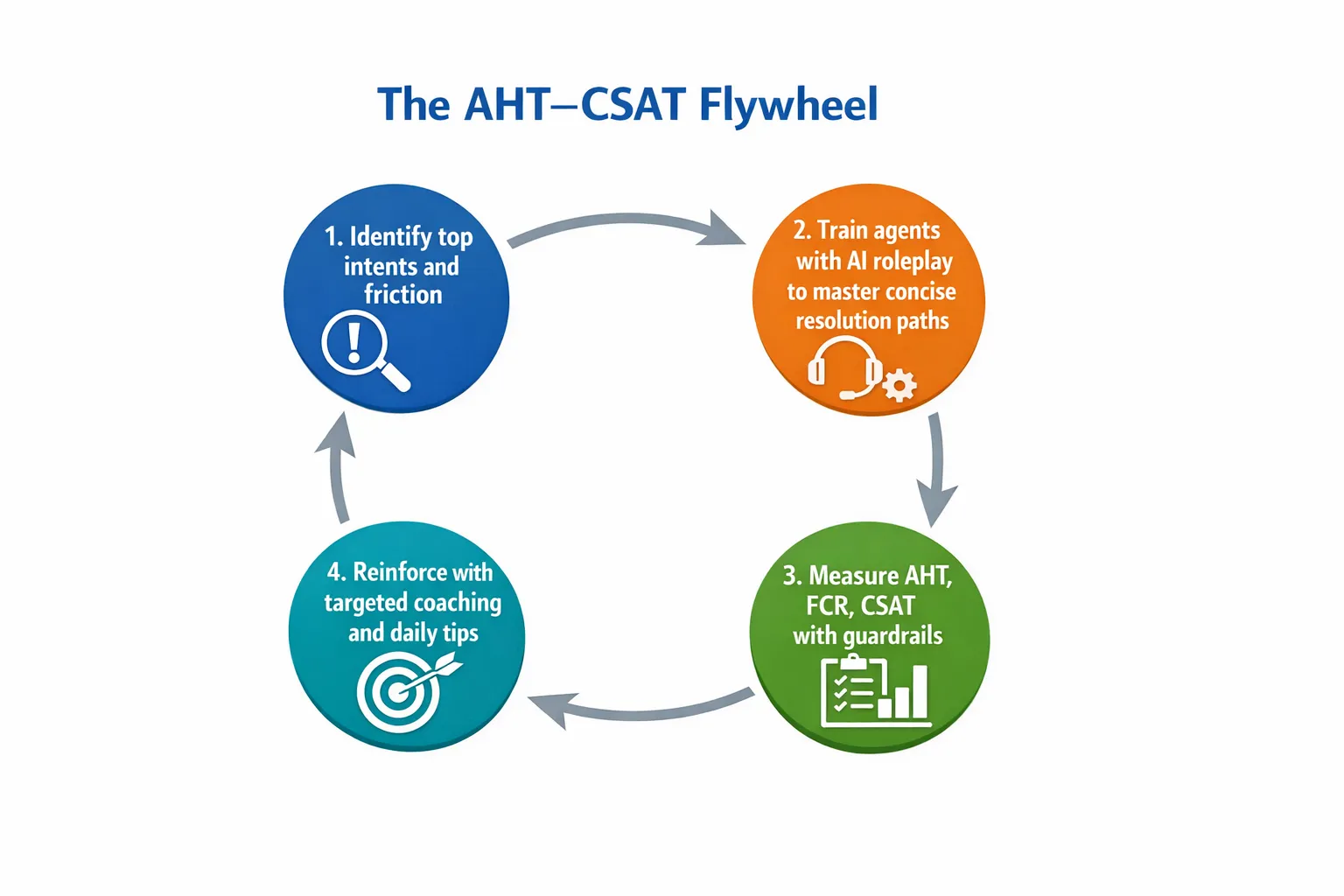
AHT vs. CSAT, the real relationship
Average Handle Time is the sum of talk time, hold time, and after call work, divided by completed contacts. CSAT is usually measured through a post interaction survey. Chasing a lower AHT by itself often creates downstream costs, repeat contacts, transfers, compliance risk, and lower satisfaction. Optimizing for resolution and low customer effort tends to reduce AHT naturally because agents avoid backtracking and rework.
Harvard Business Review’s research on customer effort shows that reducing the work customers must do is a better predictor of loyalty than trying to delight them. That principle applies directly to handle time initiatives, eliminate effort, and speed follows. See “Stop Trying to Delight Your Customers” at Harvard Business Review.
Why many AHT programs backfire
- Blanket time targets pressure agents to rush discovery, which leads to callbacks and escalations.
- Over scripted flows restrict judgment, so complex issues drag on or bounce between queues.
- Knowledge friction, slow search, and outdated articles force holds and transfers.
- ACW bloat, manual forms and copy paste notes add minutes with no customer value.
- Misaligned incentives, rewarding speed without guardrails, quietly punishes quality.
The operating model for fast and loved service
The goal is not to talk faster, it is to think clearer, navigate smarter, and close confidently. These five levers reduce AHT while protecting CSAT.
1) Design for first contact resolution
Start by mapping your top intents by volume and repeat rate. For each, define the shortest safe path to resolution, including eligibility checks, required disclosures, and the minimum number of clarifying questions. Train agents to confirm the goal, probe once with high yield questions, and set expectations early. FCR cuts repeat contacts, which lowers total load and makes AHT gains sustainable.
2) Move knowledge to the agent, not the customer
Agents lose time hunting for answers. Streamline knowledge with intent based snippets and decision points that mirror how agents think. Keep answers on one page with the next recommended step visible. If you deploy real time assist tools, ensure they summarize context and suggest one best action rather than flooding the screen with options.
3) Calibrate the talk track for concise empathy
Agents can be warm and short. Replace long empathy scripts with natural, ten second acknowledgments followed by a confident plan. Teach agents to name the problem, lay out the steps, and ask for permission to proceed. This lowers handle time without making customers feel rushed.
4) Attack ACW and transfer causes at the root
Shorten wrap time by simplifying forms and removing duplicate fields. Standardize note templates. Track and fix the top five transfer reasons by clarifying ownership and simplifying entitlements. Each transfer removed is 30 to 120 seconds saved and a happier customer.
5) Coach behaviors, not just results
Leaders should coach to decision quality, intent recognition, and friction free navigation, not only to the final AHT number. Use sampling to spot the two or three behaviors that explain most outliers, then coach only those. Adults learn by doing, so blend practice into the workweek.
What to pull, what to protect
| AHT lever | Primary impact on AHT | CSAT safeguard | What to watch |
|---|---|---|---|
| FCR focused flows | Fewer repeat contacts, fewer transfers | Keep disclosures and eligibility checks explicit | Repeat contact rate within 7 days, transfer rate |
| Intent based knowledge | Less hold time, faster navigation | Keep reasons why and edge cases visible | Hold time per contact, knowledge article usage |
| Concise empathy | Shorter talk time, fewer digressions | Preserve validation and clear next steps | CSAT verbatims for empathy tone |
| ACW simplification | Lower wrap time | Protect note quality norms | ACW minutes, rework due to poor notes |
| Coaching on behaviors | Broad impact across components | Use call sampling with human review | QA pass rate, AHT distribution tails |
Where contact center AI fits
Modern AI can accelerate both the doing and the learning.
- Real time knowledge and suggestions, surface the most likely answer and next step based on intent and context, which trims holds and cuts navigational waste.
- AI quality monitoring, analyze behaviors at scale and flag coaching opportunities faster than manual QA alone.
- AI roleplay training, let agents practice high volume and high risk scenarios until they become second nature, with immediate feedback that builds confidence and speed.
Scenario IQ focuses on the learning side of the stack. Teams use AI powered roleplay simulations to master the conversations that matter most. Personalized training scenarios let each agent practice the specific intents they handle, adaptive feedback and guidance shows what to improve in real time, daily actionable tips keep skills sharp between sessions, and progress tracking analytics with performance metric dashboards help leaders see which behaviors are changing. For security conscious organizations, enterprise grade security protects training data, and team focused learning makes it easy to roll out targeted programs by queue or skill level.

A 30 to 60 day playbook to lower AHT without hurting CSAT
Establish baselines and guardrails
Capture a clean baseline for AHT by component, talk, hold, ACW, along with CSAT, First Contact Resolution, transfer rate, and repeat contact rate within 7 days. Set guardrails, CSAT and FCR must hold or rise while AHT declines. Share the rule of engagement with agents so the target is understood as quality plus speed.
Prioritize the right intents
Rank intents by volume times repeat rate to find the biggest sources of avoidable demand. Start with three to five intents where you see a combination of long handle times, frequent transfers, or low FCR.
Build a simulation library
Turn your top intents into scenario based practice. For each scenario, define the customer goal, facts and artifacts available, required compliance points, allowed remedies, and the shortest safe resolution path. Create variations for easy, normal, and hard to reflect real life complexity. With Scenario IQ, you can set customizable skill levels and deploy team focused learning so everyone gets the reps they need.
Run daily micro drills
Replace one meeting per week with 10 to 15 minutes of high intensity practice. Use daily actionable tips to reinforce a single behavior, for example one probe, then propose, name the next step before placing a customer on hold, summarize in one sentence at the end. Real time feedback in the simulation shortens the feedback loop and builds muscle memory faster than monthly coaching alone.
Measure, learn, and iterate
Use progress tracking analytics to tag improvements by behavior and intent. Watch the AHT distribution to see if the long tail is shrinking. Review CSAT verbatims weekly for empathy and clarity cues. Adjust knowledge articles and flows where agents still pause or transfer.
Keep security and scale in mind
As you expand training, ensure data minimization in scenarios and follow company privacy policies. Scenario IQ’s enterprise grade security supports safe rollout across regulated teams.
Experiment your way to the sweet spot
Finding the optimal balance requires controlled experiments. Vary your talk track or knowledge layout for a subset of agents, monitor AHT by component plus CSAT and FCR, then keep only what works. Borrow a page from digital commerce where auction based experiments help identify the true market clearing price, for instance, sellers can discover true market value through a self service auction approach. In CX you will not run auctions, but the principle applies, test systematically, keep guardrails, and let the data pick the winner.
Practical talk tracks that save seconds without sounding rushed
- Clarify once, fast: Thanks for calling about the double charge on your card, I can fix this now. I will confirm the transaction, check eligibility for a refund, then issue it. Does that plan work for you?
- Hold with purpose: To verify the merchant’s response I need to check one system. This will take under one minute. I can stay with you or place you on a brief hold while I look, which do you prefer?
- Close confidently: We removed the duplicate charge and you will see the credit within two business days. I am sending a confirmation to your email now. Is there anything else I can resolve while we are together?
Scorecard to prove you are winning on both axes
Use a simple, balanced scorecard so no single metric dominates.
- AHT components, talk, hold, ACW, target a combined reduction while each component trends rationally.
- CSAT and FCR, hold or rise as AHT falls, focus on verbatim themes for empathy and clarity.
- Transfers and repeat contact rate, should decline on targeted intents.
- QA pass rate, should be steady or improving, especially on compliance elements.
If a test lowers AHT but raises repeats or lowers CSAT, it fails. If AHT drops while FCR and CSAT are steady or better, you found a keeper.
Why training is the multiplier for every tool you deploy
New knowledge systems, scripts, and AI assist features only change outcomes when agents change behaviors. Simulation first makes changes stick. With Scenario IQ’s AI powered roleplay simulations, personalized training scenarios, adaptive feedback and guidance, and performance dashboards, teams build confidence quickly and leaders get visibility into which behaviors move the needle. That is how you reduce AHT without sacrificing the experience.
Ready to blend faster resolution with higher satisfaction, and to do it safely? Request a personalized walkthrough at Scenario IQ and see how AI roleplay training can create a measurable AHT and CSAT win in your contact center.