
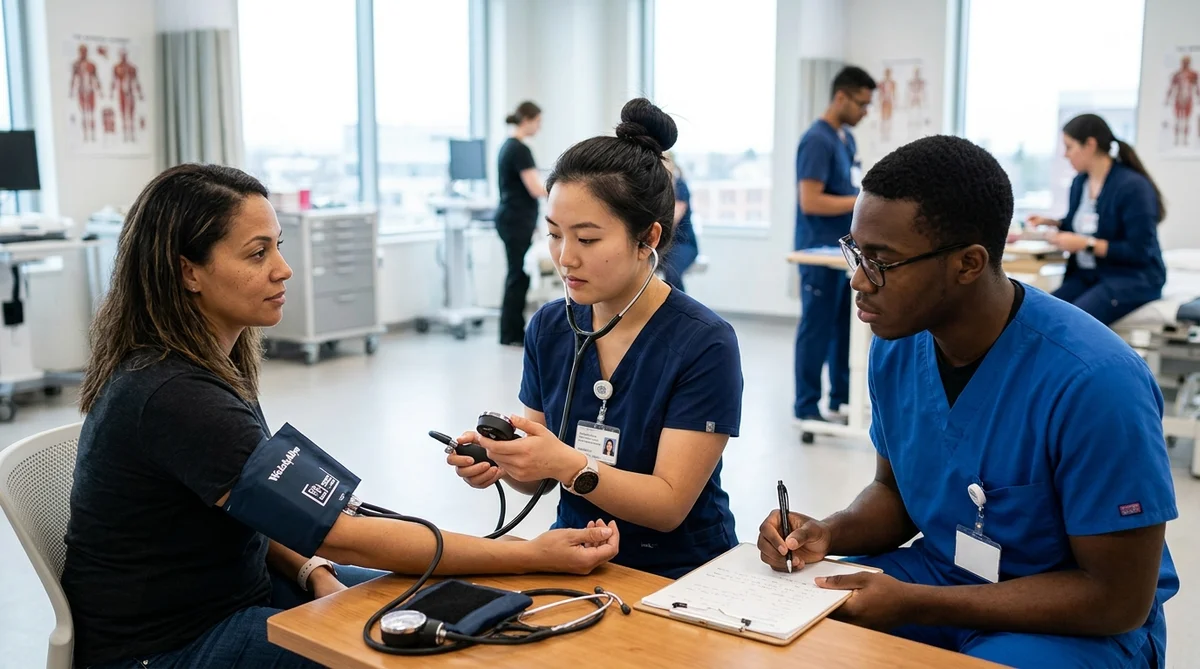
Effective OSCE prep requires a structured approach focusing on clinical communication, physical examination, and diagnostic reasoning. Research indicates that students utilizing high-fidelity simulations, including virtual patient simulation, can improve their performance scores by 25-30%. Success relies on mastering the 12-15 core clinical skills most frequently assessed in high-stakes medical examinations.
What is an OSCE and Why is Preparation Critical?
The Objective Structured Clinical Examination (OSCE) is a modern type of examination used in health sciences to test clinical skill performance and competence. Unlike traditional written exams, the OSCE evaluates what you can do rather than just what you know. It consists of several 'stations' where candidates are asked to perform specific tasks, such as taking a history, performing a physical examination, or explaining a diagnosis to a patient. Preparation is critical because the exam environment is high-pressure, timed, and requires a blend of technical knowledge and interpersonal nuance.
For many students, the challenge of OSCE prep lies in the transition from textbook learning to active application. You are not just recalling facts; you are demonstrating professional behavior and clinical safety. This requires a shift in mindset. You must view yourself not as a student, but as a junior clinician. This shift involves adopting the standards set by professional bodies, such as the General Medical Council's Good Medical Practice, which emphasizes the importance of communication and patient-centered care.
How to Structure Your OSCE Prep Timeline?
Structuring your time effectively is the difference between frantic cramming and confident performance. A successful OSCE prep timeline usually spans three to six months, depending on your prior clinical exposure. In the early stages, focus on the 'building blocks'—the individual physical examination techniques and the core history-taking frameworks. This is a period of slow, deliberate practice where accuracy is more important than speed.
As you move into the mid-stage of preparation, approximately two months before the exam, start integrating these skills into timed scenarios. This is where you begin to simulate the actual exam environment. You should identify your weak points through a systematic review. Utilizing tools for Mastering Training Needs Analysis: A Data-Driven Guide for High-Performance Teams can help you objectively determine which clinical systems—be it cardiovascular, respiratory, or neurological—require the most focus.
In the final month, your preparation should be almost entirely simulation-based. You should be practicing with peers, using clinical equipment, and engaging with diverse patient scenarios. The goal at this stage is to build 'muscle memory' so that the physical steps of an examination become second nature, allowing your cognitive bandwidth to be used for complex diagnostic reasoning and empathetic communication.
The Core Domains of OSCE Assessment
While every university or licensing body has its own marking criteria, most OSCEs are built around five core domains. Understanding these domains allows you to tailor your OSCE prep to what the examiners are actually looking for.
- Clinical Communication: Your ability to build rapport, use open-ended questions, and avoid medical jargon.
- Physical Examination: Your technical proficiency in performing systemic examinations (e.g., abdominal, musculoskeletal).
- Clinical Procedures: Practical skills such as venepuncture, catheterization, or basic life support.
- Diagnostic Reasoning: Your ability to synthesize findings into a coherent differential diagnosis and management plan.
- Professionalism and Safety: Ensuring patient comfort, maintaining hygiene (hand washing), and recognizing clinical red flags.
| Station Type | Key Objective | Common Scenarios |
|---|---|---|
| History Taking | Diagnostic reasoning & Rapport | Chest pain, breathlessness, abdominal pain, forgetfulness. | Physical Exam | Technical proficiency | Cardiovascular, Respiratory, Neurological, Orthopedic. | Communication | Empathy and ethics | Breaking bad news, consenting for surgery, dealing with an angry patient. | Procedures | Manual dexterity & Safety | Venepuncture, IV Cannulation, Suturing, Urinary Catheterization. |
What are the Most Common OSCE Stations?
While the specific cases change, the categories of stations remain remarkably consistent. In your OSCE prep, you must prioritize the 'high-yield' stations. These are the scenarios that appear year after year because they represent the bread-and-butter of clinical practice. For history taking, this includes cardiovascular, respiratory, gastrointestinal, and neurological histories. For examinations, the 'big four' are cardiovascular, respiratory, abdominal, and neurological (cranial nerves and limbs).
Specialty stations are also common, particularly in final year exams. You should be prepared for pediatric history taking (often with a parent), obstetric and gynecological histories, and psychiatric assessments. Emergency 'A to E' assessments are also a staple, testing your ability to manage an acutely unwell patient in a systematic manner. Scenario IQ provides an excellent environment for practicing these high-stakes interactions through its virtual patient simulation capabilities, allowing students to rehearse their responses to critical patient cues in a safe, repeatable digital environment.
Mastering Clinical Communication and Patient Interaction
Communication is often the domain where students lose the most marks, yet it is arguably the easiest to improve with deliberate practice. Examiners are looking for the 'Calgary-Cambridge' model of communication. This involves initiating the session, gathering information, providing structure, building rapport, and closing the session. A key element is the 'ICE' framework: asking about the patient's Ideas, Concerns, and Expectations.
In your OSCE prep, you must practice active listening. This means giving the patient space to speak without interruption, using verbal prompts like "go on," and mirroring their body language. For more on refining these skills, see our guide on Mastering Effective Communication Training for High-Performance Teams. Remember that empathy is not just about feeling for the patient; it is about demonstrating that you understand their perspective through your words and actions.
The Role of Technology and AI in Modern Clinical Training
Traditional OSCE prep relied heavily on peer-to-peer practice, which, while valuable, often lacks objective feedback. Modern medical education is increasingly turning to AI-driven tools to fill this gap. An AI roleplay training platform can simulate a vast range of patient personalities and clinical conditions, providing students with the opportunity to practice history taking and communication skills at any time of day.
Scenario IQ, for instance, offers personalized training scenarios that adapt to the student's skill level. This is particularly useful for practicing difficult conversations, such as breaking bad news or explaining complex treatments. By using The Future of Medical Education: How a Patient Simulator Enhances Clinical Competency as a reference, we can see how digital tools provide a bridge between theoretical knowledge and the bedside. These platforms offer real-time feedback on your questioning style, empathy levels, and diagnostic accuracy, which is often more consistent than feedback from a tired peer or a busy clinician.
How Can Simulation Improve OSCE Performance?
Simulation is the cornerstone of effective OSCE prep because it mimics the cognitive load of the real exam. When you sit a station, you are multitasking: you are remembering the steps of the exam, observing the patient's reactions, and thinking about what you will say to the examiner. High-fidelity simulation helps you manage this load by automating the technical aspects of your performance.
Using Scenario IQ for AI roleplay for universities allows institutions to scale their simulation training without the logistical hurdles of hiring standardized patients. Students can engage in unlimited practice sessions, refining their approach to different patient demographics and clinical presentations. This repetition builds the confidence necessary to handle the 'curveballs' that examiners often throw, such as a patient who is uncooperative or a physical sign that is difficult to find.
| Prep Method | Pros | Cons |
|---|---|---|
| Peer Practice | Low cost, social learning, physical touch. | Risk of reinforcing bad habits, inconsistent feedback. | Clinical Placement | Real-world experience, exposure to pathology. | Unpredictable case exposure, time-consuming. | AI Roleplay (Scenario IQ) | Repeatable, 24/7 availability, objective data. | Digital interface vs. physical patient contact. | Paid Courses | Expert feedback, exam-realistic setting. | High cost, limited sessions, travel required. |
Developing a Systematic Approach to Physical Examinations
The secret to a perfect physical examination in an OSCE is a system. You should never be 'fishing' for signs; you should be following a pre-defined path. For most systems, this follows the Inspection, Palpation, Percussion, and Auscultation (IPPA) sequence. In your OSCE prep, you should develop a 'script' for each system. For example, in a cardiovascular exam, your script starts at the hands (looking for clubbing or splinter hemorrhages), moves to the pulse, then the face (eyes for anemia, mouth for cyanosis), and finally the chest.
While technical accuracy is vital, don't forget the 'soft' side of the examination. Always ask for permission before touching a patient, ensure they are adequately draped to maintain their dignity, and check if they are in any pain before you begin. These small professional touches are often what separate a 'pass' from a 'distinction' in the examiner's eyes. If you find yourself struggling with the flow of an exam, record yourself on your phone and watch it back. You will quickly spot hesitations or awkward movements that need smoothing out.
Final Checklist: The Week Before the Exam
In the final week of OSCE prep, your focus should shift from learning new material to maintaining your mental and physical health. You cannot perform well if you are burnt out. Review your summary sheets, practice your 'opening and closing' statements for each station, and ensure your equipment (stethoscope, penlight, tendon hammer) is in good working order.
On the day of the exam, dress professionally—usually 'smart casual' or as per your medical school's dress code. Arrive early to familiarize yourself with the layout of the building. During the 'reading time' outside each station (usually 1-2 minutes), read the instructions twice. Identify exactly what the task is. Is it a focused history? Is it an examination of a single joint? Don't do more than what is asked, as you will run out of time for the core tasks. Stay calm, be systematic, and treat every 'patient' with the respect and care you would give a member of your own family.
FAQ
How long should I spend on OSCE prep? Most students find that three to six months of consistent, structured practice is ideal. This allows time to move from basic skill acquisition to high-pressure timed simulations.
What is the most difficult part of an OSCE? Many students struggle most with time management and maintaining composure when they encounter an unexpected finding. Practicing under timed conditions is the best way to mitigate these challenges.
Can I use AI to practice for my OSCE? Yes, AI roleplay platforms like Scenario IQ are increasingly used to practice history taking and communication skills. They provide a safe, repeatable environment with objective feedback on your performance.
What should I do if I freeze during a station? Take a deep breath, look at your patient, and summarize what you have found so far. This often helps reset your thinking and gives you a moment to remember the next step in your system.
Are physical examination techniques more important than communication? Both are essential, but many marking schemes weigh communication and professional behavior heavily. You can perform a perfect exam, but if you are rude or ignore the patient's pain, you may still fail the station.
Preparing for your OSCEs is a journey from student to clinician. By combining traditional clinical practice with modern tools like Scenario IQ, you can build the skills, confidence, and empathy required to excel in your exams and your future career. Start your journey toward clinical mastery today by integrating simulation into your daily study routine.