

Remote selling is no longer a temporary workaround. For many teams it is the default operating model, which creates a practical coaching problem: the moments that used to make coaching easy (ride-alongs, hallway debriefs, hearing live calls) are now scattered across calendars, tools, and time zones.
The good news is that coaching remote sales teams does not have to become more complicated. With AI roleplay and a tight cadence, you can replace “hope they practice” with a repeatable system that builds confidence, improves objection handling, and makes coaching measurable.
Why remote coaching breaks (and what to replace it with)
Most remote coaching struggles for three reasons:
- Less shared context. Managers see fewer real selling moments, so feedback becomes generic.
- Inconsistent practice. Reps practice when they feel like it, often right before high stakes calls.
- Coaching becomes reactive. One bad call triggers a long coaching session, then nothing happens for weeks.
What works better is a closed loop where reps practice targeted skills, get immediate feedback, and managers coach off consistent data.
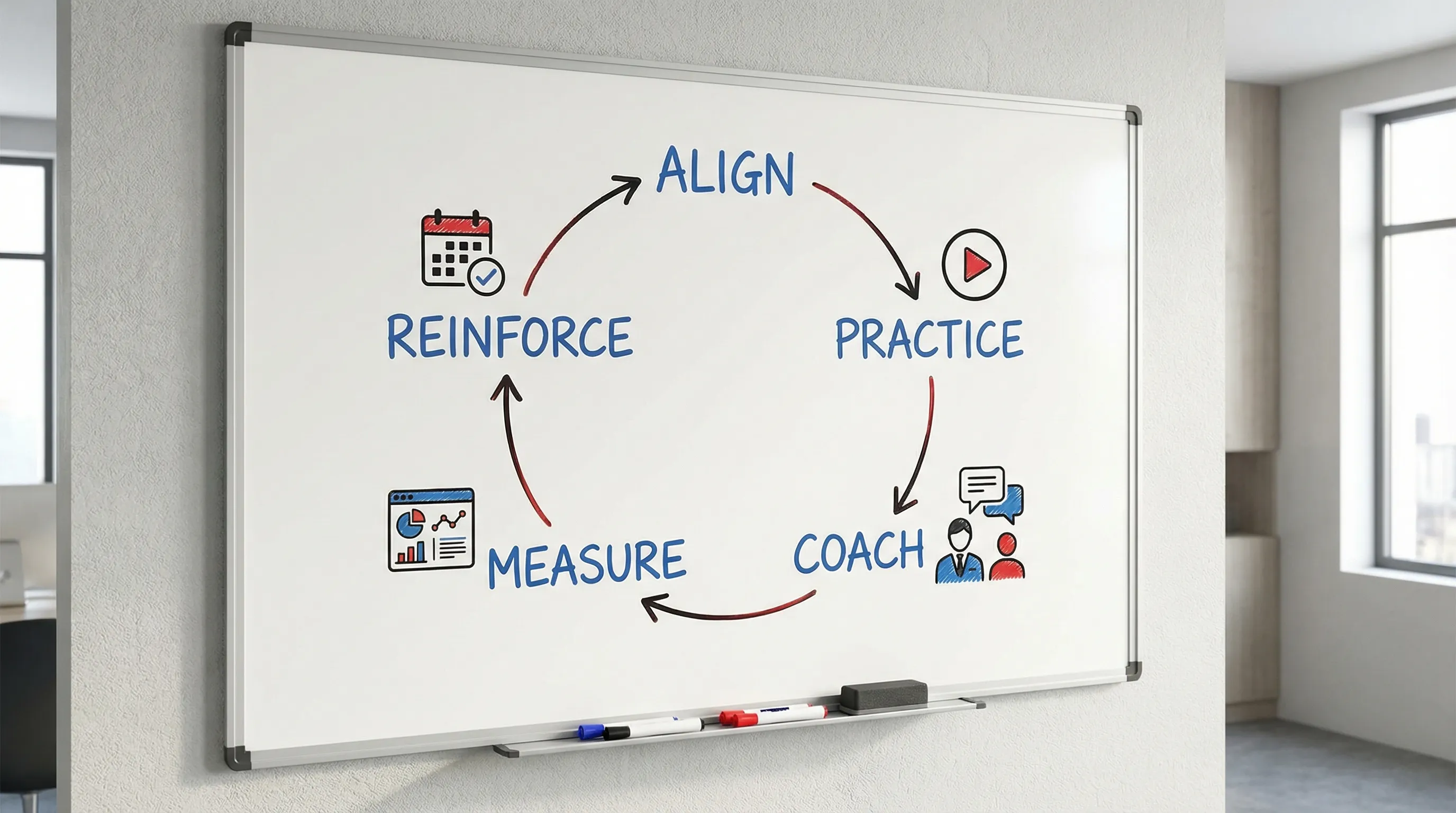
A simple model to follow is:
Align → Practice → Coach → Measure → Reinforce
This can be run in any CRM and meeting stack, but AI roleplay makes the “Practice” and “Measure” steps far easier to scale.
The simple system: the minimum viable cadence that actually sticks
If you implement only one thing from this article, implement a cadence that is small enough to survive busy weeks.
Here is a baseline cadence that works well for remote and hybrid teams:
| Rhythm | Rep activity | Manager activity | Output you can inspect |
|---|---|---|---|
| Daily (8 to 12 min) | 1 AI roleplay rep (targeted scenario) | Spot check exceptions only | Practice completion, skill score trend |
| Weekly (30 min) | Review feedback, pick 1 focus skill | Team coaching on 1 pattern | One “skill of the week” and examples |
| Biweekly (25 to 40 min) | Bring 1 win, 1 stuck deal | 1:1 coaching off metrics and talk tracks | Individual coaching plan |
| Monthly (45 min) | Contribute scenarios and objections | Calibration and enablement updates | Updated scenario library and rubric |
This cadence reduces the need for managers to “catch reps in the act” on live calls, which is harder remotely. Instead, managers coach patterns across the team and individuals coach toward measurable behaviors.
Step 1: Align on what “good” looks like (one page, not a playbook)
Remote coaching gets noisy when every manager has a different definition of “good discovery” or “strong objection handling.” Before you add AI, align on a short rubric.
Keep it to 5 to 7 observable behaviors. Examples:
- Opens with a clear agenda and outcome
- Asks situation and impact questions (not just feature questions)
- Confirms the problem in the buyer’s words
- Handles a pricing objection without discounting immediately
- Closes with a clear next step and mutual commitment
A practical tip: write each behavior so it can be scored from a transcript or roleplay. “Builds trust” is hard to score. “Summarizes buyer’s top 2 priorities and asks for confirmation” is easy.
A lightweight scoring rubric (example)
| Skill | 1 (Needs work) | 3 (Meets standard) | 5 (Excellent) |
|---|---|---|---|
| Discovery depth | Mostly surface questions | Connects needs to business impact | Quantifies impact and confirms priority |
| Objection handling | Defends, argues, or discounts | Acknowledges and reframes | Diagnoses root cause and resolves with proof |
| Next step | Vague follow-up | Clear next step with date | Mutual action plan with roles and deliverables |
This rubric becomes the backbone for AI feedback, manager coaching, and rep self review.
Step 2: Build a scenario library tied to your pipeline (not generic roleplay)
AI roleplay works best when scenarios match:
- Your ICP and common buyer roles
- Your sales stages
- Your real objections and constraints
Start with 10 to 15 scenarios. That is enough variety to avoid memorization, and small enough to maintain.
Scenario templates you can reuse
| Stage | Scenario title | What it trains | Common pitfalls |
|---|---|---|---|
| Prospecting | “Referral outreach to skeptical VP” | Relevance, brevity, ask | Over explaining, weak CTA |
| Discovery | “Ops leader with unclear problem” | Problem framing, questioning | Pitching too early |
| Evaluation | “Security review call” | Risk handling, internal navigation | Hand waving, no documentation |
| Negotiation | “Procurement pushes discount” | Value defense, trade-offs | Discount first, no give-get |
| Renewal/Expansion | “Renewal at risk” | Executive alignment, retention | Talking features, not outcomes |
Once this exists, your managers are not improvising coaching topics. They are selecting the scenario that matches what is actually stalling deals.
Step 3: Use AI for daily reps, not occasional events
The biggest unlock with AI is not “a fancy demo.” It is frequency.
In skill development research, fast feedback and repetition are what change performance over time. Traditional roleplay fails because it is awkward, infrequent, and hard to schedule. AI roleplay removes the scheduling bottleneck.
When you run daily reps, focus on three design choices:
Keep reps short
Aim for 5 to 10 minutes per rep. You are building a habit, not running a full mock sales cycle.
Make the goal specific
One rep should train one goal, for example:
- “Confirm impact and quantify it”
- “Handle ‘we already have a vendor’ without bashing competitors”
- “Get to a mutual next step with date and owner”
Increase difficulty gradually
If your tool supports adjustable skill levels, start easier than you think. Early wins build momentum. Then add complexity, such as:
- The buyer interrupts
- The buyer goes off topic
- The buyer challenges ROI assumptions
Platforms like Scenario IQ are designed around this workflow, using AI-powered roleplay simulations, personalized scenarios, and adaptive feedback so teams can practice the same real situations they face in the field.
Step 4: Make coaching remote-friendly with “coaching off artifacts”
In a remote team, coaching improves when it is based on artifacts (roleplay transcripts, feedback summaries, scored behaviors, and trends) instead of memory.
A practical 1:1 structure is:
Review (5 minutes)
Look at one simple dashboard view:
- Practice completion consistency
- Skill score trend for the last 2 weeks
- One area improving, one area stuck
Diagnose (10 minutes)
Pick one transcript snippet where the rep struggled, then ask:
- What was the buyer’s underlying concern?
- What did you assume?
- What question would have uncovered that sooner?
Rebuild (10 minutes)
Write a short talk track together (2 to 4 sentences). The manager is not delivering a lecture, they are co-creating language the rep will actually use.
Rehearse (5 minutes)
The rep immediately reruns the same scenario and tries the improved talk track.
That final step is where most remote coaching breaks down. Without rehearsal, coaching becomes advice. With rehearsal, it becomes behavior change.
Step 5: Measure the leading indicators that predict performance
Remote leaders often over-index on lagging metrics (revenue, quota, win rate). Those matter, but they move slowly. AI practice generates leading indicators you can inspect weekly.
Here is a clean measurement stack:
| Metric type | Examples | Why it matters | How often to review |
|---|---|---|---|
| Habit (leading) | Practice sessions completed, minutes practiced | Predicts whether skills will improve | Weekly |
| Skill (leading) | Rubric scores by competency, improvement rate | Shows what is actually getting better | Weekly |
| Execution (mid) | Meeting-to-next-step rate, stage progression | Connects skill to pipeline movement | Biweekly |
| Outcome (lagging) | Win rate, ASP, sales cycle length | Validates impact | Monthly/Quarterly |
If you are using AI feedback and analytics, you can also track variability. Two reps may have the same average score, but one is consistent and one swings wildly. Consistency matters for forecasting and manager time.
For context on why many teams are doubling down on remote and digital selling motions, see McKinsey’s ongoing B2B sales research, including their overview of how buying preferences shifted toward remote interactions (McKinsey insights).
Step 6: Reinforce with “one thing” per week
AI coaching systems fail when teams try to fix everything at once. Reinforcement should be boring and repetitive.
Run a weekly reinforcement loop:
- Pick one competency (for example, “objection handling: budget”)
- Share two examples (one strong, one common mistake)
- Assign one scenario for the week
- Celebrate measurable improvement, not just closed deals
If your platform supports daily actionable tips, use them to keep the weekly focus alive without adding meetings.
Step 7: Protect trust with clear guardrails (especially with AI)
Remote teams are sensitive to surveillance. If reps think AI training is a “gotcha,” adoption will collapse.
Set guardrails upfront:
- Training data vs performance management. Be explicit about what is used for coaching, and what is used for evaluation.
- Transparency. Share the rubric and how scoring works.
- Human override. AI feedback should be reviewed and contextualized by managers, especially for nuanced conversations.
- Security requirements. In regulated industries, ensure the tool meets your enterprise security expectations.
Scenario IQ positions itself as an AI training platform with enterprise-grade security and team-focused analytics, which is the right direction for organizations that need both scale and control.
A 30-day rollout plan (simple, realistic)
You can launch this without a huge enablement project.
Week 1: Pilot with one team
Define the rubric, load 10 scenarios, and run daily reps with a small group. Collect rep feedback on realism and difficulty.
Week 2: Calibrate scoring and talk tracks
Have managers review a handful of practice artifacts together. Align on what a “3 vs 5” looks like for two key skills.
Week 3: Expand and standardize the cadence
Roll out the daily and weekly cadence to the broader team. Keep meetings the same, change what happens inside them.
Week 4: Connect to pipeline reality
Pick scenarios based on live deal blockers (pricing pressure, security review, competitor displacement). This is where reps start believing the system is helping them win.
What to look for in an AI coaching tool for remote sales teams
If you are evaluating platforms, prioritize capabilities that support the system above (not just AI novelty):
- Scenario customization for your ICP and objections
- Real-time feedback tied to a clear rubric
- Progress analytics that show trends by rep and team
- Adaptive difficulty so reps keep improving
- Manager workflows for coaching off artifacts
If you want a concrete example of how this comes together, Scenario IQ focuses specifically on AI-driven roleplay training with personalized scenarios, real-time feedback, and dashboards that make remote coaching inspectable.
The bottom line
Coaching remote sales teams with AI works when you treat AI as the engine for repetition and feedback, and you keep humans responsible for alignment, judgment, and motivation.
Build a small scenario library, run short daily reps, coach off artifacts, and measure leading indicators weekly. Do that for a quarter and you will have something many remote teams lack: a coaching system that scales without burning out managers.