

A roleplay scenario that’s perfect for a new hire can feel painfully slow to a top performer. The opposite is worse: a “hard mode” simulation dropped on a beginner can create anxiety, awkward calls, and training that looks like failure instead of growth.
Building custom roleplay scenarios for different skill levels solves that mismatch. Done well, it creates a clear progression from “can follow the script” to “can handle real customers, real pressure, real objections,” while still keeping practice safe, repeatable, and measurable.
Start with a skill ladder, not a scenario idea
Most teams start scenario design with a situation (“price objection” or “angry customer”) and then try to make it easier or harder. A more reliable approach is to define levels first, then build scenarios to match those levels.
A practical skill ladder for sales and service usually includes:
- Foundational: can follow a basic process, ask essential questions, and use approved language.
- Proficient: can adapt to common variations, diagnose needs, and recover from mild friction.
- Advanced: can handle ambiguity, emotional tension, trade-offs, complex stakeholders, and competitive pressure.
If you already use a competency framework, map it to levels. If you do not, borrowing established training structures can help. For example, Bloom’s Taxonomy is useful for thinking about progression from recall to application to evaluation under pressure.
The anatomy of a roleplay scenario (what you should standardize)
To make scenarios “level-able,” standardize the parts that stay consistent, then vary difficulty through specific levers.
At minimum, every scenario should include:
- Role and context: who the learner is (AE, SDR, support agent), customer type, industry, relationship stage.
- Objective: what “success” looks like (book meeting, de-escalate, qualify, renew, resolve).
- Customer persona: motivations, pain points, communication style, and emotional state.
- Constraints: time pressure, policy limitations, pricing boundaries, compliance requirements.
- Critical moments: 2 to 4 turning points (objection, confusion, escalation, competitor mention).
- Evaluation rubric: observable behaviors and outcomes tied to your process.
When you standardize these fields, you can create multiple versions of the same scenario for different skill levels without reinventing everything.
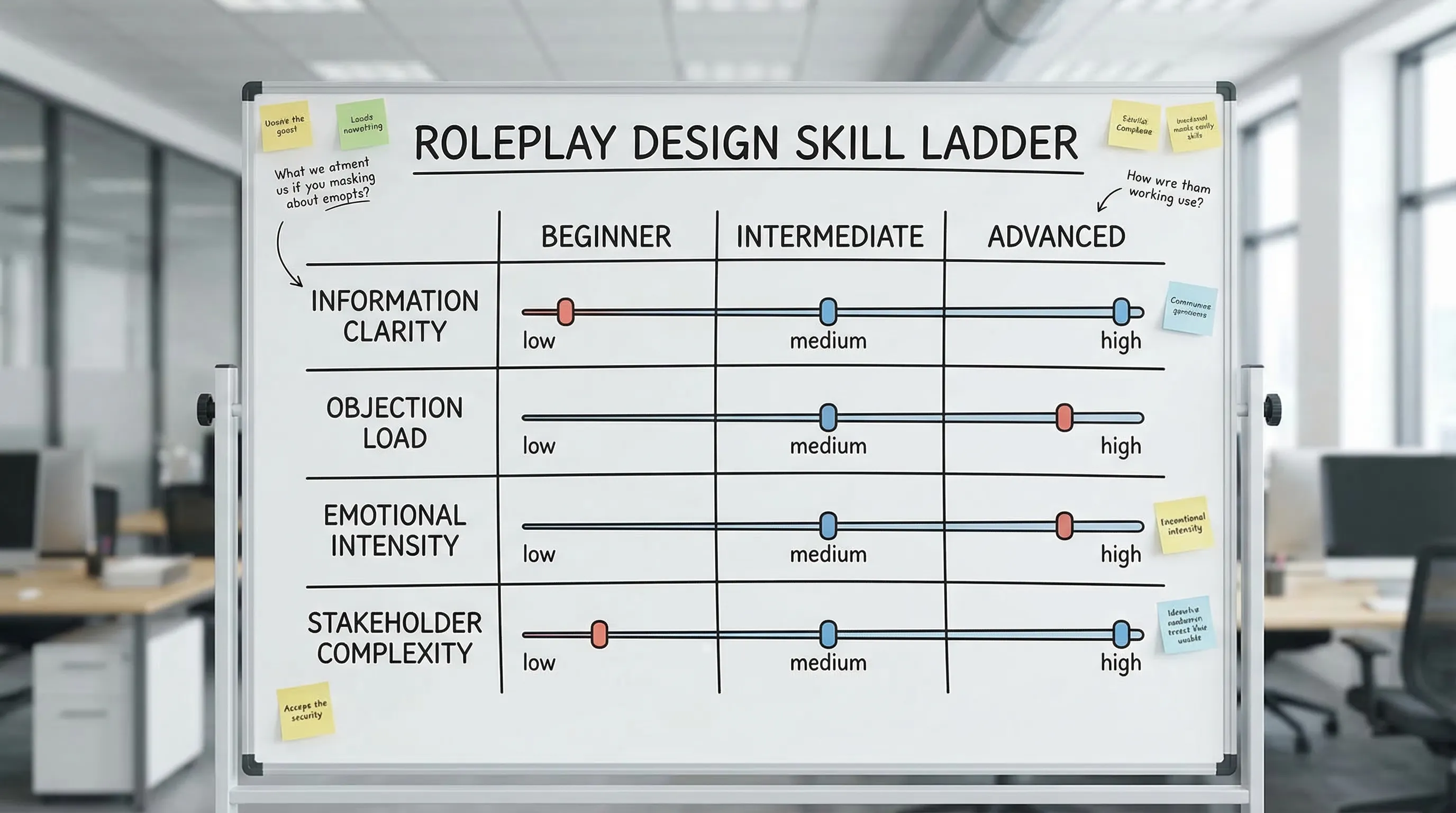
Define “difficulty” with explicit levers (so it’s not subjective)
Difficulty is not just “meaner customer” or “more objections.” In real calls, complexity comes from uncertainty, competing goals, emotion, and constraints.
Here are difficulty levers you can intentionally adjust:
- Information clarity: clear problem statement vs vague symptoms and partial details.
- Customer emotional temperature: neutral vs frustrated vs distrustful.
- Objection stack: single objection vs multiple objections in sequence.
- Stakeholder complexity: one contact vs multi-person buying committee.
- Process constraints: generous policy vs strict policy and limited exceptions.
- Trade-offs: easy win-win vs meaningful concessions (price, timeline, scope).
- Channel friction: chat vs phone vs video, or switching channels mid-case.
- Competitive pressure: no competitor vs named competitor with strong claims.
The goal is repeatability. If two managers design “advanced” scenarios and they feel wildly different, your level definitions are not concrete enough.
A simple matrix for skill levels (use this to brief scenario writers)
Use a shared matrix so everyone builds scenarios to the same standard.
| Skill level | Primary training goal | Customer behavior | Info availability | Typical complexity | What you measure most |
|---|---|---|---|---|---|
| Beginner | Correct process execution | Cooperative, neutral | Clear and complete | Single issue, few branches | Structure, required questions, compliance language |
| Intermediate | Adaptation and diagnosis | Mild pushback | Some gaps | 2 to 3 decision points | Discovery quality, objection handling basics, next-step control |
| Advanced | Judgment under pressure | Emotional, skeptical | Ambiguous, conflicting | Multiple stakeholders, trade-offs | Strategic prioritization, de-escalation, negotiation, outcome quality |
This table is intentionally general so it works across sales and service. Your organization can make it more specific by adding your methodology (MEDDICC, SPIN, internal QA checklist, escalation policy, and similar).
How to build one scenario in three levels (a repeatable workflow)
Instead of creating dozens of unrelated scenarios, design a “scenario family” where the context stays consistent but the difficulty scales.
Step 1: Pick a real work situation with high frequency or high risk
Choose scenarios that either happen often (so practice compounds quickly) or carry meaningful downside when handled poorly.
Good candidates include:
- First discovery call with a skeptical prospect
- “Your price is too high” objection
- Customer threatens to cancel
- Escalation due to delayed delivery or downtime
- Feature gap compared to a competitor
Step 2: Write the beginner version first (the clean room)
A beginner scenario should feel like a well-lit practice gym.
Design choices that help:
- Make the customer cooperative and clear.
- Keep the goal singular (for example, “schedule the next meeting” or “resolve and confirm resolution”).
- Add guardrails like a short customer profile and one primary pain point.
Most importantly, align scoring to the basics. If your rubric punishes beginners for not negotiating masterfully, you will train hesitation.
Step 3: Create the intermediate version by adding branching, not chaos
Intermediate scenarios should reward good diagnosis and flexible wording.
Increase difficulty by:
- Removing one key detail so the learner must uncover it.
- Adding one additional stakeholder concern (security, finance, operations).
- Introducing a mild objection that can be resolved with a clear explanation.
The intermediate level is where you want to see consistent behavior change. This is also where real-time coaching signals (prompts to ask a clarifying question, reminders to summarize) are most valuable.
Step 4: Create the advanced version by adding trade-offs and tension
Advanced scenarios should force prioritization. The learner cannot “perfectly” satisfy every constraint.
Increase difficulty by:
- Making the customer skeptical or emotionally charged.
- Introducing competing objectives (customer wants a refund plus expedited replacement plus a discount).
- Adding policy constraints or approval requirements.
- Including competitor comparisons or a renewal deadline.
In advanced scenarios, your rubric should reward judgment, not just “said the right phrase.”
Example scenario family: Sales discovery call (three levels)
Here is a concrete example you can adapt to your product and ICP.
Beginner: Straightforward discovery
Context: Inbound lead requested a demo.
Customer persona: Friendly operations manager who has a clear problem.
Objective: Confirm pain, qualify basic fit, book a full demo with decision-maker.
Critical moment: Customer asks, “How quickly can we get started?”
What to score: Opening and agenda, discovery questions, summarizing needs, confirming next step.
Intermediate: Partial information and a soft objection
Context: Same company, but the lead is not sure if they have budget.
Customer persona: Busy, slightly skeptical.
Objective: Diagnose urgency and impact, handle “we’re just researching,” secure next step.
Critical moment: “We already have a tool, we’re not sure switching is worth it.”
What to score: Depth of discovery, relevance of value framing, calm objection handling, meeting control.
Advanced: Stakeholders, competitive pressure, and trade-offs
Context: Customer is comparing you to a named competitor and has a deadline.
Customer persona: Direct, challenges claims.
Objective: Run discovery while defending differentiation, align to a multi-stakeholder evaluation plan.
Critical moments:
- “Competitor X does this cheaper.”
- “Security will block anything without SOC 2.”
- “If we cannot launch this quarter, we are out.”
What to score: Strategic questioning, managing conflict, prioritization, creating a mutual action plan.
Example scenario family: Customer service escalation (three levels)
Service teams also benefit from level-based scenario families because tone, policy, and emotion change the difficulty dramatically.
Beginner: Clear issue, cooperative customer
Context: Customer cannot reset password.
Objective: Resolve issue, confirm success, close politely.
What to score: Correct troubleshooting steps, clear communication, confirmation and documentation.
Intermediate: Confusion and mild frustration
Context: Billing mismatch, customer has incomplete info.
Objective: Identify root cause, explain charges, set expectations.
What to score: Clarifying questions, empathy statements that match the situation, accurate explanation.
Advanced: High emotion plus policy constraints
Context: Outage caused business impact, customer demands refund beyond policy.
Objective: De-escalate, offer appropriate remedy, protect retention.
What to score: Emotional regulation, policy adherence with options, ownership language, escalation judgment.
Rubrics: make performance measurable and level-appropriate
Scoring is where many scenario programs break. If “advanced” and “beginner” share the same rubric, learners either game the checklist or feel unfairly judged.
A strong approach is to create a core rubric that applies to all levels, then add level-specific criteria.
Core rubric examples (applies to all levels):
- Accuracy (correct info, correct process)
- Clarity (organized, easy to follow)
- Professionalism (tone, respect, compliance)
Level-specific examples:
- Beginner: asks required questions, follows call flow, confirms next step.
- Intermediate: adapts questioning, handles one objection without losing structure.
- Advanced: manages trade-offs, handles emotion, aligns stakeholders to a plan.
If you use an AI roleplay tool, this is also where real-time feedback and progress tracking analytics can become more than “nice to have.” Analytics are only meaningful when tied to a rubric that reflects the level’s job to be done.
Calibrate your scenarios with a quick “pilot loop”
Before rolling out, run a short calibration cycle:
- Have 3 to 5 people at the target level run the scenario.
- Check completion rates, time to resolution, and where learners get stuck.
- Review transcripts or summaries for common failure points.
- Adjust difficulty levers one at a time (for example, reduce ambiguity but keep emotion).
This prevents a common mistake: “advanced” scenarios that are actually unclear, not challenging.
Personalization: when to vary the scenario vs vary the coaching
Not every learner needs a different scenario. Often, what they need is different guidance.
A practical split:
- Vary the scenario when the job context changes (segment, product line, channel, policy).
- Vary the coaching when the scenario is the same but performance differs (discovery depth, talk-to-listen ratio, empathy, objection structure).
This is where AI-driven roleplay platforms can help scale training. For example, Scenario IQ supports AI-powered roleplay simulations, personalised training scenarios, and adaptive feedback and guidance, which makes it easier to keep the “scenario family” consistent while tailoring practice to individuals.
If you want to see what this looks like in practice, you can explore Scenario IQ and evaluate whether AI simulations fit your team’s training workflow.

Common pitfalls (and how to avoid them)
Making advanced scenarios “gotcha” exercises
If advanced scenarios rely on hidden information or trick questions, you train defensiveness, not competence. Keep the challenge in prioritization and trade-offs, not surprises.
Measuring what’s easy instead of what matters
It’s easy to score whether someone said a phrase. It’s harder to score whether they clarified impact, reduced tension, or created a mutual plan. Use observable behaviors that correlate with outcomes.
For training evaluation, many teams also use the Kirkpatrick Model to connect practice performance to on-the-job results.
Scaling content without maintaining consistency
If every manager writes scenarios differently, your analytics will be noisy and coaching will be inconsistent. Standardize scenario anatomy, difficulty levers, and rubrics first.
A practical “ready to build” template
Use this as a copy-and-fill starting point for any scenario family:
- Level: Beginner / Intermediate / Advanced
- Learner role:
- Customer persona (role, tone, stakes):
- Starting context (what happened before the conversation):
- Objective (single sentence):
- Constraints (policy, time, budget, compliance):
- Critical moments (2 to 4):
- Must-do behaviors (3 to 6):
- Rubric (core + level-specific):
- Pass condition (what “good enough” looks like at this level):
When you build custom roleplay scenarios this way, you get a training library that feels coherent to learners, useful to managers, and measurable for leadership.
If you already have scenarios but they are not leveling well, your fastest win is to retrofit them into scenario families, define difficulty levers, and update rubrics so each level is judged by the right standard.