

A coaching culture is not a poster on the wall or a single manager training. It is a set of repeatable behaviors that help people practice, get feedback, and improve in public, without fear. The fastest way to create it is to stop treating coaching as an “extra” and turn it into weekly rituals with clear owners, short agendas, and visible outcomes.
This guide gives you a practical, week-by-week operating system you can run with sales teams, support teams, or any customer-facing org.
What “coaching culture” actually means (in sales and service)
In high-performing revenue and service organizations, coaching is not limited to performance reviews or a ramp period. It shows up in the workflow:
- Reps and agents regularly practice specific behaviors (discovery, objection handling, de-escalation, tone, negotiation).
- Managers provide fast, specific feedback tied to a shared rubric.
- The team treats mistakes as inputs, not personal failures.
- Improvement is measured in skills and behaviors, not just outcomes.
That last point matters. Outcomes (closed-won, CSAT, handle time) lag behind. A coaching culture focuses on leading indicators: what people can do better this week that makes next month’s results more predictable.
Why weekly rituals beat “big training days”
Workshops can be valuable, but they struggle to change behavior on their own. The reason is simple: skill is built through practice and feedback over time.
A weekly rhythm creates:
- Frequency: small reps beat occasional marathons.
- Consistency: the team knows coaching will happen, so it becomes normal.
- Relevance: you can coach what is happening in the pipeline or inbox right now.
- Compounding: each week builds on the last, which is how confidence is formed.
If you want a useful mental model, look up the concept of deliberate practice, popularized by psychologist K. Anders Ericsson, which emphasizes targeted repetition with feedback rather than mindless repetition.
The design rules for rituals that stick
Before you copy-paste a calendar, make sure your rituals follow these rules.
Keep them short, specific, and scheduled
If a ritual regularly runs long, it will be “rescheduled” until it disappears. Aim for 10 to 30 minutes, with one outcome.
Use a shared coaching language
Coaching fails when feedback is vague (“be more confident”) or personal (“you’re not consultative”). A simple rubric keeps feedback behavioral and fair.
Example rubric categories that work across sales and service:
- Opening and agenda-setting
- Question quality (open vs leading)
- Problem clarification
- Value articulation
- Objection handling
- Next-step control (mutual action plan)
- Tone, empathy, and de-escalation
Make it psychologically safe
If people only get coached when something goes wrong, coaching becomes punishment. Make “practice + feedback” routine for everyone, including top performers.
For background, Harvard Business School professor Amy Edmondson’s work on psychological safety is a useful reference on why teams learn faster when it is safe to speak up (see her overview in Harvard Business Review).
Close the loop every week
A ritual sticks when people can answer:
- What did I practice?
- What feedback did I get?
- What will I do differently next time?
If your coaching does not reliably produce a “next time I will…” commitment, it will feel like conversation, not development.
The weekly coaching cadence (a simple model you can run immediately)
Below is a proven weekly structure. Adjust the days to your environment, but keep the intent.
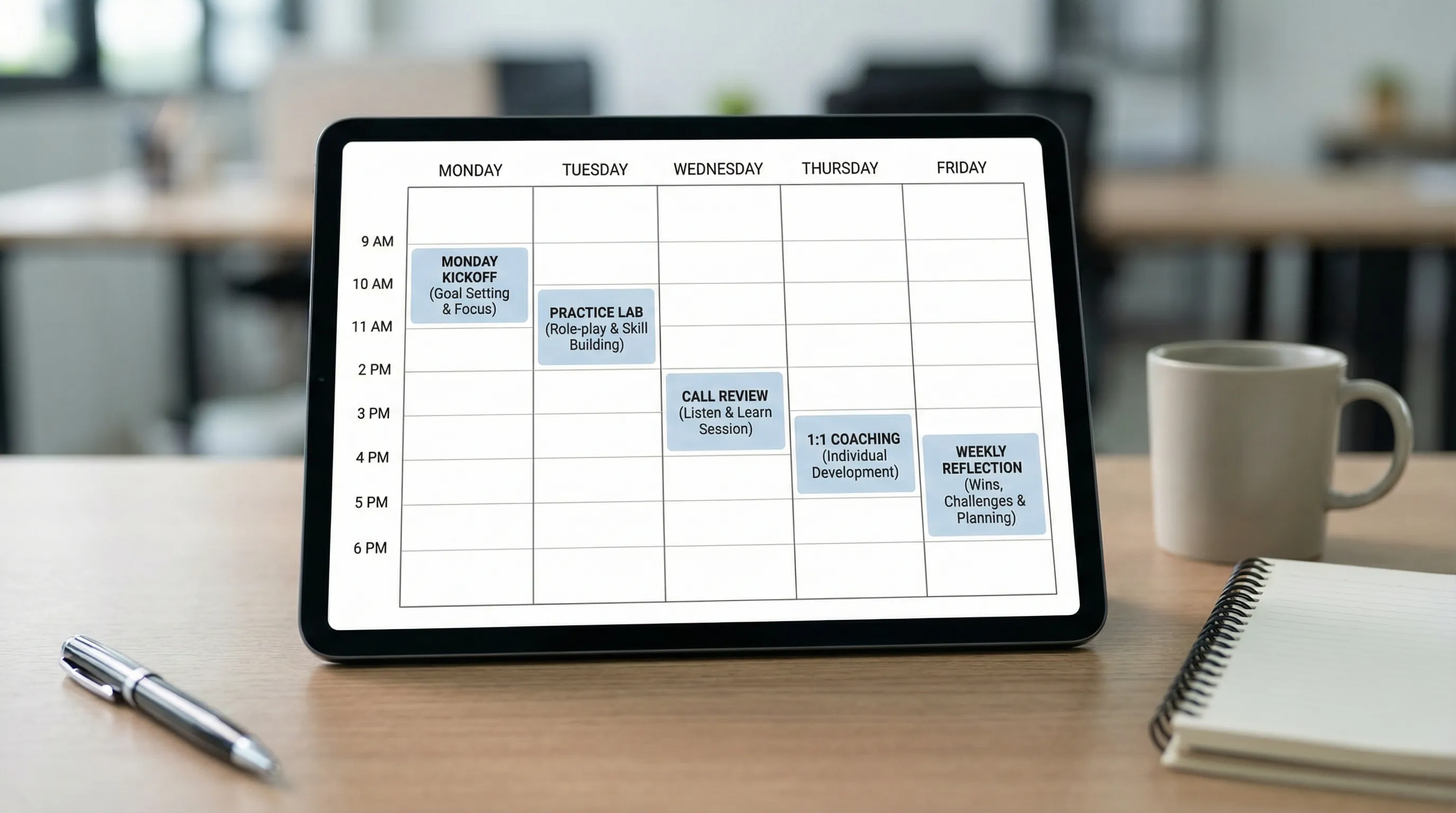
Ritual 1: Monday “Win, Learn, Focus” kickoff (15 minutes)
Purpose: set the skill focus for the week and normalize learning.
Agenda:
- 1 team win (what worked, in one sentence)
- 1 team learn (what was hard, in one sentence)
- Skill of the week (manager chooses one behavior)
- Example phrase or pattern to copy (a “golden line”)
What makes it stick: you are not “motivating,” you are naming a specific behavior everyone will practice.
Ritual 2: Midweek practice lab (20 to 30 minutes)
Purpose: create real reps in a low-risk environment.
This is the ritual most teams skip, and it is the one that changes performance fastest.
Run it as:
- 2 scenarios tied to real work (a deal stage, a complaint type, a renewal risk)
- 2 short rounds per person (2 to 4 minutes each)
- 1 coaching point per round (not five)
If you have remote teams, rotating breakout pairs works. If you have managers stretched thin, this is where AI roleplay can reduce the coordination burden (more on that below).
Ritual 3: Thursday call, chat, or ticket review (20 minutes)
Purpose: coach from reality, not hypotheticals.
Pick one interaction that represents the week’s focus. Keep it lightweight: you do not need a full call coaching program to start.
How to run it:
- Share a short excerpt (60 to 120 seconds of a call, or a small chat/ticket snippet)
- Identify what the rep did that mapped to the rubric
- Agree on one alternative phrasing to test next time
The key is consistency. One reviewed interaction per week is enough to create momentum.
Ritual 4: Weekly 1:1 coaching slot (25 minutes)
Purpose: personalize the week’s focus.
Keep your weekly 1:1 from becoming a status meeting. A simple structure that prevents that:
- 5 minutes: pipeline or workload blockers
- 15 minutes: coaching on one skill (use a real example)
- 5 minutes: commitment and support needed
If you only change one thing: stop spending the full 25 minutes on updates that could be in your CRM or ticketing system.
Ritual 5: Friday reflection and next-week setup (10 minutes)
Purpose: turn coaching into habit formation.
This can be asynchronous. Ask everyone to submit:
- One moment I handled well
- One moment I want to redo
- The one phrase I will use next week
Managers can scan these quickly and pick next week’s “skill of the week” based on patterns.
Summary table: the weekly rituals at a glance
| Ritual | Time | Owner | Output that proves it happened |
|---|---|---|---|
| Win, Learn, Focus kickoff | 15 min | Team lead | Skill of the week + example phrasing |
| Practice lab | 20 to 30 min | Manager or enablement | Reps completed + one coaching point per rep |
| Interaction review | 20 min | Manager | One improved alternative phrasing |
| Weekly 1:1 coaching | 25 min | Manager | One commitment for next week |
| Friday reflection | 10 min | Rep (reviewed by manager) | Written “do differently next time” statement |
Make coaching measurable (without turning it into surveillance)
If you cannot see progress, coaching becomes optional. If you measure the wrong things, it becomes threatening.
A balanced approach:
- Track participation (did coaching happen?)
- Track skill progress (are behaviors improving?)
- Track outcome directionally (are results improving over time?)
Avoid using a single metric as a weapon. Coaching metrics should guide where to invest time.
Here is a clean set of signals most teams can implement quickly.
| What you measure | Why it matters | How to capture it |
|---|---|---|
| Practice reps per person per week | Predicts skill improvement | Simple log, LMS entry, or roleplay platform record |
| Skill score by rubric category | Shows what to coach next | Manager scoring, peer scoring, or AI feedback |
| “Next-time” commitments completed | Proves behavior change | 1:1 notes + follow-up check |
| Time-to-competency for new hires | Shows ramp effectiveness | Onboarding milestones |
| Quality signals (QA, CSAT themes, objection outcomes) | Connects coaching to reality | QA form, tags, call notes |
Common reasons coaching rituals fail (and how to fix them)
“We did it for a month, then it faded”
Cause: no one owned the calendar and the outcomes.
Fix: assign an owner per ritual (not “the team”), and define the output that proves it happened. The table above helps.
“Managers aren’t consistent coaches”
Cause: managers were promoted for performance, not coaching ability.
Fix: standardize the rubric and the agenda, then train managers on giving feedback in one behavior at a time. Consistency beats brilliance.
“Roleplays feel cringe”
Cause: scenarios are unrealistic, or feedback is too personal.
Fix: use scenarios from real deals, real tickets, and real objections. Coach phrases, not personalities.
“We coach, but performance doesn’t change”
Cause: coaching is too generic, and reps do not get enough reps.
Fix: narrow the weekly focus (one skill), require practice reps, and track commitments.
Where AI roleplay fits (and why it helps rituals stick)
Weekly rituals break down when managers do not have time to create scenarios, observe practice, and give consistent feedback.
This is exactly where an AI training platform can support the system:
- AI-powered roleplay simulations give every rep a realistic practice partner on demand.
- Personalised training scenarios let you match skill level, industry, and common objections.
- Real-time feedback reduces the delay between attempt and correction.
- Progress tracking analytics make improvement visible across individuals and teams.
Scenario IQ is designed around this kind of scenario-based training, with adaptive simulations, real-time feedback, and analytics to help organizations coach at scale. If you already have weekly rituals, AI roleplay can make them easier to run consistently. If you do not, it can provide the structure that managers struggle to maintain.

A practical way to combine rituals + Scenario IQ
You do not need a big rollout to start. A low-friction approach:
- Use Monday kickoff to choose the week’s skill and scenario theme.
- Assign one Scenario IQ roleplay simulation midweek tied to that skill.
- Use the analytics and feedback in Thursday review or weekly 1:1s to coach one behavior.
- Use Friday reflection to lock in next-week commitments.
The advantage is repeatability: the ritual stays the same, while the scenarios and guidance adapt as the team improves.
Frequently Asked Questions
What is a coaching culture in sales and customer service? A coaching culture is a team environment where practice and feedback happen routinely, using shared rubrics and clear habits, so people improve skills continuously rather than only being evaluated on outcomes.
How often should managers coach reps or agents? Weekly is ideal for maintaining momentum. Even short weekly rituals, like a 20-minute practice lab plus a focused 1:1 coaching segment, can outperform less frequent, longer sessions.
What are good weekly coaching topics to rotate? Focus on one observable behavior each week, such as discovery questions, objection handling, tone and empathy, closing next steps, handling pricing pushback, or de-escalation in difficult service interactions.
How do you make roleplay feel realistic (and not awkward)? Use scenarios pulled from real calls, tickets, and deals. Keep rounds short, coach phrases not personalities, and ensure everyone practices, including top performers.
Can AI roleplay replace a manager coach? AI roleplay is best as a force multiplier. It can provide consistent practice and real-time feedback, while managers focus on judgment, context, and helping each person apply skills to live opportunities.
Build rituals first, then scale them
If your team is serious about performance, the goal is not “more training.” The goal is more practice with better feedback, delivered in a way that survives busy weeks.
When you are ready to scale consistent roleplay and coaching across the team, explore Scenario IQ to run AI-driven scenario training with real-time feedback and progress analytics that support the weekly rhythm, not replace it.